Why The XRP Lawsuit Has Gone Silent — What Lawyers Know That You Don’t

bitcoinistPublicado em 2025-08-05Última atualização em 2025-08-05

Resumo

Nearly five years after the Securities and Exchange Commission charged Ripple Labs with conducting an unregistered securities offering, the XRP...

Trusted Editorial content, reviewed by leading industry experts and seasoned editors. Ad Disclosure

Nearly five years after the Securities and Exchange Commission charged Ripple Labs with conducting an unregistered securities offering, the XRP lawsuit is quiet once again. The hush has prompted a fresh round of conjecture on X, but interviews and public statements by two veteran securities lawyers—Australian solicitor Bill Morgan and former SEC San Francisco Regional Director Marc Fagel—offer a straightforward procedural explanation: the Commission has not yet completed the internal vote required to abandon its own appeal.

When Will The Quiet End In The XRP Lawsuit?

Ripple scored a partial victory in July 2023 when US District Judge Analisa Torres found that programmatic sales of XRP on exchanges did not constitute securities transactions, while institutional sales did. Both sides noticed appeals in October 2024. Ripple withdrew its cross-appeal in June 2025 and has already placed the agreed-upon $125 million civil penalty in escrow, but the SEC’s appeal remains technically alive, leaving the judgment non-final and the injunction in place.

The agency’s posture toward crypto changed sharply after President Donald Trump elevated former commissioner Paul Atkins to the chair earlier this year. “We will make sure the next chapter of financial innovation is written right here in America,” Atkins declared in an August 4 X post unveiling “Project Crypto,” a commission-wide rulemaking agenda to replace the prior regulation-by-enforcement strategy. His broader regulatory détente has fueled hopes that the Commission will simply drop the XRP lawsuit and cement Judge Torres’s retail-market ruling as binding precedent.

Against that backdrop, pro-XRP lawyer Bill Morgan asked his followers whether Atkins “can actually get the SEC commissioners to vote to dismiss the Appeal … and his SEC attorneys to file papers dismissing the Appeal.” Morgan noted, “No, conspiracy. But let’s just have them get it done.” He points to August 15 as “a procedural checkpoint” when both sides must file a joint status report with the Second Circuit. “I hope we will have an update soon on or before 08/15,” he writes.

Marc Fagel, who spent two decades inside the agency and now lectures at Stanford Law School, responded that the case is stalled on a single mechanical step: “There was a (very small) chance the original approval vote encompassed dismissal even without the modification of the injunctive order. Given the delay, seems pretty clear that was not the case, so we’re presumably still waiting on another vote.”

Fagel further explained on X that the prior Commission, during failed settlement talks this spring, did authorize dismissal in principle, but only contingent on modifications to the proposed injunctive order. “They already voted to do this (in the context of the failed settlement) before Atkins even arrived. So it seems pretty obvious where this is going. They just have to get through the standard internal approval process,” Fagel noted.

Because Judge Torres rejected the negotiated injunction, a second formal vote appears to be necessary. Contrary to social-media speculation, the Senate’s August recess and the still-pending CLARITY Act have no bearing on that purely administrative process. As Fagel put it, “They will file to dismiss as soon as the commissioners vote to do so.”

What Happens On—Or After—15 August

The upcoming status report is not a hard deadline to abandon the appeal; it merely obliges each party to declare whether further briefing is necessary. If the SEC remains divided—or if staff review drags—the agency can seek another sixty-day extension. Yet insiders see little appetite for prolonging a fight that the new chair has publicly framed as regulatory overreach.

Should the Commission vote in the coming days, dismissal notices would be filed almost immediately. That would lift the injunction, release the $125 million penalty to the US Treasury, and end the one remaining appeal that prevents XRP’s legal status from crystallizing.

At press time, XRP traded at $3.02.

XRP price
XRP reclaimed the 0.786 Fib, 1-day chart | Source: XRPUSDT on TradingView.com
Featured image created with DALL.E, chart from TradingView.com
Editorial Process for bitcoinist is centered on delivering thoroughly researched, accurate, and unbiased content. We uphold strict sourcing standards, and each page undergoes diligent review by our team of top technology experts and seasoned editors. This process ensures the integrity, relevance, and value of our content for our readers.

Jake Simmons has been a Bitcoin enthusiast since 2016. Ever since he heard about Bitcoin, he has been studying the topic every day and trying to share his knowledge with others. His goal is to contribute to Bitcoin's financial revolution, which will replace the fiat money system. Besides BTC and crypto, Jake studied Business Informatics at a university. After graduation in 2017, he has been working in the blockchain and crypto sector. You can follow Jake on Twitter at @realJakeSimmons.

Criptomoedas em alta

Leituras Relacionadas

Building USDC by Its Own Hands, Why Does Coinbase Turn to Support Competitor OUSD?

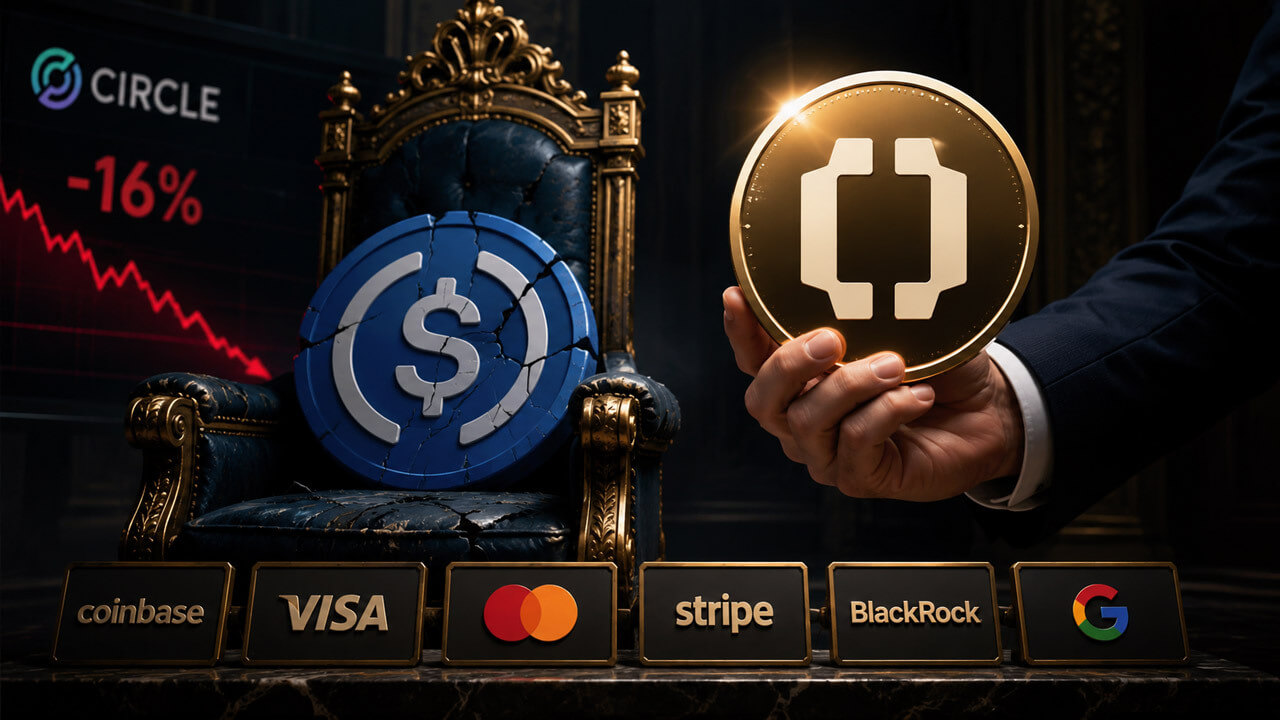
Coinbase, a key distributor of the dominant stablecoin USDC, has joined over 140 major companies—including Visa, Mastercard, and BlackRock—as a founding member of the Open USD (OUSD) alliance, a move that directly challenges the current stablecoin economic model. The new project aims to upend the established profit structure by offering zero minting and redemption fees and allocating the majority of reserve interest earnings to distribution partners, rather than the issuer. This shift highlights a growing power struggle in the $320+ billion stablecoin market, where platforms with massive user bases are demanding a larger share of the revenue generated from the underlying reserves. Circle, the issuer of USDC, saw its stock plummet 16% on the day of the OUSD announcement, reflecting investor concern over the potential strain on its crucial partnership with Coinbase. While Coinbase earned over $900 million from its USDC partnership in 2024, its support for a competing model gives it significant leverage as its revenue-sharing agreement with Circle nears expiration in August 2026. Circle CEO Jeremy Allaire defended the USDC model, emphasizing its decade-long development, deep liquidity, and extensive ecosystem integration, which he argues cannot be easily replicated by a large, potentially slow-moving consortium. He also questioned the sustainability of a zero-fee model and warned that diverting all reserve interest would leave issuers without funds for critical compliance and operational infrastructure. Analysts remain skeptical of OUSD's prospects, citing the "cold start" problem of building liquidity, potential governance challenges within a large alliance, and heightened regulatory scrutiny. The emergence of OUSD signals a broader industry bifurcation, where stablecoins are increasingly viewed as backend settlement tools. The core competition is shifting from technology to a direct negotiation over how profits from the network are distributed between issuers and the powerful distribution channels.

Foresight NewsHá 1h

Building USDC by Its Own Hands, Why Does Coinbase Turn to Support Competitor OUSD?

Foresight NewsHá 1h

Trading

Spot

Artigos em Destaque

Como comprar T

Bem-vindo à HTX.com!Tornámos a compra de Threshold Network Token (T) simples e conveniente.Segue o nosso guia passo a passo para iniciar a tua jornada no mundo das criptos.Passo 1: cria a tua conta HTXUtiliza o teu e-mail ou número de telefone para te inscreveres numa conta gratuita na HTX.Desfruta de um processo de inscrição sem complicações e desbloqueia todas as funcionalidades.Obter a minha contaPasso 2: vai para Comprar Cripto e escolhe o teu método de pagamentoCartão de crédito/débito: usa o teu visa ou mastercard para comprar Threshold Network Token (T) instantaneamente.Saldo: usa os fundos da tua conta HTX para transacionar sem problemas.Terceiros: adicionamos métodos de pagamento populares, como Google Pay e Apple Pay, para aumentar a conveniência.P2P: transaciona diretamente com outros utilizadores na HTX.Mercado de balcão (OTC): oferecemos serviços personalizados e taxas de câmbio competitivas para os traders.Passo 3: armazena teu Threshold Network Token (T)Depois de comprar o teu Threshold Network Token (T), armazena-o na tua conta HTX.Alternativamente, podes enviá-lo para outro lugar através de transferência blockchain ou usá-lo para transacionar outras criptomoedas.Passo 4: transaciona Threshold Network Token (T)Transaciona facilmente Threshold Network Token (T) no mercado à vista da HTX.Acede simplesmente à tua conta, seleciona o teu par de trading, executa as tuas transações e monitoriza em tempo real.Oferecemos uma experiência de fácil utilização tanto para principiantes como para traders experientes.

487 Visualizações TotaisPublicado em {updateTime}Atualizado em 2026.06.02

Como comprar T

Discussões

Bem-vindo à Comunidade HTX. Aqui, pode manter-se informado sobre os mais recentes desenvolvimentos da plataforma e obter acesso a análises profissionais de mercado. As opiniões dos utilizadores sobre o preço de T (T) são apresentadas abaixo.

活动图片