Coinbase Faces New Lawsuit Over Stock Drop Damages Following Data Breach

bitcoinistPublicado em 2025-05-26Última atualização em 2025-05-27

Resumo

Coinbase is facing a new class action lawsuit claiming that investors suffered significant losses over the years due to the...

Trusted Editorial content, reviewed by leading industry experts and seasoned editors. Ad Disclosure

Coinbase is facing a new class action lawsuit claiming that investors suffered significant losses over the years due to the crypto exchange’s “omissions,” which have affected the company’s stock price.

Coinbase Accused Of Key ‘Omissions’

Last week, a Coinbase investor filed a class action lawsuit in the US District Court for the Eastern District of Pennsylvania against Coinbase, CEO Brian Armstrong, and CFO Alesia Hass, alleging that the company’s shareholders have suffered “significant losses and damages” over the past four years.

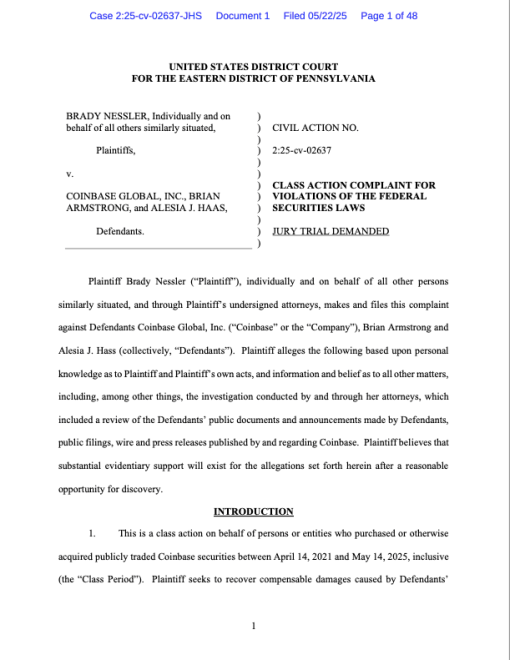
In the May 22 complaint, investor Brady Nessler, on behalf of persons or entities who purchased or otherwise acquired publicly traded Coinbase securities between April 14, 2021, and May 14, 2025, claims that the exchange has a long list of “wrongful acts and omissions” that have led to the “precipitous decline in the market value of the Company’s common shares” affecting the Plaintiff and other Class members.
coinbase

New lawsuit against crypto exchange Coinbase, Armstrong, and Hass. Source: CourtListener

Among the omissions, the lawsuit lists the company’s recent data breach and its failure to disclose that it breached its 2020 agreement with the UK’s Financial Conduct Authority (FCA).

In October 2020, the company’s UK subsidiary, Coinbase Payments (CBPL), signed a voluntary agreement to prevent onboarding clients considered “high risk” by the regulator and reduce potential criminal activity on the CBPL platform.

The lawsuit alleges that the company made several “materially false and misleading” statements at the time that omitted that Coinbase Payments, Ltd. (CBPL) had been found guilty by the UK regulator of having “inadequate anti-money laundering focused systems to prevent high-risk individuals from using its platform, and that CBPL then breached the Agreement designed to address those deficiencies, creating legal exposure.”

Notably, the price of the company’s common stock reportedly fell by $13.52 per share, a 5.52% decline, when a Reuters article titled “Coinbase UK unit fined for breaching financial crime requirements” was published during market hours on July 25, 2024. The FCA fined Coinbase’s UK subsidiary a $4.5 million penalty for breaching the voluntary agreement.

Data Breach Leads To Class Action Lawsuits

Moreover, the Class action suit argues that the recent data breaches also resulted in significant losses and damages for stockholders, highlighting the May 15 statement from the crypto exchange.

As reported by Bitcoinist, Brian Armstrong shared that threat actors bribed a handful of customer support contractors to access Coinbase’s internal tools, resulting in the breach of names, email addresses, limited transaction records, and partial Social Security numbers of 1% of the exchange’s users.

The hackers attempted to blackmail the exchange, demanding $20 million in Bitcoin (BTC) to return the sensitive customer data. However, Armstrong revealed they refused to pay the ransom.

The lawsuit states that, following the news, the price of Coinbase’s common stock fell by $19.85 per share, a 7.2% decline, to close at $244 on May 15, 2025. Since then, multiple lawsuits have been filed against the crypto exchange, and a US Department of Justice Investigation has been opened.

Based on this, Plaintiff seeks to “recover compensable damages caused by Defendants’ violations of the federal securities laws under the Securities Exchange Act of 1934 (the ‘Exchange Act’).”
Coinbase, bitcoin, btc, btcusdt

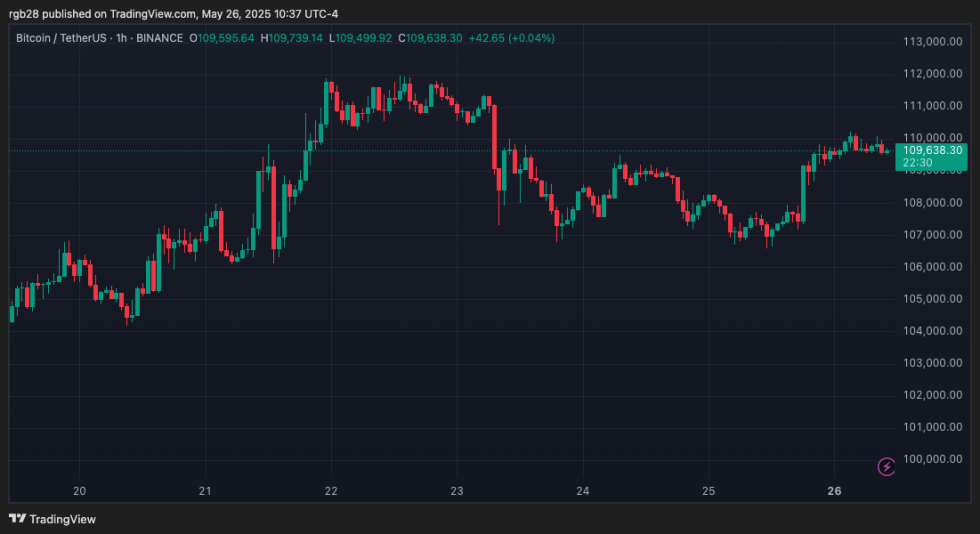
Bitcoin trades at $109,638 in the one-week chart. Source: BTCUSDT on TradingView
Featured Image from Unsplash.com, Chart from TradingView.com
Editorial Process for bitcoinist is centered on delivering thoroughly researched, accurate, and unbiased content. We uphold strict sourcing standards, and each page undergoes diligent review by our team of top technology experts and seasoned editors. This process ensures the integrity, relevance, and value of our content for our readers.

Rubmar is a crypto enthusiast who likes learning and improving constantly. She enjoys reporting on the latest news and developments in the crypto industry. Rubmar also enjoys scrapbooking, crafting, simulation games, and watching football.

Leituras Relacionadas

RWA Weekly: EU Proposes Revision of MiCA to Cover Tokenization and Non-EU Stablecoins; Swift and 17 Banks to Pilot Tokenized Cross-Border Payments

RWA Weekly: EU Proposes MiCA Revision for Tokenization and Non-EU Stablecoins; Swift to Pilot Tokenized Cross-Border Payments with 17 Banks During the statistical period of July 3-10, 2026, the RWA sector showed signs of recovery. The total on-chain market capitalization of RWAs rebounded to $33.12 billion, ending a prolonged decline. The stablecoin market cap also returned above $300 billion, with active addresses and holders increasing, indicating restored market vitality. Key regulatory developments include China promoting the use of digital yuan in consumption vouchers, the EU considering revisions to its MiCA framework to cover tokenization and non-EU stablecoins, and Kazakhstan authorizing stablecoin use for cross-border corporate and government payments. In Hong Kong, HSBC issued its first "digitally native" structured product. Major project updates feature Swift announcing readiness of its blockchain ledger for a 24/7 tokenized cross-border payment pilot involving 17 global banks. Ondo launched a perpetuals platform allowing tokenized stocks as collateral. Sony received conditional U.S. OCC approval to launch a stablecoin-focused trust bank in 2027. Tether plans to natively issue USDT on Bitcoin via the RGB protocol. Significant funding rounds saw Securitize planning to deploy over $400 million for acquisitions to expand its institutional tokenization business, while Tether invested $20 million in Brazil's Mercado Bitcoin to support its growth in on-chain financial services. Analysis highlights that stablecoins are evolving into global financial infrastructure with regional specializations and that institutions should consider international expansion to gain practical experience in the RWA tokenization space amidst evolving regulations.

marsbitHá 16m

RWA Weekly: EU Proposes Revision of MiCA to Cover Tokenization and Non-EU Stablecoins; Swift and 17 Banks to Pilot Tokenized Cross-Border Payments

marsbitHá 16m

The first to catch the wave of the Robinhood Chain hype is Arbitrum, up nearly 20%

"ARB, the native token of Arbitrum, surged nearly 20% recently, emerging as a top-performing L2 token. This rally is attributed to the launch of 'Robinhood Chain,' a Real-World Asset (RWA) Layer 2 built using Arbitrum's technology. The launch has brought renewed attention to the 'Arbitrum Expansion Plan' (AEP), a year-and-a-half-old program. AEP allows external projects to build their own chains using Arbitrum's Orbit technology. In return, these 'tenant' chains that do not settle on Arbitrum's main networks must share 10% of their net protocol revenue with the Arbitrum ecosystem—8% to the DAO treasury and 2% to the developer guild. While smaller chains like Degen Chain previously triggered AEP, Robinhood Chain is the first major, high-profile tenant, making the revenue-sharing model economically significant for the first time. Initial data from Robinhood Chain is impressive, with over 35 million transactions, 350,000 addresses, $2.5 billion in TVL, and over $1 billion in DEX volume shortly after launch. However, its current protocol revenue, at roughly $146,000 net, translates to only a minimal payout to Arbitrum DAO. The ARB price surge thus reflects the market's anticipation of future revenue as Robinhood's vast $324 billion platform assets potentially migrate on-chain. This 'landlord' model mirrors Optimism's approach with its OP Stack and Superchain. However, Optimism's model faces pressure as its largest tenant, Base, announced plans to depart, causing a significant drop in OP's price. Similarly, analysts question Robinhood Chain's long-term dependence on Arbitrum, noting its daily sequencer revenue already nears three times that of Arbitrum itself. There is speculation that, like Base, it may eventually seek independence, with ETH potentially being its primary economic token rather than ARB."

Foresight NewsHá 44m

The first to catch the wave of the Robinhood Chain hype is Arbitrum, up nearly 20%

Foresight NewsHá 44m

The Ethereum Foundation is Dead, The Era of Ethereum's Pluralistic Organizations Has Dawned

The Ethereum Foundation (EF) has announced the dissolution of its Protocol Support Team, marking a significant organizational shift. This move, described as the largest layoff in EF's history with a 20% staff reduction, follows a major internal restructuring announced in late June. The restructuring, which EF framed as necessary to streamline for future challenges, has drawn criticism for its perceived cold execution. Concurrently, several new independent non-profit organizations have emerged, founded by former EF members. These include Ethlabs, a research and development lab, and Ethereum Institutional, which focuses on promoting institutional adoption of Ethereum. Their rise is seen as both filling roles vacated by EF's downsizing and signaling a fragmentation of the Ethereum ecosystem's leadership. Amidst these changes, EF is also integrating advanced AI tools into its security operations. The security team has begun using AI agents to conduct red-team testing, which has already uncovered vulnerabilities in Ethereum's code. While EF states that AI complements rather than replaces human researchers, this technological shift hints at potential future reductions in human-centric roles within the organization. The article posits that these developments—massive layoffs, the exodus of key personnel like former Executive Director Xiaowei Wang, the rise of rival organizations, and AI integration—collectively point to a decline in EF's central authority. Once the undisputed leader of the Ethereum ecosystem, EF now faces questions about its future role, with speculation that it may evolve into more of a symbolic "ecosystem mascot" rather than a driving force for growth and adoption. This organizational turmoil unfolds against a backdrop of ongoing market pressure and community debate over Ethereum's value proposition.

marsbitHá 49m

The Ethereum Foundation is Dead, The Era of Ethereum's Pluralistic Organizations Has Dawned

marsbitHá 49m

Trading

Spot
活动图片