This week's statistical period covers July 3, 2026 - July 10, 2026.
This week, the total on-chain market value of RWA ended its previous months-long decline, returning to positive growth at $33.12 billion; the total market value of stablecoins also returned above $300 billion, monthly transfer volume continued a moderate recovery, and both monthly active addresses and holders increased simultaneously, indicating a significant recovery in market vitality.
On the regulatory front, China's Ministry of Commerce and eight other departments issued a document promoting the use of digital RMB in the issuance and settlement of consumer vouchers; the EU plans to revise MiCA to cover tokenization and non-EU stablecoin issuers; the President of Kazakhstan signed a decree allowing businesses and government agencies to use stablecoins for cross-border payments; Hong Kong's HSBC completed the first issuance of a "digital-native" structured product, marking a shift in tokenization from "post-factum on-chain" to "native issuance".
On the project front, Swift announced its blockchain-based ledger is ready, with 17 global banks set to pilot tokenized cross-border payments; Ondo launched a perpetual futures platform supporting tokenized US stocks as collateral, becoming the first platform to allow RWA perpetual contracts trading using tokenized stocks as collateral; Sony received conditional approval from the U.S. OCC to launch a stablecoin trust bank in 2027.
On the financing front, Securitize plans to utilize over $400 million for acquisitions to expand its institutional-grade tokenization business; Tether invested $20 million betting on Brazil's Mercado Bitcoin to expand on-chain financial services.
Data Insights
RWA Landscape Overview
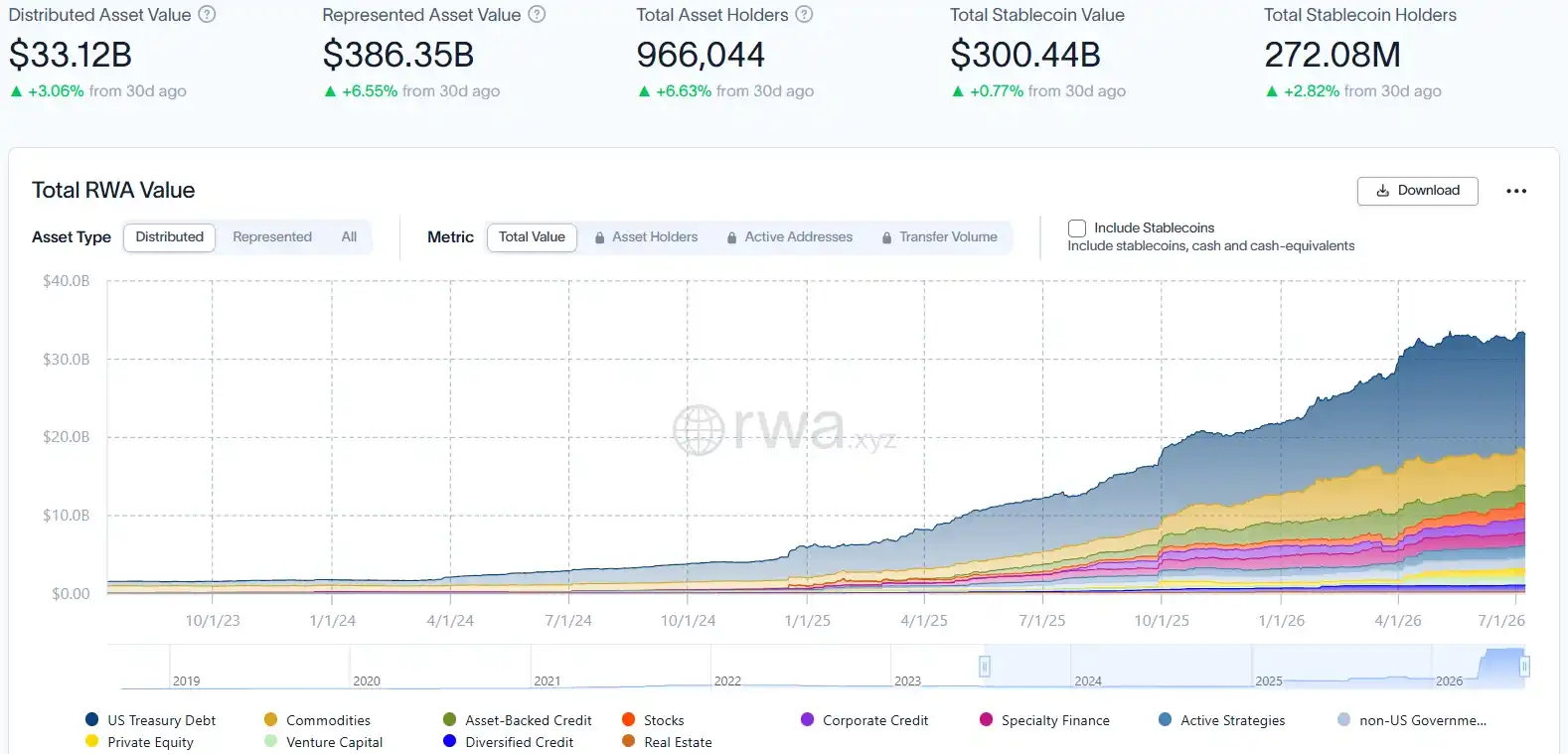
Latest data from RWA.xyz reveals that as of July 10, 2026, the total on-chain market value of RWA increased to $33.12 billion, up 3.06% month-on-month, ending the previous months-long decline and returning to positive growth, indicating a recovery in the vitality of tokenized assets. The total number of asset holders increased to approximately 966,000, up 6.63% month-on-month, showing steady growth that largely matches the asset growth rate, suggesting a balanced incremental allocation.
Stablecoin Market
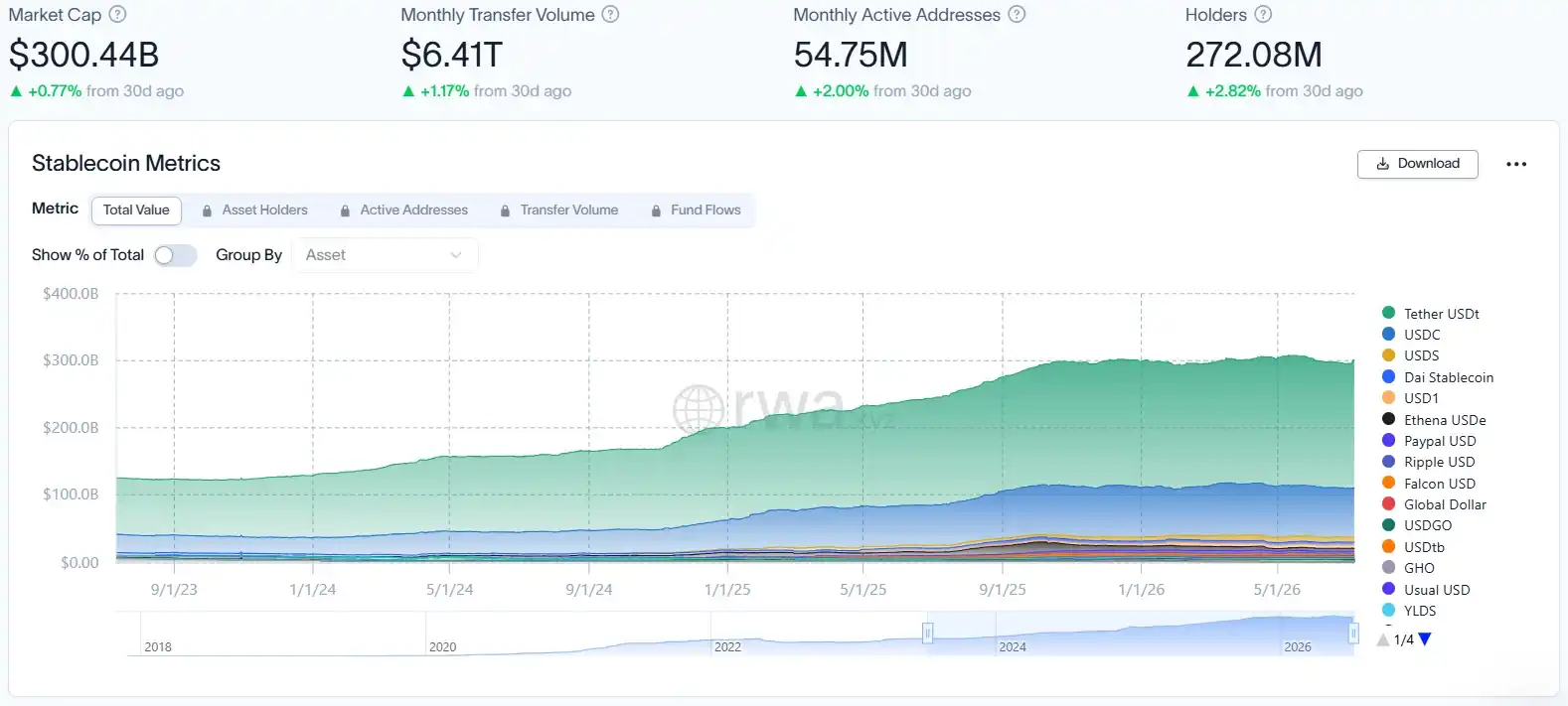
The total stablecoin market value returned to $3,004.3 billion, up 0.77% month-on-month, ending the previous months-long contraction, with the liquidity pool re-entering an expansion phase; monthly transfer volume rose to $6.41 trillion, an increase of 1.17% month-on-month, continuing a moderate recovery trend, reflecting stabilized market settlement demand.
The total number of monthly active addresses increased to 54.75 million, up 2% month-on-month; the total number of holders expanded to 272 million, up 2.82% month-on-month. The resonance between these two metrics indicates continued recovery in retail participation and steady growth in allocation demand.
The leading stablecoins are USDT, USDC, and USDS. Among them, USDT's market value increased by 1.79% month-on-month; USDC's market value decreased by 1.8% month-on-month; USDS's market value declined by 4.67% month-on-month.
Regulatory News
Ministry of Commerce and 8 Departments: Promote the Use of Digital RMB in Consumer Voucher Issuance, Settlement, and Other Links
According to Securities Times, the Ministry of Commerce and eight other departments issued an opinion on accelerating the innovative development of the retail industry. It mentions enhancing digital and intelligent capabilities. Support the digital transformation of retail business entities to achieve full-chain digitalization of inventory, logistics, and distribution, integrating online and offline channels, goods, services, and data. Encourage platforms to provide technological empowerment and resource sharing to small and medium-sized retail business entities. Support third-party technology companies in developing digital management systems for small and medium-sized retail businesses, offering comprehensive solutions. Promote "AI+", expanding scenarios like intelligent shopping guides, low-altitude delivery, and unmanned vending. Promote the use of digital RMB in the issuance and settlement of consumer vouchers, utilizing digital RMB smart contracts for efficient circulation and precise delivery of subsidy funds.
EU Proposes Revision of MiCA to Cover Tokenization and Non-EU Stablecoins, Consultation Until September 30
According to The Block citing Euronews, the EU is considering revising the MiCA regulation to cover emerging areas like tokenization and non-EU stablecoin issuers, with the consultation deadline set for September 30. MiCA fully came into effect after the transitional period ended on July 1, with only 244 companies approved as crypto-asset service providers. The background for this revision includes the rise of tokenized securities (the scale of on-chain stocks has reached $2.16 billion, up nearly 45% month-on-month) and global progress in stablecoin regulation following the passage of the U.S. GENIUS Act. An EU diplomat stated that "re-examining the document at this point seems inevitable." The European Commission had already launched a related survey in May, stating that "since MiCA was drafted, the digital asset market has continued to evolve, and the global policy and regulatory landscape has also undergone significant changes," and is assessing whether the EU framework needs updating.
Kazakhstan President Signs Decree to Allow Businesses and Government to Use Stablecoins for Cross-Border Payments
According to Bits.media, Kazakhstan President Kassym-Jomart Tokayev signed a presidential decree on "Measures to Stimulate and Develop the Digital Asset Industry," aiming to allow businesses and government agencies to use stablecoins for cross-border payments. The decree states that studying mechanisms for using crypto assets for payments will "open up additional channels for import and export operations for Kazakhstan." The decree also plans to exempt individuals from personal income tax for crypto transactions conducted through state-regulated Kazakh infrastructure and encourages the transfer of digital assets previously held on unregulated foreign platforms to domestic service providers. The decree restricts the use of associated gas for mining, stipulating that this resource can only be used for crypto asset mining when it is "not needed to meet state requirements." The decree was drafted jointly by Kazakhstan's Ministry of Artificial Intelligence and Digital Development, the central bank, and the Astana International Financial Center.
Local Insights
HSBC Issues Native Digital Structured Product in Hong Kong
According to The Defiant, HSBC completed the first issuance of a "digital-native" structured product in Hong Kong, a private placement of USD-denominated notes issued directly on the blockchain rather than digitized post-issuance. Marketnode served as the tokenization agent and digital payment agent, managing the payment flow between the issuer and investors. HSBC did not disclose the issuance size, reference asset, note tenor, number of investors, or the blockchain used.
The transaction was a private placement of structured notes. HSBC positioned it as a pilot to demonstrate how tokenization impacts the entire product lifecycle of issuance, settlement, and servicing. Previously, HSBC, Marketnode, and United Overseas Bank (UOB) participated in the Monetary Authority of Singapore's Project Guardian and submitted a case study on digital-native structured note issuance.
Project Progress
Swift Announces Its Blockchain Ledger is Ready, 17 Banks to Pilot Tokenized Cross-Border Payments
According to official news, Swift announced that its blockchain-based ledger is ready, with 17 banks from six continents preparing to pilot the use of tokenized deposits for 24/7 cross-border payments. This ledger provides participating banks with a secure orchestration layer, supporting them in issuing tokenized deposits on their own ledgers and enabling round-the-clock fund movement before final settlement through existing systems.
Participating banks include ANZ, BNP Paribas, Bank of New York Mellon, Citibank, DBS Bank, First Abu Dhabi Bank, FirstRand Bank, HSBC, Itaú Unibanco, Lloyds Bank, Mashreq Bank, Mitsubishi UFJ Financial Group, OCBC, Standard Chartered Bank, UBS, United Overseas Bank, and Wells Fargo.
Dinari and tZERO Launch On-Chain Token Platform for US Stocks Targeting Brokerages
According to CoinDesk, tokenization service provider Dinari has partnered with licensed broker-dealer tZERO to offer a one-stop tokenization platform for US stocks to brokerages, covering issuance, trading, custody, clearing, settlement, and shareholder services. Dinari's dShares are backed 1:1 by real stocks held by regulated custodians, retaining shareholder rights like dividends and corporate actions; tZERO provides brokerage, custody, and clearing infrastructure.
Tether Plans to Natively Issue USDT on Bitcoin via RGB Protocol
According to Bitcoin Magazine, Tether plans to natively issue USDT on Bitcoin using the RGB protocol version 0.11.1, with deployment led by UTEXO. The RGB protocol combines its client-side validation mechanism with the Lightning Network, enabling instant, private settlement while anchoring security to Bitcoin's UTXO model. Users will be able to handle USDT using native Bitcoin addresses and can also send and receive USDT via the Lightning Network using compatible wallets. The product is expected to launch in the coming weeks, potentially in July.
Ondo Launches Perpetual Futures Platform Supporting Tokenized US Stocks as Collateral
According to an official announcement, Ondo launched the perpetual futures platform Ondo Perps, allowing users to open leveraged trades up to 20x using tokenized stocks as collateral. The platform currently supports commodities like Oil, Gold, and Silver, as well as US stocks including Apple, Nvidia, Tesla, Meta, Microsoft, Amazon, Coinbase, Robinhood, indices like US 100 and US 500, and related targets like SpaceX and Palantir, with 24/7 trading. Ondo stated that Ondo Perps is the first platform allowing RWA perpetual contract trading using tokenized stocks as collateral, aiming to provide on-chain liquidity and capital efficiency close to traditional derivatives exchanges. A Pre-Alpha version is currently open to users in non-U.S., non-Panama, and other unrestricted regions.
PayPal's Dollar Stablecoin PYUSD to be Natively Issued on Polygon Network
According to The Block, PayPal announced that its dollar stablecoin PYUSD will be natively issued on the Polygon network and integrated into Polygon's Open Money Stack, facilitating integrated receipt of payments, cross-border settlement, and redemption for businesses.
Sony Receives Conditional U.S. OCC Approval, to Launch Stablecoin Trust Bank in 2027
According to Banking Dive, Sony has received conditional approval from the U.S. Office of the Comptroller of the Currency to establish a national trust bank, planning to launch Connectia Trust in 2027, focused on the issuance and management of USD stablecoins. This trust subsidiary belongs to Sony Financial Group, with capital of $40 million.
Hyundai Card and Hyundai Motor Complete PoC for Stablecoin Remittance Between US and Mexico Business Units
According to Asia Business Daily, Hyundai Card and Hyundai Motor have completed a proof-of-concept (PoC) for stablecoin-based cross-border remittance, achieving stablecoin transfers between Hyundai Motor's US and Mexico legal entities, with plans to launch a second round of verification between European entities by the end of this month.
In the first PoC, Hyundai Motor's US entity converted $20,000 into USDT, remitted it to the Mexico entity, and converted it back to dollars, with the entire process averaging 7 minutes, far shorter than the 3 to 4+ hours typically required for traditional interbank transfers. Participants included Hyundai Card, Hyundai Motor's US and Mexico entities, Tether, Avalanche, and Axiym. The second PoC will be conducted in Europe, involving actual remittances in non-USD local currencies, with participation from Circle and Visa, among others. Hyundai Card stated that this verification laid the groundwork for the actual introduction of stablecoin cross-border remittances and will explore applications in settlement and fund transfers among Hyundai Motor Group's global legal entities in the future.
Korean Fintech Company Toss Partners with Optimism and Sunnyside Labs to Explore KRW Stablecoin
According to The Block, Korean fintech company Toss has partnered with Optimism and Sunnyside Labs to explore a Korean Won-denominated stablecoin. The three parties will conduct a proof-of-concept in the coming months, testing the application of OP Stack in compliant blockchain digital financial infrastructure.
US Stock Token Trading Platform Maits MSX Lists Five New US Stock Tokens
The US stock token trading platform Maits MSX has listed tokens for five US stocks: semiconductor materials hidden champion $Q.M, SPDR S&P Biotech ETF $XBI.M, absolute leader in semiconductor advanced consumables $ENTG.M, crude oil tanker freight ETF $BWET.M, and institutional-grade photonics-themed ETF $LAZR.M.
Financing Updates
Securitize Gains $400 Million Ammunition, Plans Expansion of Institutional Tokenization Business via Acquisitions
According to CoinDesk, NYSE-listed company Securitize (SECZ) plans to utilize over $400 million to expand its institutional tokenization platform by acquiring complementary businesses, rather than acquiring direct competitors. Securitize previously merged with a Cantor-backed SPAC to go public, retaining about 70% of the trust funds, with total fundraising exceeding $400 million. Since its founding in 2017, the company has issued approximately $4.4 billion in tokenized assets, including BlackRock's $2.2 billion US Treasury money fund BUIDL and nearly $300 million of Securitize's own tokenized stock, making it one of the largest tokenized asset issuers currently. CEO Carlos Domingo stated optimism about the opportunity for stocks and ETFs on-chain, noting that even if only 2% of the global approximately $140 trillion equity market goes on-chain, it could create a tokenized market of about $3 trillion.
Tether Invests $20 Million Betting on Brazil's Mercado Bitcoin to Expand On-Chain Financial Services
Tether announced a $20 million strategic growth investment in Latin American on-chain financial services platform Mercado Bitcoin, supporting its expansion in areas like tokenization, stablecoin payments, credit, on-chain capital markets, and compliant digital financial services. Founded in 2013, Mercado Bitcoin currently has 4.5 million users, has cumulatively issued over BRL 2 billion in tokenized assets, and holds over 10 financial licenses in Brazil and Europe. Tether stated that this investment will further promote the development of on-chain financial infrastructure in Brazil and Latin America, accelerating the mainstream adoption of stablecoins and asset tokenization.
Crypto Startup M1X Global Completes $5.5 Million Seed Round Led by Paradigm
According to The Block, crypto startup M1X Global completed a $5.5 million seed round led by Paradigm, with participation from Breed VC, bringing total funding to $8.5 million. The company previously completed a $3 million angel round in March, with investors including former Coinbase CTO Balaji Srinivasan and Cumberland Labs CEO Tama Churchouse.
M1X Global, which is building sovereign financial infrastructure, partnered with the Republic of the Marshall Islands to issue USDM1. USDM1 is a tokenized USD-denominated sovereign debt instrument, backed one-to-one by US Treasury bonds and natively issued by a sovereign nation on a public blockchain. USDM1 was initially issued on the Stellar blockchain and can now also be traded on the Canton and Solana blockchains.
Insights Compilation
Stablecoins Enter Era of Scenario Specialization: East Asia Becomes Major Stablecoin Savings Hub, Tether Bets on New Growth Markets
PANews Overview: Stablecoins are transitioning from crypto tools to global financial infrastructure, showing distinct regional differentiation globally: Latin America focuses on cross-border remittances, while East Asia and the Pacific region dominate stablecoin savings.
The industry is accelerating into an "era of scenario specialization," with the development paths of the two giants diverging significantly: USDC dominates in total transaction volume and the DeFi sector due to compliance and institutional demand; USDT maintains an absolute advantage in transaction count and B2B cross-border settlement through its extensive circulation network.
Facing strict compliance pressure in Europe and the US, Tether chose to proactively exit Europe, instead seeking new growth avenues and diversifying revenue by investing in compliant platforms in emerging markets, promoting USDT's return to the Bitcoin network, and activating gold reserves to launch a gold Visa card.
In the future, non-USD stablecoins, AI payments, and on-chain foreign exchange will become new focal points for the industry.
Tiger Research: Move RWA Tokenization Overseas First
PANews Overview: Although the RWA (Real World Assets) tokenization market has reached tens of billions of dollars, due to regulatory vacuums in many regions, financial institutions in unregulated areas should not blindly wait or confine themselves to sandbox experiments. Instead, they should decisively choose to "go overseas" to accumulate practical experience. Conducting cross-border RWA business requires institutions to meticulously prepare in six core areas: overseas base, licenses, asset and investor definitions, settlement, and operations.
Currently, going overseas mainly follows two paths: First, the jurisdictional path, directly entering jurisdictions with mature regulations like Hong Kong, Singapore, and the US, leveraging licensed local platforms to accelerate business implementation. Second, the on-chain native path, using overseas compliant structures (like SPVs) of platforms like Ondo or Plume to bypass jurisdictional entity restrictions and quickly access global and DeFi liquidity.
The essence of RWA tokenization lies in completing actual sales and business implementation rather than technical demonstrations. The market will not wait for regulations to be perfected; institutions should immediately build core competencies through practical application.