The first to catch the wave of the Robinhood Chain hype is Arbitrum, up nearly 20%

Foresight NewsPublicado em 2026-07-10Última atualização em 2026-07-10

Resumo

"ARB, the native token of Arbitrum, surged nearly 20% recently, emerging as a top-performing L2 token. This rally is attributed to the launch of 'Robinhood Chain,' a Real-World Asset (RWA) Layer 2 built using Arbitrum's technology. The launch has brought renewed attention to the 'Arbitrum Expansion Plan' (AEP), a year-and-a-half-old program. AEP allows external projects to build their own chains using Arbitrum's Orbit technology. In return, these 'tenant' chains that do not settle on Arbitrum's main networks must share 10% of their net protocol revenue with the Arbitrum ecosystem—8% to the DAO treasury and 2% to the developer guild. While smaller chains like Degen Chain previously triggered AEP, Robinhood Chain is the first major, high-profile tenant, making the revenue-sharing model economically significant for the first time. Initial data from Robinhood Chain is impressive, with over 35 million transactions, 350,000 addresses, $2.5 billion in TVL, and over $1 billion in DEX volume shortly after launch. However, its current protocol revenue, at roughly $146,000 net, translates to only a minimal payout to Arbitrum DAO. The ARB price surge thus reflects the market's anticipation of future revenue as Robinhood's vast $324 billion platform assets potentially migrate on-chain. This 'landlord' model mirrors Optimism's approach with its OP Stack and Superchain. However, Optimism's model faces pressure as its largest tenant, Base, announced plans to depart, causing a significant...


Author:angelilu, Foresight News


ARB briefly touched $0.094 during trading today, rising nearly 20% over the past week, making it one of the strongest performing mainstream L2 tokens of the week.


The catalyst for this round of gains is the launch of "Robinhood Chain"—a RWA (Real World Asset) Layer 2 built by Robinhood using Arbitrum technology, which officially went live on mainnet during a launch event in London on July 1.


The more subtle logic behind it is an old rule that's been in place for a year and a half being brought back into the spotlight: a portion of Robinhood Chain's revenue will automatically flow back into the Arbitrum ecosystem, with a large chunk going directly to the ArbitrumDAO treasury. This is not a new policy, but a revenue-sharing mechanism that was previously lukewarm. With the entry of the heavyweight TradFi brand Robinhood, it is being seriously priced by the market for the first time.


The First Major Tenant in a Year and a Half


This rule is called the Arbitrum Expansion Program (AEP), launched in January 2024 by the Arbitrum Foundation and Offchain Labs. In simple terms, it allows Arbitrum to open its technology for others to build chains on, with the condition of revenue sharing.


The sharing logic is simple: any independent chain built using Arbitrum Orbit technology but not settling on Arbitrum One/Nova (e.g., settling directly on Ethereum or Base) must allocate 10% of its net protocol revenue to the Arbitrum ecosystem—8% to the DAO treasury, 2% to the Developer Guild. However, L3 chains that settle back to Arbitrum One/Nova, such as Xai and Sanko, are exempt from this sharing and retain their status as first-tier members of the ecosystem.
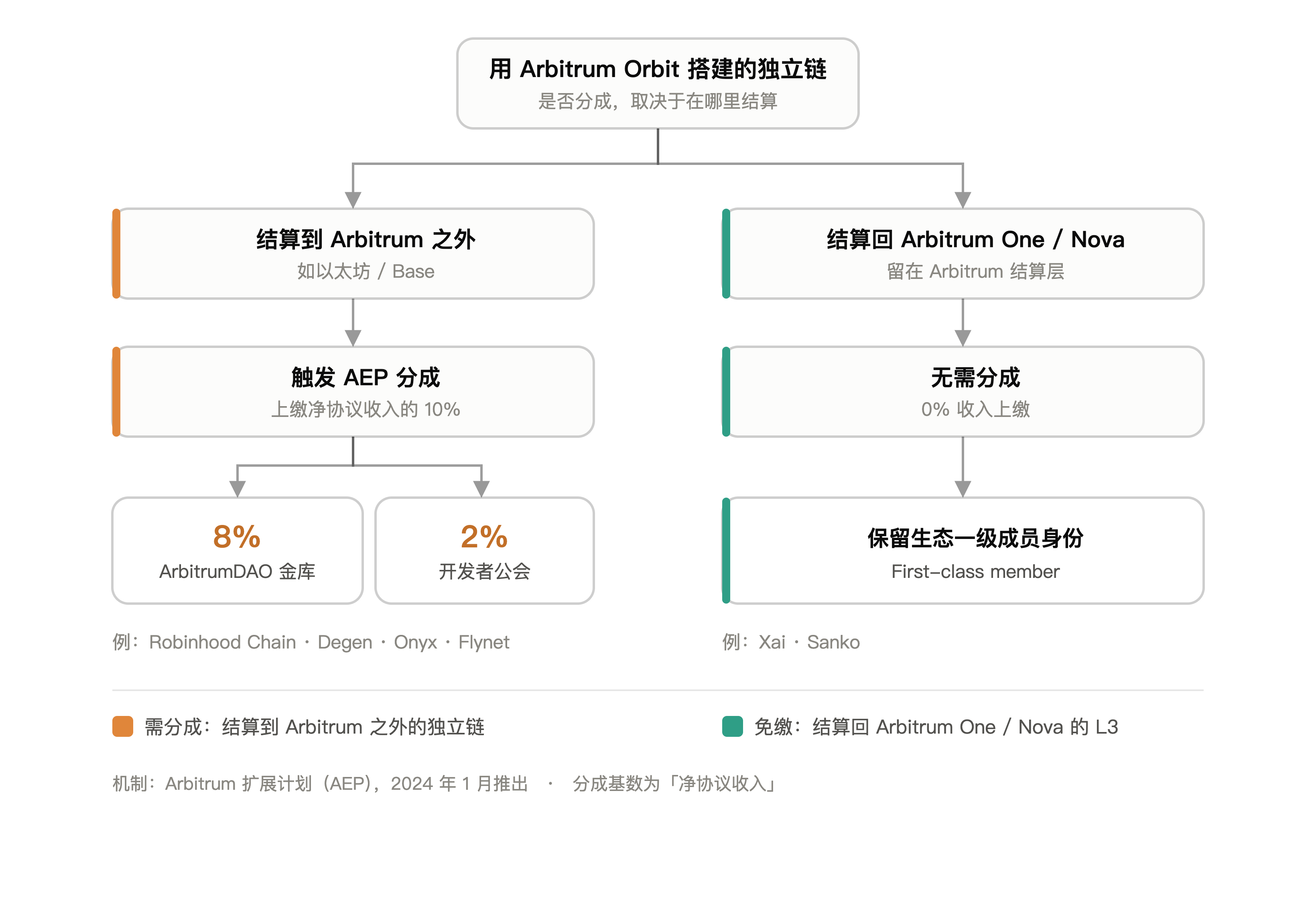
The key point is that Robinhood Chain is not the first chain to trigger the AEP. Smaller chains like Degen Chain, Onyx, and Flynet, which settle on Base, have been paying this share all along. Their scale was just too small for anyone to care. The difference with Robinhood Chain lies solely in it being the first heavyweight chain to bring tangible scale to the sharing amount.


Great Data, But the Landlord's Rent Income is Still Tiny


According to the latest data disclosed by Johann, Head of Robinhood International and Crypto Business: as of July 10, a little over a week after launch, Robinhood Chain has recorded over 17 million transactions, over 350,000 addresses, a TVL of approximately $250 million, and DEX trading volume exceeding $1 billion. For a newly launched chain, this report card is indeed impressive.


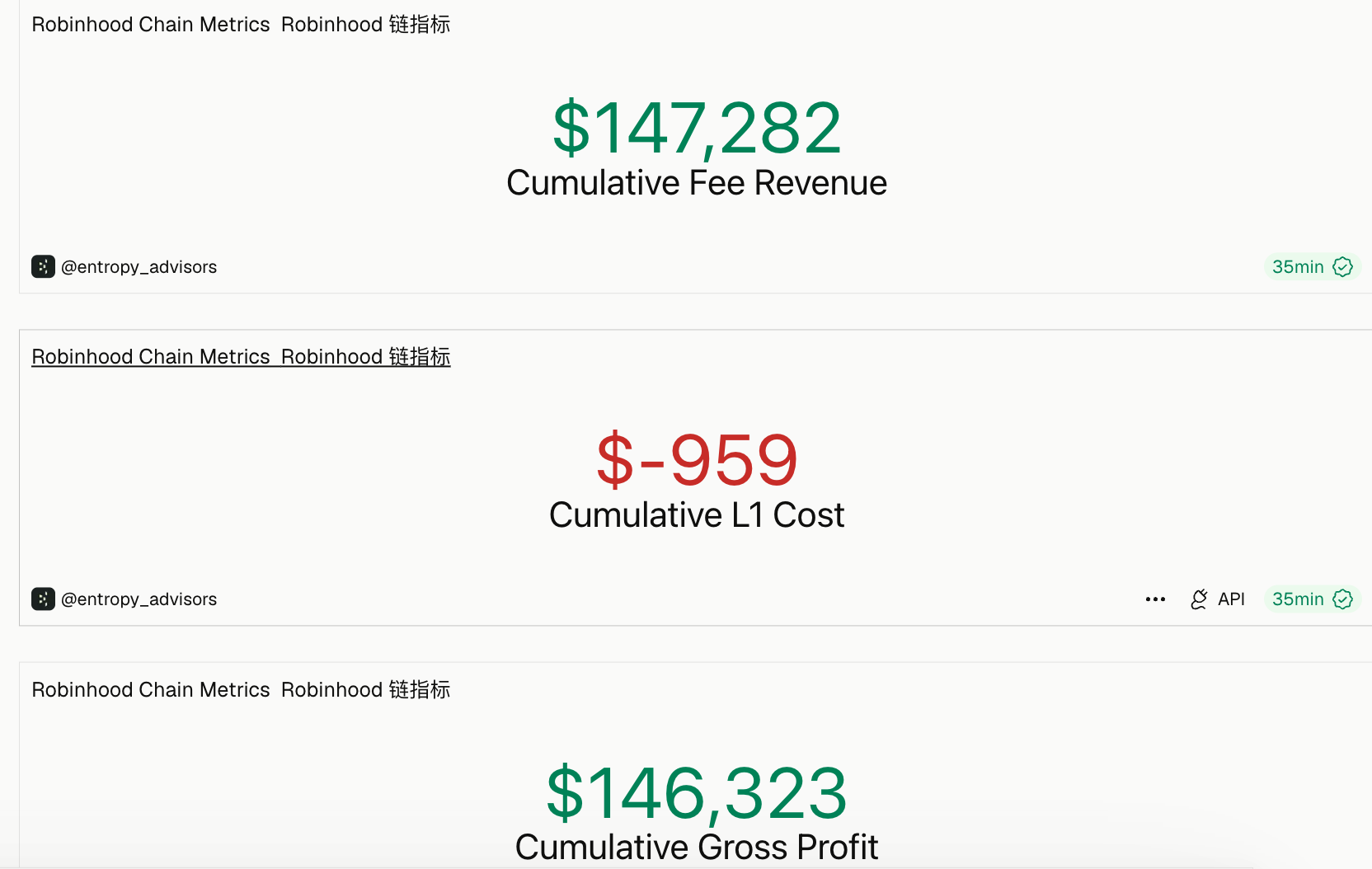
But the rental income is nowhere near that scale. According to Dune data, as of the time of writing, Robinhood Chain's current protocol revenue is about $147,000. After deducting the costs of data settlement back to the Ethereum L1, it amounts to a mere $146,000. Even with the 10% allocation to Arbitrum DAO, this amount is pitifully small. ARB's rise reflects the market's premium valuation on the future expansion potential of the AEP protocol—a typical narrative-driven rally.


Laying out the imagination, the ceiling for AEP is indeed not low: Robinhood's platform holds approximately $324 billion in total assets and $143.6 billion in custody assets. Tokenized stocks have expanded to over 2000 tokens, covering 120 countries. Most of these assets are not yet on-chain today. Once settlement gradually migrates over, the $57,000 sharing base will reach a completely different scale.


Old Landlord Losing its Biggest Tenant, New Landlord Just Got a Major Client


Arbitrum's "landlord" model is actually not new. Optimism has been running the "landlord" business for quite some time.


The Optimism Collective collects rent from all Superchain member chains (Base, Zora, Mode, Unichain, etc.) via OP Stack—charging 2.5% of sequencer revenue or 15% of net profit (whichever is higher). OP Mainnet itself also contributes its net revenue to the treasury. However, its rental income has been gradually shrinking, dropping to approximately $2.9 million in Q1 2026 (with Base alone contributing about $1.4 million), a 21.5% sequential decrease from the previous quarter's $3.7 million.
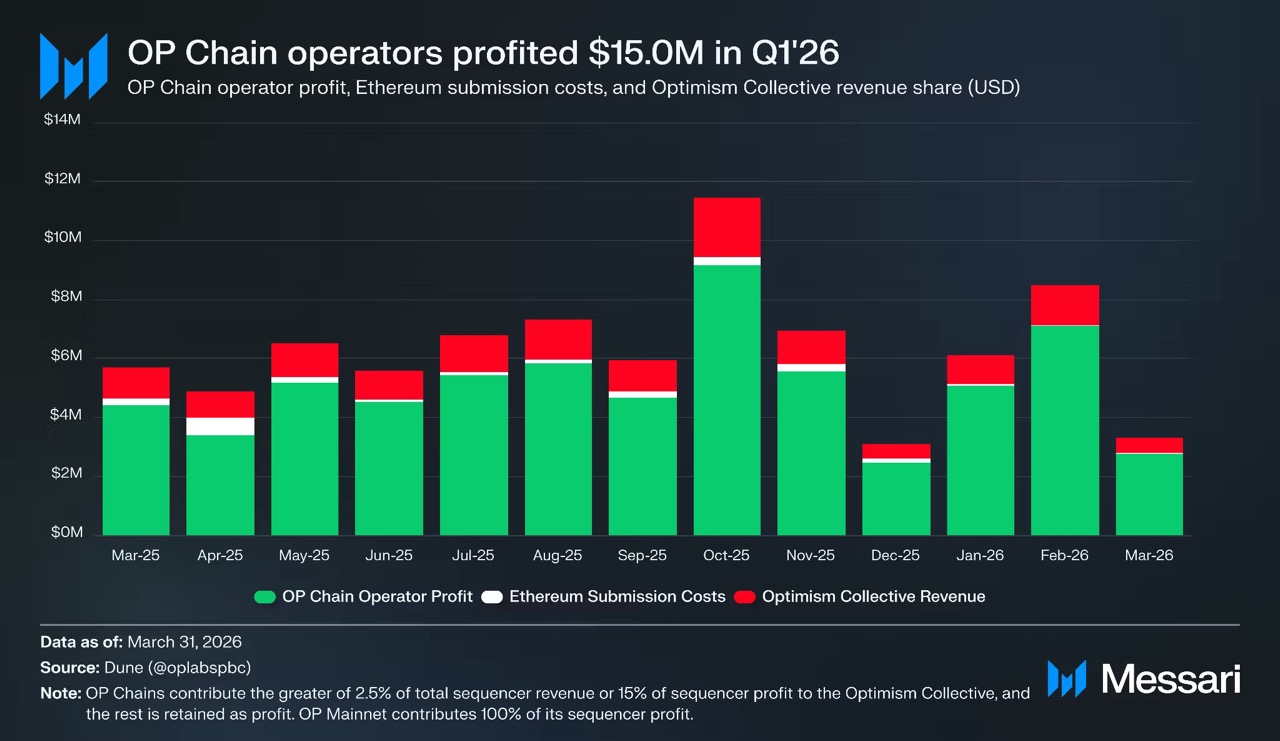


In February this year, Base officially announced its departure from OP Stack—based on the Gas fee metric, Base contributed about 96.5% of the revenue flowing into the Collective. Upon this news, the OP token dropped 28% within two days.


Meanwhile, Arbitrum just revived its landlord business from scratch with Robinhood Chain. The structures are completely symmetrical—both collect rent from external chains using their underlying technology, with the money going to their respective DAO treasuries (ArbitrumDAO vs. Optimism Collective). The only difference is that although Arbitrum's AEP rules were written in 2024, it never had a major tenant until this week, finally giving its "rent collection" a tangible sense of scale for the first time.


But Can This Major Tenant Be Kept?


It is precisely this history with Base that some analysts use to pour cold water. Some believe that, following the same script, Robinhood Chain will eventually detach from Arbitrum Orbit and align directly with Ethereum, just as Base did from OP Stack. According to growthepie data, Robinhood Chain's single-day sequencer revenue is now nearly $60,000, second only to Base's $72,000 among Ethereum L2s, approaching three times that of its parent chain Arbitrum.
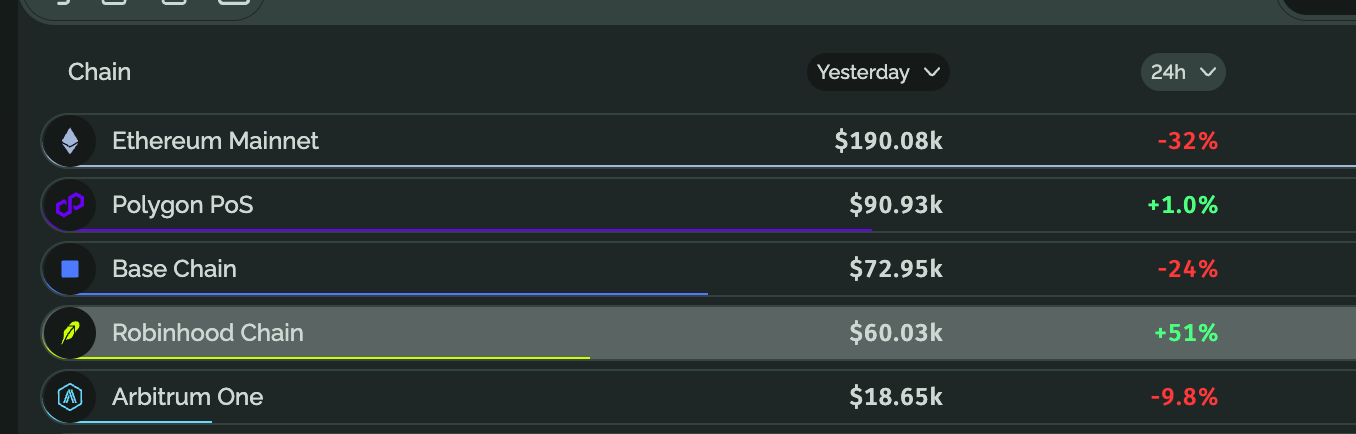


The beneficiary issue is even more subtle. Within a week of its launch, Robinhood Chain has become the second-largest demand source for Ethereum DA, second only to Base. Its sequencer pays blob fees, settles in ETH, and permanently burns them. Analysts therefore argue that if there can only be one ecosystem currency for this chain, it's more likely to be ETH, not ARB.


Criptomoedas em alta

Perguntas relacionadas

QWhat is the name of the new L2 chain built on Arbitrum technology that was recently launched by Robinhood and is driving the price increase of ARB?

AThe chain is called Robinhood Chain, a RWA-focused Layer 2 built by Robinhood based on Arbitrum technology.

QWhat is the specific name of the revenue-sharing rule that Robinhood Chain triggers, and what is the breakdown of the fees paid to the Arbitrum ecosystem?

AThe rule is called the Arbitrum Expansion Program (AEP). Independent chains built with Arbitrum Orbit technology but not settling on Arbitrum One/Nova must pay 10% of their net protocol revenue to the Arbitrum ecosystem: 8% to the DAO treasury and 2% to the developers guild.

QWhat is the primary reason cited in the article for the recent 20% price increase of ARB, given the actual AEP revenue from Robinhood Chain is currently minimal?

AThe ARB price increase is a narrative-driven rally. It reflects the market's premium valuation of the future potential and scaling boundaries of the AEP model, following the high-profile entry of a major TradFi player like Robinhood.

QAccording to the article, which existing L2 platform's 'landlord' model does Arbitrum's AEP resemble, and what is a key challenge that platform is currently facing?

AIt resembles Optimism's 'landlord' model for its Superchain (via OP Stack). A key challenge Optimism faces is its largest 'tenant,' Base, announcing plans to move away from OP Stack, which previously contributed ~96.5% of its revenue.

QWhat argument do some analysts use to suggest that Robinhood Chain might eventually leave the Arbitrum Orbit ecosystem, similar to Base's move from OP Stack?

AAnalysts point to Robinhood Chain's high sequencer revenue, which is already close to three times that of its 'parent' chain, Arbitrum. They argue that if the chain were to align with a single ecosystem currency, it would more likely be ETH (which it uses to pay and burn blob fees on Ethereum) rather than ARB.

Leituras Relacionadas

June Transaction Volume Doubles: x402 Ecosystem Continues to Expand, Content Monetization Narrative Faces Crucial Test

X402, a protocol for AI and data services, experienced significant growth in June. Its transaction volume doubled compared to May, primarily driven by the AI inference routing service BlockRun. The ecosystem expanded with new integrations: Apify enabled data scraping services, Exa extended its AI search to Solana, and Seal launched 'Hacks', a marketplace for automated AI agents. The protocol itself received crucial upgrades, including 'Builder Codes' for tracking and affiliate systems and 'Batch Settlement' to enable practical micropayments for high-frequency AI tasks. Major external validation came from tech giants. Amazon Web Services (AWS) launched a solution for AI traffic metering at its edge nodes. More significantly, Cloudflare opened its waitlist for a Content Monetization Gateway. This gateway allows websites to charge AI bots and other automated agents for accessing content, using x402 for stablecoin payments. This addresses a core internet monetization problem and represents x402's most promising path to mass adoption, though Cloudflare's CEO noted current blockchain scalability remains a critical hurdle. Current leading use cases are AI inference routing and paid data feeds. However, the large-scale real-world test with Cloudflare's gateway will be decisive in determining if x402 can transition from a useful tool to a fundamental infrastructure component for a new web economy where AI agents pay for the content they consume.

Foresight NewsHá 14m

June Transaction Volume Doubles: x402 Ecosystem Continues to Expand, Content Monetization Narrative Faces Crucial Test

Foresight NewsHá 14m

RWA Weekly: EU Proposes Revision of MiCA to Cover Tokenization and Non-EU Stablecoins; Swift and 17 Banks to Pilot Tokenized Cross-Border Payments

RWA Weekly: EU Proposes MiCA Revision for Tokenization and Non-EU Stablecoins; Swift to Pilot Tokenized Cross-Border Payments with 17 Banks During the statistical period of July 3-10, 2026, the RWA sector showed signs of recovery. The total on-chain market capitalization of RWAs rebounded to $33.12 billion, ending a prolonged decline. The stablecoin market cap also returned above $300 billion, with active addresses and holders increasing, indicating restored market vitality. Key regulatory developments include China promoting the use of digital yuan in consumption vouchers, the EU considering revisions to its MiCA framework to cover tokenization and non-EU stablecoins, and Kazakhstan authorizing stablecoin use for cross-border corporate and government payments. In Hong Kong, HSBC issued its first "digitally native" structured product. Major project updates feature Swift announcing readiness of its blockchain ledger for a 24/7 tokenized cross-border payment pilot involving 17 global banks. Ondo launched a perpetuals platform allowing tokenized stocks as collateral. Sony received conditional U.S. OCC approval to launch a stablecoin-focused trust bank in 2027. Tether plans to natively issue USDT on Bitcoin via the RGB protocol. Significant funding rounds saw Securitize planning to deploy over $400 million for acquisitions to expand its institutional tokenization business, while Tether invested $20 million in Brazil's Mercado Bitcoin to support its growth in on-chain financial services. Analysis highlights that stablecoins are evolving into global financial infrastructure with regional specializations and that institutions should consider international expansion to gain practical experience in the RWA tokenization space amidst evolving regulations.

marsbitHá 47m

RWA Weekly: EU Proposes Revision of MiCA to Cover Tokenization and Non-EU Stablecoins; Swift and 17 Banks to Pilot Tokenized Cross-Border Payments

marsbitHá 47m

The Ethereum Foundation is Dead, The Era of Ethereum's Pluralistic Organizations Has Dawned

The Ethereum Foundation (EF) has announced the dissolution of its Protocol Support Team, marking a significant organizational shift. This move, described as the largest layoff in EF's history with a 20% staff reduction, follows a major internal restructuring announced in late June. The restructuring, which EF framed as necessary to streamline for future challenges, has drawn criticism for its perceived cold execution. Concurrently, several new independent non-profit organizations have emerged, founded by former EF members. These include Ethlabs, a research and development lab, and Ethereum Institutional, which focuses on promoting institutional adoption of Ethereum. Their rise is seen as both filling roles vacated by EF's downsizing and signaling a fragmentation of the Ethereum ecosystem's leadership. Amidst these changes, EF is also integrating advanced AI tools into its security operations. The security team has begun using AI agents to conduct red-team testing, which has already uncovered vulnerabilities in Ethereum's code. While EF states that AI complements rather than replaces human researchers, this technological shift hints at potential future reductions in human-centric roles within the organization. The article posits that these developments—massive layoffs, the exodus of key personnel like former Executive Director Xiaowei Wang, the rise of rival organizations, and AI integration—collectively point to a decline in EF's central authority. Once the undisputed leader of the Ethereum ecosystem, EF now faces questions about its future role, with speculation that it may evolve into more of a symbolic "ecosystem mascot" rather than a driving force for growth and adoption. This organizational turmoil unfolds against a backdrop of ongoing market pressure and community debate over Ethereum's value proposition.

marsbitHá 1h

The Ethereum Foundation is Dead, The Era of Ethereum's Pluralistic Organizations Has Dawned

marsbitHá 1h

Trading

Spot

Artigos em Destaque

Como comprar HYPE

Bem-vindo à HTX.com!Tornámos a compra de Hyperliquid (HYPE) simples e conveniente.Segue o nosso guia passo a passo para iniciar a tua jornada no mundo das criptos.Passo 1: cria a tua conta HTXUtiliza o teu e-mail ou número de telefone para te inscreveres numa conta gratuita na HTX.Desfruta de um processo de inscrição sem complicações e desbloqueia todas as funcionalidades.Obter a minha contaPasso 2: vai para Comprar Cripto e escolhe o teu método de pagamentoCartão de crédito/débito: usa o teu visa ou mastercard para comprar Hyperliquid (HYPE) instantaneamente.Saldo: usa os fundos da tua conta HTX para transacionar sem problemas.Terceiros: adicionamos métodos de pagamento populares, como Google Pay e Apple Pay, para aumentar a conveniência.P2P: transaciona diretamente com outros utilizadores na HTX.Mercado de balcão (OTC): oferecemos serviços personalizados e taxas de câmbio competitivas para os traders.Passo 3: armazena teu Hyperliquid (HYPE)Depois de comprar o teu Hyperliquid (HYPE), armazena-o na tua conta HTX.Alternativamente, podes enviá-lo para outro lugar através de transferência blockchain ou usá-lo para transacionar outras criptomoedas.Passo 4: transaciona Hyperliquid (HYPE)Transaciona facilmente Hyperliquid (HYPE) no mercado à vista da HTX.Acede simplesmente à tua conta, seleciona o teu par de trading, executa as tuas transações e monitoriza em tempo real.Oferecemos uma experiência de fácil utilização tanto para principiantes como para traders experientes.

313 Visualizações TotaisPublicado em {updateTime}Atualizado em 2026.06.02

Como comprar HYPE

Discussões

Bem-vindo à Comunidade HTX. Aqui, pode manter-se informado sobre os mais recentes desenvolvimentos da plataforma e obter acesso a análises profissionais de mercado. As opiniões dos utilizadores sobre o preço de HYPE (HYPE) são apresentadas abaixo.

活动图片