Schwab Warns Crypto Could Go to Zero – Solaxy ($SOLX) Is Proving Otherwise

bitcoinistPublicado em 2025-04-20Última atualização em 2025-04-20

Resumo

Charles Schwab, a major U.S. financial services firm, is finally gearing up to let users trade crypto directly – but not...

Trusted Editorial content, reviewed by leading industry experts and seasoned editors. Ad Disclosure

Charles Schwab, a major U.S. financial services firm, is finally gearing up to let users trade crypto directly – but not without issuing a big, bold warning.

The legacy investment giant now says it expects to launch spot crypto trading by next year, including Bitcoin. That’s a huge shift from its long-held cautious stance.

At the same time, Schwab’s website still warns that crypto investments ‘could become entirely worthless,’ claiming that digital assets like Bitcoin have no intrinsic value.

So what gives? Is crypto the future or financial vapor? According to Schwab, it might be both – depending on who’s asking.

While TradFi plays both sides, Web3 platforms like Solaxy ($SOLX) are moving forward with purpose, clarity, and community at the core.

Schwab Dips in, But With a Disclaimer

After years of sitting on the sidelines, Schwab is joining the crypto party – slowly.

The goal? Tap into the new wave of millennial and Gen Z investors. In fact, Schwab’s own research shows that 62% of millennials plan to buy crypto in 2025, ahead of stocks and bonds. That’s a massive cultural shift.
But even as Schwab leans in, it’s keeping one foot on the brake.
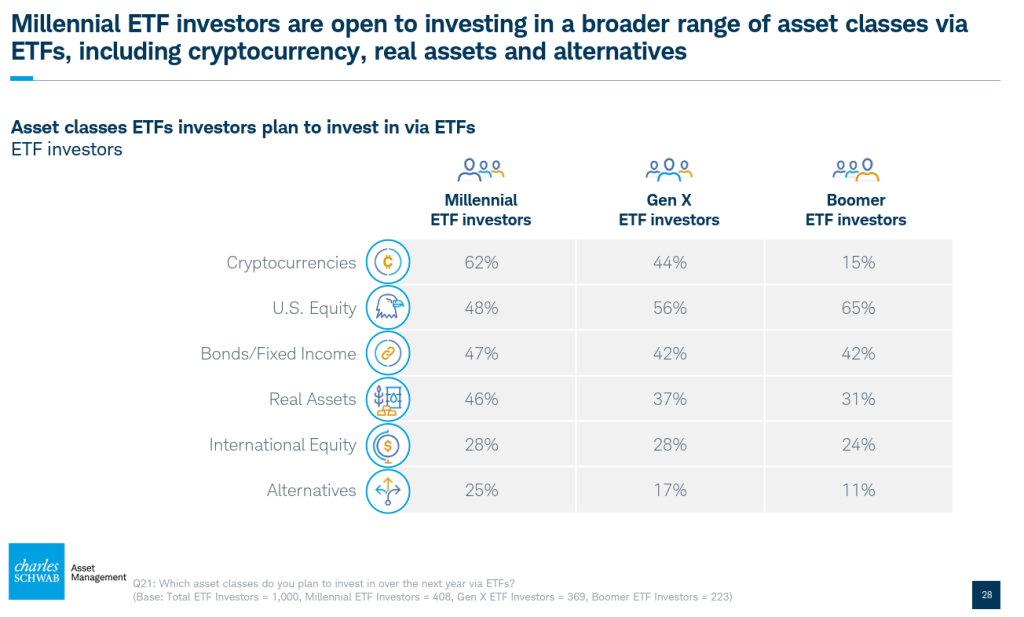
Charles Schwab's research into how millenials invest
Source: Charles Schwab’s study

Its website still includes harsh warnings – that crypto is too volatile, could go to zero, and that Bitcoin lacks fundamentals like earnings or a P/E ratio. Basically: ‘We’re launching crypto trading… but don’t say we didn’t warn you.’

This cautious approach stands in sharp contrast to crypto-native players like Robinhood and Kraken.

Robinhood has seen a 700% jump in crypto revenue, while Kraken now lets users trade over 11K U.S. equities. These platforms aren’t hedging – they’re evolving fast and fusing traditional finance with Web3 functionality.

Which brings us to Solaxy, a project that fully embraces this new direction – without the institutional baggage.

Solaxy ($SOLX) – The First Solana Layer 2 With Real Utility

Solaxy ($SOLX) is a new crypto project and a next-gen Layer 2 blockchain built on Solana, designed to supercharge speed, scalability, and access to multichain DeFi.

If you’re looking to buy Solaxy, now is the time to do it – at just $0.0017 per token. With over $30M already raised in presale, Solaxy isn’t just gaining attention – it’s rewriting the rules of what a crypto project can be.

Solaxy raised $30M in presale

As the first-ever Solana Layer 2, Solaxy fixes what holds Solana back: congestion, scalability limits, and failed transactions. But it doesn’t stop there – it enhances Solana’s strengths too, offering more speed, scalability, and performance than ever before.

$SOLX is a multichain token that bridges the speed of Solana with the massive liquidity and reach of Ethereum.

It unlocks the full potential of both ecosystems, giving holders access to the best of DeFi across two of the biggest blockchains in the world.

The token is built for altcoin traders, DeFi degens, and serious builders alike – anyone looking for low fees and lightning-fast execution without sacrificing reach.

With analysts predicting $SOLX could hit $0.032 by 2025 and even reach $0.2 by 2026, this isn’t just a cool concept – it’s a serious contender for the next major Layer 2 breakout.

And in a market where giants like Schwab are still hesitating, Solaxy is already building the future of decentralized finance.

What Makes Solaxy Stand Out

Solaxy does what no one else has: it democratizes high-speed trading tools, putting the power of sniper bots into the hands of everyday users. While Ethereum offers liquidity and Solana brings speed, Solaxy unites both – without the friction.

It’s not just a faster blockchain – it’s a gateway to the future of DeFi, meme coins, and multichain ecosystems.
Developers, traders, and investors all win here.
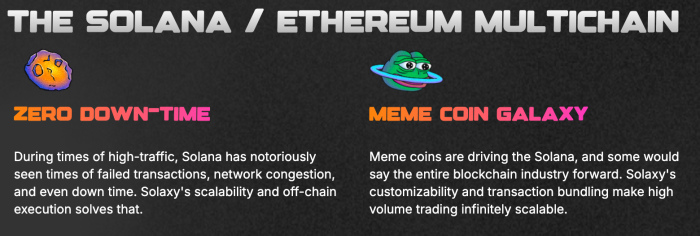
Solaxy ($SOLX) multichain token

And as Schwab cautiously enters crypto, Solaxy is already sprinting ahead, showing what innovation really looks like in Web3.

Solaxy Builds While Wall Street Waits

Schwab’s cautious dip into crypto may comfort traditional investors, but it feels outdated in a world moving at Web3 speed. Digital natives aren’t looking for more disclaimers – they want real utility, ownership, and engagement.

That’s exactly what Solaxy ($SOLX) delivers. With its mission-based ecosystem and multichain reach, it’s not just another token – it’s an invitation to participate in the future of finance.

While Wall Street debates whether crypto is a risk or a revolution, Solaxy is already proving it’s both powerful and inevitable.

Before investing, always do your own research (DYOR). This article is for informational purposes only and doesn’t constitute financial advice.

Editorial Process for bitcoinist is centered on delivering thoroughly researched, accurate, and unbiased content. We uphold strict sourcing standards, and each page undergoes diligent review by our team of top technology experts and seasoned editors. This process ensures the integrity, relevance, and value of our content for our readers.

Bitcoinist is the ultimate news and review site for the crypto currency community!

Leituras Relacionadas

Pacific 'Fever': How Extreme Weather Becomes Wall Street's ATM?

"Pacific 'Fever': How Extreme Weather Becomes Wall Street's Piggy Bank" The article examines how the 2026-2027 El Niño, potentially the strongest since 1950, is not only disrupting global weather but also creating major financial opportunities. It links recent extreme events in China and worldwide to this climate phenomenon, which alters atmospheric patterns, increasing risks of floods, droughts, and heatwaves. The core narrative explores how financial markets capitalize on these disruptions. A hedge fund is raising $500 million specifically to bet on El Niño-affected crops like South African corn and Malaysian palm oil. Historically, such strategies have yielded massive profits. Examples include Richard Dennis ("Turtle Trader") making his first fortune in the 1970s soy boom triggered by El Niño's impact on Peruvian anchovies (a key fishmeal source), and Anthony Ward's cocoa empire built on superior weather intelligence. The 2024 cocoa price surge, driven by West African drought, enriched quantitative trend-following funds. Currently, markets are preemptively bidding up palm oil, rubber, and sugar futures based on anticipated future supply shocks, despite high current inventories. The article details El Niño's asymmetric global impacts: causing drought in Southeast Asia (hurting palm oil/rubber) and India (affecting sugar/cotton), but bringing beneficial rains to South American soy and sugarcane. Key metrics to watch include the Niño3.4 index, Indian monsoon data, and Malaysian palm oil stocks. The true price effects often materialize *after* the El Niño peaks, suggesting 2027 may see the real volatility. The conclusion warns that beyond trading gains, the convergence of El Niño, energy shortages, and fertilizer scarcity poses a systemic risk, potentially raising the cost of living for everyone, turning a climate event into a global economic story.

链捕手Há 6m

Pacific 'Fever': How Extreme Weather Becomes Wall Street's ATM?

链捕手Há 6m

Just Now, OpenAI's Chief Futurist Departed, Once Called a Jackass by Musk

Just now, OpenAI's Chief Futurist, Joshua Achiam, announced his departure from the company via X. Having joined as a 25-year-old intern in 2017, he spent nine years at OpenAI, evolving from an AI safety research scientist to leading the Mission Alignment team. Earlier this year, that team was dissolved, and Achiam transitioned to the newly created role of Chief Futurist, positioned at the intersection of AI safety and policy to study AGI's long-term risks and opportunities. In his departure statement, Achiam called his time a "graduation," reflecting on the immense progress from AI that couldn't converse to systems solving scientific problems. He expressed optimism about a future of peace, prosperity, and possibility, closing with "To safe AGI." His tenure was notably marked by a 2018 incident where he publicly challenged Elon Musk—then still with OpenAI—on safety compromises if Musk pursued AGI at Tesla, leading Musk to call him a "jackass." This became an internal legend, with colleagues later giving him a trophy inscribed, "To safety, never stop being that jackass." Achiam's exit follows a pattern of prominent safety and alignment experts leaving OpenAI, including Jan Leike and others who joined rivals like Anthropic or started non-profits. His departure coincides with OpenAI's internal efforts to more tightly integrate its research and policy teams, and the recent hiring of former White House AI advisor Dean Ball. Achiam did not cite a specific reason for leaving but indicated it was a long-considered decision, stating the mission to ensure AGI benefits humanity can now be advanced beyond the "frontier lab's" walls.

marsbitHá 8m

Just Now, OpenAI's Chief Futurist Departed, Once Called a Jackass by Musk

marsbitHá 8m

Anthropic Drops $19 Billion to 'Sponsor' a Bitcoin Miner

On July 6, 2026, Bitcoin mining company TeraWulf (NASDAQ: WULF) saw its stock surge 15% pre-market following the announcement of a landmark 20-year agreement with AI giant Anthropic. The deal grants Anthropic 401 MW of IT load capacity at TeraWulf's "Justified Data" campus in Kentucky and is projected to generate approximately $19 billion in contracted revenue for the miner over its duration. On the same day, TeraWulf also sold its 50.1% stake in a Texas joint venture for about $530 million. This dual move signals a strategic pivot: divesting non-core assets to fund its fully-owned Kentucky project and shifting focus from cryptocurrency mining to becoming a specialized infrastructure provider for AI. The agreement highlights a key advantage for Bitcoin miners transitioning to AI: their pre-existing access to land and critical power grid capacity, which is becoming a major bottleneck for data center expansion. Unlike peers who operate AI clouds, TeraWulf is adopting a "landlord" model, leasing only the physical space and power for clients' own servers. However, a significant gap exists between the deal's announcement and revenue generation, with the first phase of the Kentucky site not operational until late 2027. The $19 billion figure represents a long-term bet on both TeraWulf's execution and Anthropic's financial durability in the capital-intensive AI race. The market's positive reaction reflects the growing value of fundamental infrastructure—secured land and reliable electricity—in the era of AI compute scarcity.

marsbitHá 12m

Anthropic Drops $19 Billion to 'Sponsor' a Bitcoin Miner

marsbitHá 12m

Securitize Drops 40% in First Week of Trading as Tokenization Industry Enters Patent Wars

The article discusses the recent stock performance of Securitize (NYSE: SECZ) and a looming patent war in the tokenization industry. Securitize, a leading tokenization platform and transfer agent for BlackRock's BUIDL fund, debuted on the NYSE via a SPAC merger on July 2. After an initial rise, its stock plummeted nearly 40% within a week, closing at $8.06 on July 7. Analysts attribute the sharp decline largely to typical post-SPAC investor turnover and broader pressure on crypto-related stocks, rather than fundamental business deterioration. Concurrently, Securitize faces significant legal challenges. On June 15, infrastructure rival tZERO accused Securitize of patent infringement concerning its core DS Protocol and Vault Registrar products. Securitize preemptively filed a lawsuit on June 22 seeking a declaratory judgment of non-infringement. tZERO, holding 105 patents, has indicated it has identified at least six other market participants for potential infringement actions, signaling a broader industry-wide patent conflict. A separate lawsuit was also filed by Liquid Rarity Exchange. The article concludes that while Securitize's stock drop may be a temporary SPAC-related correction, the patent disputes initiated by tZERO represent a more profound, long-term risk for the entire tokenization sector, potentially shifting competitive dynamics from business execution to intellectual property litigation.

Foresight NewsHá 41m

Securitize Drops 40% in First Week of Trading as Tokenization Industry Enters Patent Wars

Foresight NewsHá 41m

Trading

Spot
活动图片