Securitize Drops 40% in First Week of Trading as Tokenization Industry Enters Patent Wars

Foresight NewsPublicado em 2026-07-08Última atualização em 2026-07-08

Resumo

The article discusses the recent stock performance of Securitize (NYSE: SECZ) and a looming patent war in the tokenization industry. Securitize, a leading tokenization platform and transfer agent for BlackRock's BUIDL fund, debuted on the NYSE via a SPAC merger on July 2. After an initial rise, its stock plummeted nearly 40% within a week, closing at $8.06 on July 7. Analysts attribute the sharp decline largely to typical post-SPAC investor turnover and broader pressure on crypto-related stocks, rather than fundamental business deterioration. Concurrently, Securitize faces significant legal challenges. On June 15, infrastructure rival tZERO accused Securitize of patent infringement concerning its core DS Protocol and Vault Registrar products. Securitize preemptively filed a lawsuit on June 22 seeking a declaratory judgment of non-infringement. tZERO, holding 105 patents, has indicated it has identified at least six other market participants for potential infringement actions, signaling a broader industry-wide patent conflict. A separate lawsuit was also filed by Liquid Rarity Exchange. The article concludes that while Securitize's stock drop may be a temporary SPAC-related correction, the patent disputes initiated by tZERO represent a more profound, long-term risk for the entire tokenization sector, potentially shifting competitive dynamics from business execution to intellectual property litigation.


Written by: Sanqing, Foresight News


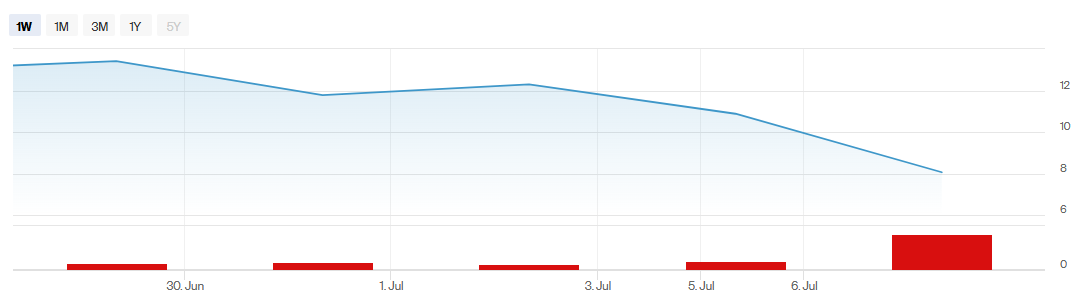
On July 2nd, Securitize (NYSE:SECZ) officially listed on the New York Stock Exchange via a SPAC merger completed with Cantor Equity Partners II. The stock rose on its first trading day, an event initially seen by the market as a landmark signaling the acceptance of the tokenization industry by traditional capital markets. However, the script took a sharp turn just a few trading days later. By the close on July 7th, SECZ was trading at $8.06, plummeting 25.92% for the day, having touched an intraday low of $8.00. This represented a pullback of approximately 40% from its peak during the first week of trading.

Source: NYSE


This is a company selected by BlackRock's tokenized money market fund BUIDL as its transfer agent, widely recognized by the capital markets as a leading platform in the tokenization space, with a pre-merger valuation of $1.25 billion. The stark contrast of its post-listing decline has led many investors to scrutinize the gap between the "tokenization narrative" and the "secondary market reality."


SPAC Mechanism Exposes Issues Before Fundamentals


In recent years, crypto-related companies that have gone public via SPAC have almost universally undergone similar valuation re-pricing during the handover period.


Twenty One Capital (XXI), also orchestrated by an entity affiliated with Cantor Fitzgerald, fell about 25% on its first day of trading on the NYSE via a SPAC merger on December 9th, 2025, closing at $11.42. It continued to decline thereafter, with its share price once falling below $6, a drop of over 80% from its peak of $49. ProCap Financial (BRR), a Bitcoin treasury company that completed its merger around the same time, debuted at $10 and is now trading around $2.4, a decline of roughly 76%.


Several market participants attribute the recent sharp decline to the SPAC structure itself rather than a deterioration in company fundamentals.


According to a CoinDesk report, Jeff Dorman of Arca stated publicly that this volatility is more a result of the SPAC mechanism than a worsening of fundamentals. Post-SPAC listing, the investor base undergoes a complete shift—from the original SPAC subscribers who prefer fixed income to long-term equity holders focused on fundamentals. This handover process inherently creates significant volatility.


Market confidence in the "tokenization" story itself has not collapsed; what has collapsed is confidence in the SPAC pricing mechanism. Despite the falling stock price, Securitize tokenized $295 million worth of its own stock on its first trading day and deployed it on Solana and Avalanche.


Securitize's decline also coincided with broader pressure on U.S.-listed crypto-related stocks. By early July, shares of Coinbase and Circle had fallen approximately 63% and 74%, respectively, from their respective all-time highs set in July 2025. Over the same period, the S&P 500 index retreated only about 2% from its June peak. When the entire sector's stocks are more volatile than their underlying assets, a newly listed tokenization platform can hardly remain unscathed.


Patent Lawsuit Reveals Industry Fissures


On June 15th, tokenization infrastructure company tZERO sent a "cease and desist and reservation of rights" letter to Securitize, alleging that its two core products, DS Protocol and Vault Registrar, infringe patents held by tZERO. The allegations specifically involve U.S. Patents No. 11,216,802 ("Smart Contract Rules for Self-Executing Security Tokens") and No. 11,394,560 ("Cryptographic Integration Platform").


tZERO demanded that Securitize cease commercialization of the relevant products by June 18th or face injunctive relief and claims for monetary damages.


Securitize took the offensive, filing a declaratory judgment action for non-infringement on June 22nd in the U.S. District Court for the District of Delaware (Case No. 1:26-cv-00722, Securitize, Inc. v. tZERO Group, Inc. et al.). It seeks a court declaration that its products do not infringe tZERO's patents, characterizing the allegations as "baseless," "lacking in substance," and "contrary to the spirit of fair competition in the industry."


The case is currently in its early stages, assigned to Judge Gregory B. Williams. There have been no substantive pleadings, counterclaims, motions to dismiss, or settlement announcements. This means the case could still take various paths, including an out-of-court settlement, partial dismissal, or even a withdrawal of the allegations by tZERO.


The weight of this lawsuit far exceeds that of an ordinary commercial dispute.


tZERO's patent assertions were not made on a whim. Founded in 2014 and stemming from the vision of a security token trading platform by Overstock.com (a longstanding U.S. online retailer whose founder, Patrick Byrne, was an early blockchain evangelist), the company initiated a strategic review of its intellectual property portfolio following a management reshuffle at the end of 2025.


According to tZERO's announcement on June 15th regarding the progress of its IP portfolio enforcement, it holds 105 patents across 23 patent families. Its business scope spans core aspects of tokenization infrastructure, including compliant security token systems, crypto asset integration, and KYC verification processes.


More critically, tZERO has explicitly stated that its patent review has identified "at least six" other market participants with potential infringements, covering areas such as compliant RWA platforms, institutional infrastructure, prime brokers, and decentralized exchanges. It plans to issue infringement warning letters to more companies after completing its analysis.


As of July 8th, the case remains in its early stages, with neither party having submitted substantive pleadings, counterclaims, or settlement documents.


However, the patent pressure facing Securitize is not limited to tZERO. Concurrently, Liquid Rarity Exchange has also filed a separate lawsuit against Securitize over two other patents, seeking damages and injunctive relief.


In other words, Securitize might be the first, but not the only one. According to data from rwa.xyz, the RWA market has accelerated its expansion from approximately $22 billion at the beginning of the year to over $33 billion, moving from the "proof-of-concept" stage to "actual deployment."


This is the backdrop against which tZERO has chosen to turn its long-dormant patent portfolio into a commercial bargaining chip. When the patent barriers within the tokenization industry begin to be actively asserted, nearly every platform claiming to "master core technologies" risks being drawn into similar disputes. This warrants more long-term attention than a single stock price pullback.


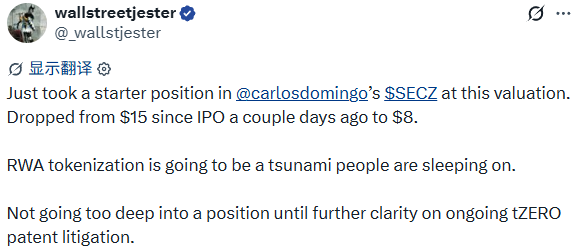
As X user wallstreetjester noted, he "just opened a position" in SECZ but clearly stated he "will not add significantly until the lawsuit has clearer progress." This represents the genuine sentiment of a segment of potential buyers.


Primary Market Believes in Institutions, Secondary Market Believes in Liquidity


Securitize's shareholder roster is impressively distinguished. It was chosen by BlackRock's BUIDL fund as its transfer agent, and during its PIPE financing round, it attracted institutional investors like Borderless Capital and Hanwha Investment. The SPAC transaction itself was initiated by an affiliate of Cantor Fitzgerald.


This narrative of "joint endorsement by traditional financial institutions" is highly persuasive during primary market fundraising and was a key support for Securitize's $1.25 billion pre-merger valuation.


However, the secondary market doesn't care about endorsements; it only cares about liquidity. The market still buys into the "tokenization" story; what has cooled off is merely the short-term pricing of Securitize's specific stock.


BlackRock's name might make primary market investors willing to pay for the valuation story, but it cannot convince the secondary market to continue holding shares when patent disputes are unresolved and SPAC handover pressure persists. Trust is a static brand asset; liquidity is the dynamic outcome of market博弈. This sharp decline precisely proves there is no necessary conversion rate between the two.


Securitize's share price will eventually stabilize or rebound as the investor base transition completes, a near-inevitable phase of growing pains for SPAC-listed companies. However, the patent war ignited by tZERO warrants vigilance from all participants in the tokenization industry.


With tZERO holding 105 patents and targeting at least six potential infringers, the next round of competition in the tokenization industry may no longer be just about compliance licenses, institutional relationships, or trading volume.


For platforms still relying on the valuation story of "we were the first to implement a certain technical solution," a cease-and-desist letter could bring that story to an abrupt halt at any moment.


Securitize's fall has wiped out short-term valuation; but tZERO's lawsuit may have unveiled a patent war that the entire tokenization industry is not yet prepared to face.


Perguntas relacionadas

QWhat are the main reasons for Securitize's (SECZ) sharp stock price decline shortly after its NYSE listing?

AThe primary reasons for SECZ's decline are attributed to the inherent volatility of the SPAC listing mechanism and sector-wide pressure on crypto-related stocks. The SPAC structure triggered a shift in investor base from SPAC investors to long-term equity holders, causing significant price volatility during the handover. Simultaneously, the entire crypto-stock sector, including companies like Coinbase and Circle, has been underperforming the broader market, creating a negative backdrop for SECZ.

QWhat is the core nature of the legal dispute between tZERO and Securitize mentioned in the article?

AtZERO has accused Securitize of patent infringement, specifically alleging that Securitize's DS Protocol and Vault Registrar products violate two of its U.S. patents related to self-executing smart contract rules for security tokens and crypto integration platforms. Securitize responded by filing a declaratory judgment lawsuit, asking the court to confirm that its products do not infringe and characterizing tZERO's claims as baseless.

QHow does the article contrast the forces driving primary market valuation versus secondary market performance for companies like Securitize?

AThe article contrasts that in the primary market, valuation is driven by institutional trust and prestigious backers (like BlackRock, Cantor Fitzgerald), which supported Securitize's $1.25 billion pre-merger valuation. However, the secondary market prioritizes liquidity and immediate risk factors over brand endorsements. It reacts to concrete issues like pending patent lawsuits and SPAC-related selling pressure, leading to a disconnect between the initial valuation narrative and the stock's trading reality.

QWhat broader implication does the tZERO vs. Securitize patent lawsuit hold for the tokenization industry according to the article?

AThe lawsuit signals the potential start of a widespread patent war within the tokenization industry. tZERO's announcement that it has identified at least six other market participants as potential infringers suggests that patent enforcement could become a new, critical competitive dimension. This shift moves the industry beyond competition based solely on compliance, institutional relationships, and trading volume, introducing legal and intellectual property risks that could disrupt many platforms' business narratives.

QAccording to the article, what is the current status of the patent lawsuits against Securitize as of July 8th?

AAs of July 8th, the legal cases are in their early stages. The primary lawsuit filed by Securitize against tZERO (case 1:26-cv-00722) is before Judge Gregory B. Williams, with no substantive pleadings, counterclaims, motions to dismiss, or settlement news filed yet. Additionally, Securitize faces a separate, independent patent infringement lawsuit from Liquid Rarity Exchange. The outcomes remain uncertain, with possibilities ranging from out-of-court settlement to case dismissal.

Leituras Relacionadas

Just Now, The World's First Ultra-High-Frame World Model Was Born, Nvidia Content 0, Racing to 50 FPS

Just Now, Global First Ultra-High-Frame World Model Born, 0% NVIDIA, Speeds to 50 FPS A Chinese team has developed MoWorld, the world's first Flash World Model, achieving real-time interactive inference exceeding 50 FPS. Crucially, it is entirely built on domestic NPUs (National Processing Units), bypassing NVIDIA GPUs. Developed by Moxin Technology in collaboration with Zhejiang University's Pan Yunhe academician team, MoWorld represents a complete, closed-loop system from training and distillation to deployment on domestic computing power. The model tackles the critical industry bottleneck of real-time performance, essential for applications like robotics, gaming, and digital worlds. MoWorld achieves this through a full-stack redesign for NPUs, including a proprietary 3D-annotated data pipeline, system-level optimizations for long-sequence training (up to 2000 frames), and inference optimizations like dynamic mixed-precision quantization. On a Huawei Ascend 910C platform, a 14B MoE parameter model achieves over 50 FPS, reducing typical inference costs by 70% compared to equivalent GPU solutions. This breakthrough lowers the deployment barrier, potentially accelerating the industrialization of world models. Key application areas include gaming/entertainment (offering 6-DoF camera control for immersive exploration), embodied AI/autonomous driving (providing a high-fidelity digital training ground), film pre-visualization, and 3D reconstruction/digital twins due to its strong geometric consistency. MoWorld demonstrates that a full-stack domestic compute ecosystem can support cutting-edge, real-time world models, positioning China at a competitive starting line in defining next-generation spatial intelligence standards. The project underscores a shift in competition from model scale to real-world usability and cost-effective deployment.

marsbitHá 33m

Just Now, The World's First Ultra-High-Frame World Model Was Born, Nvidia Content 0, Racing to 50 FPS

marsbitHá 33m

Pacific 'Fever': How Extreme Weather Becomes Wall Street's Cash Machine?

"Pacific Fever": How Extreme Weather Becomes Wall Street's ATM? The summer of 2026 sees unusually fierce weather across China and globally. The common driver behind this global pattern is a powerful El Niño event, potentially the strongest since 1950, as declared by NOAA. This phenomenon, characterized by warming central/eastern Pacific waters, disrupts global atmospheric circulation, raising risks of floods, droughts, and heatwaves, further intensified by climate change. For financial markets, especially commodities, El Niño is not just weather but a major trading theme. History shows its price impact is profound. In the 1970s, El Niño-driven anchovy collapse in Peru fueled a soybean boom, giving Richard Dennis his first million. Anthony Ward's cocoa empire was built on superior weather intelligence. Most recently in 2024, West African droughts caused cocoa prices to soar over 400%, delivering huge gains for trend-following hedge funds. In 2026, markets are again pricing in future El Niño-induced supply shocks. Despite high current inventories, prices for palm oil, rubber, and sugar have rallied on anticipation of upcoming Southeast Asian droughts and weak Indian monsoons. Analysts identify key indicators to watch: the Niño3.4 index, Indian monsoon rainfall, Malaysian palm oil stocks, and the fundraising scale of specialized weather funds like Moreton Capital. Beyond trading opportunities, a concerning narrative is gaining traction online, linking El Niño with fertilizer shortages and energy supply disruptions to warn of potential global food crises within months. While alarmist, it highlights a deeper truth: the cascading effects of climate-driven weather extremes ultimately translate into higher costs of living for everyone, far beyond the trading floor.

marsbitHá 38m

Pacific 'Fever': How Extreme Weather Becomes Wall Street's Cash Machine?

marsbitHá 38m

Pacific 'Fever': How Extreme Weather Becomes Wall Street's ATM?

"Pacific 'Fever': How Extreme Weather Becomes Wall Street's Piggy Bank" The article examines how the 2026-2027 El Niño, potentially the strongest since 1950, is not only disrupting global weather but also creating major financial opportunities. It links recent extreme events in China and worldwide to this climate phenomenon, which alters atmospheric patterns, increasing risks of floods, droughts, and heatwaves. The core narrative explores how financial markets capitalize on these disruptions. A hedge fund is raising $500 million specifically to bet on El Niño-affected crops like South African corn and Malaysian palm oil. Historically, such strategies have yielded massive profits. Examples include Richard Dennis ("Turtle Trader") making his first fortune in the 1970s soy boom triggered by El Niño's impact on Peruvian anchovies (a key fishmeal source), and Anthony Ward's cocoa empire built on superior weather intelligence. The 2024 cocoa price surge, driven by West African drought, enriched quantitative trend-following funds. Currently, markets are preemptively bidding up palm oil, rubber, and sugar futures based on anticipated future supply shocks, despite high current inventories. The article details El Niño's asymmetric global impacts: causing drought in Southeast Asia (hurting palm oil/rubber) and India (affecting sugar/cotton), but bringing beneficial rains to South American soy and sugarcane. Key metrics to watch include the Niño3.4 index, Indian monsoon data, and Malaysian palm oil stocks. The true price effects often materialize *after* the El Niño peaks, suggesting 2027 may see the real volatility. The conclusion warns that beyond trading gains, the convergence of El Niño, energy shortages, and fertilizer scarcity poses a systemic risk, potentially raising the cost of living for everyone, turning a climate event into a global economic story.

链捕手Há 47m

Pacific 'Fever': How Extreme Weather Becomes Wall Street's ATM?

链捕手Há 47m

Just Now, OpenAI's Chief Futurist Departed, Once Called a Jackass by Musk

Just now, OpenAI's Chief Futurist, Joshua Achiam, announced his departure from the company via X. Having joined as a 25-year-old intern in 2017, he spent nine years at OpenAI, evolving from an AI safety research scientist to leading the Mission Alignment team. Earlier this year, that team was dissolved, and Achiam transitioned to the newly created role of Chief Futurist, positioned at the intersection of AI safety and policy to study AGI's long-term risks and opportunities. In his departure statement, Achiam called his time a "graduation," reflecting on the immense progress from AI that couldn't converse to systems solving scientific problems. He expressed optimism about a future of peace, prosperity, and possibility, closing with "To safe AGI." His tenure was notably marked by a 2018 incident where he publicly challenged Elon Musk—then still with OpenAI—on safety compromises if Musk pursued AGI at Tesla, leading Musk to call him a "jackass." This became an internal legend, with colleagues later giving him a trophy inscribed, "To safety, never stop being that jackass." Achiam's exit follows a pattern of prominent safety and alignment experts leaving OpenAI, including Jan Leike and others who joined rivals like Anthropic or started non-profits. His departure coincides with OpenAI's internal efforts to more tightly integrate its research and policy teams, and the recent hiring of former White House AI advisor Dean Ball. Achiam did not cite a specific reason for leaving but indicated it was a long-considered decision, stating the mission to ensure AGI benefits humanity can now be advanced beyond the "frontier lab's" walls.

marsbitHá 48m

Just Now, OpenAI's Chief Futurist Departed, Once Called a Jackass by Musk

marsbitHá 48m

Anthropic Drops $19 Billion to 'Sponsor' a Bitcoin Miner

On July 6, 2026, Bitcoin mining company TeraWulf (NASDAQ: WULF) saw its stock surge 15% pre-market following the announcement of a landmark 20-year agreement with AI giant Anthropic. The deal grants Anthropic 401 MW of IT load capacity at TeraWulf's "Justified Data" campus in Kentucky and is projected to generate approximately $19 billion in contracted revenue for the miner over its duration. On the same day, TeraWulf also sold its 50.1% stake in a Texas joint venture for about $530 million. This dual move signals a strategic pivot: divesting non-core assets to fund its fully-owned Kentucky project and shifting focus from cryptocurrency mining to becoming a specialized infrastructure provider for AI. The agreement highlights a key advantage for Bitcoin miners transitioning to AI: their pre-existing access to land and critical power grid capacity, which is becoming a major bottleneck for data center expansion. Unlike peers who operate AI clouds, TeraWulf is adopting a "landlord" model, leasing only the physical space and power for clients' own servers. However, a significant gap exists between the deal's announcement and revenue generation, with the first phase of the Kentucky site not operational until late 2027. The $19 billion figure represents a long-term bet on both TeraWulf's execution and Anthropic's financial durability in the capital-intensive AI race. The market's positive reaction reflects the growing value of fundamental infrastructure—secured land and reliable electricity—in the era of AI compute scarcity.

marsbitHá 52m

Anthropic Drops $19 Billion to 'Sponsor' a Bitcoin Miner

marsbitHá 52m

Trading

Spot
活动图片