Незаконная криптореклама преобладает в Британии, несмотря на предупреждение FCA

cryptonews.ruPublicado em 2022-07-02Última atualização em 2025-01-02

Незаконная реклама криптовалюты продолжает появляться в Британии, несмотря на то, что ее финансовый регулятор потребовал от криптопроектов удалить свою рекламу, ориентированную на страну.

Согласно отчету Financial Times, 54% из 1702 предупреждений, выпущенных Управлением по финансовому поведению Британии (FCA) в период с октября 2023 года по октябрь 2024 года, закончились удалением незаконной рекламы криптовалюты. В отчете говорится, что остальные рекламные акции, связанные с криптовалютой, все еще действуют.

FCA еще не оштрафовала компании, которые не удалили рекламу криптовалюты, нарушающую правила FCA. Правила требуют, чтобы рекламные акции цифровых активов получали одобрение FCA или уполномоченного FCA бизнеса перед запуском.

Законодательство Британии
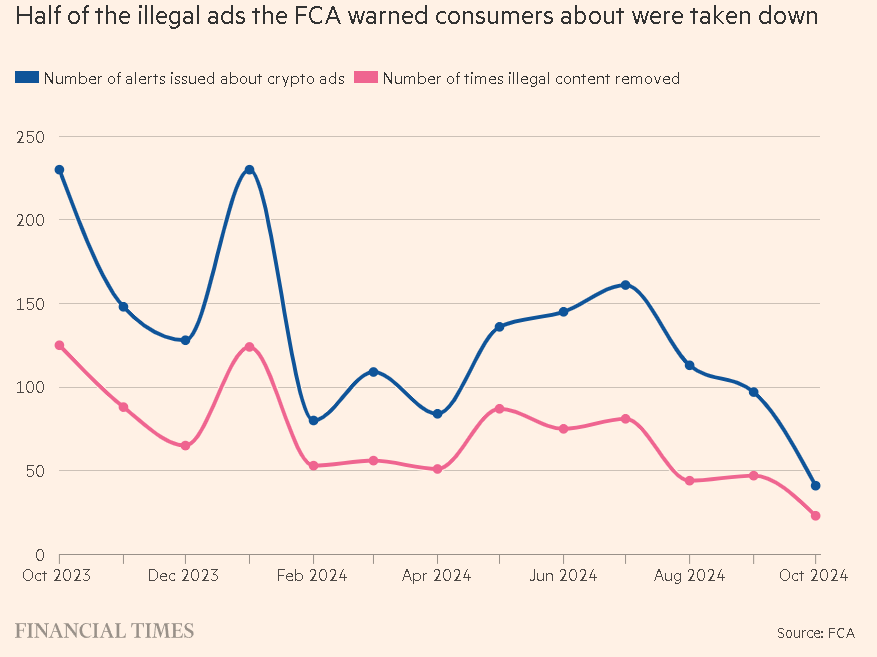

Половина незаконной рекламы, о которой FCA предупредила потребителей, была удалена. Источник: FCA

В отчете говорится, что, несмотря на возможность FCA штрафовать или возбуждать уголовные дела против нарушителей, вместо этого оно сосредоточилось на финансовых инфлюенсерах, которые продвигали свои схемы в Интернете.

Google будет требовать регистрацию в FCA для рекламы в Британии

В соответствии с нормативными актами FCA о рекламе криптовалют, Google Ads обновил свои правила. Теперь они требуют одобрения FCA для криптопроектов, ориентированных на британских пользователей.

Начиная с 15 января рекламодатели, предлагающие продукты и услуги обмена криптовалютами, могут продвигать свои объявления только при наличии регистрации FCA. Платформа поисковой рекламы заявила, что разрешит рекламу аппаратных кошельков, хранящих закрытые ключи для криптовалют, невзаимозаменяемых токенов (NFT) или других цифровых активов, если они не предоставляют услуги по покупке, продаже или торговле.

Google не опубликовала никаких других требований к аппаратным кошелькам. Однако компания напомнила своим рекламодателям, что ожидает от них соблюдения местных законов в любой области, на которую они хотят нацелиться с помощью рекламной платформы Google.

FCA предупреждает граждан избегать мемкоинов

Одним из проектов, к которым FCA призвало относиться с осторожностью, является мемкоин Retardio на блокчейне Solana (SOL). 16 декабря FCA предупредило граждан Британии избегать этого мемкоина.

Финансовый надзорный орган заявил, что проект токенов может продвигать финансовые услуги в Британии без разрешения FCA. Регулятор рекомендовал потребителям иметь дело только с компаниями, одобренными FCA, чтобы обеспечить себе защиту в случае неудач.

FCA заявило, что пользователи, которые имеют дело с несанкционированными проектами, такими как Retardio, не будут иметь доступа к Службе финансового омбудсмена страны, которая урегулирует финансовые жалобы, или к Схеме компенсаций в сфере финансовых услуг, которая защищает потребителей, когда компании выходят из бизнеса.


Leituras Relacionadas

A Threefold Performance Leap! NEAR Achieves 200ms Physical Block Time Limit with SPICE

NEAR's core development team, Near One, has announced its next major protocol evolution: SPICE (Separation of Consensus and Execution). Currently in development, SPICE represents the most significant upgrade before the full implementation of Nightshade 3.0. Its core innovation is decoupling the consensus layer, responsible for ordering transactions, from the execution layer, which processes them. This allows the consensus layer to run at full speed without waiting for transaction execution to complete. Once deployed, SPICE is projected to triple NEAR's block production speed, achieving a 200ms block time, which is considered the physical limit due to the speed of light and network latency. This leap will dramatically reduce transaction latency and finality, with transactions confirming in roughly 0.4 seconds—faster than a typical card payment. The upgrade also enables more complex, long-running transactions and significantly improves user experience for applications like NEAR Intents and near.com. Beyond raw speed, SPICE enhances network scalability and security. It enables deeper parallelism, efficiently distributing workload across shards and improving resource utilization. The simpler block structure and lighter contracts also facilitate formal verification and security auditing. Furthermore, SPICE lays the critical groundwork for future Nightshade 3.0 features, most notably atomic cross-shard transactions, which would simplify complex contract logic and eliminate development hurdles caused by asynchronous execution. The Near One team is actively developing SPICE, targeting deployment in the coming months.

Foresight NewsHá 56m

A Threefold Performance Leap! NEAR Achieves 200ms Physical Block Time Limit with SPICE

Foresight NewsHá 56m

Deep Insight: Decentralized Inference is Not Hype, but a Key Track for AI to Break Through Centralized Monopoly

Decentralized Reasoning: Beyond the Hype, a Key to Breaking AI's Centralized Monopoly A future scenario where a powerful AI model is banned by a major government illustrates the core value proposition of decentralized AI: resistance to censorship. The core bet of decentralized inference networks is mitigating this risk, with other benefits like cost being secondary. The path is extremely difficult, involving four key challenges: 1. **Running Massive Models:** Distributing a single model across a decentralized GPU swarm requires sophisticated techniques like pipeline and speculative decoding to overcome crippling network latency, aiming for usable speeds (e.g., 30-40 tokens/second). 2. **Proving Model Integrity:** Verifying that a node runs the correct model is critical. Solutions range from cryptographically secure but slow ZKML to faster, economically-secure methods like statistical fingerprints, deterministic re-execution, or live-weight proofs, each involving trade-offs between integrity, latency, and cost. 3. **Ensuring Prompt Privacy:** Simply sharding a model does not protect user inputs from nodes. Robust solutions currently require trusted hardware (TEEs) or advanced cryptography (FHE), which are not yet widely deployed in consumer swarms. 4. **Building a Real Market:** Identifying the ideal customer is tough. Beyond speculative AI agents, the viable market currently consists of startups embedding AI and projects needing batch processing (e.g., synthetic data generation), where decentralized aggregation can be an advantage over low-latency needs. The article analyzes several projects tackling these problems, such as Dolphin Network (live-weight proofs), Inference.net (statistical verification), Morpheus (TEE-based), and Darkbloom (Apple Secure Enclave). It provides a framework: decentralization is a "tax" for latency-sensitive applications (e.g., chat) but a potential supply-side advantage for throughput-oriented tasks (e.g., batch processing). The long-term vision is a closed data loop where decentralized inference generates valuable data (traces, preferences) to feed decentralized training networks, which in turn produce better open-weight models for the inference networks. A due diligence checklist advises focusing on projects that: are truly decentralized at specific layers; have a credible integrity method; offer real cost benefits; ensure genuine privacy; handle node reliability; have paying users; and are built by teams with deep AI expertise. The ultimate goal should be products that appeal beyond the crypto-native audience, using crypto mechanisms invisibly to deliver better cost, performance, or privacy.

Foresight NewsHá 1h

Deep Insight: Decentralized Inference is Not Hype, but a Key Track for AI to Break Through Centralized Monopoly

Foresight NewsHá 1h

Trading

Spot
Futuros
活动图片