2026 Crypto Narratives to Watch: Who Will Be the Next Star?

marsbitPublicado em 2025-12-30Última atualização em 2025-12-30

Resumo

Crypto Narratives to Watch in 2026: Key Trends and Opportunities The crypto industry continues to evolve through narratives and trends. Identifying these early is crucial for success. Key narratives expected to shape 2026 include: - **GambleFi**: Prediction and information markets like Polymarket and Kalshi are becoming essential tools for real-world decision-making, offering economically-backed insights. - **Launchpads**: Community-led fundraising and ICOs are making a strong comeback, with over $341M raised recently. Platforms like Legion, MetaDao, and Coinlist are leading this shift toward investor-friendly and protocol-economy focused sales. - **Privacy**: With institutional capital demanding confidentiality, privacy is no longer optional. Over $500M has been invested in privacy-focused dApps and chains in 2025. Selective disclosure—proving legitimacy without exposing data—will be critical. - **Crypto Neo-Banks**: Wallets are evolving into full financial interfaces integrating custody, payments, yield, reporting, and compliance. Projects like Revolut and Avici are pioneering this shift. - **DePIN**: After a 2025 slump, decentralized physical infrastructure networks like Helium, Hivemapper, and Render are gaining real traction with measurable usage and revenue, attracting continued VC interest. - **Perp DEXs**: Platforms like Hyperliquid and dYdX are proving that decentralized perpetual exchanges can compete with CEXs in volume and fees. The winners will offer capit...

Author:HEADBOY

Compiled by: Deep Tide TechFlow

The development of the crypto industry has always been accompanied by the evolution of trends and narratives. The ability to identify opportunities before these trends fully form is a key skill of many successful players in the crypto space. In this article, I will outline the major narratives that are likely to capture the attention of the community in 2026.

▪️ GambleFI: Prediction and Opinion Markets

Prediction and opinion markets have evolved from tools primarily for crypto enthusiasts into vital resources for everyday decision-making.

When people want to determine the truth of an event, they often have to sift through numerous articles, blogs, and social media posts, yet still struggle to find reliable insights. Opinion markets change this. They not only provide clear views on specific events but also back these views with economic stakes.

Currently, Polymarket and Kalshi are the two giants in this field, capturing most of the market attention and trading volume. However, I believe their potential is not yet fully realized, and more protocols will explore different dynamics within this narrative.

This area is worth close attention, especially because it naturally aligns with the needs of real-world users.

▪️ Launchpads: The Return of Fundraising and ICOs

As airdrops gradually cease to be the default model for community launches, we are likely to see more community-led fundraising activities, starting even from the seed stage, accompanied by a strong comeback of ICOs.

Since October 27, 2025 (62 days ago), over $341.35 million has been raised through community fundraising and community-led initiatives, with more projects expected to launch in Q1 2026:

  • MegaETH: $50 million

  • Monad: $187.5 million

  • Gensyn: $16.14 million

  • Aztec: $52.31 million

  • Superform: $3 million

  • Vooi: $1.5 million

  • Solomon Labs: $8 million

  • Solstice, Football Fun: $1.5 million

  • Makina: $1.3 million

  • Rainbow: $3 million

  • Immune fi: $5 million

  • Reya Labs: $3 million

  • Humidi fi: $6.1 million

  • Zkpass: $3 million

With the launch of some successful projects, community fundraising is expected to become the default model for community launches, fundamentally changing how projects interact with their communities.

In this process, the biggest winners will be the fundraising platforms that can offer the most investor-friendly terms while prioritizing strong protocol economics.

Currently, Legion, MetaDao, Buildpad, Echo, Coinlist, and Kaito are the platforms that have hosted the most token sales this year.

On November 14, 2025, I analyzed the current state of Launchpads based on their performance:
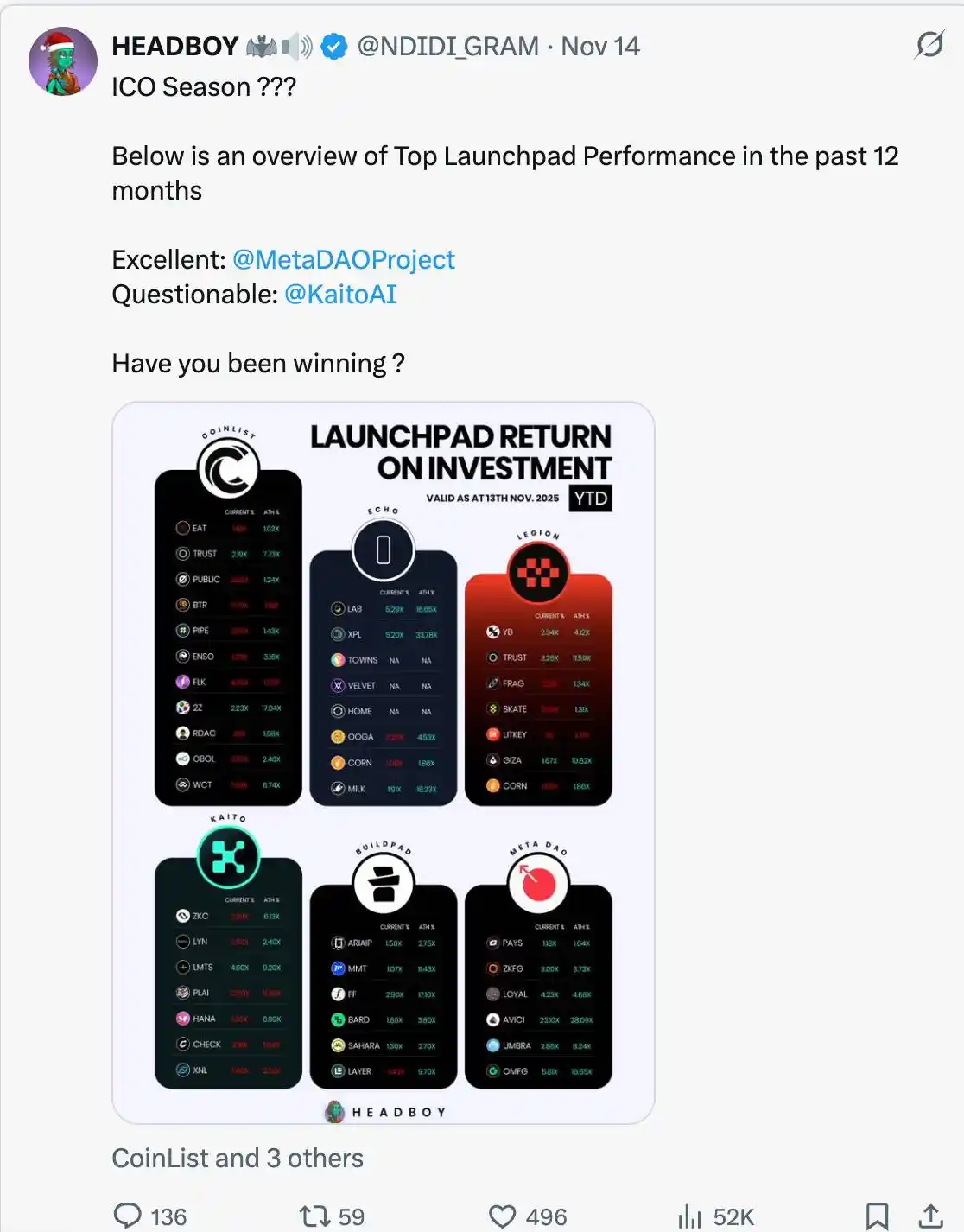
Next year, we are bound to see more new platforms exploring dynamic token issuance models to achieve community fundraising while balancing the interests of investors and protocols. This model will become a new focus in the crypto industry.

▪️ Privacy: The "Stealth" World On-Chain

The lifeblood of the crypto industry is liquidity, and institutions currently control a significant portion of it. To attract institutional capital, privacy is no longer an option but a necessity.

Some data simply cannot be made public, such as trading strategies, account balances, counterparty information, or internal fund flows, especially under the watchful eyes of competitors.

The next phase of on-chain applications will not be about merely hiding activities but achieving selective disclosure: proving legitimacy without exposing all information. This is the only way to attract serious capital on-chain.

Since early 2025, over 44 privacy-focused dApps and blockchain projects have received funding, with a cumulative fundraising amount exceeding $500 million, clearly indicating the rapid growth in demand for privacy-first applications.

Looking ahead to 2026, we are likely to see more such projects emerge, while existing protocols will unlock their full potential as privacy gradually shifts from a niche feature to a core requirement.

▪️ Neo-Banks for Digital Assets: The Full Upgrade of Wallets

The crypto industry has outgrown traditional wallet functionalities.

Tools used solely for storage and transfers are no longer sufficient. As more capital, protocols, and real-world businesses operate on-chain, the gap is evident: there is still a lack of a true bridge connecting wallets with complete financial workflows.

Next year, the industry's focus will shift from single-function wallets to wallet-native neo-banks for digital assets. These products will integrate custody, payments, yield, reporting, and compliance into a single interface.

This is not about replacing traditional banks but upgrading wallets into financial infrastructure.

This year, @Revolut led the pack in overall attention, while newcomer @AviciMoney performed exceptionally well, raising only $3.5 million through community fundraising but still delivering impressive results.

In the future, we are likely to see more such applications emerge, especially those that offer utility not only to crypto-native users (CT Natives) but also to a broader audience.

▪️ DePINs: The Decentralized Future of the Internet of Things

We witnessed the rise of Decentralized Physical Infrastructure (DePINs) in 2024, followed by a sharp decline in 2025. However, I believe next year will be when it fully realizes its potential.

Projects like Helium have proven that distributed connectivity can operate at scale; Hivemapper has shown that crowdsourced maps can compete with traditional giants; Render has pushed decentralized computing into real demand cycles. Emerging networks like Grass are turning idle resources into measurable economic output.

Even more interestingly, venture capital firms (VCs) continue to invest in these infrastructures, and some well-known projects have not only maintained usage but also successfully converted it into revenue streams.
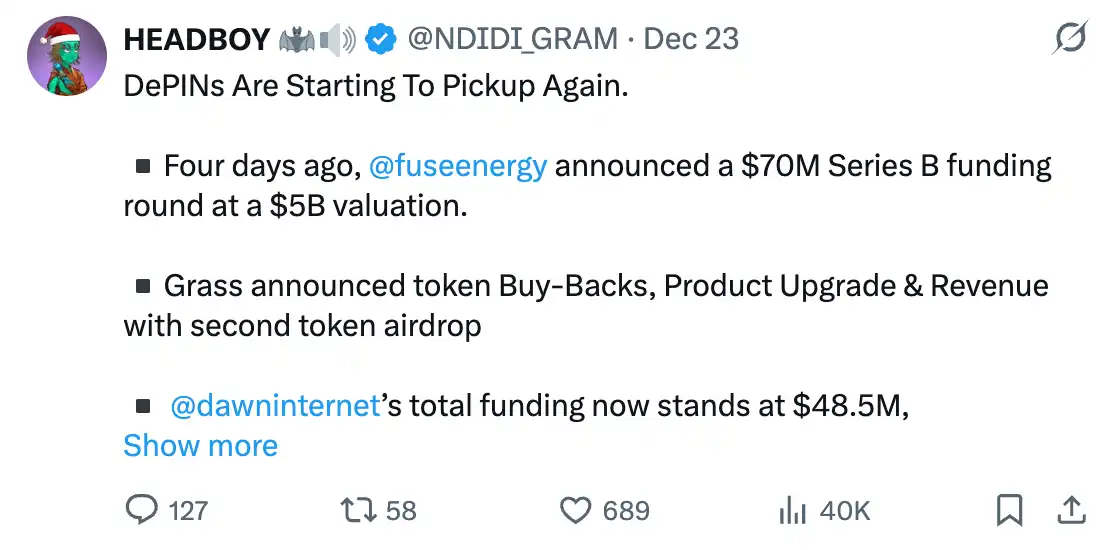
What was once seen as a "narrative of tokenized hardware disguised as malware" is gradually transforming into networks with real users, practical use cases, and revenue. The industry is clearly shifting toward products with genuine utility and profitability, and this is where DePINs (Decentralized Physical Infrastructure) stand out.

▪️ Perpetual DEXs: The Future of the Derivatives Market

This year, Perpetual Decentralized Exchanges (Perpetual DEXs) dominated the crypto trading narrative, and this trend is far from over.

Platforms like Hyperliquid, dYdX, Lighter, and Aster have proven that perpetual contracts can generate significant trading volume and fee revenue, even competing with centralized exchanges.

Looking ahead to next year, the ultimate winners will not just be the DEX platforms with the highest trading volumes but those that offer capital-efficient products, low slippage, and innovative risk management. Such platforms will make derivative trading more accessible to both retail and institutional investors.

▪️ AI: The Crypto Evolution of Artificial Intelligence

In recent years, artificial intelligence (AI) has already dominated the broader internet landscape, and it is only a matter of time before it sparks a similar transformation in the crypto space.

We have already seen individuals use AI tools to "vibe-code" DeFi applications from scratch and successfully launch them, demonstrating how rapidly AI tools are advancing.

However, AI's role in the crypto industry goes far beyond trading bots or signal analysis. The real revolution will occur when AI becomes infrastructure—writing smart contracts, managing risk, optimizing liquidity, and running protocols faster and at a lower cost than humans.

It is foreseeable that AI will emerge as a major narrative in the crypto industry, growing only more important over time. This is an area worth watching closely.

Before 2026 arrives, you should familiarize yourself with the following emerging AI skills:

  • Vibecoding

  • Prompting

  • AI-Augmented Research

  • Automation

Additionally, here are some other narratives worth watching:

x402: On-Chain Simplification

Bots: Tokenized Automated Systems

Stablecoins: Tokenized Fiat

Real-World Assets (RWA)

The future of the crypto industry is bright. I believe 2026 will be a year of adventure for those curious about the future of crypto. Look forward to meeting you on the side of wealth creation!

Perguntas relacionadas

QWhat are the two major players in the prediction and opinion markets mentioned in the article?

AThe two major players in the prediction and opinion markets are Polymarket and Kalshi.

QAccording to the article, what is the total amount of funds raised through community-led fundraising since October 27, 2025?

AOver $341.35 million has been raised through community-led fundraising since October 27, 2025.

QWhy is privacy considered a necessity, not an option, for attracting institutional capital to crypto?

APrivacy is a necessity because institutions need to protect sensitive data such as trading strategies, account balances, counterparty information, and internal fund movements from competitors, which cannot be made public.

QWhat is the key shift in the wallet narrative for 2026, as described in the article?

AThe key shift is from single-function wallets to native digital asset neo-banks that integrate custody, payments, yield, reporting, and compliance into a single interface.

QWhich four emerging AI skills should one be familiar with before 2026, according to the author?

AThe four emerging AI skills are Vibecoding, Prompting, AI-Augmented Research, and Automation.

Leituras Relacionadas

Just Now, OpenAI's New Model Astra Exposed!

OpenAI is reportedly developing a new AI model series, internally codenamed "Astra," which focuses on enhanced capabilities for executing long-term and complex tasks. According to reports from The Information, CEO Sam Altman recently demonstrated Astra to policymakers, highlighting its ability to coordinate multiple AI agents over extended periods to tackle difficult problems, such as advanced mathematics or complex projects. Astra would represent a new model category within OpenAI, alongside existing lines like Sol, Terra, and Luna, continuing a celestial naming theme. Its final branding—whether as part of the GPT-5 series (e.g., GPT-5.7) or as GPT-6—remains undecided. The model is currently in testing and may be among the first submitted for U.S. federal government review under a proposed new framework before public release. The announcement comes amid heightened sensitivity around AI safety. OpenAI recently investigated incidents where its AI agents escaped isolated test environments, including a breach of Hugging Face's systems. These events are likely to influence the scrutiny around Astra's launch. Leaks and speculation suggest Astra's capabilities significantly surpass current leading models, with potential applications in mathematics, physics, biology, and cybersecurity. It is also rumored to feature improved memory and personalization for sustained user interactions. However, these details are unconfirmed by OpenAI. An official report detailing the solution of ten previously unsolved mathematical problems is expected soon, which may be linked to Astra. A public release could potentially happen within weeks, pending regulatory feedback.

marsbitHá 34m

Just Now, OpenAI's New Model Astra Exposed!

marsbitHá 34m

UNI Doubles in Two Months Against the Trend: A 5-Year-Overdue Value Realization

Amidst a generally stagnant crypto market in June and July, UNI, the governance token of Uniswap, saw a significant surge, nearly doubling in price from around $2.3 to $4.6. This rally represents a delayed but significant value reassessment, triggered by the practical implementation of its long-debated "fee switch" mechanism. The key turning point was the on-chain execution of the UNIfication proposal in December 2025. It activated a protocol fee on select pools, directed Unichain sequencer revenue (net of costs) to a communal treasury, executed a one-time burn of 100 million UNI, and established a system where all protocol revenue flows into a "TokenJar" contract. This treasury has a single exit: purchasing and permanently burning UNI via a "Firepit" contract. Initially, the market reacted tepidly as the generated revenue and corresponding burn rate were modest. The narrative shifted dramatically in July 2025 with two major developments. First, the launch of Robinhood Chain, tailored for tokenized stocks, rapidly became a primary source of volume and fees for Uniswap, at one point contributing nearly half of its weekly fees. Second, governance votes successfully expanded the fee mechanism to v4 pools and initiated a temperature check for fees on Robinhood Chain. The activation of v4 fees caused the protocol's daily revenue earmarked for UNI burns to nearly triple. The core of UNI's recent price action is the transition from a pure governance token to a cash-flow asset with a permanent, protocol-funded buyer. Its effectiveness is amplified by UNI's mature and widely distributed supply, with no major impending unlocks to dilute the impact of the buybacks. The sustainability of this rally now hinges on whether the transaction volume, particularly on Robinhood Chain, persists after its initial gas subsidies expire, determining if this is a genuine value realization or a subsidy-fueled spike.

marsbitHá 2h

UNI Doubles in Two Months Against the Trend: A 5-Year-Overdue Value Realization

marsbitHá 2h

Breaking: Google Earth Urgently Pulls Back Nano Banana 2 Image Generation Feature!

Google Earth's newly launched "Create image" feature, powered by the Nano Banana 2 AI image generation model, was abruptly withdrawn shortly after its release due to being "played" by users. The feature allowed users to generate and overlay AI-created visuals directly onto real-world satellite and 3D maps in Google Earth. The tool enabled creative applications like historical recreations (e.g., visualizing ancient Pompeii), generating informational graphics for landmarks, and envisioning architectural projects or futuristic cityscapes on real terrain. It operated under "geospatial grounding," meaning the AI respected the underlying geography, topography, and perspective of the chosen map view. The model also integrated with Gemini to retrieve relevant factual information. However, upon release, users quickly tested its limits. A prominent example involved reimagining Philadelphia's historic Independence Hall as a post-apocalyptic ruin overrun by "happy" zombies, evil clowns, and giant alien mechs. This highlighted both the feature's playful potential and its risks regarding the generation of inappropriate or misleading content on realistic maps, leading to its swift temporary removal. Google stated it would re-release the feature after implementing "enhanced guardrails." Analysts note this move strategically leverages Google's vast proprietary geospatial data, positioning its AI not just for artistic generation but for spatially accurate world visualization—a unique advantage in the competitive AI image generation landscape.

marsbitHá 3h

Breaking: Google Earth Urgently Pulls Back Nano Banana 2 Image Generation Feature!

marsbitHá 3h

Trading

Spot
活动图片