2025 Crypto Industry Workplace Survey: 70% Earn Less Than $4,000 Monthly, N+1 Severance Becomes a Distant Hope

深潮Publicado em 2025-12-26Última atualização em 2025-12-26

Resumo

2025 Crypto Industry Workplace Survey: 70% Earn Under $4K Monthly, N+1 Compensation a Luxury Based on 506 survey responses, a report reveals the stark realities of the crypto industry, contrasting sharply with common perceptions of wealth. Over 70% of respondents earn a monthly salary below $4,000, with overall compensation lower than in developed regions. A quarter of workers are in a "pay-to-work" situation, reporting an overall net loss. Nearly half have experienced layoffs, and most did not receive standard severance packages like N+1. Despite the challenging conditions, over 80% plan to remain in the industry. Key attractions include remote work flexibility, with nearly 70% of companies offering remote options, and reasonable working hours, as 80% work 40-50 hours per week. The most desired employers are Binance, OKX, and Coinbase. The most cited high-earning professions are traders and KOLs. The primary pressures include product growth, market volatility, and job insecurity. For most, the target retirement fund is between $1 million to $5 million. Overall, the average job satisfaction rating was 3.51/5, reflecting a mix of frustration with compensation and appreciation for flexibility.

Author: Deep Tide TechFlow

While Xiaohongshu (Little Red Book) continues to glorify the "get-rich-quick myths" and "six-figure annual salaries" of Web3, what is the true state of the crypto industry?

Through 506 survey questionnaires, we engaged in a candid conversation with industry practitioners. The results were surprising, even somewhat brutal: This is not a land paved with gold. Over 70% of respondents earn less than $4,000 per month, a figure generally lower than in developed regions like Europe and the US. Even a quarter of respondents are in a state of "paying to work," experiencing overall losses. There is also a lack of proper safeguards; nearly half have experienced layoffs, and most did not receive N+1 severance compensation.

Yet, despite this, over 80% choose to stay. Is it because of the freedom of remote work enjoyed by 70%? Or is it because of the shared dream of "retiring with $5 million"?

In this report, we attempt to look beyond the cold data to reveal the most authentic anxieties, desires, and survival strategies of Web3 workers.

This content is the questionnaire results section of the "Web3 Recruitment & Job Hunting 2025 Year-End Review: Who's Making Money, Who's Paying to Work?" Full report available at:

https://www.techflowpost.com/article/detail_29702.html

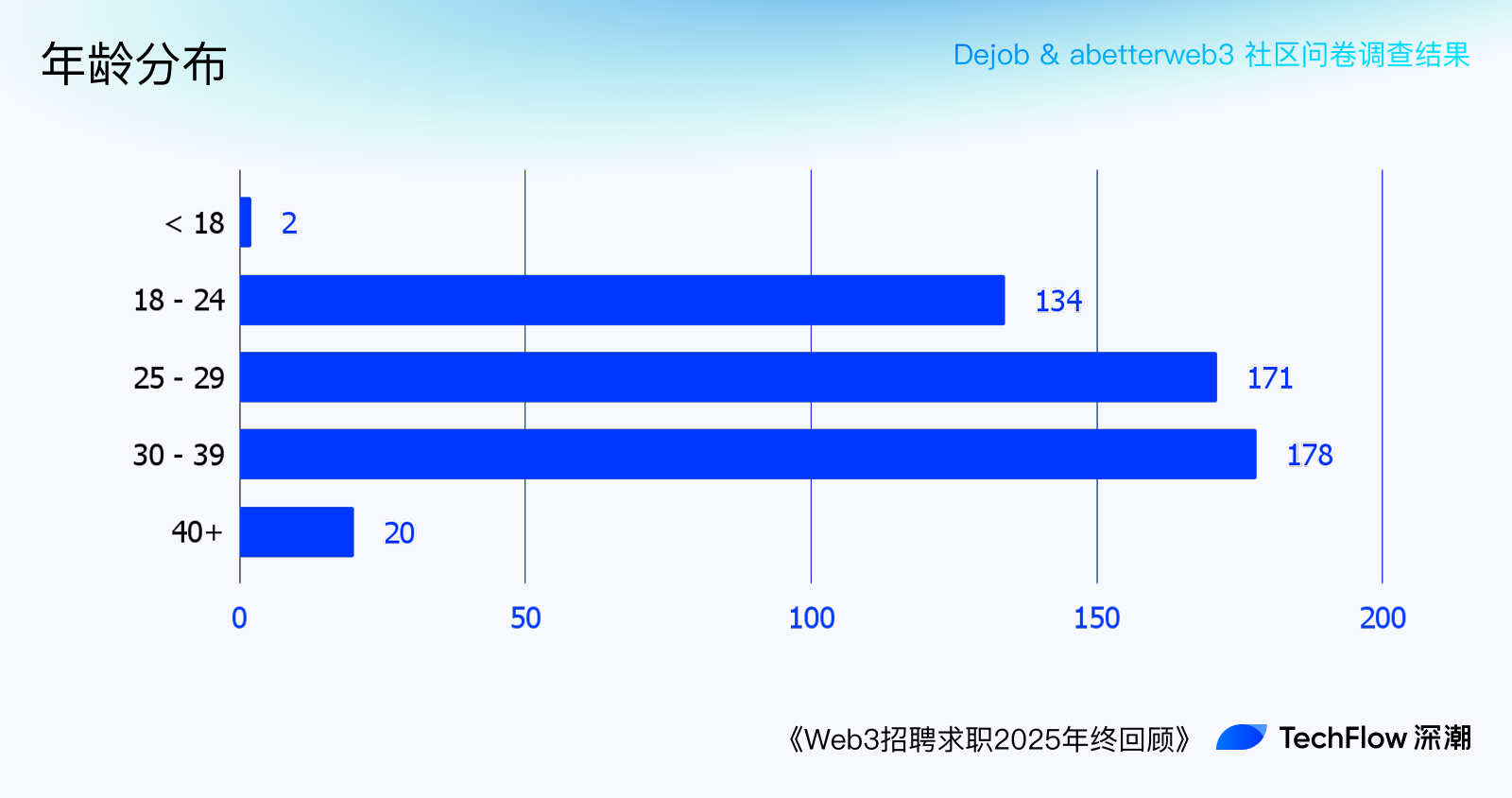
Regarding age distribution, the main workforce aged 18-29 is indeed the majority, but middle-aged practitioners (>30 years old) are also quite numerous. This might be related to the less severe "age 35 ceiling" in the Web3 industry. Compared to internet companies, Web3 companies value experience, capability, and efficiency more, with many hoping that seasoned professionals can quickly build products "ready to use."
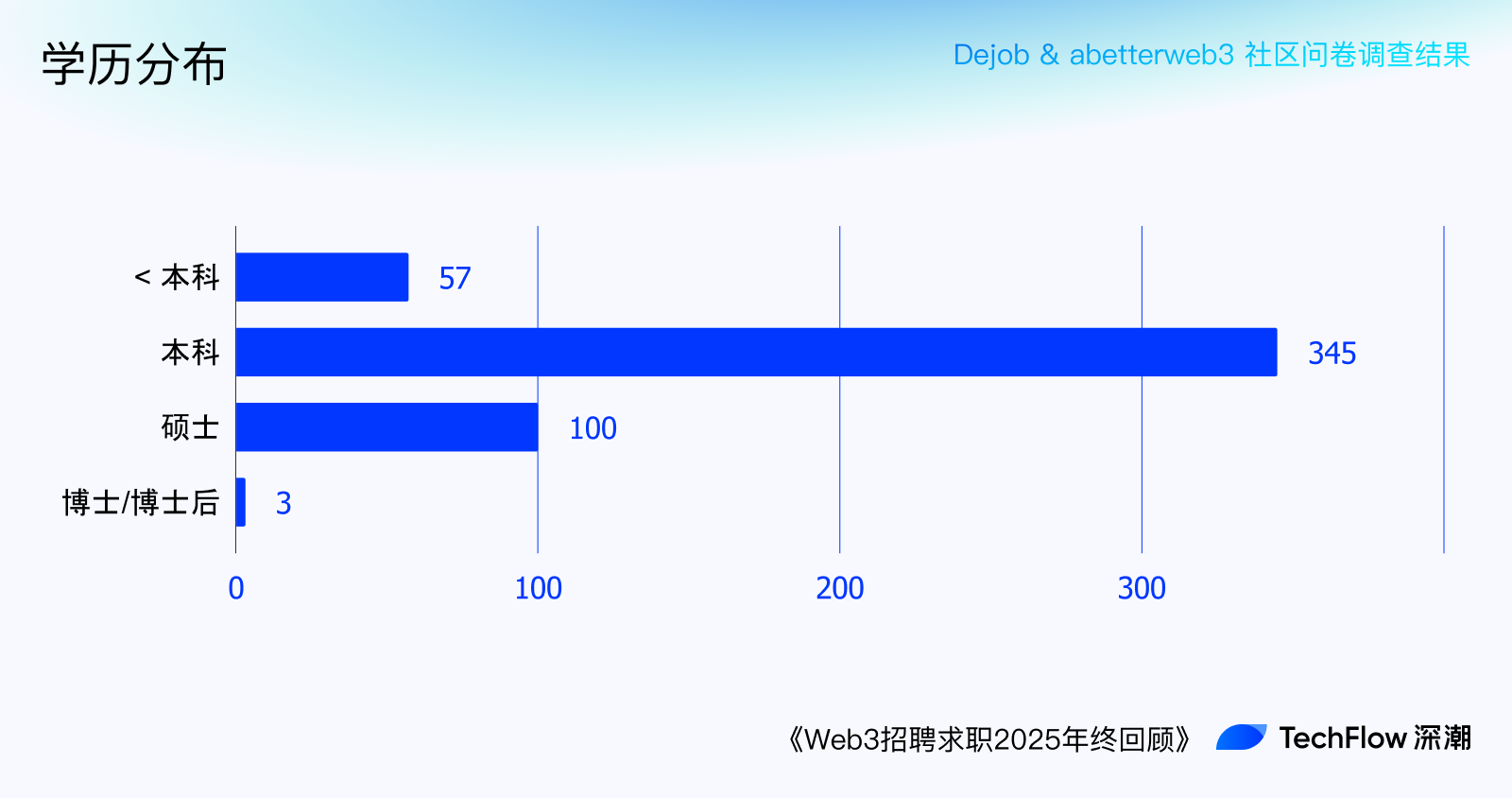
The distribution of educational backgrounds is largely consistent with the earlier talent data statistics, predominantly undergraduate degrees. There are individuals with less than a bachelor's degree as well as master's and PhD holders, though the proportion of postgraduates is not high.
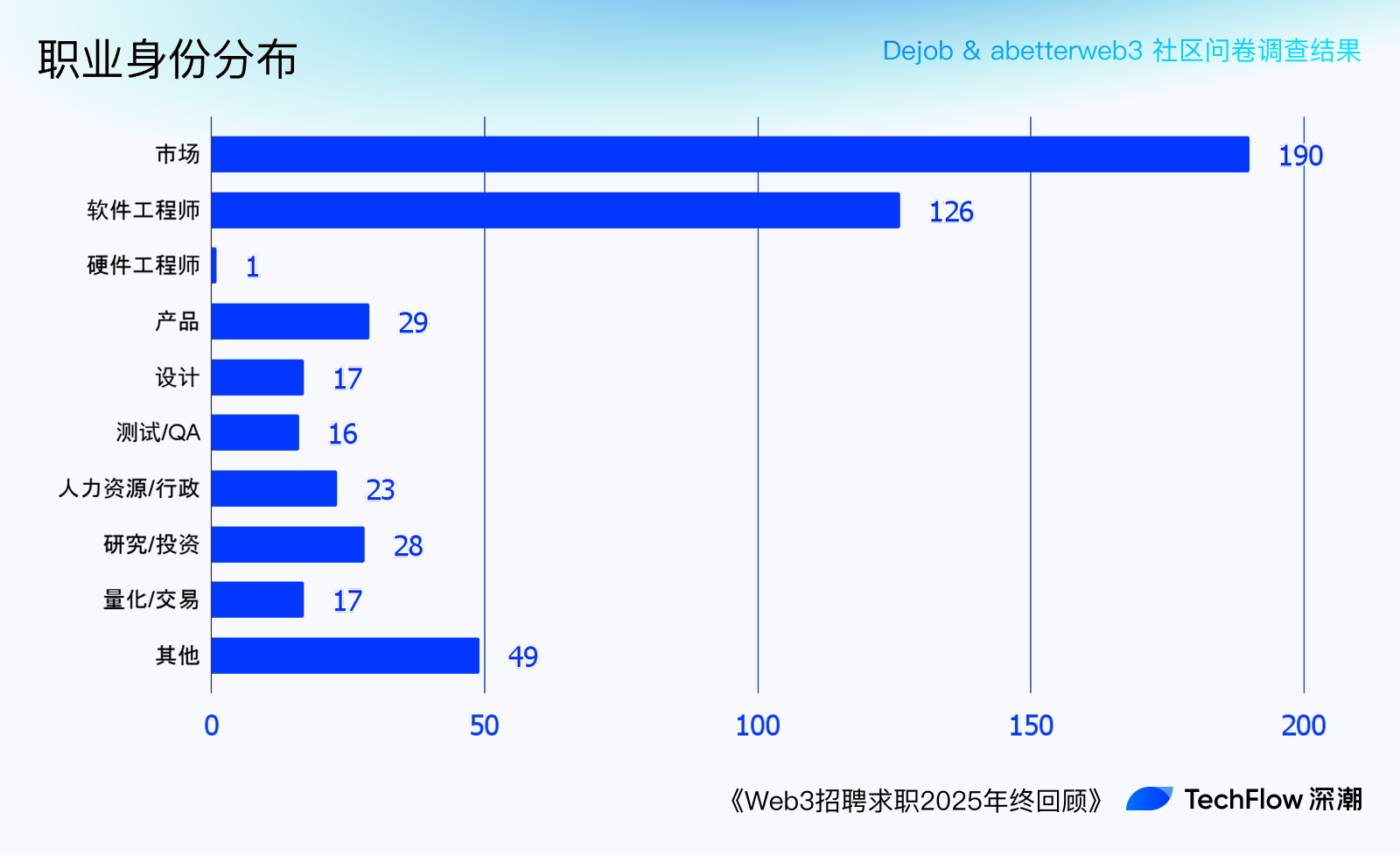
In terms of professional roles, the largest group is in market-related functions (Operations/BD/Customer Service, etc.), followed by developers (Frontend/Backend/Smart Contracts/Blockchain, etc.). These are followed by Product, Human Resources, Investment Research, Design, Trading, etc. Among the "Other" submissions, common entries were Risk Control & Security, KOLs, etc.
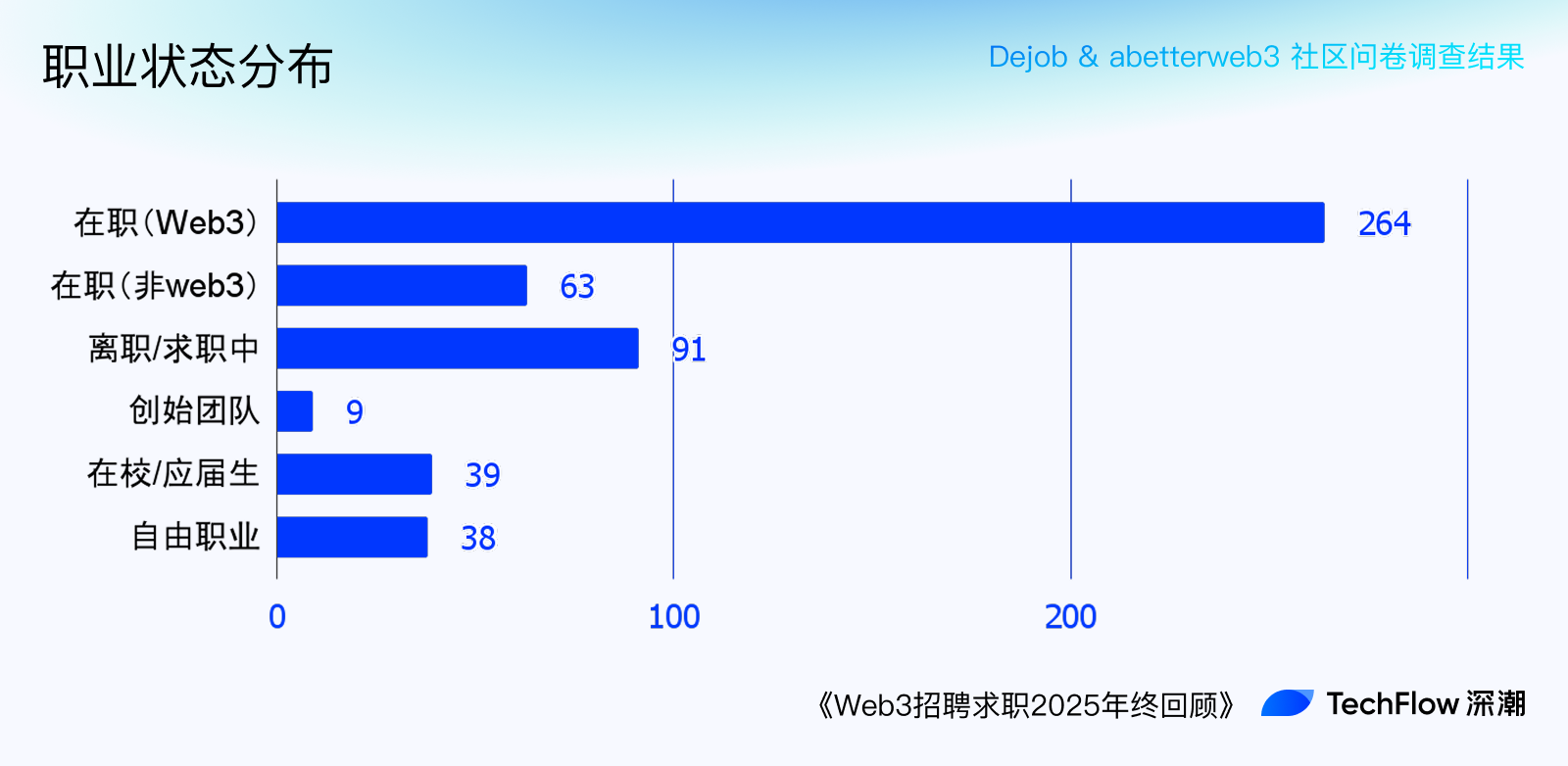
Regarding employment status, only 52% of respondents are employed in Web3. Over 30% are in a more flexible life situation. This indicates, on one hand, that market conditions affecting company headcount (HC) have impacted many; on the other hand, it might be because certain unique business models in Web3 (like being a KOL or trader) have made a regular job less necessary for generating cash flow for some individuals.
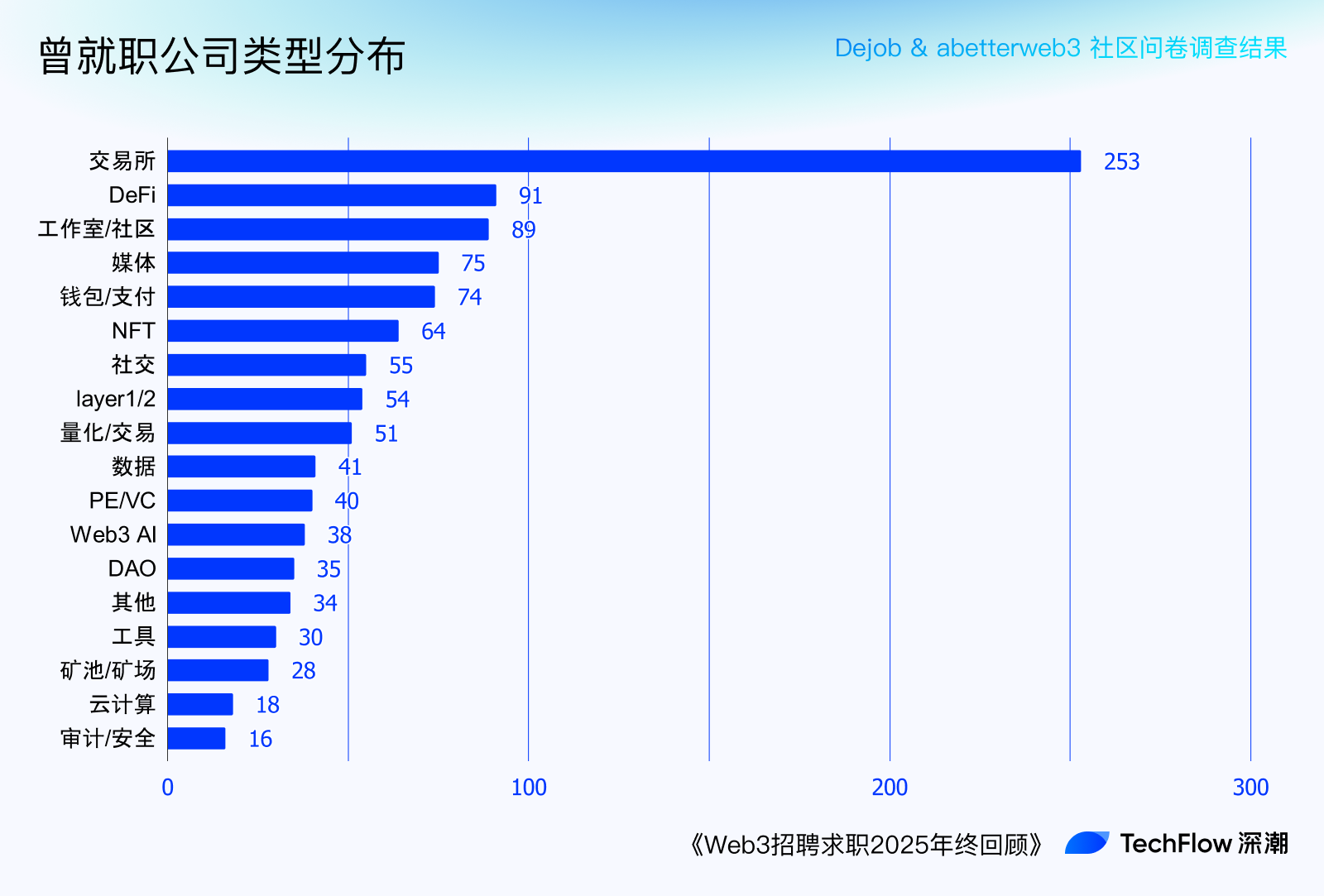
Over half of the submissions indicated having worked at an exchange, followed by studios/communities, DeFi, media, wallets, and other common business types. Both talent and job providers converge with absolute Matthew Effect intensity towards exchanges. This also reflects, to some extent, the current industry dilemma: apart from exchanges, the revenue-generating capabilities of most other business models generally decrease from C-end -> tools -> infrastructure.
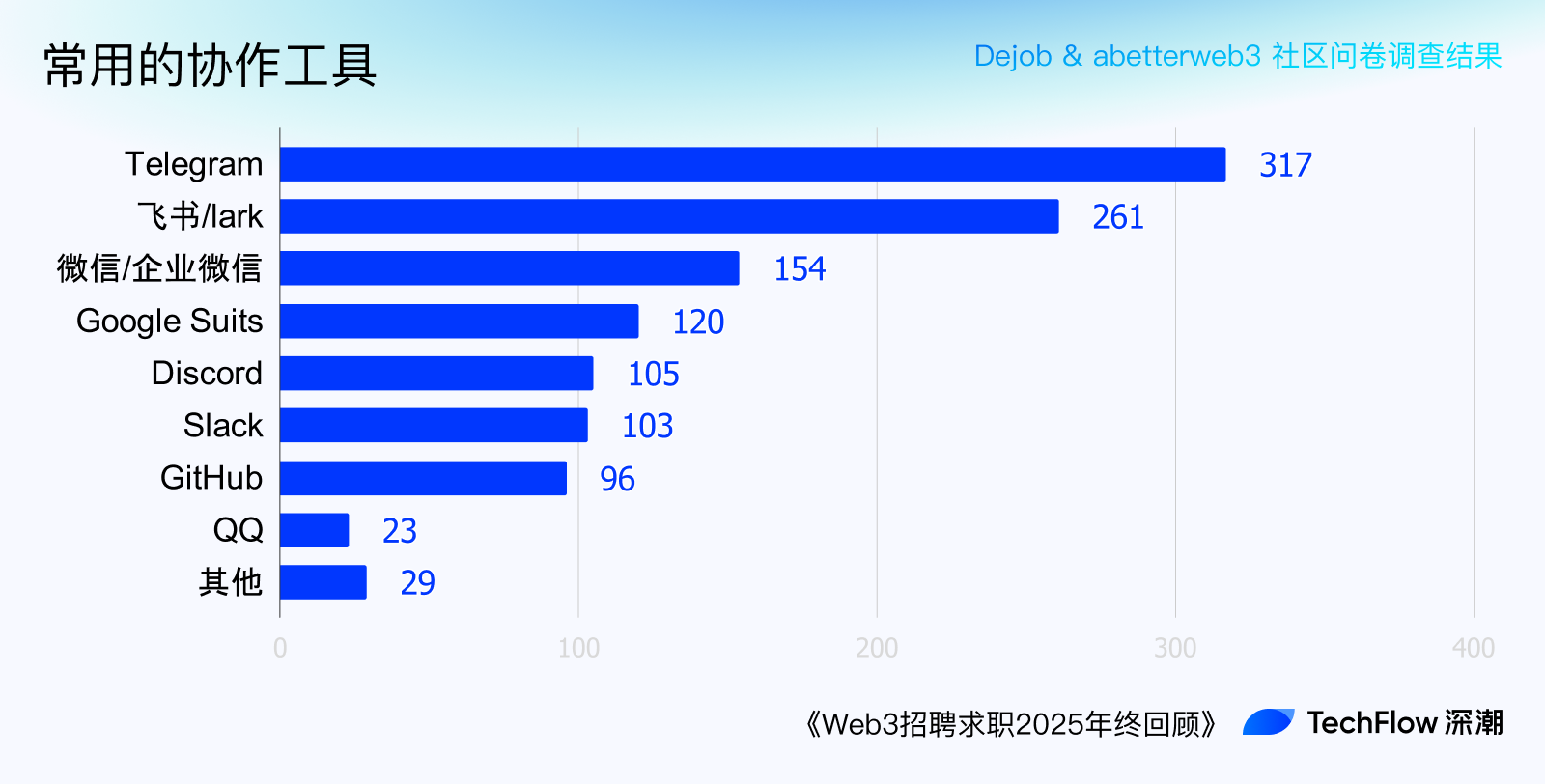
Regarding remote collaboration tools, as this survey took place within a Chinese-language vertical Web3 recruitment community, Telegram is favored by most companies for its confidentiality and usability, followed by mainstream domestic tools like Feishu and WeChat, and finally tools commonly used by foreign companies like Google Suites, Discord, Slack, etc.
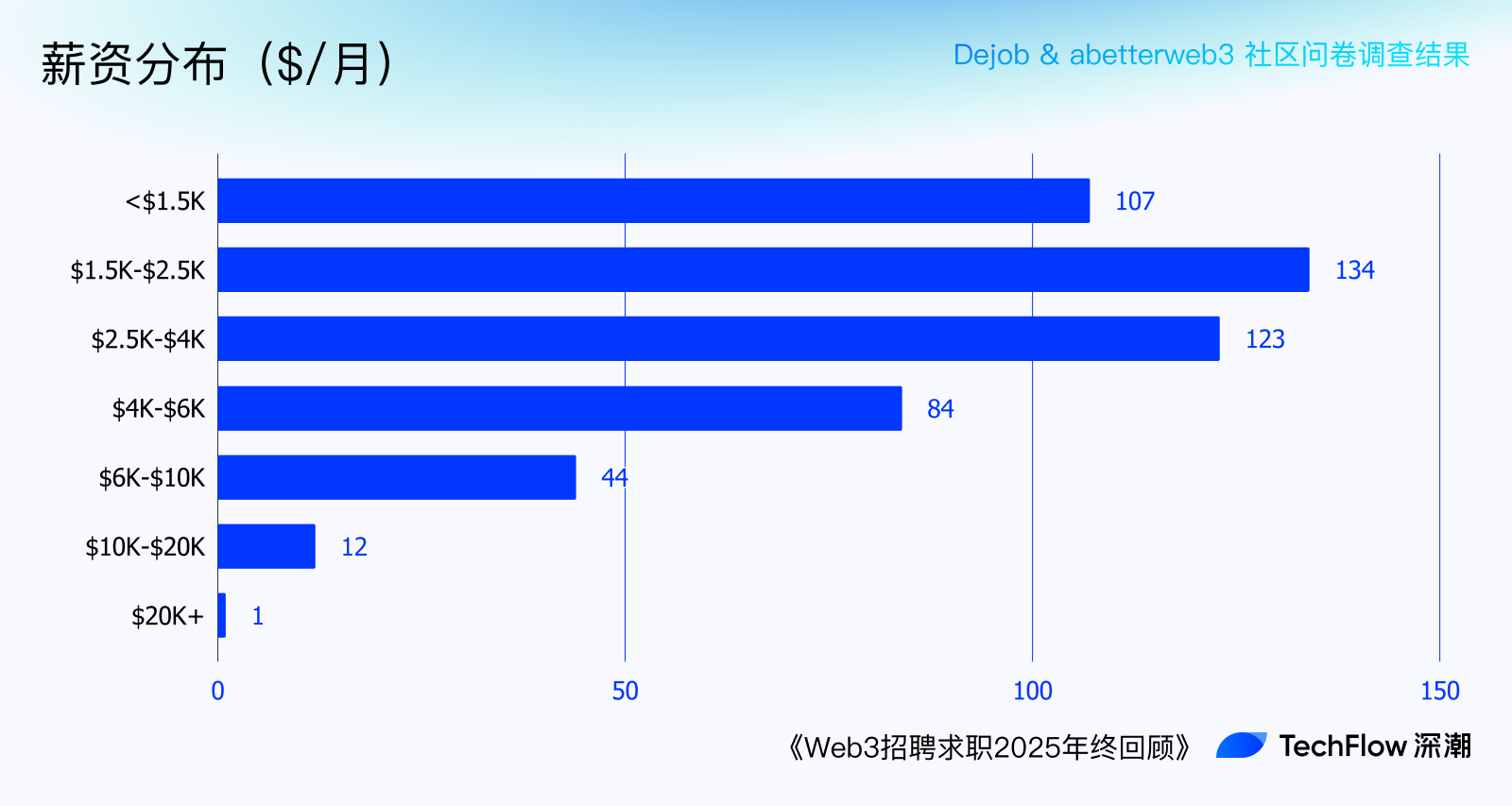
In terms of income levels, contrary to the external myths of immense wealth, most Web3 workers' incomes are not only lower than those in most top internet companies but also severely lacking in long-term incentives (tokens/equity), year-end bonuses, and layoff compensation.

Over 70% have a monthly salary of less than $4,000 (approx. RMB 28,000). The frequently mentioned monthly salary of $10,000 on Xiaohongshu is a rarity.
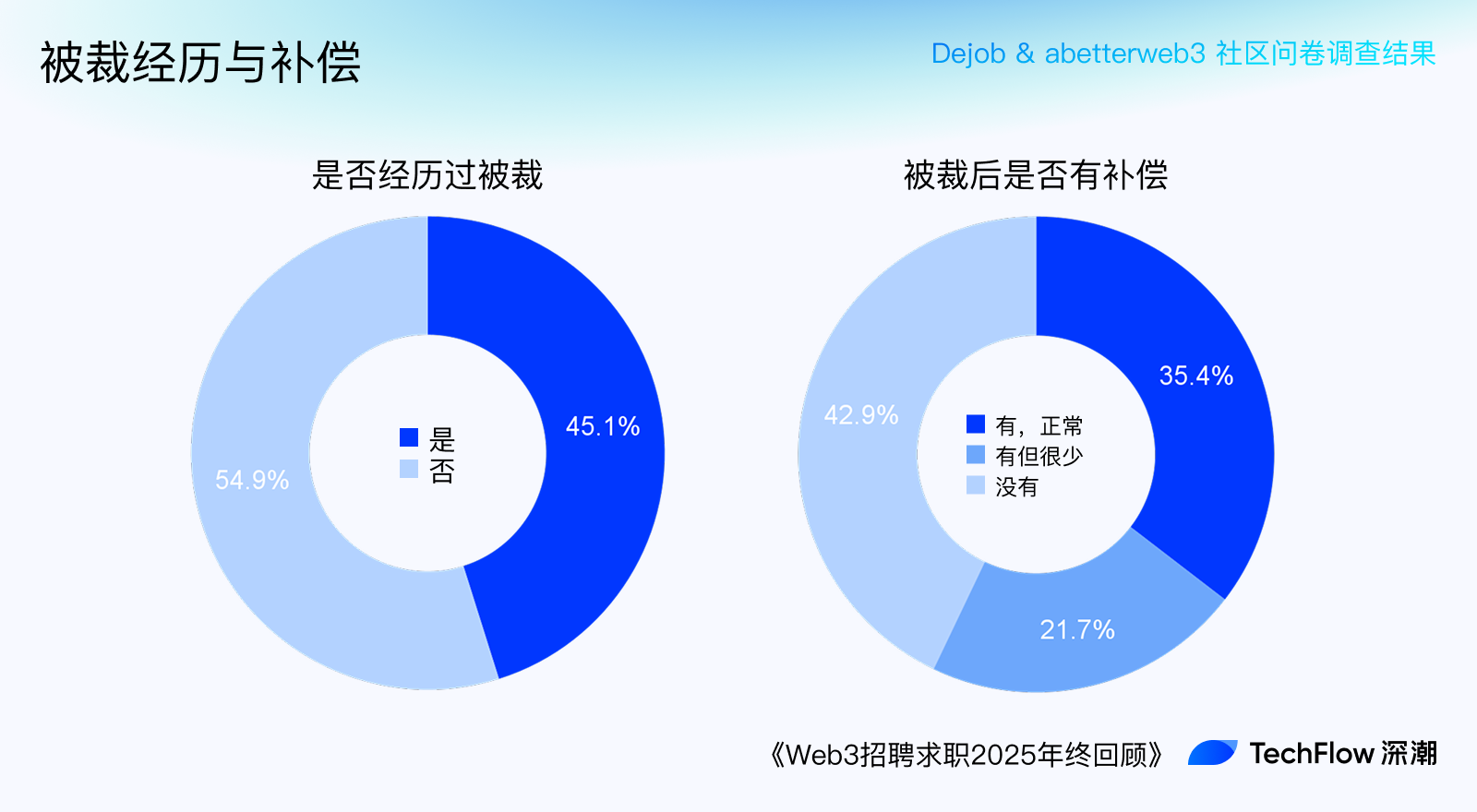
Close to half have experienced layoffs, and 40% of those laid off reported receiving no compensation. 21% said that even if they received compensation, it fell far short of the legal standard (e.g., N+1).
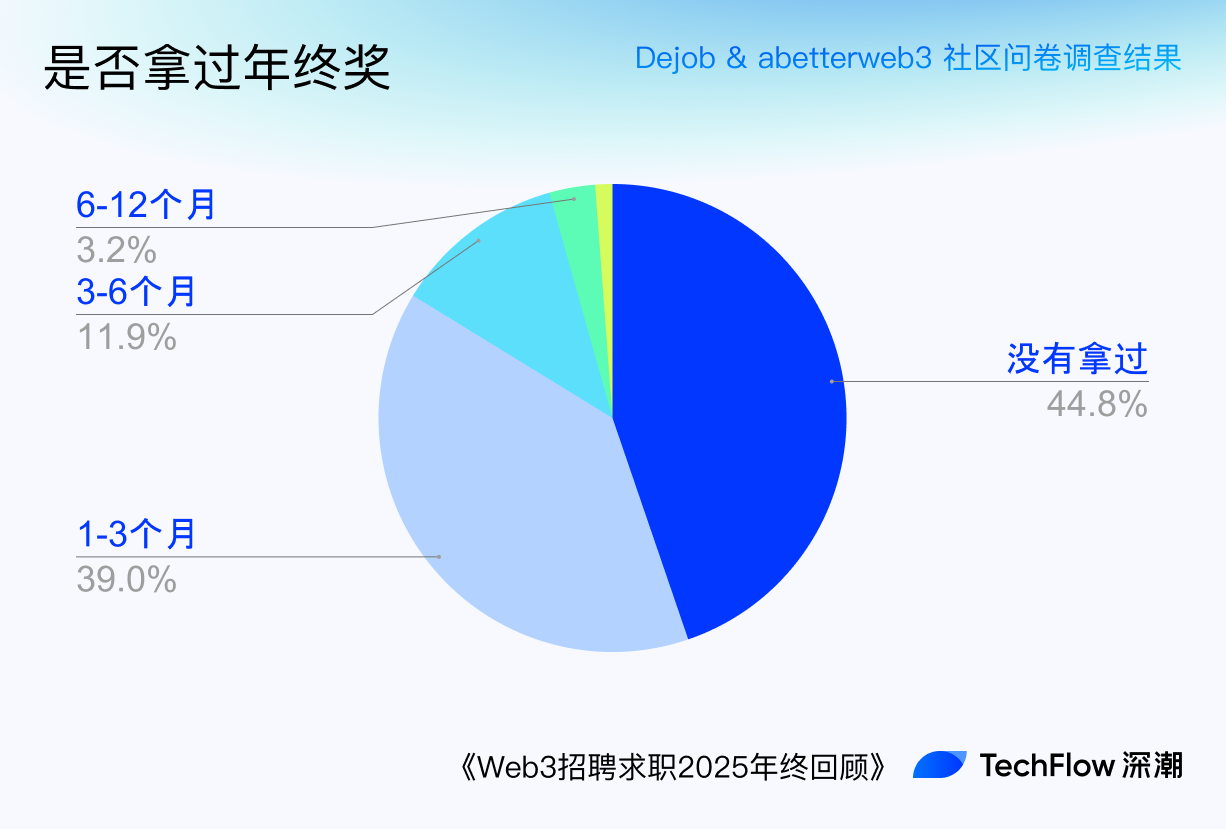
Nearly half reported not receiving a year-end bonus; even among those who did, it was generally 1-3 months' salary, basically on par with most internet companies outside the Web3 industry.
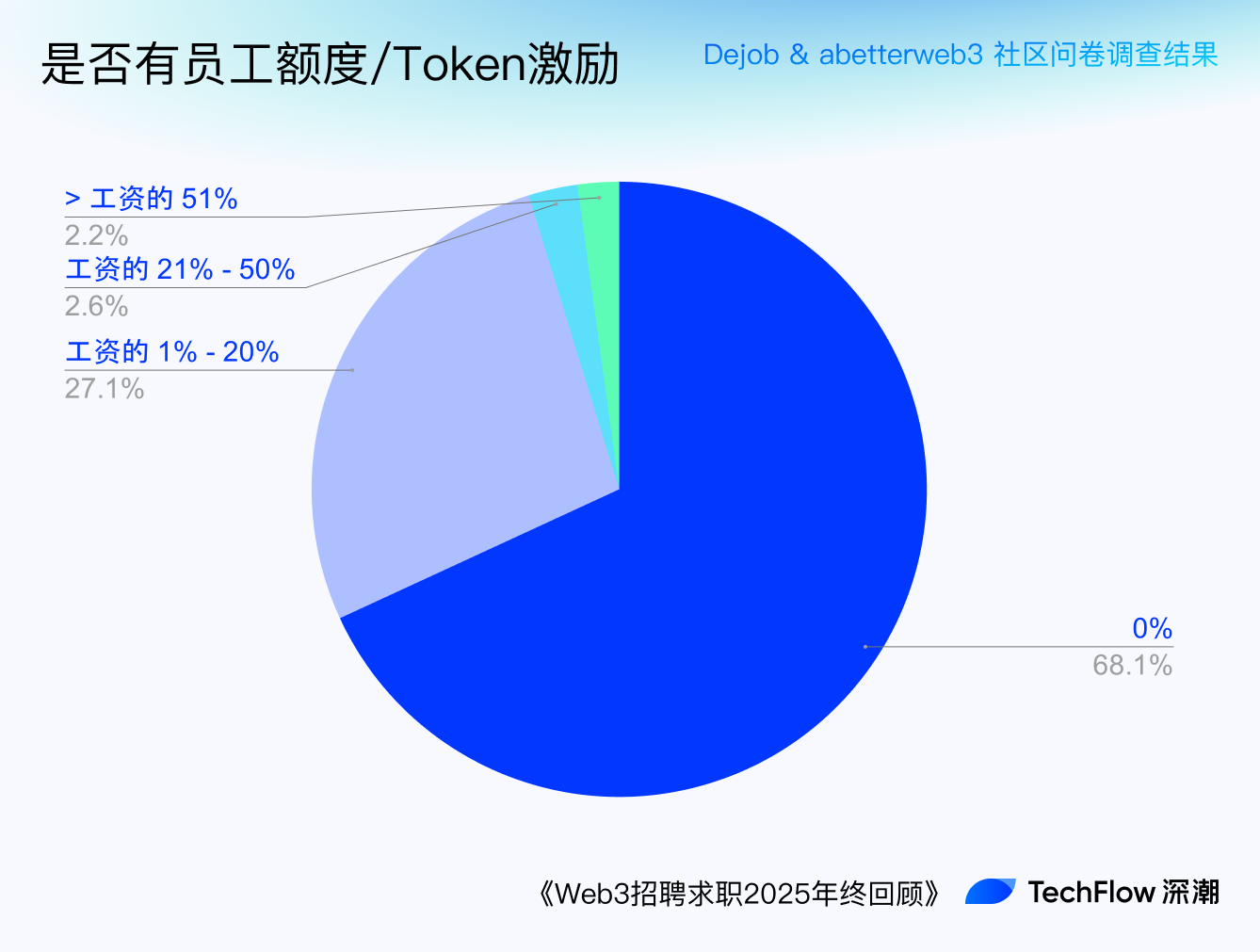
Regarding the well-known "upward channel" of token/equity incentives, nearly 70% of practitioners reported never having received any. Even among those who did, very few received incentives exceeding 20% of their salary.
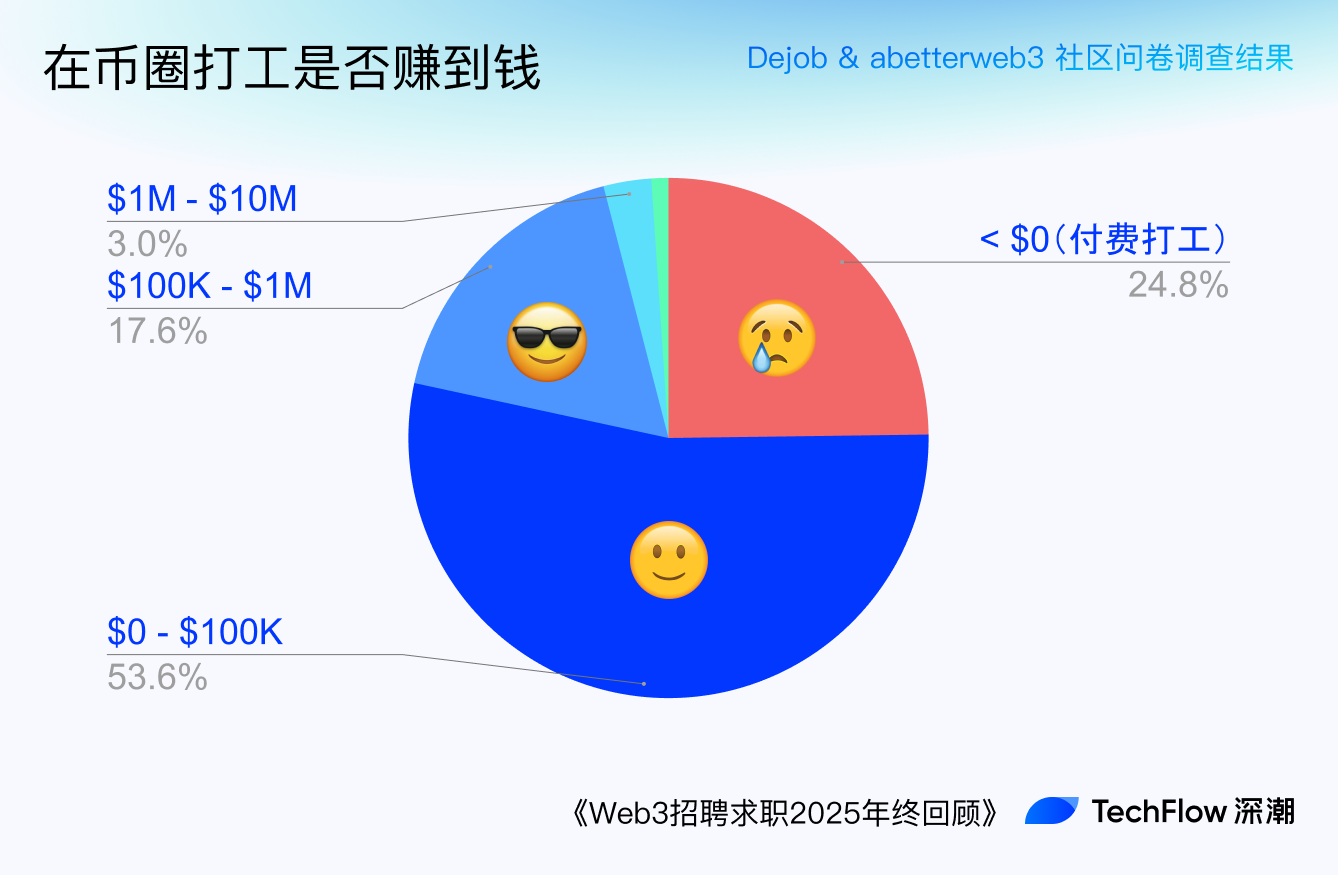
Remarkably, a quarter of respondents reported an overall net wealth loss since entering the crypto space, effectively "paying to work." Other respondents mostly accumulated wealth around $100K (approx. RMB 700,000).
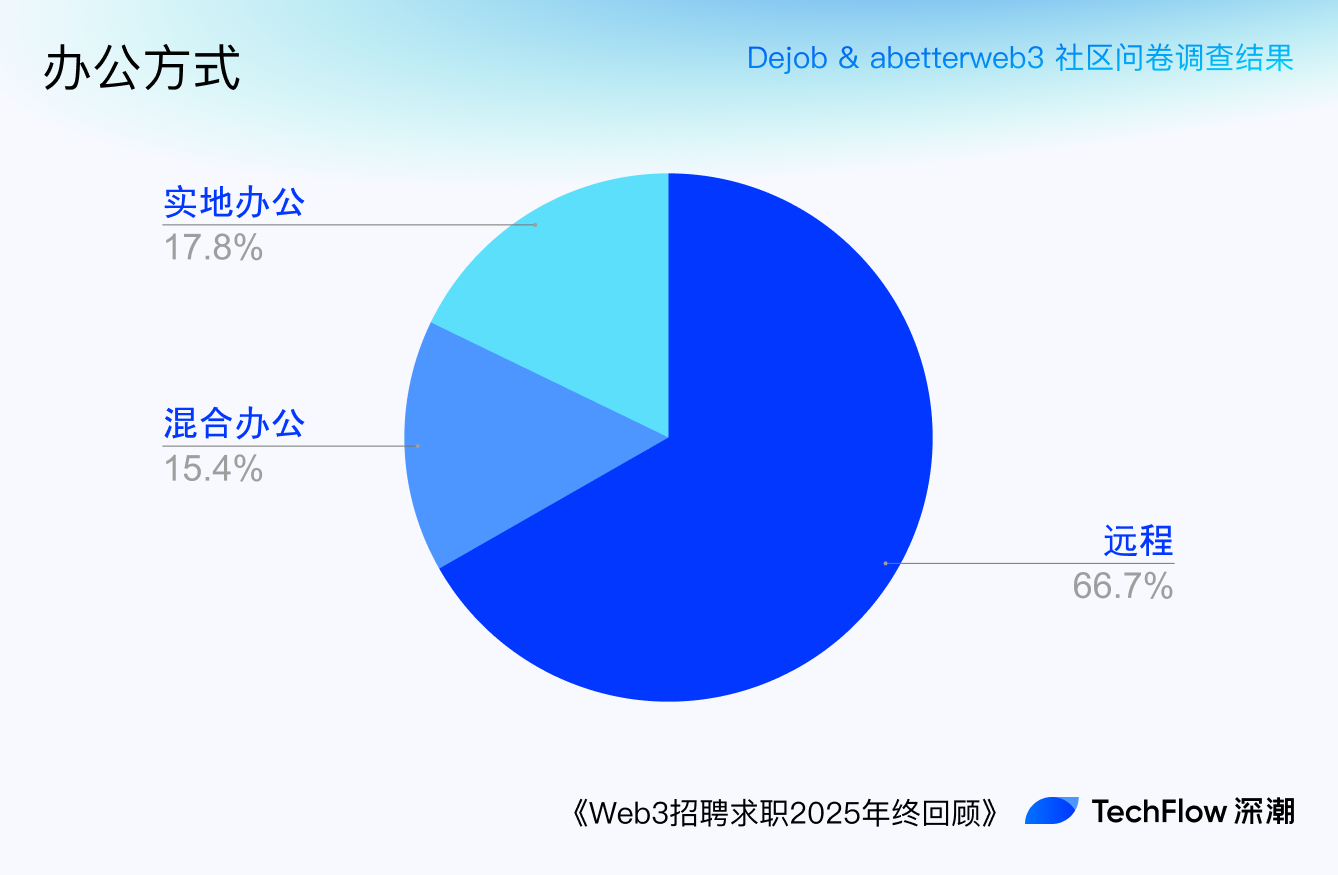
However, on the flip side of this seemingly hopeless income landscape, Web3's strong remote work culture offers a significant breath of fresh air for many workers. Nearly 70% of respondents indicated their company supports remote work, with another 15% supporting hybrid work (i.e.,虽然有办公室 but not mandatory attendance, or work-from-home allowed several days a week).
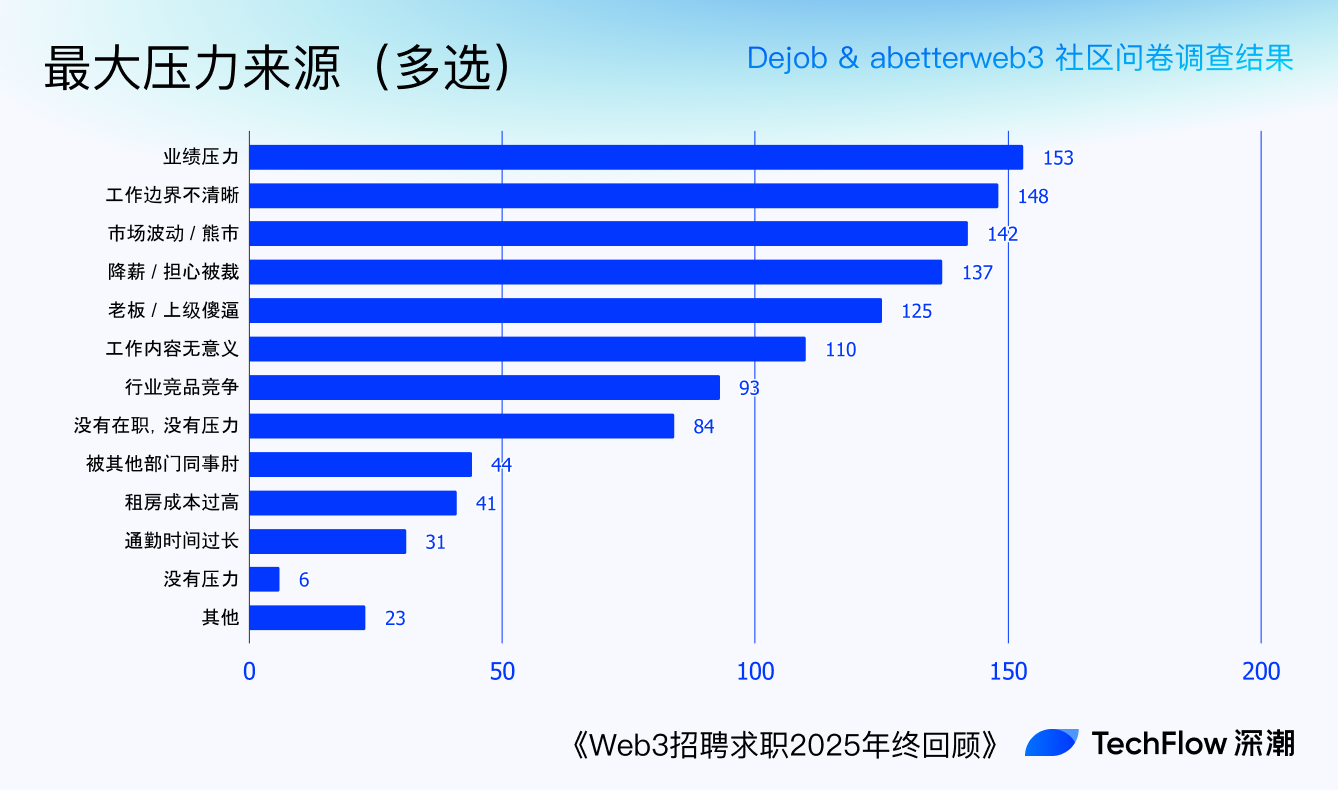
Remote work does alleviate some of the pain of being an employee. In the "biggest source of stress" question, 31 submissions chose "excessively long commute." Other top stress sources were product growth, work boundaries, market volatility, fear of being laid off, and having a foolish boss (老板傻逼).
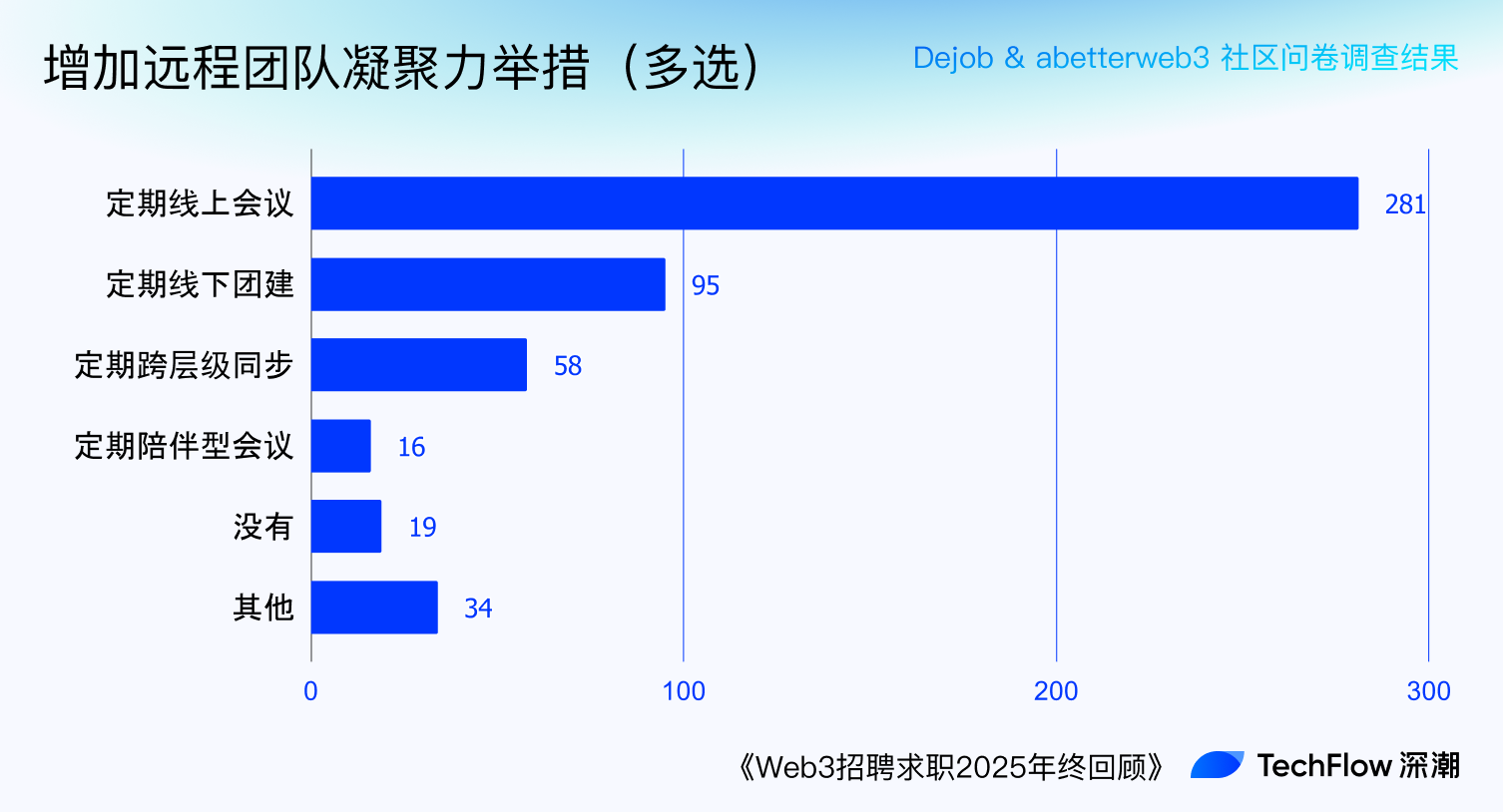
To maintain employees' mental health as social creatures, many companies have adopted measures to maintain team cohesion.
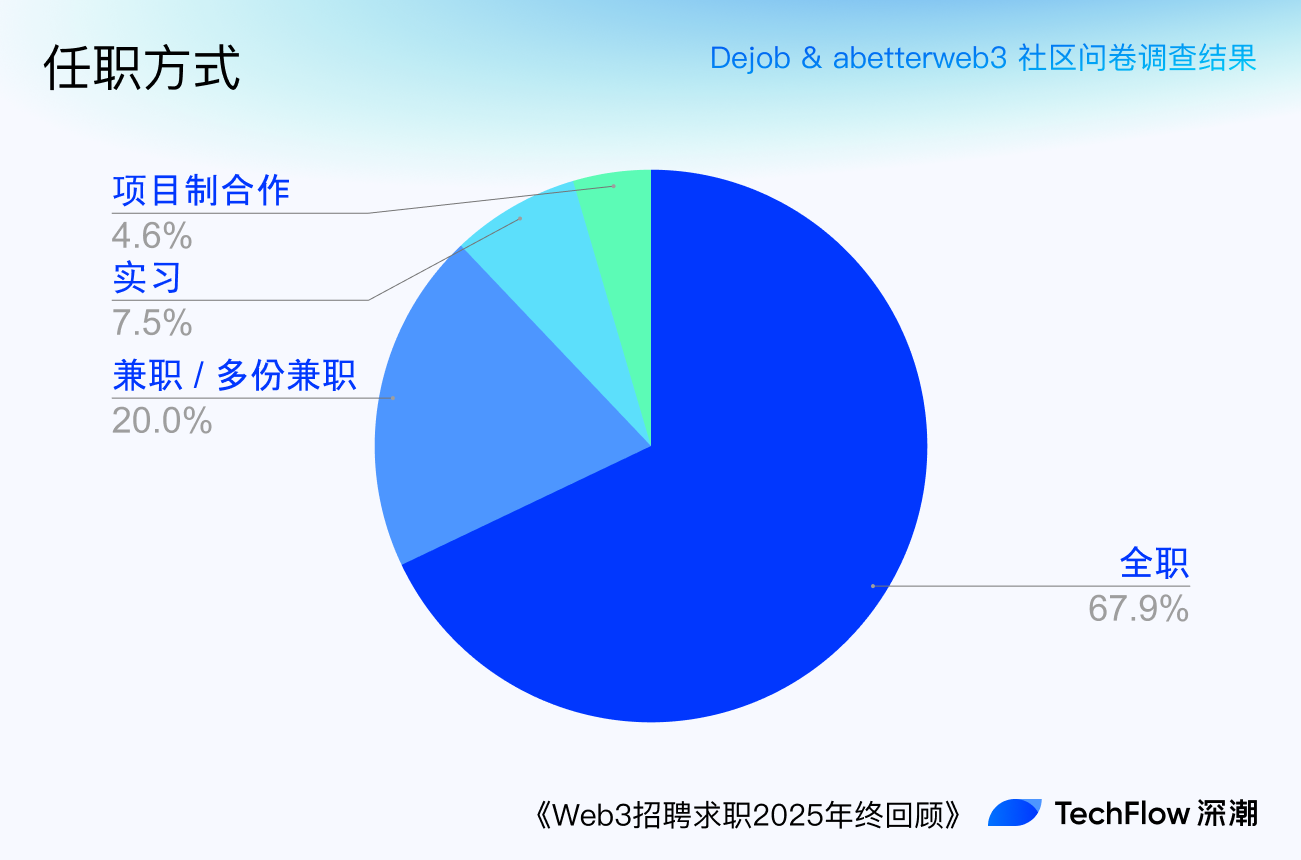
Under the combined effect of low income and instability, many choose to hold multiple jobs. 20% of respondents reported having side hustles. This also indirectly reflects the tech-oriented culture of most Web3 companies: as long as problems are solved and capabilities are sufficient, they generally do not interfere with employees' lifestyles or income sources.
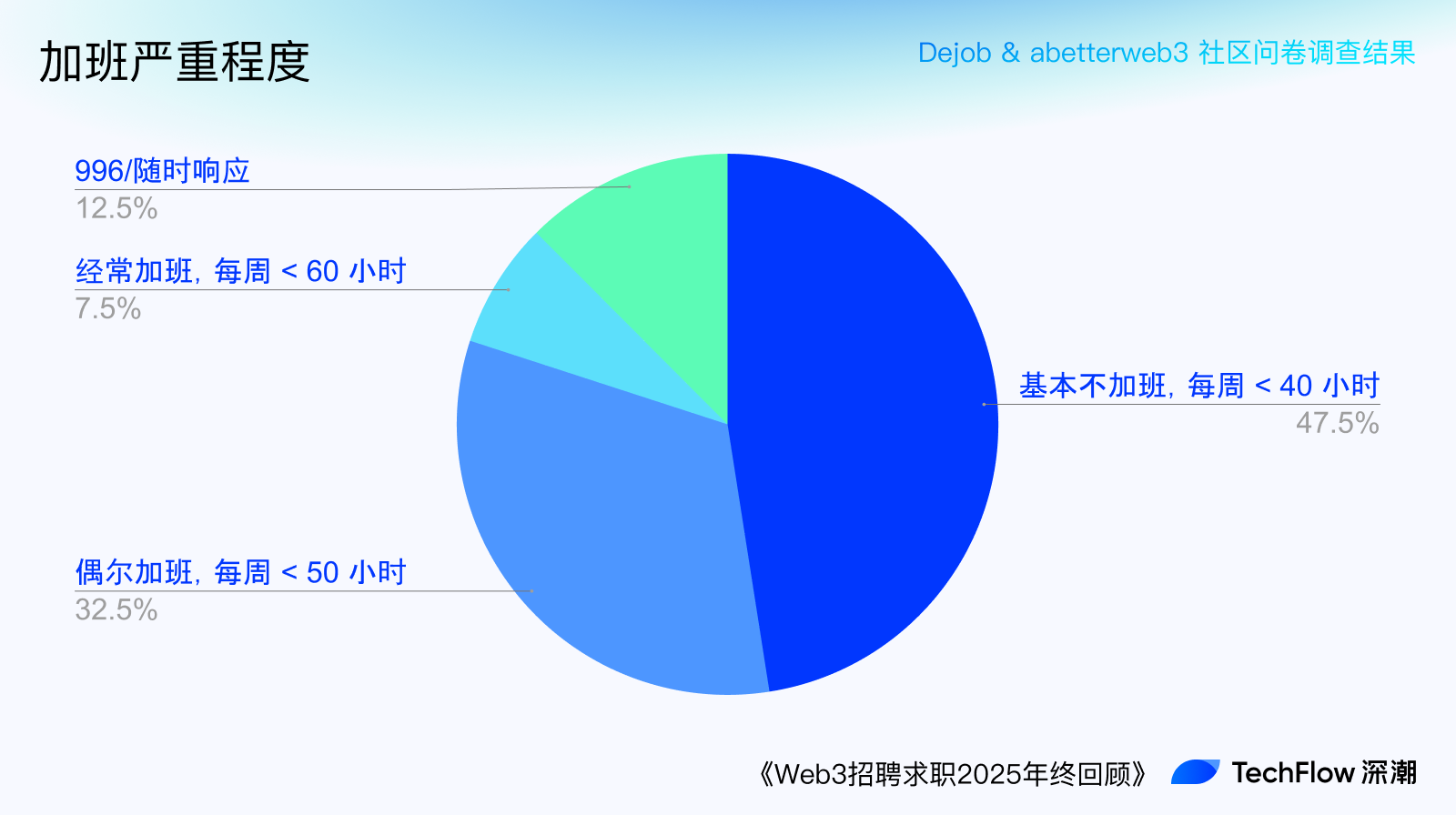
Regarding overtime intensity, 80% work approximately 40-50 hours per week. Thus, Web3 overtime seems less intense than many 996/007 sweatshops in web2.
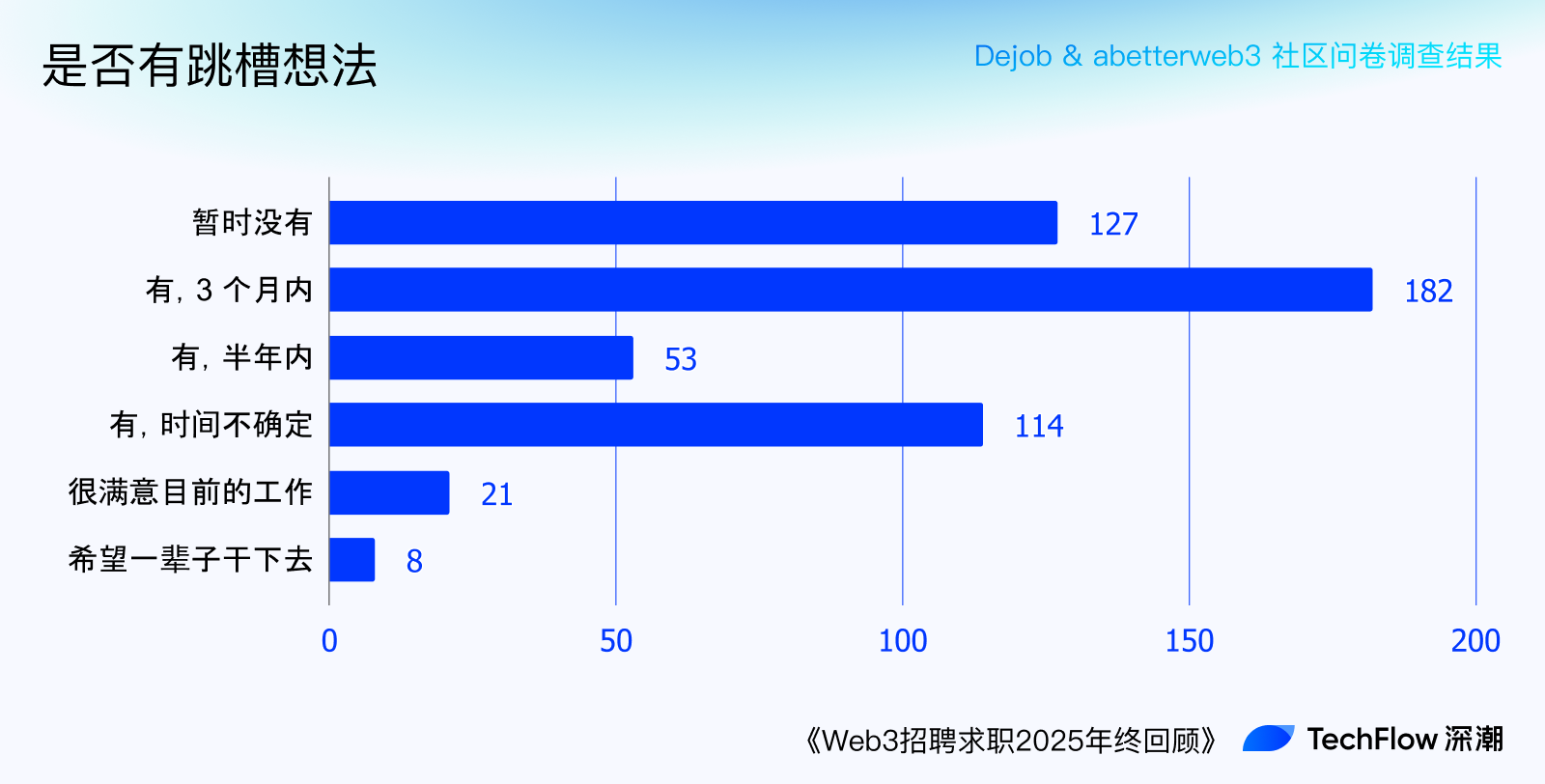
Regarding job hopping, over half want to change companies, with 30% planning to do so within 3-6 months. But about a quarter are satisfied with their current situation, and 8 respondents even identified a "dream company they hope to work for forever."
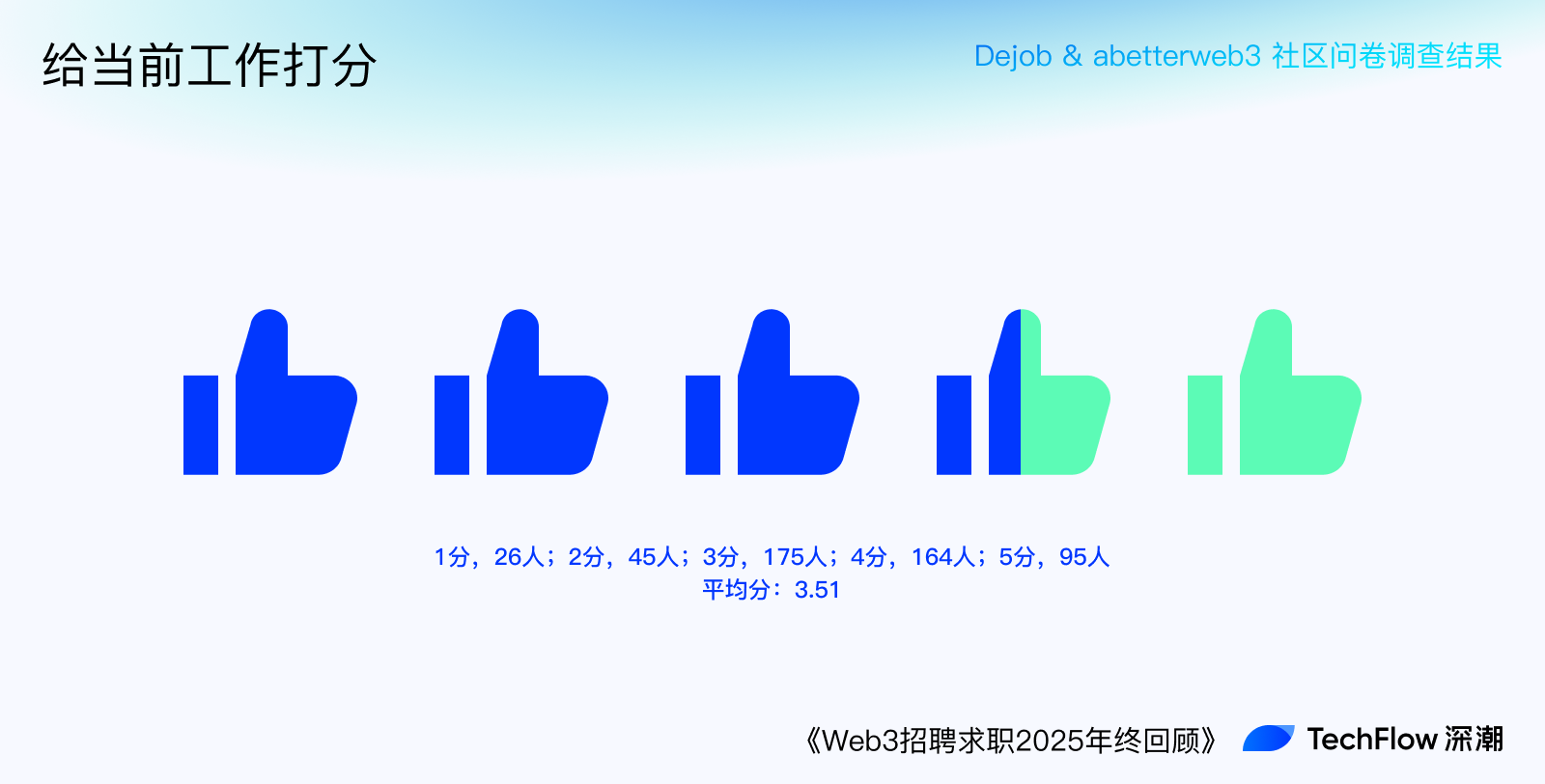
Considering factors like reasonable hours, remote work options, and side hustle tolerance, many rate their current job positively. The average score given in the job rating section was 3.51.
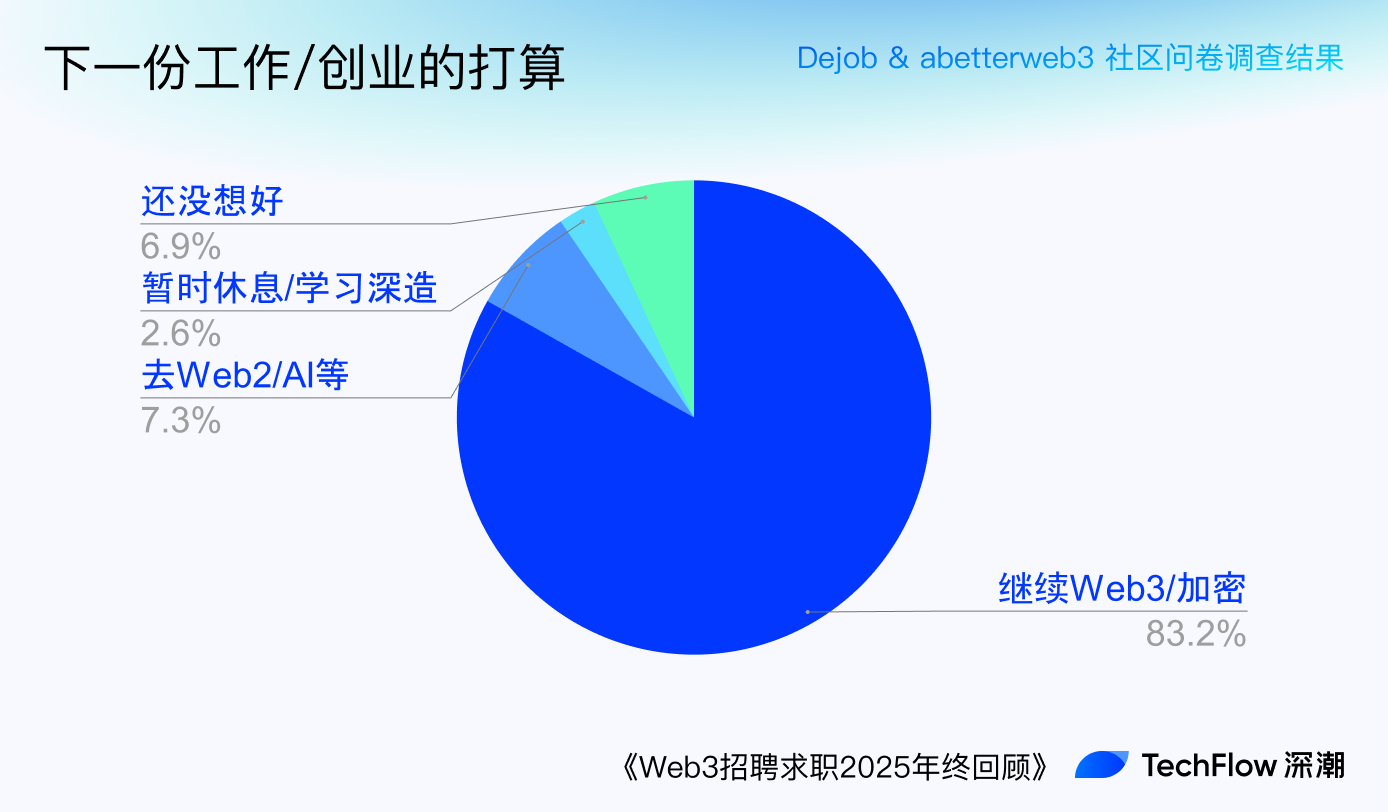
When asked if their next job would still be in the crypto space, over 80% chose to stay, while 7% chose to leave.
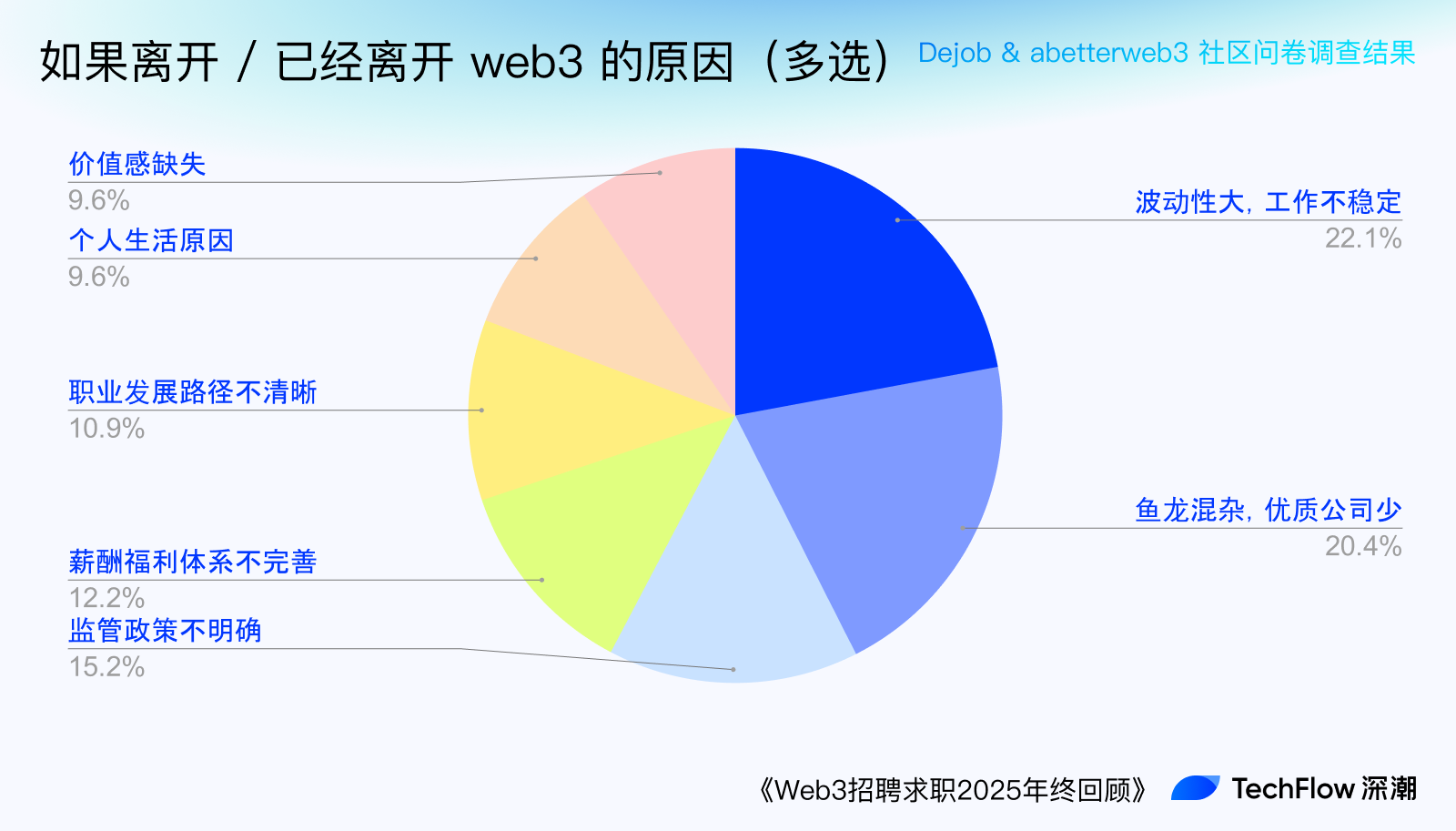
The choices for reasons to leave reflect the cold, harsh reality at the industry's core.
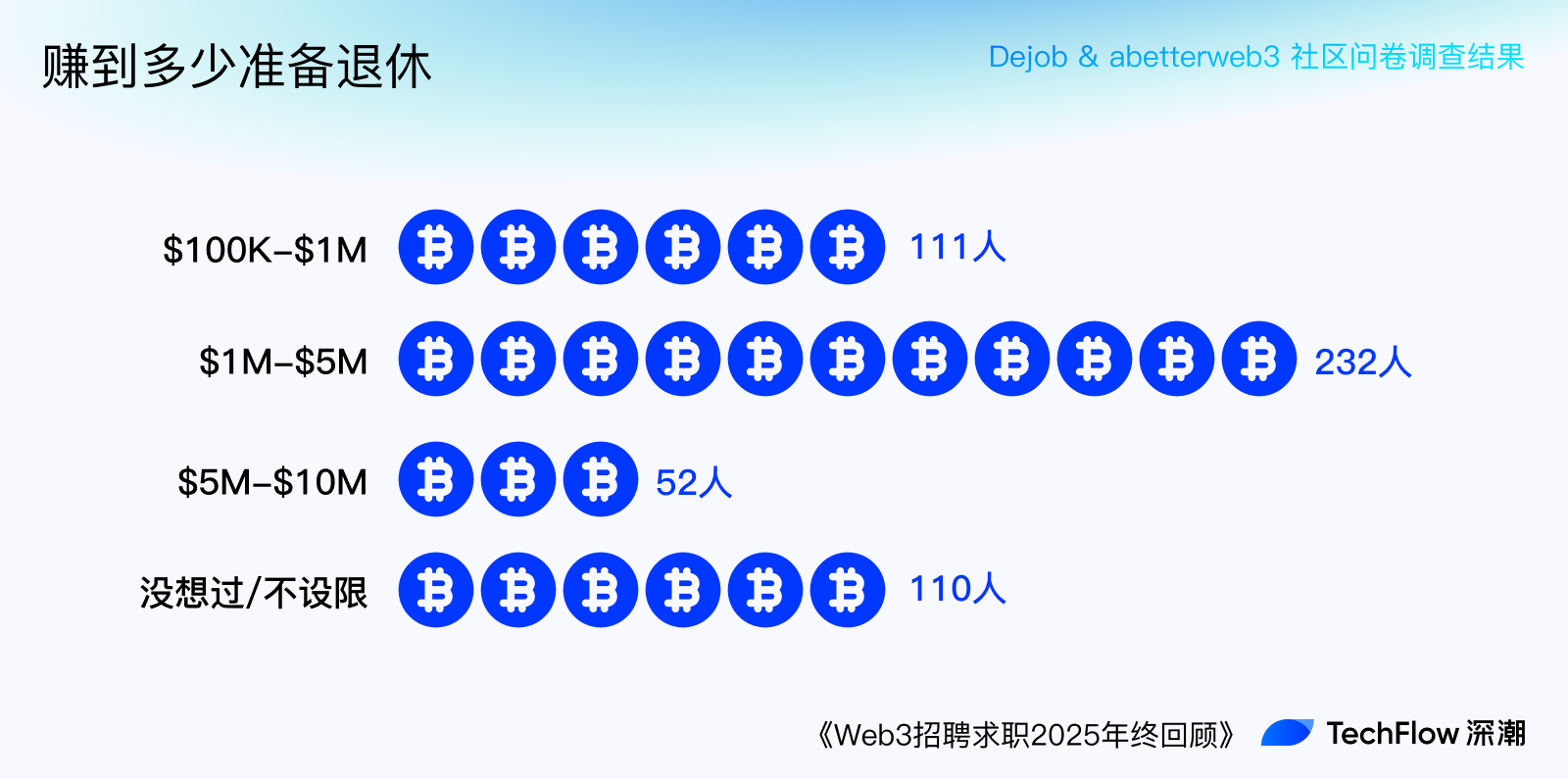
But all this preparation is for early retirement. When asked "What level of wealth would make you consider resigning?", the vast majority chose $1M - $5M (approx. RMB 7 million ~ 35 million). This might indeed be the upper limit of wealth attainable through salaried work for one person. However, 20% chose "no limit," reflecting confidence in their own abilities.
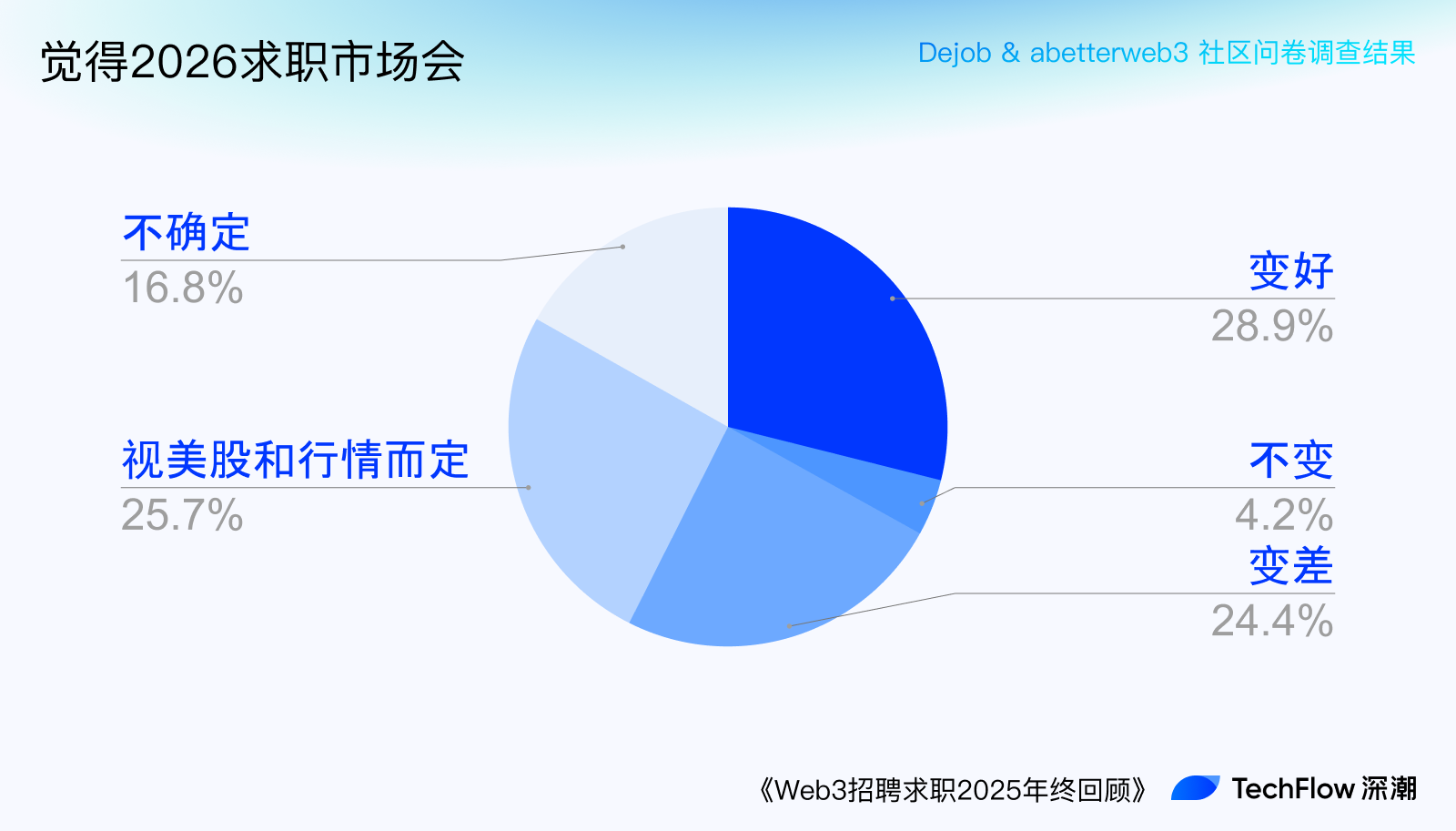
Regarding optimism about the 2026 job market, only 28% believe it will improve, with most being pessimistic or taking a wait-and-see attitude.
Truth Session 👀

Beyond the above questions, we added a few optional ones to gather some practitioners' most candid views on current industry companies (for entertainment purposes only).

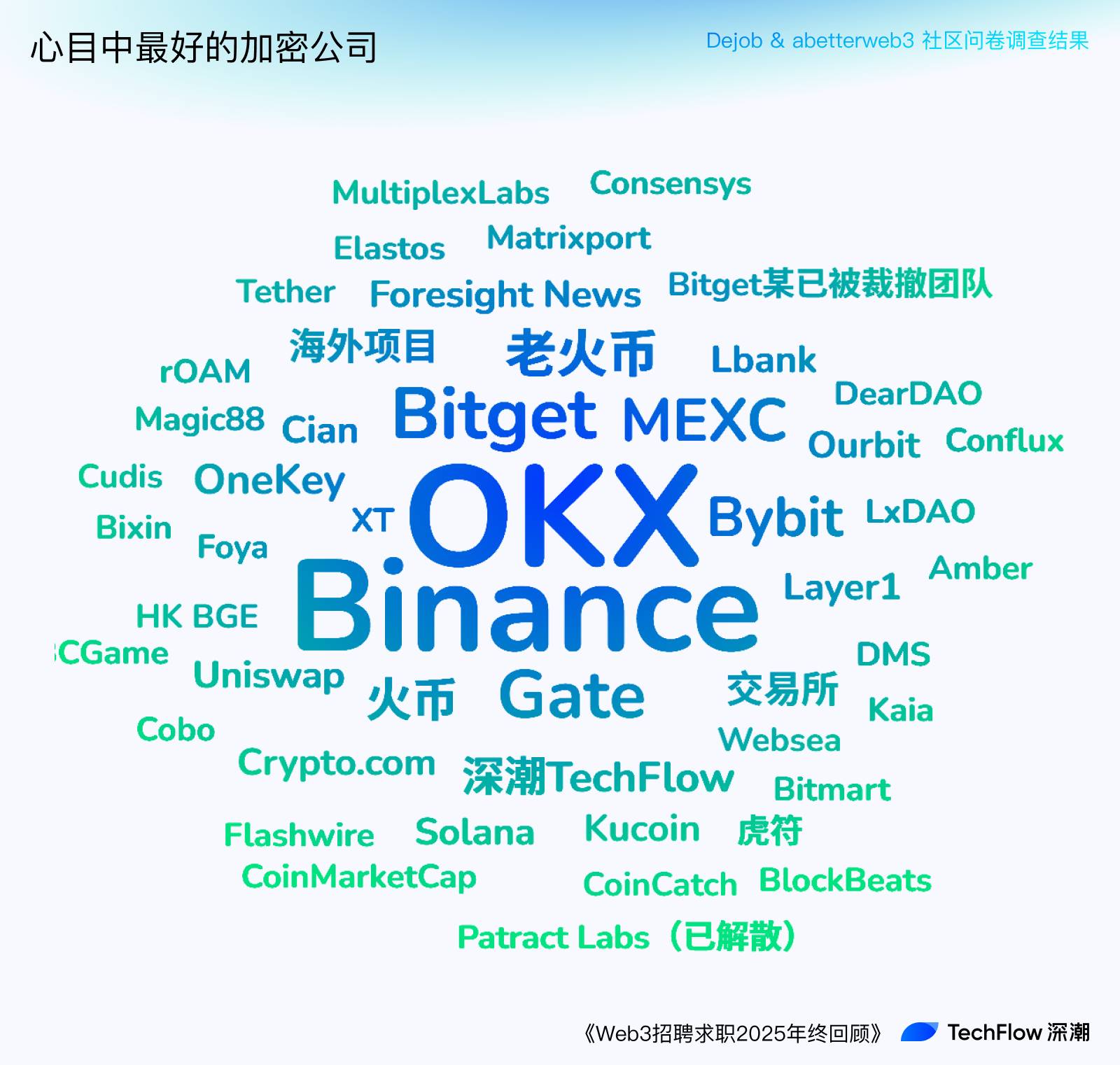
In the question "The best crypto company in your opinion", the top ten companies were:

  • OKX (26), Binance (23), Bitget (10), Gate (9), MEXC (7), Bybit (6), Old Huobi (5), Huobi (4), Deep Tide TechFlow (3), OneKey (3)

Surprisingly, some already dissolved teams were mentioned, like Huobi from the Li Lin era, a since-disbanded team at Bitget, the dissolved Consensus Lab, etc. Perhaps dream companies are worth remembering for a lifetime.
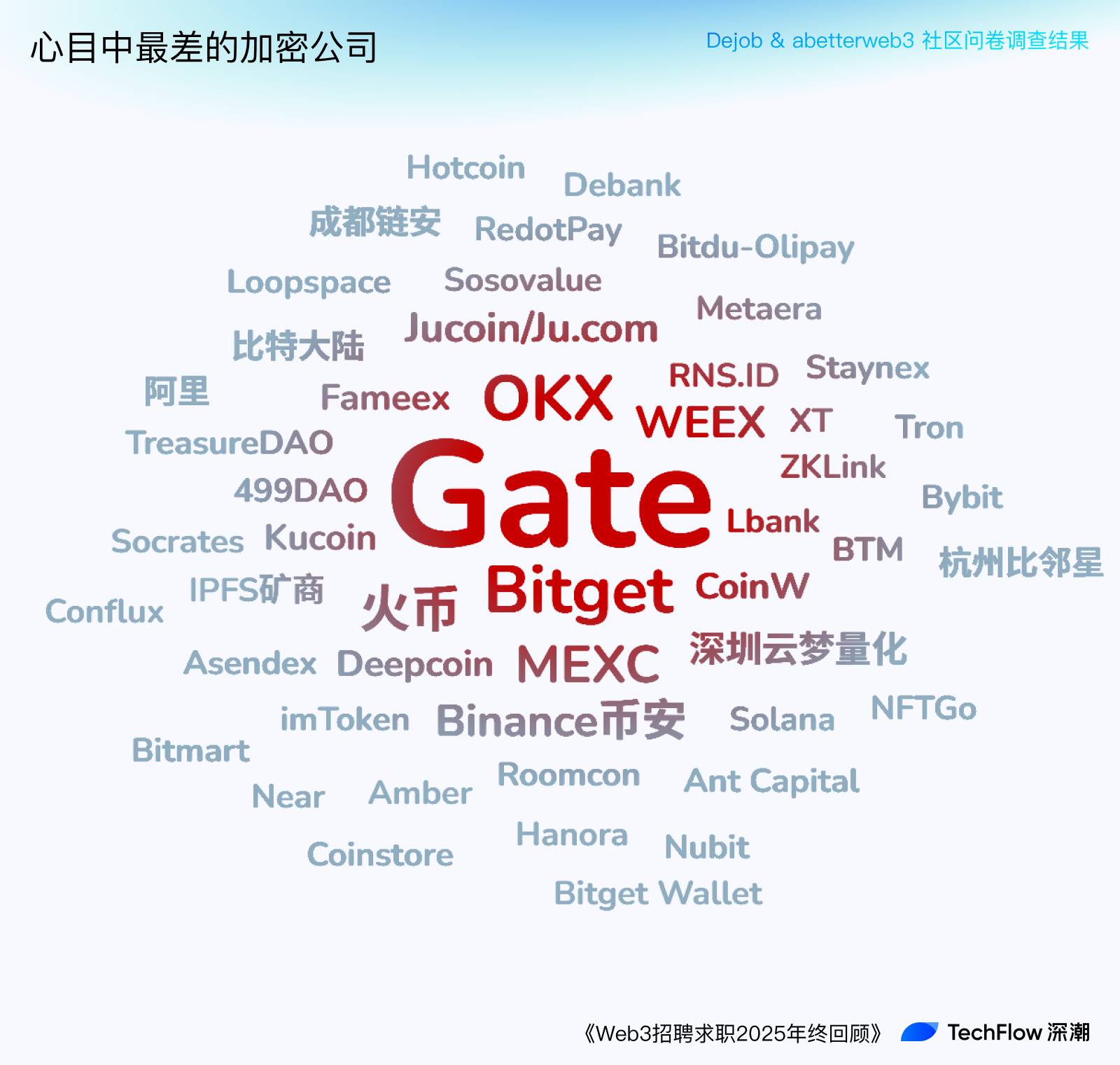
In the question "The worst crypto company in your opinion", the top ten companies were:

  • Gate (43), Bitget (13), OKX (12), MEXC (8), Huobi (7), Binance (5), WEEX (5), CoinW (2), Kucoin (2), Lbank (1)

Some exchanges appear on both the best and worst lists. This might indicate that exchanges are vast entities with complex structures, and the experience of working in different departments under different leaders can be worlds apart.
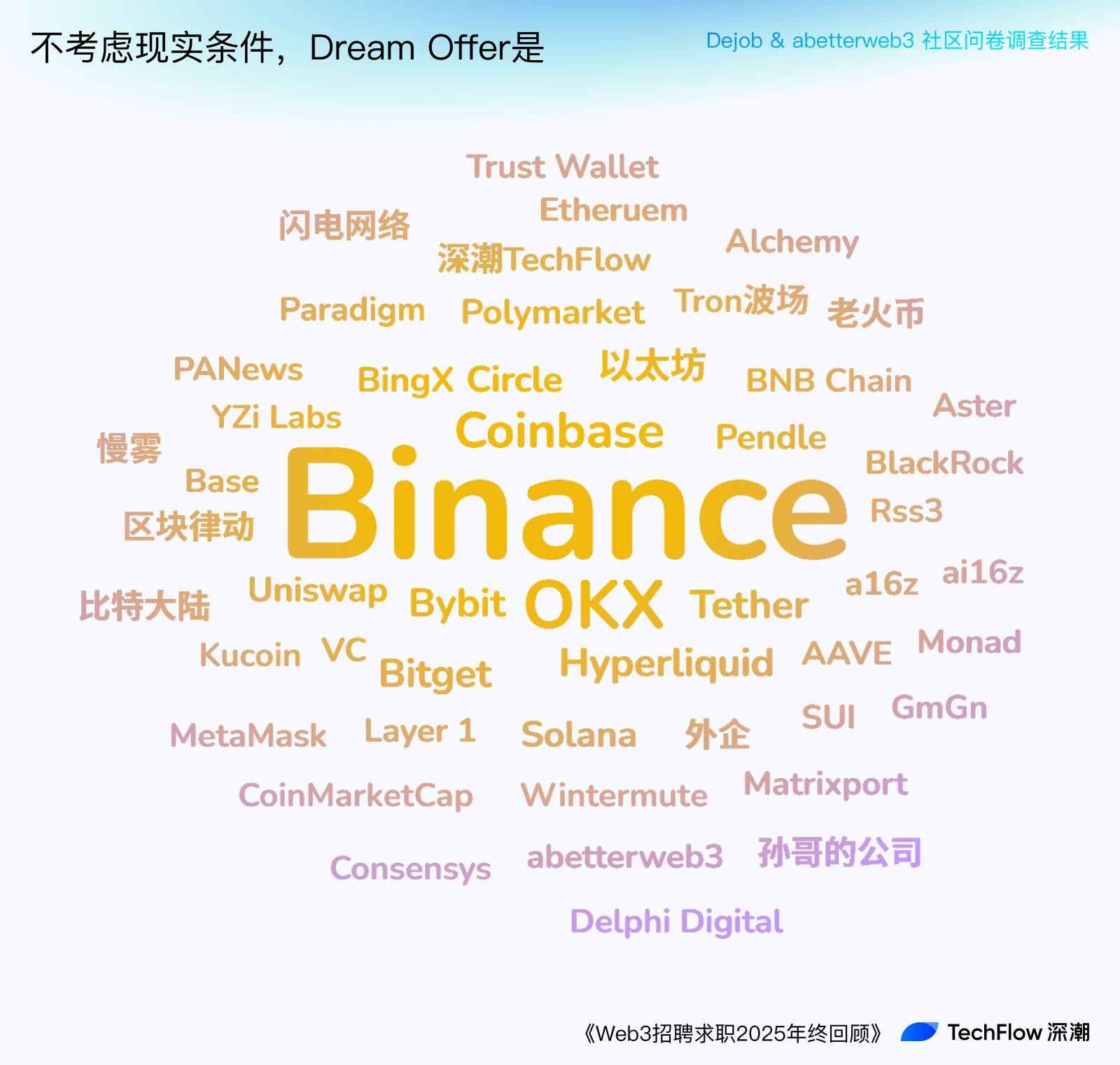
In the question "Disregarding practical constraints, which company would you most want to work for?", the top ten companies were:

  • Binance (177), OKX (50), Coinbase (25), Hyperliquid (11), Bybit (11), Bitget (10), Tether (10), Circle (6), Solana (5), Ethereum (5)

Binance, as the industry leader, unsurprisingly tops the list. As the "Tencent of the crypto circle," Binance holds prestige both externally and as a golden resume booster within the industry,名副其实地扶持个人职业生涯 (living up to its name in fostering personal careers). The chain's new star Hyperliquid, as a non-exchange entity, made the top 10, reflecting its strong community and people's desire for non-exchange products. Besides top exchanges, names of foreign companies/overseas infrastructure significantly increased in these answers, also reflecting, in a way, most job seekers' positive view of foreign companies and disappointment with Chinese teams.
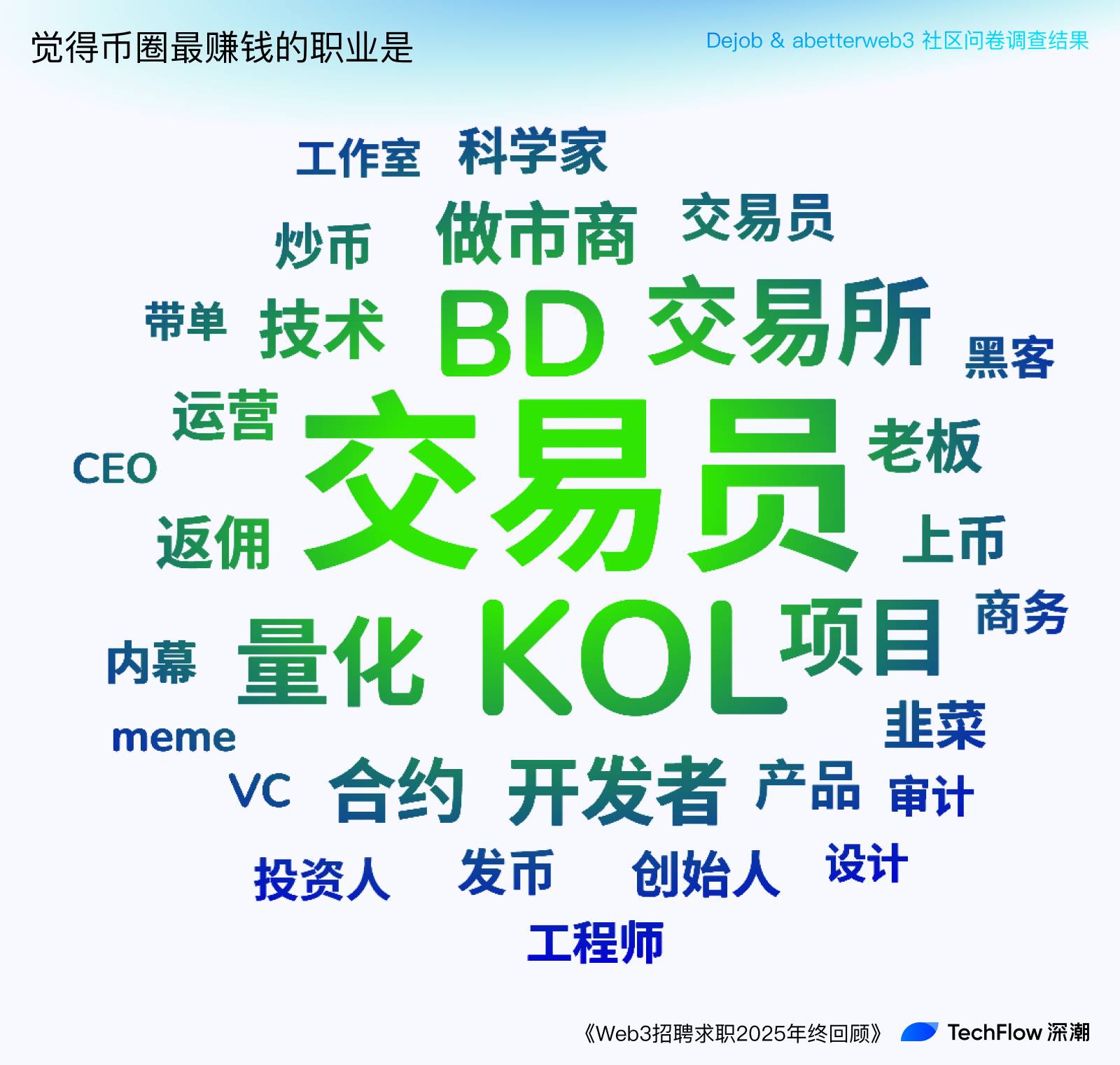
In the question "Which profession do you think is the most profitable in crypto?", high-frequency keywords included:

  • Trader (85), KOL (68), BD (Business Development) (47), Exchange (32), Quant (Quantitative Trading) (32), Project (方) (27), Developer (20), Futures (合约) (17), Market Maker (16), Technology (14)

Traders rank first, likely because the erratic market of recent years made many realize that no matter the company or role, it might not compare to directly participating in the market博弈 (gaming); KOLs follow closely, likely because they have the opportunity to access project tokens, possess informational advantages, or can directly influence specific assets for profit. Pure technical roles远离市场 (away from the market) were also mentioned, perhaps because in the eyes of most non-developers, "technology" is an indispensable part for a "super individual" to achieve a breakthrough.
Perguntas relacionadas

QWhat percentage of surveyed crypto industry workers earn less than $4000 per month?

AOver 70% of surveyed crypto industry workers earn less than $4000 per month.

QWhat is the most common type of company where crypto professionals have worked, according to the survey?

AExchanges are the most common type of company, with over half of the respondents having worked at one.

QDespite the low pay, what key benefit leads over 80% of respondents to choose to stay in the crypto industry?

AA key benefit is the prevalence of remote work, with nearly 70% of companies supporting it, offering greater flexibility.

QWhat was the most frequently cited 'most profitable profession' in the crypto space according to the survey's 'heart-to-heart' section?

ATrader was cited as the most profitable profession, followed by KOL (Key Opinion Leader).

QWhat fraction of respondents reported being in a 'pay-to-work' state, meaning their overall wealth accumulation in crypto is negative?

AA quarter (25%) of the respondents reported being in a 'pay-to-work' state with negative overall wealth accumulation.

Leituras Relacionadas

The Value Distribution of Stablecoins

**Summary: The Value Distribution of Stablecoins** The article argues that stablecoins are evolving from mere trading tools into broader channels for dollar access. It divides the stablecoin ecosystem into four layers to analyze how value is distributed: 1. **Issuance Layer:** Mints stablecoins, holds reserve assets, and captures the spread between reserve yield and user costs (e.g., Tether, Circle). This layer currently earns the largest profit margin. 2. **Infrastructure Layer:** Connects stablecoins to the traditional financial system, handling fiat on/off-ramps, banking integration, compliance (KYC/AML), and asset management (e.g., Bridge, BVNK). This is the "unglamorous" but critical work, building the essential bridges between crypto and real-world finance. 3. **Acquiring/Distribution Layer:** Integrates stablecoins into merchant systems, manages payment flows, and provides enterprise financial software (e.g., Stripe, Coinbase). They act as the access point for businesses. 4. **Application Layer:** The end-users and businesses that ultimately use stablecoins for payments, settlements, or as a store of value. They benefit from convenience but have little pricing power. The core thesis is that while the issuance layer currently dominates profits, the often-overlooked **infrastructure layer holds significant long-term potential**. The real challenge and barrier to mass adoption is not the on-chain transfer of stablecoins (which is simple), but the complex "last mile" integration into existing business workflows, banking systems, and regulatory frameworks across different countries. Companies in this layer are currently in a "land grab" phase, investing heavily to build networks, secure bank partnerships, and establish compliance pathways. While their position is currently pressured by the profitable issuers above and distribution platforms below, the article suggests that if stablecoins become a default financial rail for businesses, the infrastructure providers who have done the hard work of integration will ultimately gain strong pricing power and become entrenched, essential players.

marsbitHá 45m

The Value Distribution of Stablecoins

marsbitHá 45m

The Value Distribution of Stablecoins

The Value Distribution of Stablecoins The article argues that stablecoins are evolving from a mere trading tool into a broad "dollar channel." It analyzes the industry's value chain through four layers: 1. **Issuance Layer (e.g., Tether, Circle):** The top layer that mints stablecoins, holds reserve assets, and captures the thickest interest rate spread. 2. **Infrastructure Layer (e.g., Bridge, BVNK):** Connects stablecoins to the traditional financial system, handling critical but complex "dirty work" like fiat on/off-ramps, banking integration, compliance (KYC/AML), and cross-border settlement. 3. **Acquiring/Distribution Layer (e.g., Stripe, Coinbase):** Embeds stablecoins into merchant systems, manages payment flows, and integrates with enterprise software. 4. **Application Layer:** End-users and businesses that ultimately use stablecoins for payments, settlement, or storing value. The author posits that while the issuance layer currently captures the most profit, the most overlooked and potentially critical layer is infrastructure. The core challenge for stablecoin adoption isn't the on-chain transfer (which is simple), but bridging the gap between blockchain and the real-world financial system. This involves solving practical problems for businesses: fiat conversion, reconciliation, tax handling, and user onboarding. Infrastructure companies are currently in a difficult "land-grab" phase—building networks, securing banking relationships, and achieving compliance country-by-country. They face pressure from both the profitable issuance layer above and distribution platforms below. However, the author suggests this layer is building a crucial moat. Once stablecoins become a default business rail, the infrastructure players who have done the hard work of integration may gain significant, durable value and pricing power.

链捕手Há 49m

The Value Distribution of Stablecoins

链捕手Há 49m

How to Do Research Well: Deliberately Practice the Real Skills That Matter

No one truly teaches you how to do research. You're often given a desk, a pre-selected problem, and vague instructions to "create something new." Consequently, many people reverse-engineer the job based on visible outputs—papers, posts, announcements—learning only how to *appear* like a researcher rather than how to *become* one. True research capability is built from stacking small, trainable skills, nearly all of which can be developed through deliberate practice. **Pick Your Own Problem:** Most researchers absorb problems from advisors or trends, lacking the underlying reasoning. Choosing a problem you genuinely care about, as John Schulman advises, leads to original work. Develop "taste" like a muscle: predict experiment outcomes, guess paper results from methods, and track which findings remain important over time. **Upgrade Your Inputs:** Relying on shared reading lists (arXiv hot lists, filtered group chats) leads to unoriginal conclusions. Undervalued old literature often holds crucial insights (e.g., MoE, LSTM, backpropagation). Richard Sutton's "The Bitter Lesson" or Claude Shannon's 1952 talk on creative thinking are more predictive than lengthy modern surveys. Breadth matters as much as depth: draw from neuroscience, mechanism design, hardware knowledge, and honest statistics. Read papers directly, especially appendices and limitations sections. **Write Everything Down:** As Paul Graham noted, writing exposes flaws in seemingly mature ideas. Writing is the cheapest defense against self-deception. Following Feynman's principle, Darwin programmatically wrote down facts contradicting his theory to combat memory bias. Maintain a detailed log of hypotheses, setups, predictions, results, and updated understandings. Reviewing past logs fosters essential humility.

marsbitHá 3h

How to Do Research Well: Deliberately Practice the Real Skills That Matter

marsbitHá 3h

Trading

Spot
Futuros

Artigos em Destaque

O que é ATWO

I. Introdução ao ProjetoArena Two é uma plataforma interativa descentralizada que permite aos fãs desempenhar um papel ativo e tokenizado nos resultados de eventos em tempo real. Ao contrário dos modelos tradicionais de transmissão que reduzem os fãs a espectadores passivos, a Arena Two utiliza a tecnologia blockchain para permitir que os fãs votem diretamente em tempo real e influenciem os resultados em campo.II. Informação sobre o TokenNome do token: ATWO(Arena Two)III. Links RelacionadosWebsite:https://arenatwo.com/Exploradores:https://basescan.org/token/0x499D35eBE6cEe9B2Ac35Fd003fcBbeeB9CFc7B32Twitter:https://x.com/arenatwoXNota: A introdução ao projeto provém dos materiais publicados ou fornecidos pela equipa oficial do projeto, que é apenas para referência e não constitui aconselhamento de investimento. A HTX não se responsabiliza por quaisquer perdas diretas ou indiretas resultantes.

258 Visualizações TotaisPublicado em {updateTime}Atualizado em 2026.06.02

O que é ATWO

Como comprar ATWO

Bem-vindo à HTX.com!Tornámos a compra de Arena Two (ATWO) simples e conveniente.Segue o nosso guia passo a passo para iniciar a tua jornada no mundo das criptos.Passo 1: cria a tua conta HTXUtiliza o teu e-mail ou número de telefone para te inscreveres numa conta gratuita na HTX.Desfruta de um processo de inscrição sem complicações e desbloqueia todas as funcionalidades.Obter a minha contaPasso 2: vai para Comprar Cripto e escolhe o teu método de pagamentoCartão de crédito/débito: usa o teu visa ou mastercard para comprar Arena Two (ATWO) instantaneamente.Saldo: usa os fundos da tua conta HTX para transacionar sem problemas.Terceiros: adicionamos métodos de pagamento populares, como Google Pay e Apple Pay, para aumentar a conveniência.P2P: transaciona diretamente com outros utilizadores na HTX.Mercado de balcão (OTC): oferecemos serviços personalizados e taxas de câmbio competitivas para os traders.Passo 3: armazena teu Arena Two (ATWO)Depois de comprar o teu Arena Two (ATWO), armazena-o na tua conta HTX.Alternativamente, podes enviá-lo para outro lugar através de transferência blockchain ou usá-lo para transacionar outras criptomoedas.Passo 4: transaciona Arena Two (ATWO)Transaciona facilmente Arena Two (ATWO) no mercado à vista da HTX.Acede simplesmente à tua conta, seleciona o teu par de trading, executa as tuas transações e monitoriza em tempo real.Oferecemos uma experiência de fácil utilização tanto para principiantes como para traders experientes.

141 Visualizações TotaisPublicado em {updateTime}Atualizado em 2026.06.02

Como comprar ATWO

O que é ZEST

I. Introdução ao Projeto1. O que é o Zest Protocol?O Zest Protocol é um protocolo de empréstimos nativo do Bitcoin construído na camada 2 do Stacks que permite aos utilizadores ganhar rendimento com BTC ou emprestar ativos colateralizando BTC. Os contratos inteligentes do protocolo são escritos na linguagem Clarity, operam totalmente em cadeia e são de código aberto, com um design inspirado no Aave v3. O Zest é atualmente o maior protocolo DeFi no Stacks, com mais de 800 BTC depositados e um pico de TVL superior a 100 milhões de dólares. Em maio de 2026, o protocolo introduziu ainda os Cofres de Colateral em Bitcoin, estendendo as capacidades de empréstimo do Stacks para a rede principal do Bitcoin. Isso permite que os utilizadores emprestem stablecoins sem mover BTC da rede Bitcoin, possibilitando empréstimos com custódia própria.2. Como funciona o Zest Protocol?O Zest Protocol consiste em dois mercados. O mercado do Stacks é construído sobre o Aave v3, permitindo que os utilizadores depositem ativos como sBTC, STX e USDC para ganhar rendimento ou contrair empréstimos sobre-colateralizados. O LTV máximo padrão é de 50% (70% para sBTC). O mercado do Bitcoin opera através dos recém-lançados Cofres de Colateral em Bitcoin. Os utilizadores emprestam stablecoins ao bloquear BTC em cofres de custódia própria na cadeia do Bitcoin. O colateral permanece na rede principal do Bitcoin durante todo o processo, e os utilizadores mantêm a custódia, a menos que a posição seja liquidada.3. Quem fundou o Zest Protocol?Tycho Onnasch (Co-Fundador): Formado na Universidade de Oxford. Envolvido em pesquisa e subsídios para a Stacks Open Internet Foundation. Antigo Gestor na Trust Machines e Fundador da Deedmob. Perfil do LinkedIn: https://www.linkedin.com/in/tychokoonnasch/.Fernando Foy (Co-Fundador): Trabalhou anteriormente em consultoria de TI na Objectif Emploi. Perfil do LinkedIn: https://www.linkedin.com/in/fernando-foy/.Emil E. (Co-Fundador): Possui um Mestrado em Física pela Universidade de Warwick. Antigo Partner de Engenharia na Trust Machines, Desenvolvedor Full-Stack para projetos Web3 e Cientista de Dados no HSBC. Perfil do LinkedIn: https://www.linkedin.com/in/emil-e-49771a145/.Detalhes de Financiamento: Em maio de 2024, o Zest Protocol anunciou a conclusão de uma ronda de financiamento inicial de 3,5 milhões de dólares liderada por Tim Draper, com a participação da Binance Labs, Flow Traders, Trust Machines, entre outros.4. Tokenomics do $ZEST$ZEST é o token nativo do Zest Protocol com um fornecimento total fixo de 1 mil milhões de tokens e sem mecanismo inflacionário.Comunidade (27,83%): Usado para airdrops e incentivos aos utilizadores;Desenvolvimento do Ecossistema (24,82%): Usado para liquidez, parcerias, marketing, listagens em bolsas, etc.;Investidores (22,35%): Apoio às partes investidoras que apoiaram o desenvolvimento inicial do Zest Protocol;Equipa (25%): Alocado para colaboradores principais.Calendário de Vesting: Os tokens da Equipa e dos Investidores estão sujeitos a um período de bloqueio de 1 ano, seguido de 3 anos de desbloqueio linear.5. Cronologia dos Principais Marcos2022: O Zest Protocol é oficialmente fundado.Março de 2024: Concluída a auditoria de segurança e lançado o mercado de empréstimos do Stacks na rede principal.Em fevereiro de 2026, é lançado o Stacks Market V2, introduzindo Grupos de Risco.Em maio de 2026, foram introduzidos os Cofres de Colateral em Bitcoin, e um protótipo operacional da rede principal está agora disponível. Isso permite que os utilizadores utilizem BTC com custódia própria na L1 do Bitcoin como colateral para emprestar stablecoins em cadeias EVM, encerrando a necessidade de bridging, wrapping e custódia de terceiros. Este lançamento é dividido em duas fases. Fase 1: Utiliza transações pré-assinadas para restringir o movimento de BTC; Fase 2: Utiliza BitVM para verificação. II. Informações sobre o TokenNome do token: ZEST (Zest Protocol)III. Links RelacionadosWebsite: https://www.zestprotocol.com/Exploradores: https://bscscan.com/token/0x5506599c722389a60580b5213ea1da60d64754a1Twitter: https://twitter.com/ZestProtocolNota: A introdução ao projeto provém dos materiais publicados ou fornecidos pela equipa oficial do projeto, que é apenas para referência e não constitui aconselhamento de investimento. A HTX não se responsabiliza por quaisquer perdas diretas ou indiretas resultantes.

203 Visualizações TotaisPublicado em {updateTime}Atualizado em 2026.06.02

O que é ZEST

Discussões

Bem-vindo à Comunidade HTX. Aqui, pode manter-se informado sobre os mais recentes desenvolvimentos da plataforma e obter acesso a análises profissionais de mercado. As opiniões dos utilizadores sobre o preço de A (A) são apresentadas abaixo.

活动图片