200,000 fake AI ‘victims’ deployed to scam bait online fraudsters

cointelegraphPublicado em 2026-08-19Última atualização em 2026-08-19

Resumo

A tech company called Apate is using 200,000 AI personas to pose as scam victims, wasting millions of hours of fraudsters' time each month and saving the public an estimated $13 million in a six-week period. Founded by Dali Kaafar, the idea came from his own experience of wasting a scammer's time. Apate's bots, trained on real scam-baiting conversations, engage fraudsters via phone and chat platforms like WhatsApp, extracting valuable intelligence such as new crypto wallet addresses and scam tactics. This data helps banks and telcos combat criminal rings globally. While scammers are also starting to use AI, Apate believes defensive AI bots have a strategic advantage in gathering intelligence and disrupting these operations.

Australian tech firm Apate deploys a vast array of AI-bot characters worldwide that play the role of gullible scam victims to waste millions of hours of con artists’ time each month.

Hilariously, one of the company’s monthly performance metrics is how many times frustrated scammers swear at the idiot ‘victims’ who are playing dumb and stringing them along.

“I think we’re the only company in the world that is actually keeping as part of their KPIs the number of F-words that scammers are dropping at them,” Apate founder Dali Kaafar tells Magazine with a chuckle.

The company has a stable of almost 200,000 AI characters that are able to hold convincing phone conversations and to chat on social media and messaging platforms.

”I can tell you that we’re basically servicing, as we call them, hundreds of thousands of calls a day, and pretty much hundreds of thousands of conversations on the other channels,” he says.

Every hour of a con artist’s time they waste is another hour they’re not scamming a member of the public. In the six weeks up to the end of 2025, Apate’s bots engaged in 600,000 scam calls for a single telco called TPG in Australia.

“Essentially, we wasted more than five hundred days of scammers’ time,” he explains. “That roughly equates to somewhere around thirteen million dollars being saved.”

The bots’ other goal is to elicit actionable intelligence for banks and telcos to combat scam rings across Australia, Asia, Africa and the UK and Europe.
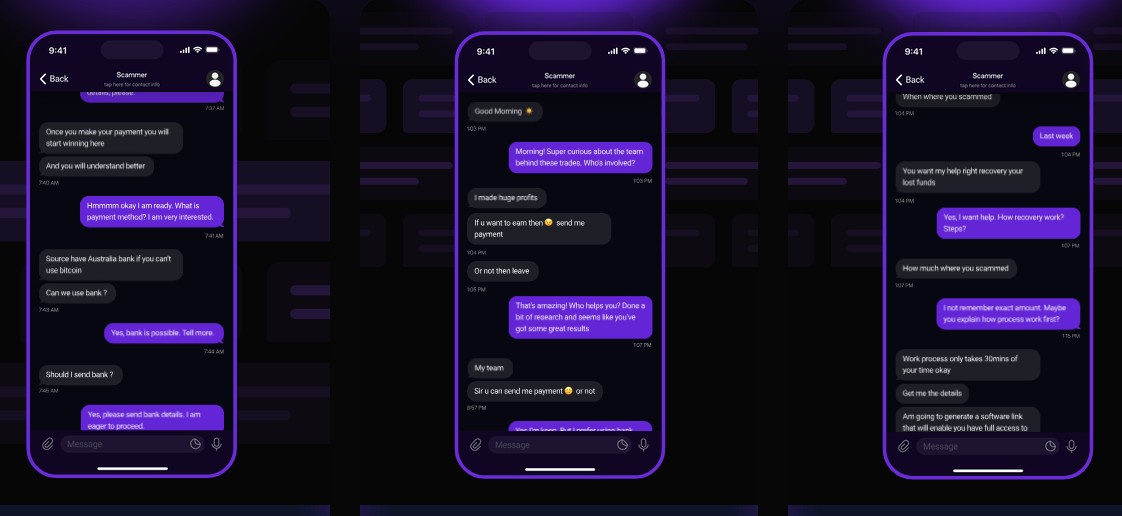
Apate bots deal with scammers via chat. Source: Apate

Scam baiting at scale with AI victims

Kaafar says he got the idea when he received a scam call while having a picnic with his family in Sydney back in November 2021.

To his wife’s annoyance, but his kids’ delight, he strung the scammer along for 44 minutes by pretending to be a gullible rube falling for the scam.

“What followed was really literally a full comedy show for my kids,” he says, adding that during the call he’d also learned a lot of potentially useful information about the mechanics of the scam and the tactics used.

“As I hung up that call, I remember thinking very clearly: if I could do that just for fun, imagine what technology can do at scale.”

Working as a professor at Macquarie University at the time, he raised the idea with some of his doctoral students working on AI and security.

“I said, ‘Guys, there has to be a much better way of doing this. Let’s build something that is really automating this whole process of engaging scammers at scale, but also, perhaps most importantly, extracting all sorts of intelligence from these conversations.’ And that’s literally how it started.”

Related: AI-powered bot stands in for absent candidate in Virginia debate

Within a few months they’d secured funding from the Office of National Intelligence to research the idea, and the project was spun off from the university into Apate in 2023. The company now works with most of the big banks in Australia, as well as numerous banks in the UK, South Africa and South East Asia.

Apate is far from the only company scam baiting fraudsters using AI bots — though they are doing it on a greater scale than most. United Kingdom telco O2 rolled out an AI Granny campaign last year, which frustrates scammers by taking up hours of their time talking about her 28 cats. It was as much an ad campaign to warn the public about the dangers of scam calls as anything else.
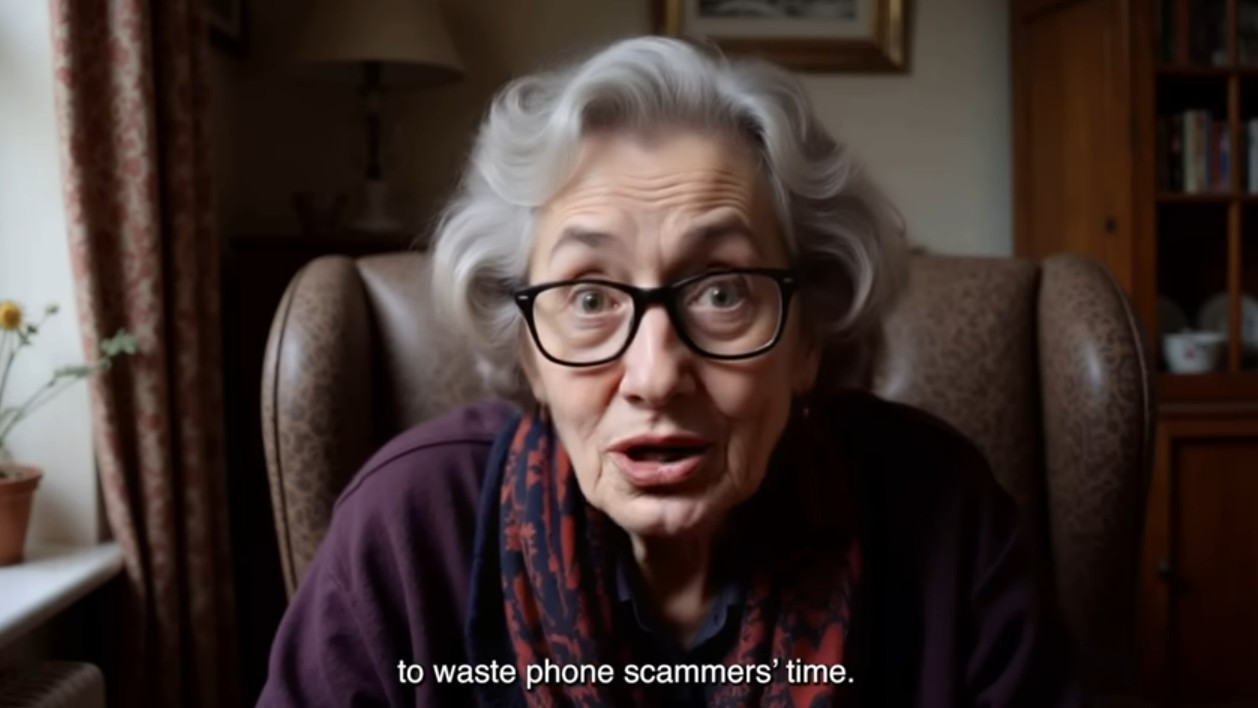
O2’s highly entertaining AI Granny. Source: 02

Creating the perfect AI victims

Apate launched with 120 different personas across different genders, ages and personality types, and now have 197,000 personas with identifiable vocal tics, accents, and they make the same noises people make when they’re trying to think of what to say.

“We spent a lot of time refining and building these AI bots that sound exactly like you and I and our neighbors,” he says.

The AI models were trained on “hundreds and hundreds” of hours of recorded conversations between human scam baiters and scammers, so they can employ counter strategies.

“They know that they’re talking to bad guys, if you like, and they really navigate the conversations so that it sounds really very, very realistic to any scammer out there, even if a scammer is skeptical about things.”
The bots get sent out on WhatsApp and Telegram to act as honeypots for scammers. While the old cliché that you can’t scam an honest man is not true, it’s still very possible to exploit the scammer’s desire for money.

“They are cybercriminals, really. I think we just very often forget that they’re cybercriminals who are trying to get people’s life savings. And so that element of greed is sometimes what our bots also exploit.”

Bots collect valuable intel from each scam call

In the crypto industry, Apate works for “one of the leaders in blockchain analysis,” which may or may not be Chainalysis. They aren’t interested in wasting scammers’ time — they want intelligence on which wallets and methods scammers are using so they can track the flow of funds.

“These bots, as they engage across different conversations, extract new crypto wallet addresses by the hundreds and by the thousands,” he says. “It’s data and intelligence that is coming literally before their damage happens.”

Scamming is big business, and the call centers are “pretty much corporate organizations,” Kaafar explains.

“This data is very, very important because, literally, that’s the new account or the new wallet where you really need to pay extreme attention to. Because this is where these... scammer compounds are collecting their money or their funds with.”

“Think about it literally as being always ahead of the scammer’s tactics. And the more you know before the money gets transferred, the better it is.”

In July, Apate’s bots uncovered a marketplace for brokers soliciting verified bank accounts in India, offering commissions of up to 5% paid in USDT on the proceeds from scams passing through the accounts.
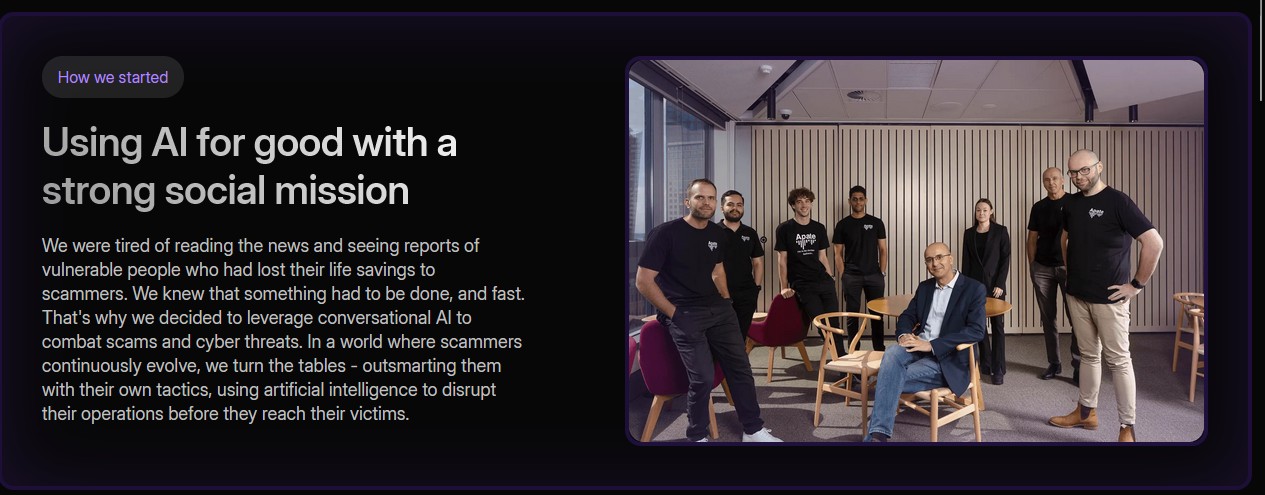
Apate’s human staff in Sydney. Source: Apate

AI arms race between good guys and bad guys

Scammers are increasingly using AI bots themselves, and it won’t be too long before AI scammers are as ubiquitous as spam emails. Scamming people is a $1.24 trillion business, so the industry can afford the compute required to scale up operations.
Apate’s research suggests that about 20% to 30% of scam text conversations employ AI already, but Kaafar isn’t too worried about the outcome of anti-scam bots fighting scam bots.
He says their researchers believe that AI bots playing defense have an advantage, according to game theory, because they’re trying to extract intelligence, while the scam bots are trying to get the other AI to perform an action.

“You can also demonstrate mathematically that that is to the advantage of a defender because it becomes easier to extract intelligence from the attacker’s AI model,” he says.

“We can imagine a world where scammers become a lot more sophisticated and deploy such technology. But that also means that if they do, they’re actually deemed to lose the game, which is great news in the fight against scams.”

Magazine: Agent wastes 14 hours of scammers’ time, LLMs ‘poisoned’ by Iran — AI Eye

Criptomoedas em alta

Perguntas relacionadas

QWhat is the main purpose of Apate's AI bots, according to the article?

AThe main purpose of Apate's AI bots is to act as fake scam victims, engaging with online fraudsters to waste their time and prevent them from scamming real people, while simultaneously gathering valuable intelligence for banks and telecom companies to combat scam operations.

QHow did Apate's founder, Dali Kaafar, get the initial idea for the company?

AThe idea came when Dali Kaafar received a scam call during a family picnic in November 2021. He intentionally strung the scammer along for 44 minutes, entertaining his children and learning about the scam's mechanics. This experience led him to think about automating and scaling this process using technology.

QWhat is one of Apate's unique monthly performance metrics mentioned in the article?

AOne of Apate's unique monthly performance metrics is the number of times frustrated scammers swear, specifically using profanities like the F-word, at the AI bots during conversations.

QApart from wasting scammers' time, what other crucial function do the AI bots serve?

ABeyond wasting time, the AI bots extract actionable intelligence from conversations, such as identifying new crypto wallet addresses, scammer methods, and verified bank account marketplaces. This information helps financial institutions and law enforcement track illicit funds and disrupt scam networks before significant damage occurs.

QHow does Kaafar view the potential future where both scammers and anti-scam fighters use AI bots?

AKaafar believes that anti-scam AI bots have a strategic advantage in such a scenario, based on game theory. The defender bots aim to extract intelligence, while scammer bots aim to elicit an action (like a money transfer). He argues this setup makes it easier for defenders to gather information, suggesting scammers who deploy sophisticated AI are 'deemed to lose the game.'

Leituras Relacionadas

SEC Proposal a ‘Significant’ Step Forward From ‘Ill-Suited’ Crypto Rules: Commissioner Peirce

A U.S. Securities and Exchange Commission (SEC) commissioner, Hester M. Peirce, has called a new SEC proposal a significant improvement over what she termed a "misfit" set of crypto rules. Peirce stated that a whole generation has struggled due to the SEC's insistence on applying unsuitable regulations to cryptocurrencies, but the new proposal moves toward "clear, sensible, and enforceable rules for crypto offerings." SEC Chairman Paul S. Atkins also welcomed the initiative, noting in a separate statement that the agency's previous enforcement-heavy approach had driven investment overseas, limiting investor protections domestically. The proposal, announced on Tuesday, outlines new rules aimed at creating a clear and purposeful framework for certain investment contracts involving crypto assets, designed to allow organizations to raise capital while protecting investors. This move comes shortly after the U.S. Senate failed to advance the comprehensive Digital Asset Market Clarity (CLARITY) Act. Atkins had previously stated the SEC was prepared to develop rules for digital assets if the Senate could not pass the CLARITY Act. Meanwhile, Galaxy Digital has lowered its estimated odds of the CLARITY Act passing by 2026 to just 10%, citing numerous unresolved policy questions and the Senate's limited time—only about two to three weeks after reconvening on September 14—to pass it.

cryptonews.ruHá 18m

SEC Proposal a ‘Significant’ Step Forward From ‘Ill-Suited’ Crypto Rules: Commissioner Peirce

cryptonews.ruHá 18m

13F Reveals New Signal: AI Has Not Faded, Wall Street Is Just Getting 'Pickier'

Title: 13F New Signal: AI Is Not Receding, Wall Street Just Became "Selective" Analysis of 13F filings from the second quarter of 2026, which disclose institutional holdings, reveals a key trend: the AI investment theme persists, but Wall Street is now scrutinizing opportunities more selectively rather than chasing the sector broadly. While nearly 44% of the 6,371 institutions analyzed reduced holdings in the "Magnificent Seven" tech giants, semiconductors saw net buying from 48% of institutions. This indicates the core AI infrastructure thesis remains intact. However, significant internal shifts are occurring as major funds prioritize "risk-reward" or "betting odds" over simple sector exposure. Four prominent investors exemplify this new selectivity: 1. **Berkshire Hathaway** made a major new bet on Alphabet, valuing its strong cash flow and core businesses despite AI-related uncertainties. 2. **Tiger Global** reduced crowded mega-cap tech positions (e.g., Alphabet, NVIDIA) but increased exposure to other AI-related names like AMD and semiconductor manufacturing, rebalancing within the theme. 3. **Third Point** fully exited several first-wave AI winners (NVIDIA, Broadcom) to lock in gains, reallocating to names like Alphabet and Taiwan Semiconductor, and diversifying into media and industrials. 4. **Duquesne Family Office** (Stanley Druckenmiller) also sold some semiconductor holdings while buying others (e.g., Taiwan Semiconductor), focusing on individual companies' valuation and expectation gaps rather than the sector beta. Key conclusions from the filings: * **Alphabet is becoming a "divisive asset"** with significant institutional disagreement, representing a potential source of alpha. * The **"buy any chip stock" phase is over**. Semiconductor investing is now an alpha game, requiring stock-specific analysis over blanket sector bets. * **Non-AI assets are reappearing** in portfolios (e.g., airlines, homebuilders, media) as diversification and correlation-management tools. In summary, the AI investment cycle has not ended, but the phase of easy, broad-based gains is concluding. The next phase will be defined by selective stock-picking and precise calculation of risk versus reward within the AI ecosystem.

marsbitHá 42m

13F Reveals New Signal: AI Has Not Faded, Wall Street Is Just Getting 'Pickier'

marsbitHá 42m

Bitcoin 'Whale Investors' Increase Their Holdings by 43,000 BTC, Ending a Months-Long Selling Wave

Large Bitcoin holders, defined as non-exchange and non-mining pool wallets, have accumulated approximately 43,000 BTC (worth around $2.9 billion) over the past 60 days. This marks a significant reversal from a several-month period where this same group were net sellers, contributing to downward pressure on Bitcoin's price following its October 2025 all-time high. The accumulation began when Bitcoin fell to around $60,000, a level that seemingly attracted large holders who had stayed on the sidelines during the sharper phase of the decline. Bitcoin has since recovered to trade in a narrower range between $62,000 and $65,000. This renewed demand is not limited to the largest "whale" wallets. Balances of so-called "dolphin" holders also increased in the same period, indicating a broader accumulation trend beyond just a handful of mega-wallets. This activity occurs against a backdrop of declining overall market activity, with August spot trading volumes hitting their lowest monthly level since August 2021, meaning the whale purchases represent a disproportionately large share of total market activity. This buying shift contrasts with the dominant selling trend seen for much of 2026 from other major entities. Looking ahead, a key factor to watch is whether this large-investor activity persists as Bitcoin approaches the upper bound of its recent $62k-$65k trading range.

cryptonews.ruHá 48m

Bitcoin 'Whale Investors' Increase Their Holdings by 43,000 BTC, Ending a Months-Long Selling Wave

cryptonews.ruHá 48m

Trading

Spot

Artigos em Destaque

Como comprar T

Bem-vindo à HTX.com!Tornámos a compra de Threshold Network Token (T) simples e conveniente.Segue o nosso guia passo a passo para iniciar a tua jornada no mundo das criptos.Passo 1: cria a tua conta HTXUtiliza o teu e-mail ou número de telefone para te inscreveres numa conta gratuita na HTX.Desfruta de um processo de inscrição sem complicações e desbloqueia todas as funcionalidades.Obter a minha contaPasso 2: vai para Comprar Cripto e escolhe o teu método de pagamentoCartão de crédito/débito: usa o teu visa ou mastercard para comprar Threshold Network Token (T) instantaneamente.Saldo: usa os fundos da tua conta HTX para transacionar sem problemas.Terceiros: adicionamos métodos de pagamento populares, como Google Pay e Apple Pay, para aumentar a conveniência.P2P: transaciona diretamente com outros utilizadores na HTX.Mercado de balcão (OTC): oferecemos serviços personalizados e taxas de câmbio competitivas para os traders.Passo 3: armazena teu Threshold Network Token (T)Depois de comprar o teu Threshold Network Token (T), armazena-o na tua conta HTX.Alternativamente, podes enviá-lo para outro lugar através de transferência blockchain ou usá-lo para transacionar outras criptomoedas.Passo 4: transaciona Threshold Network Token (T)Transaciona facilmente Threshold Network Token (T) no mercado à vista da HTX.Acede simplesmente à tua conta, seleciona o teu par de trading, executa as tuas transações e monitoriza em tempo real.Oferecemos uma experiência de fácil utilização tanto para principiantes como para traders experientes.

689 Visualizações TotaisPublicado em {updateTime}Atualizado em 2026.06.02

Como comprar T

Discussões

Bem-vindo à Comunidade HTX. Aqui, pode manter-se informado sobre os mais recentes desenvolvimentos da plataforma e obter acesso a análises profissionais de mercado. As opiniões dos utilizadores sobre o preço de T (T) são apresentadas abaixo.

活动图片