2 Days, 20x: A Quick Look at the Automated Market Making Mechanism of the New Gem Snowball

marsbitPublicado em 2025-12-22Última atualização em 2025-12-22

Resumo

The meme token Snowball" launched on pump.fun on December 18 and gained significant traction in the English-speaking crypto community, reaching a $10 million market cap within four days while largely flying under the radar in Chinese crypto circles. Its core innovation is an automated market-making mechanism: instead of the typical "creator fee" (usually 0.5%–1% per transaction) going to the developer’s wallet—a common setup that often leads to rug pulls—Snowball directs 100% of this fee to an on-chain bot. This bot periodically: 1. Buys back tokens to create buy pressure, 2. Adds the purchased tokens and corresponding SOL to the liquidity pool to improve depth, 3. Burns 0.1% of tokens to induce deflation. The fee rate also adjusts dynamically based on market cap (0.05%–0.95%) to balance accumulation and transaction friction. The idea is a "snowball effect": trading generates fees → fees fuel buybacks → buybacks may push price up → higher prices attract more trading. On-chain data shows 7,270 holders, with the top 10 holding ~20% of supply. Trading volume has been relatively balanced between buys and sells. However, the token remains highly speculative. While the structure reduces dev exit risk, it doesn’t eliminate other meme coin risks like low liquidity, narrative fatigue, or large holder dumps. Similar projects like FIREBALL are emerging, suggesting a trend toward "mechanism-driven memes." But as past examples like OlympusDAO and Safemoon show, complex t...

The crypto market in December is as cold as the weather.

On-chain transactions have been dormant for a long time, and new narratives are hard to come by. Just look at the drama and gossip circulating in the Chinese CT (Crypto Twitter) these past few days, and you'll know hardly anyone is playing in this market anymore.

But the English-speaking community has been discussing something new.

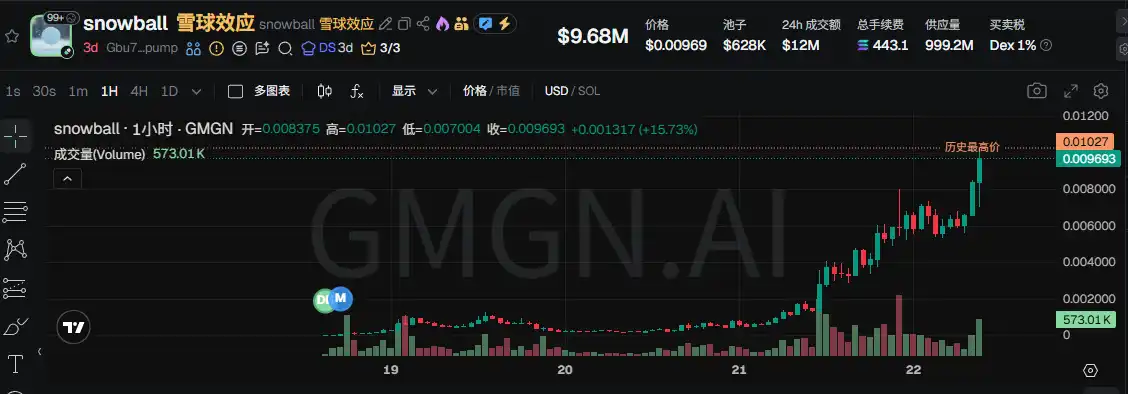
A meme coin called Snowball launched on pump.fun on December 18th. In four days, its market cap surged to $10 million and is still hitting new highs; yet it's barely mentioned in Chinese circles.
In the current environment, lacking new narratives and where even memes are considered unplayable, this is one of the few things that catches the eye and shows some localized wealth effect.

And the name Snowball itself tells the story it wants to convey:

A mechanism that allows the token to "roll and grow bigger by itself."

Turning Transaction Fees into Buying Pressure, Rolling the Snowball for Market Making

To understand what Snowball is doing, you first need to know how pump.fun tokens typically make money.

On pump.fun, anyone can create a token in minutes. The token creator can set a "creator fee," essentially taking a cut of every transaction into their own wallet, usually between 0.5% and 1%.

This money could theoretically be used for community building and marketing, but in practice, most Devs choose to: accumulate enough and then rug.

This is part of the typical life cycle of a shitcoin. Launch, pump, harvest fees, rug. Investors aren't betting on the token itself, but on the developer's conscience.

Snowball's approach is to not take this creator fee money.

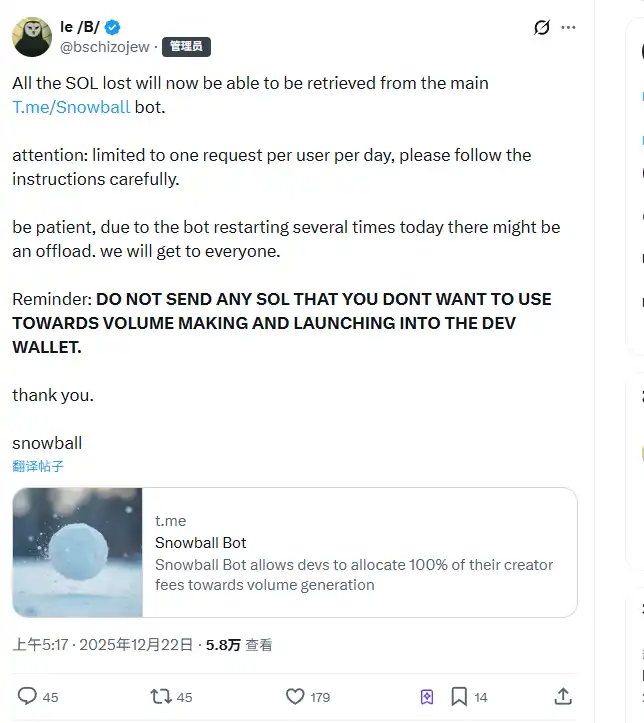
To be precise, 100% of the creator fees do not go to anyone's wallet but are automatically transferred to an on-chain market-making bot.

This bot performs three actions at regular intervals:

First, it uses the accumulated funds to buy tokens on the market, creating buying support;

Second, it adds the bought tokens and the corresponding SOL to the liquidity pool, improving trading depth;

Third, it burns 0.1% of the tokens with each operation, creating deflation.
Additionally, the percentage of creator fees this coin charges is not fixed; it fluctuates between 0.05% and 0.95% based on market cap.

It takes a higher percentage when the market cap is low, allowing the bot to accumulate ammunition faster; it reduces the fee when the market cap is high, decreasing transaction friction.

In one sentence, the logic of this mechanism is: every time you trade, a portion of the money automatically becomes buying pressure and liquidity, instead of going into the developer's pocket.

Therefore, you can easily understand this snowball effect:

Transactions generate fees → Fees become buying pressure → Buying pressure pushes up the price → Higher price attracts more transactions → More fees... theoretically, it can roll on by itself.

On-Chain Data Situation

Now that we've covered the mechanism, let's look at the on-chain data.

Snowball launched on December 18th, four days ago. Its market cap grew from zero to $10 million, with a 24-hour trading volume exceeding $11 million.

For a shitcoin on pump.fun, this performance is considered relatively long-lasting in the current environment.

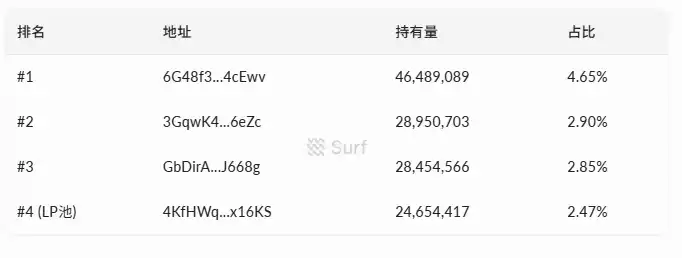
In terms of token distribution, there are currently 7,270 holder addresses. The top ten holders combined account for about 20% of the total supply, with the single largest holder holding 4.65%.
(Data source: surf.ai)

There's no address holding 20-30% of the supply; the distribution is relatively decentralized.

Regarding transaction data, there have been over 58,000 transactions since launch, with 33,000 buys and 24,000 sells. The total buy volume is $4.4 million, and the sell volume is $4.3 million, resulting in a net inflow of about $100,000. Buying and selling are basically balanced, with no one-sided selling pressure.

The liquidity pool holds about $380,000, half in tokens and half in SOL. For a market cap of this size, the depth isn't very thick, and large orders would still experience significant slippage.

Another noteworthy point is that Bybit Alpha announced listing the token less than 96 hours after launch, which to some extent confirms the short-term hype.

Perpetual Motion Meets a Cold Market

After looking around, you can see that the English community's discussion about Snowball mainly focuses on the mechanism itself. Supporters' logic is straightforward:

This is the first meme coin that locks 100% of the creator fees into the protocol, preventing developers from rugging, making it structurally safer than other shitcoins, at least.

The Dev is also playing into this narrative. The developer wallet, market-making bot wallet, and transaction logs are all public, emphasizing "verifiable on-chain."

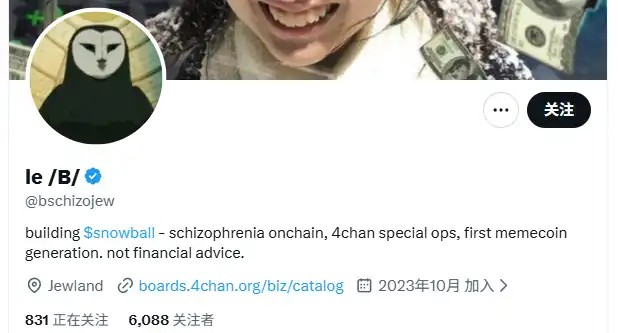
@bschizojew labels himself as "on-chain schizophrenic, 4chan special forces, first-generation meme coin veteran," radiating a self-deprecating degen vibe that strongly appeals to the crypto-native community.
But a safe mechanism and making money are two different things.

The snowball effect relies on the premise that there is sufficient trading volume to continuously generate fees to feed the bot for buybacks. More trades mean more ammunition for the bot, stronger buying pressure, higher prices, attracting more people to trade...

This is the ideal state where any meme coin's so-called buyback flywheel spins up in a bull market.

The problem is, the flywheel needs external force to start.

What is the current crypto market environment? On-chain activity is sluggish, overall meme coin hype is down, and there's already little capital willing to chase shitcoins. In this context, if new buying pressure doesn't keep up and trading volume shrinks, the fees the bot receives will become less and fewer, buybacks will weaken, price support will diminish, and trading willingness will decline further.

The flywheel can spin forward, but it can also spin in reverse.

A more realistic problem is that the mechanism solves only one risk point—"developers taking the money and running"—but meme coins face far more risks than that.

Whales dumping, insufficient liquidity, narratives going out of style—any one of these happening would render the 100% fee buyback largely ineffective.

Everyone is tired of being rugged. A Chinese crypto brother summarized it quite well:

Play if you want, but don't get in over your head.

More Than One Snowball is Rolling

Snowball isn't the only project telling this automated market-making story.

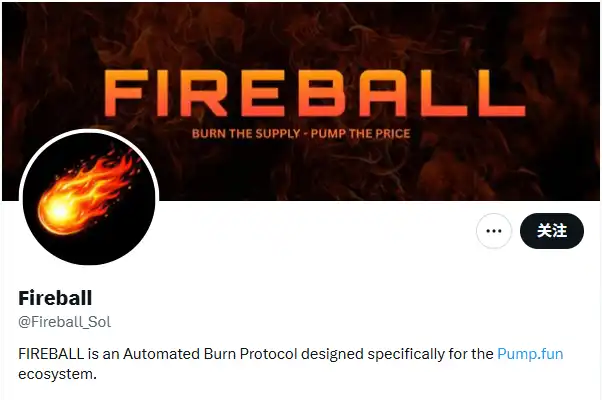
Within the pump.fun ecosystem, a token called FIREBALL is doing something similar: automatic buybacks and burns, packaged as a protocol other tokens can plug into. But its market cap is much smaller than Snowball's.
This indicates the market is currently responsive to the direction of "mechanism-based meme coins."

The traditional玩法 of shilling, pumping, and community hype is finding it harder to attract capital. Using mechanism design to tell a "structurally safe" story might be one of the recent trends for meme coins.

That said, artificially creating a specific mechanism isn't a new玩法.

The most typical case in 2021 was OlympusDAO's (3,3), which used game theory to package a staking mechanism, telling the story "if everyone holds, everyone profits," reaching a peak market cap of billions of dollars. The ending, as everyone knows, was a death spiral, dropping over 90%.

Even earlier, there was Safemoon's玩法 of "taxing every transaction and distributing it to holders," also a narrative of mechanism innovation, which ended with the SEC suing and charging the founders with fraud.

Mechanisms can be great narrative hooks, capable of gathering capital and attention in the short term, but the mechanism itself does not create value.

When external capital stops flowing in, even the most精巧designed flywheel will stop turning.

Finally, let's recap what this little gem is actually doing:

Turning the meme coin's creator fees into an "automated market-making bot." The mechanism itself isn't complicated, and the problem it solves is very clear: preventing developers from directly taking the money and running.

The developer not being able to rug doesn't mean you will make money.

If after reading this you find the mechanism interesting and want to participate, remember one thing: it is first and foremost a meme coin, and only secondly an experiment with a new mechanism.


Perguntas relacionadas

QWhat is the core mechanism that Snowball uses to create a 'self-rolling' effect?

ASnowball uses a mechanism where 100% of the creator fees from each transaction are automatically sent to an on-chain market-making bot. This bot periodically uses the accumulated funds to buy tokens (creating buy pressure), adds the purchased tokens and corresponding SOL to the liquidity pool, and burns 0.1% of the tokens to create deflation.

QHow does the creator fee in Snowball differ from a typical pump.fun token?

AIn a typical pump.fun token, the creator fee (usually 0.5% to 1%) goes directly into the developer's wallet, which they can withdraw and potentially abandon the project with. In Snowball, 100% of this fee is automatically sent to an on-chain market-making bot instead of going to any individual, making it structurally harder for the developer to 'rug pull'.

QWhat are the potential risks of investing in a meme coin like Snowball, according to the article?

AThe risks include a general decline in market activity and meme coin hype, which could lead to reduced trading volume. If new buying pressure doesn't materialize, the bot's funding from fees decreases, weakening buy support and price stability. Other risks not solved by the mechanism include large holders (whales) dumping, insufficient liquidity, and the narrative simply falling out of fashion.

QWhat precedent does the article mention for meme coins with innovative mechanisms, and what was their outcome?

AThe article mentions OlympusDAO's (3,3) staking mechanism, which promised mutual gains if holders sold, but its市值 eventually fell over 90%. It also references Safemoon, which used a transaction tax redistribution mechanism and whose founders were later charged with fraud by the SEC. These examples show that mechanisms can be a good narrative but don't inherently create value if external capital stops flowing in.

QWhat key piece of advice does the article give to potential participants interested in Snowball's mechanism?

AThe key advice is to remember that Snowball is first and foremost a meme coin, and only secondly an experiment with a new mechanism. While the mechanism addresses developer rug pulls, it does not guarantee profits. Participants are advised to 'play but don't get too carried away' or 'don't go overboard'.
Leituras Relacionadas

WSJ: Unveiling the Secret Jury That Controls Disputes on Polymarket

Last month, Garrick Wilhelm lost a $567 bet on the Polymarket prediction platform about whether a ceasefire would be reached with Hezbollah. When a truce was announced, some traders argued it counted, but Wilhelm disagreed. The dispute was settled not by Polymarket, but by a decentralized group of UMA token holders who vote on such disagreements. As trading surges, resolving ambiguous outcomes is a growing challenge for prediction markets. Unlike competitors like Kalshi that decide internally, Polymarket outsources dispute resolution to UMA. Its token holders, mostly anonymous and with voting power weighted by holdings, arbitrate cases. Critics argue this system is prone to manipulation, as voters can also bet on the same markets they judge. A Wall Street Journal analysis found that over the past year, at least 60% of active UMA voters had corresponding Polymarket accounts and held positions in disputes they voted on. Voting power is also concentrated among a few large holders. Polymarket says only 0.2% of bets go to UMA and that the system disperses authority. Its founder has acknowledged flaws and promised fixes. UMA's backers deny any proven manipulation, dismissing critics as sore losers. The platform penalizes voters in the minority to incentivize "correct" outcomes. Disputes are rising, covering topics from a streamer's pregnancy announcement to Iran. This model also helps Polymarket argue it's an offshore platform outside U.S. regulation, a shift made after a 2022 settlement with the CFTC. Some losing traders have formed groups to protest, targeting entities like UMA.rocks, which aggregates votes. Its founder says traders often blame UMA for their own mistakes. A recently ousted committee member, Scout, admitted to both betting and voting but argued involved voters research more thoroughly. He highlighted the dilemma: "Either you have conflicted traders deciding, or you have uninformed outsiders voting. There is no perfect answer right now."

marsbitHá 39m

WSJ: Unveiling the Secret Jury That Controls Disputes on Polymarket

marsbitHá 39m

China's AI Circle Has Just Established a Pecking Order, and Capital Is Already Changing the Rules Again

The article describes how the valuation logic for major Chinese AI model companies has undergone three dramatic shifts between 2022 and 2026, driven by capital's changing priorities. The first phase (around 2022) was **technology-driven valuation**, where funding was based on model performance and benchmark scores. This logic was disrupted when DeepSeek's R1 model demonstrated that comparable capabilities could be achieved at a fraction of the cost, challenging the notion of technical superiority as an unassailable moat. The second phase shifted to **IPO window-driven valuation**. Following favorable listing conditions in Hong Kong, capital flowed to companies like Zhipu and MiniMax with the clearest path to a public listing. However, this focus on liquidity over fundamentals became apparent as their Annual Recurring Revenue (ARR) lagged far behind international peers like Anthropic. The third and current phase is **national strategy-driven valuation**. This shift was marked by the state-backed "Big Fund" leading a major investment in DeepSeek, signaling that leading domestic AI models are now viewed as strategic national assets comparable to semiconductor manufacturing. This new logic, combined with soaring US valuation benchmarks (e.g., OpenAI at $850B), propelled the combined valuation of China's top AI firms ("The Four Dragons"/"Five Strong") past 1 trillion RMB. The article presents a "pricing leap model": each shift is triggered by a key event that invalidates the old logic, leading to rapid capital reallocation under a new narrative before its flaws (particularly the gap in fundamental ARR metrics) become evident. It concludes that the next major test for these valuations will be a return to scrutinizing core business fundamentals, specifically ARR growth, suggesting a fourth pricing shift is imminent.

marsbitHá 1h

China's AI Circle Has Just Established a Pecking Order, and Capital Is Already Changing the Rules Again

marsbitHá 1h

'Stock God' Trump's 3,642 Trades Disclosed: The 'Perfect Closed Loop' of Policy and Portfolio

Summary: Donald Trump's First Quarter stock trades, totaling 3,642 transactions, have been disclosed. While the White House maintains the trades were managed by an advisor and complied with disclosure laws, they reveal a portfolio heavily aligned with his policy agenda. The trades show a rotation away from major tech stocks like Microsoft, Amazon, and Meta, and into semiconductor and AI hardware companies such as NVIDIA, AMD, Broadcom, Dell, and Intel. Notably, Trump's account purchased Dell stock before he publicly praised the company, after which its stock rose. The Dell family also pledged funds to a Trump-affiliated policy project. A critical case is Intel. The Trump administration converted $8.9 billion in CHIPS Act subsidies into a 9.9% equity stake, making the U.S. government Intel's largest shareholder. Months later, Trump's personal account also bought Intel stock. This intertwines national industrial policy with potential personal financial interest. Unlike typical insider trading concerns, this situation creates a "closed loop": policy decisions (e.g., subsidies, tariffs, crypto regulation) can boost the value of his holdings, and those holdings may, in turn, influence future policy directions. This blending of presidential power and personal portfolio, while legally disclosed, raises profound questions about conflicts of interest that current rules do not address.

marsbitHá 1h

'Stock God' Trump's 3,642 Trades Disclosed: The 'Perfect Closed Loop' of Policy and Portfolio

marsbitHá 1h

Dialogue with Figure Robotics Founder: Behind the $39 Billion Valuation Lies Ambition to Mass-Produce Millions of Units

Title: Figure's Founder on the $39B Valuation and the Ambition to Mass Produce a Million Humanoid Robots In a Sourcery podcast interview, Figure founder and CEO Brett Adcock discusses the rapid rise of his humanoid robotics company. With a valuation that surged 15x in 18 months to $39 billion, Figure aims to create general-purpose humanoid robots for work in factories and homes. Adcock states that the company's primary goal is to make robots that perform real, paid work autonomously. He shares Figure's aggressive scaling plan: producing thousands of robots this year, with an ultimate ambition to reach one million units annually. Adcock explains Figure's vertically integrated strategy, designing its own motors, sensors, and joints to control its supply chain and destiny. He details the challenges, including achieving long-term, reliable, end-to-end autonomous operation—a feat no one has yet accomplished. The biggest risk is executing this complex vision at scale, but Adcock believes the potential market is enormous, representing a significant portion of global GDP. The interview also covers his departure from OpenAI, citing that Figure's internal AI team eventually surpassed OpenAI's capabilities for robotics applications. Adcock concludes by highlighting his focus for the year: large-scale commercial deployment of robots and advancing toward a "general robot" capable of any human task, potentially seeing the first signs of AGI (Artificial General Intelligence) in the physical world at Figure.

marsbitHá 1h

Dialogue with Figure Robotics Founder: Behind the $39 Billion Valuation Lies Ambition to Mass-Produce Millions of Units

marsbitHá 1h

Trading

Spot
Futuros

Artigos em Destaque

Como comprar QUICK

Bem-vindo à HTX.com!Tornámos a compra de Quickswap (QUICK) simples e conveniente.Segue o nosso guia passo a passo para iniciar a tua jornada no mundo das criptos.Passo 1: cria a tua conta HTXUtiliza o teu e-mail ou número de telefone para te inscreveres numa conta gratuita na HTX.Desfruta de um processo de inscrição sem complicações e desbloqueia todas as funcionalidades.Obter a minha contaPasso 2: vai para Comprar Cripto e escolhe o teu método de pagamentoCartão de crédito/débito: usa o teu visa ou mastercard para comprar Quickswap (QUICK) instantaneamente.Saldo: usa os fundos da tua conta HTX para transacionar sem problemas.Terceiros: adicionamos métodos de pagamento populares, como Google Pay e Apple Pay, para aumentar a conveniência.P2P: transaciona diretamente com outros utilizadores na HTX.Mercado de balcão (OTC): oferecemos serviços personalizados e taxas de câmbio competitivas para os traders.Passo 3: armazena teu Quickswap (QUICK)Depois de comprar o teu Quickswap (QUICK), armazena-o na tua conta HTX.Alternativamente, podes enviá-lo para outro lugar através de transferência blockchain ou usá-lo para transacionar outras criptomoedas.Passo 4: transaciona Quickswap (QUICK)Transaciona facilmente Quickswap (QUICK) no mercado à vista da HTX.Acede simplesmente à tua conta, seleciona o teu par de trading, executa as tuas transações e monitoriza em tempo real.Oferecemos uma experiência de fácil utilização tanto para principiantes como para traders experientes.

152 Visualizações TotaisPublicado em {updateTime}Atualizado em 2025.03.21

Como comprar QUICK

Discussões

Bem-vindo à Comunidade HTX. Aqui, pode manter-se informado sobre os mais recentes desenvolvimentos da plataforma e obter acesso a análises profissionais de mercado. As opiniões dos utilizadores sobre o preço de QUICK (QUICK) são apresentadas abaixo.

活动图片