以太坊基金会遭“前任”检举:当年The DAO被盗系自导自演

Odaily星球日报Publicado em 2023-12-21Última atualização em 2023-12-21

Resumo

以太坊啊,偏偏你因陈年旧事才有些热度?

原创 | Odaily星球日报

作者 | 0xAyA

以太坊基金会遭“前任”检举:当年The DAO被盗系自导自演Solana 的攻势汹汹来袭,而 ETH 看起来却毫无还手之力。这不,近期,以太坊又迎来场“指控危机”。

ETH 曾经面临过很多凶险时刻,最惊险的一次莫过于 The DAO 事件,这次黑客攻击事件几乎摧毁了整个社区。而最终,支持回滚和反对回滚的双方在分叉完成后停止了争论,一切看似也尘埃落定。

但就在最近,却又有基金会的前成员爆出言论,指出 The DAO 事件是基金会成员一手策划,此番言论到底是真是假?

7 年前的以太坊往事

让我们简单先回顾一下历史。DAO,即去中心化自治组织,最早是由V神提出的一个概念。DAO 依靠智能合约在区块链上运行,没有法律实体,我们可以把它理解成“去中心化的公司”。

而 The DAO 则是区块链公司 Slock.it 发起的一个众筹项目。

以太坊基金会遭“前任”检举:当年The DAO被盗系自导自演

Slock.it 是一家将区块链与物联网相结合的公司。一开始,他们只是想利用以太坊来开发他们的“全民分享网络”。随着开发的深入,他们发现,去中心分享经济很有前景。他们在伦敦的 Devcon 1 大会上演示了这个概念和愿景,出乎意料的是,这个项目反响热烈。于是,就有了 The DAO 项目。

在 The DAO 项目中,代币的持有人拥有很大的权力——项目资金的用途需要代币持有人投票决定,相关的提议由智能合约支撑。

2016 年 4 月 30 日,The DAO 项目开始众筹。项目代币 DAO,众筹时间为期 28 天,总共筹到了超过 1200 万个 ETH,几乎占到了当时 ETH 总数量的 14% ,时价超 1.5 亿美元。

同年 6 月 12 日,The DAO 背后的主要设计师之一 Stephan Tual,声称他们发现了软件中存在“递归调用漏洞”问题。

然而,或许是众筹成功的喜悦掩盖了潜在的危险, 6 月 17 日,黑客利用 The DAO 代码里的一个递归漏洞,不停地从 The DAO 资金池里分离资产;随后,黑客利用了 The DAO 的第二个漏洞,避免分离后的资产被销毁,进行了两百多次攻击,总共盗走了 360 万的以太坊,超过了该项目筹集的以太坊总数目的三分之一。

如果是正常情况,The DAO 的资产被分离之后,就会被销毁。但是,黑客在调用结束前,把盗来的 The DAO 资产转移到了其他账户,避免了被销毁。万幸的是,也正是由于这些“不良”代码,黑客无法将这些以太坊提走。因为代码里规定,要过 28 天之后才能提现,这给了社区足够的时间研究对策黑客利用这两个漏洞。

最终,经过社区讨论,决定对 ETH 进行分叉。分叉形成了两条链,未改变黑客盗币事实的原链成为 ETC,而抹去了盗币事实的链成为了新的 ETH,各自代表不同的社区共识。

7 年后被前任“检举”

Steven Nerayoff——以太坊基金会的前法律顾问与咨询师,在最近接受博客采访时表示V神曾经和他一起住在纽约,并在他租用的办公室里工作。他在博客上以太坊的 DAO 黑客攻击是内部人员所为,他声称,TruthLabs 发现的证据表明,以太坊基金会和 Slock.it 是臭名昭著的 The DAO 黑客事件的幕后黑手,其认为以太坊已经成为一个受少数开发者、监管机构和投资者影响的系统,其行为与社区的意图相悖。

同时,Nerayoff 还点名了前 SEC 主管 Bill Hinman,指出 Hinman 个人财务冲突对 SEC 诉 Ripple 案的潜在影响。

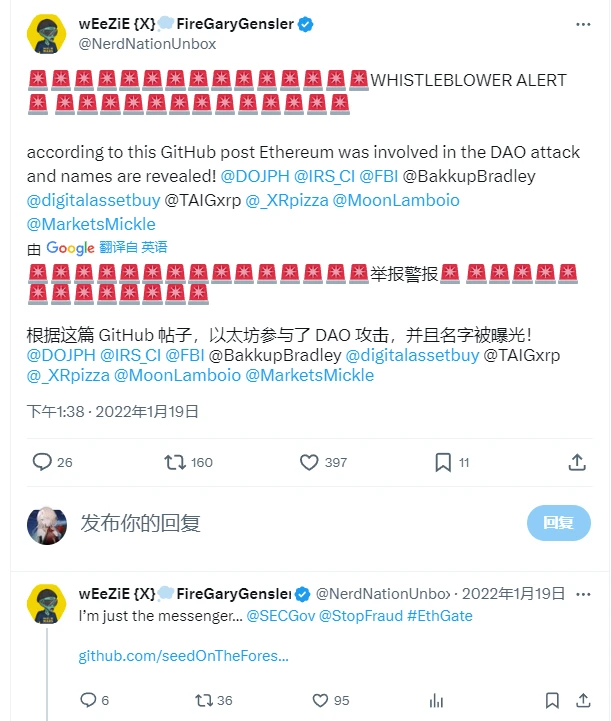
此后,有 X 用户翻出了一篇GitHub 文章,该文章指控 Swiss SA Bity 可能与其他以“白帽集团”或“罗宾汉集团”名义运营的组织合作,并对 The DAO 这起盗窃事件负责,他们目前仍持有约 7, 000, 000 个以太币,而“白帽集团”则是由以太坊基金会的 Alex Van De Sande 负责组织的。
以太坊基金会遭“前任”检举:当年The DAO被盗系自导自演

有意思的是,Steven Nerayoff 曾被美国司法部于 2019 年指控犯有刑事敲诈勒索罪,其个人信誉受到打击。一名纽约法官于 2023 年 5 月驳回了这项指控,并清理了他的指控。

Nerayoff 的指控是真是假?我们暂时不得而知,且有待官方回应,但至少指控者的言论重新让 ETH 在这个自身缺席的牛市获得了一丝丝的关注?

Leituras Relacionadas

Microsoft Announces Commercial-Grade Quantum Computer to be Completed in Three Years: Will the Boots Land?

Microsoft announces plans to build a commercially viable quantum computer by 2029, a significant acceleration from the previous industry consensus of a decade. The breakthrough is fueled by their new Majorana 2 quantum chip, which boasts a record-breaking average qubit lifetime of 20 seconds—a 1,000-fold reliability improvement over its predecessor. This leap was achieved by leveraging topological qubits, a theoretically more stable technology using Majorana zero modes, and switching the core superconducting material from aluminum to lead. Crucially, Microsoft's "Discovery" agentic AI platform accelerated the R&D process. AI agents autonomously analyzed vast experimental data, optimized manufacturing parameters (like the lead alloy composition), and solved issues like "ghost noise," dramatically speeding up experimentation. While the 20-second coherence time is a landmark, challenges remain: scaling from 12 qubits to the millions needed for practical applications, managing compilation costs, and verifying quantum results. Skeptics call for peer-reviewed data, and questions persist about whether even 20 seconds is sufficient for complex algorithms like breaking RSA encryption. The race is on with other approaches (superconducting, trapped ions), but Microsoft's confidence in its topological roadmap signals a potential shortcut to a scalable quantum future.

marsbitHá 11m

Microsoft Announces Commercial-Grade Quantum Computer to be Completed in Three Years: Will the Boots Land?

marsbitHá 11m

Is There Really a "World Cup Curse" in the Market?

Is there really a "World Cup Curse" affecting markets? Historical data shows global equity markets often underperform during the tournament. The S&P 500 has averaged negative returns of -1.5% to -2.11% across 19 World Cups since 1950, with declines in 58% of events. China's Shanghai Composite fell in 71% of tournaments since 1994. Studies confirm reduced trading activity during matches, with volumes dropping significantly, especially when a home nation plays. A team's loss can also lead to negative sentiment and selling pressure in its domestic market the next day. However, the "curse" may be partly attributed to seasonal weakness. Many tournaments are held in June-July, a historically weaker period for stocks ("Sell in May and go away"). The 2022 Qatar World Cup, held in November-December, saw a smaller drop in trading volume compared to summer events, suggesting timing plays a role. The cryptocurrency market's performance during World Cups has been mixed and largely driven by its own major catalysts (e.g., Mt. Gox hack, FTX collapse, halving cycles) rather than the tournament. Investment opportunities have shifted over time. Traditional beneficiaries like TV manufacturers have seen fading returns as streaming platforms become the core viewing channel. Classic consumer plays like beer and sportswear face challenges from changing consumption trends. Newer digital assets, like fractionalized collectible player cards on blockchain, have seen explosive growth. While gambling is a traditional sector, prediction markets are emerging. In conclusion, while a statistical correlation exists, the World Cup's direct impact on markets is likely limited and intertwined with seasonal patterns. With lower liquidity during the event, the simplest strategy for many might be to step back from trading and enjoy the games.

marsbitHá 18m

Is There Really a "World Cup Curse" in the Market?

marsbitHá 18m

Why 'AI Service Subscription' Is Destined to Die Out?

"Why 'AI Service Subscription Models' Are Doomed to Disappear" The article argues that the flat-rate subscription model for AI services is fundamentally unsustainable. It points to recent industry shifts, such as Anthropic limiting access to its flagship Claude Fable 5 model for subscribers after just 14 days, and GitHub and OpenAI moving towards credit-based or usage-based billing. The core problem is that subscription models rely on a capped human consumption limit—like watching videos or listening to music—which keeps costs predictable. However, the rise of autonomous AI agents shatters this premise. Agents can consume 5 to 30 times more computing resources (tokens) than a human chatting, and they operate continuously without user presence. This removes the natural usage cap, making fixed-price plans financially unviable as heavy users incur massive costs. Attempts to patch the model with higher tiers or usage caps have failed, often leading to "adverse selection" where only the heaviest users subscribe. The industry's solution is to hollow out subscriptions, replacing "unlimited" access with prepaid credits charged per token, akin to a utility meter. While chat-based subscriptions may linger, the real value and revenue are shifting to pay-as-you-go models. The current period represents a final, heavily subsidized phase for users. The conclusion is that the soul of subscription—a fixed price for worry-free use—is dying, soon to be replaced by pure usage-based pricing where everyone pays for their own "electricity meter."

marsbitHá 19m

Why 'AI Service Subscription' Is Destined to Die Out?

marsbitHá 19m

Trading

Spot
Futuros
活动图片