Subscription models will be hollowed out. Use it while you still can.
On June 9, Anthropic released its most powerful public model to date, Claude Fable 5. As per tradition, this should have been a celebration for paying subscribers—your monthly fee finally granting you first dibs on the flagship model.
But a single line in the announcement sparked immediate and widespread controversy: After June 22, Fable 5 will be removed from all subscription plans, requiring separate purchases of usage credits for continued access.
In other words, even if you're a paying member, the flagship model is only yours to use for 14 days.
A model arriving with its own 'eviction notice' on launch day is unprecedented in the AI industry.
Many view this as a misstep or an act of arrogance by Anthropic. My take is the opposite: This is not a mistake; it's a preview.
The AI subscription model is heading toward an inevitable demise—not because any company is greedy, but because the very premise on which subscriptions are built is being dismantled, by AI itself.
01 A Flagship Model with a 14-Day Countdown
Let's lay out the facts first. According to Anthropic's official schedule (June 9, 2026), Fable 5 will be included for free in Pro, Max, Team, and seat-based Enterprise plans from launch until June 22. Starting June 23, it will be removed from these plans, with every subsequent token charged against prepaid usage credits at the same rate as the API.
This rate isn't cheap: $10 per million input tokens and $50 per million output tokens, exactly double the rate of the previous flagship, Opus 4.8. More subtly, even during the free window, Fable 5 consumption counts roughly double against subscription limits—doing the same work burns through your allowance twice as fast.
The user reaction was predictable. On Hacker News, someone bluntly called this 'give-then-take' move unsettling, suspecting Anthropic aimed to nudge subscribers toward pay-as-you-go. Another developer reported that on the $100/month Max plan, a single agent programming session consumed nearly $100 worth of tokens.
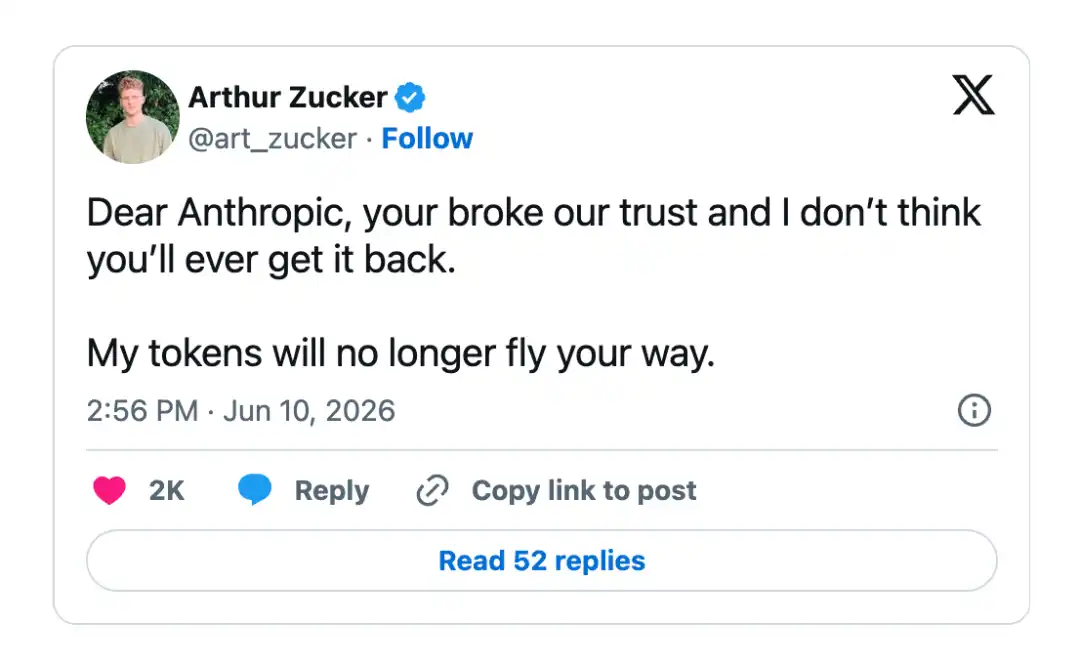
And this isn't an isolated move by Anthropic. Over the past eight weeks, the entire industry has been doing the same thing. On April 2, OpenAI switched Codex from per-message billing to per-token billing aligned with its API, later extending this to all existing enterprise customers.
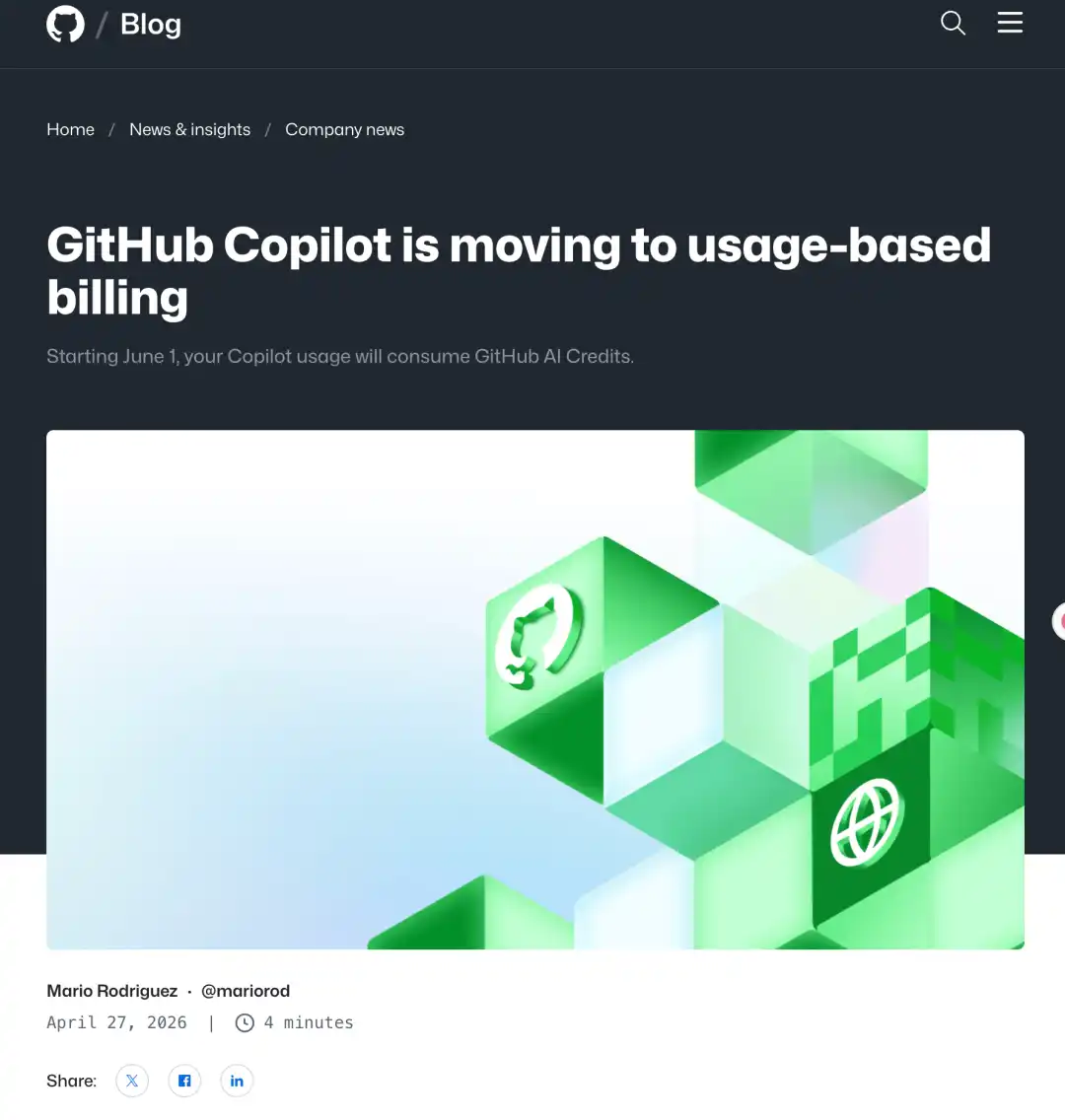
GitHub froze new personal Copilot registrations on April 20, announced a full shift to AI Credits billing a week later, and completed the transition by June 1—the $10/month Pro tier now comes with a $10 credit.
Anthropic's own moves have been the most frequent. Starting April 4, it banned third-party agent frameworks like OpenClaw from using subscription allowances, forcing them onto pay-as-you-go. On April 21, a red 'X' mysteriously appeared next to Claude Code on the Pro plan pricing page, causing an uproar and retracted within 24 hours with an official 'small test for about 2% of new users' explanation. On May 14, it was formally announced that starting June 15, the Agent SDK and headless usage would be removed from subscription pools, becoming independent credits charged at API rates.
Three companies, eight weeks, the same direction—this isn't a coincidence; it's the entire industry turning in the same answer sheet to the same math problem.
What does that math problem look like?
02 What's Being Priced Is Never Compute
Research firm SemiAnalysis recently put this math problem on the table. They purchased one of each subscription tier from Anthropic and OpenAI, ran long programming tasks until exhausting the weekly limits, and then converted that usage into dollar values based on API list prices.
The prevailing industry belief was that a $200/month plan could, at most, generate around $2000 worth of tokens. The actual results far exceeded this: The $20 Claude Pro had an upper limit of about $400; the $200 Max 20x, about $8000.
OpenAI's numbers were even more staggering—the $20 ChatGPT Plus could yield about $700 worth, and the $200 Pro 20x, about $14,000.
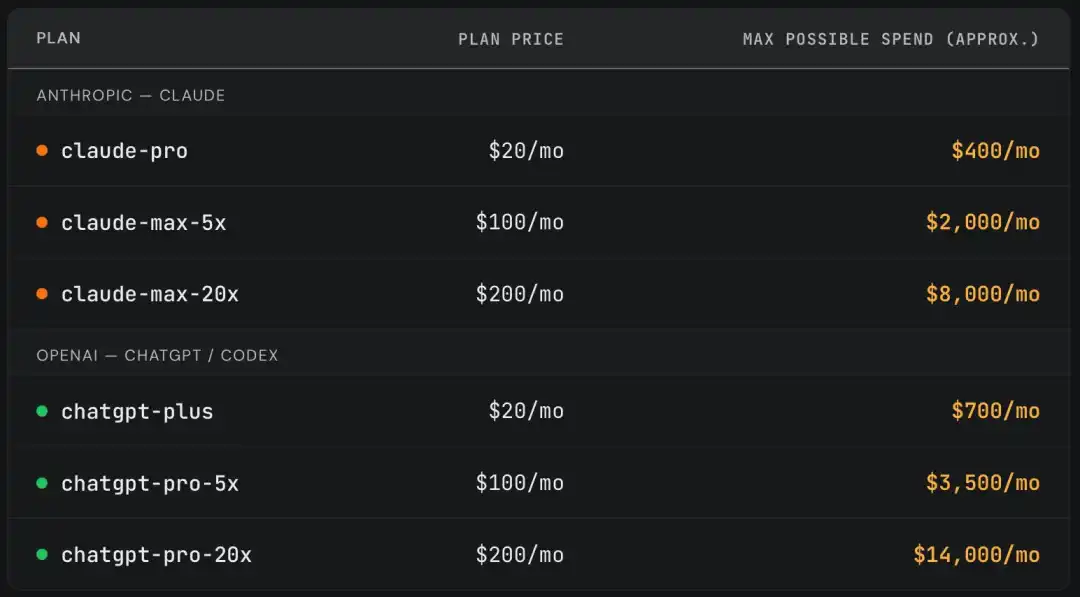
Two fair points must be made upfront: These are 'maxed-out limit' upper bounds, not typical daily usage levels for average users; API list prices include a margin, so the conversion numbers don't equal real compute costs.
But pricing must account for the upper bound—an insurance company cannot assume no one will file a claim.
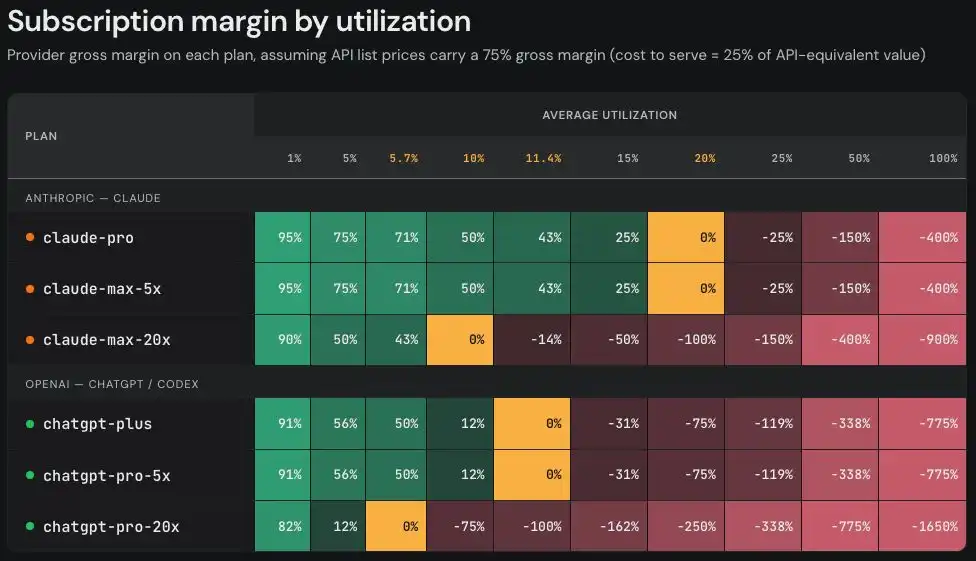
Subsidies themselves aren't fatal. Streaming services have subsidized, ride-hailing apps have subsidized; burning cash for growth is the internet's ancestral craft. What's truly fatal is that AI subscriptions have a fundamental difference from those models.
Netflix dares to sell subscriptions based on two things: the marginal cost of adding one more show approaches zero, and a person has at most 24 hours a day to watch. Spotify is the same. The implied premise of flat-rate subscriptions is that consumption is capped by human physiological limits—what's truly being priced is never the content, but a person's time.
AI in the chatbot era barely fit this premise. Even the chattiest person has a limit to how much they can type in a day; the unused allowances of light users could cover the overconsumption of heavy users.
Then, Agents arrived.
What does a single agent task look like? It reads 20 files, makes plans, modifies code, runs tests, reads errors, and iterates—one round consumes 5 to 30 times the tokens of a normal conversation. Worse yet, it doesn't require your presence.
I've experienced this myself: I recently had an agent organize flight data for two airports. I went to take a shower, came back to find the task completed, and my allowance nearly depleted. You're asleep, the meter's running.
What agents eliminate isn't the price ceiling, it's the consumption ceiling. And every evolutionary direction in the AI industry—longer tasks, greater autonomy, parallel instances—is sprinting toward the same endpoint:
Removing humans from the consumption loop entirely.
GitHub's announcement put it bluntly: agent usage 'is becoming the default.' This means the only scenario where subscriptions could still barely hold—people sitting at their screens chatting one line at a time—will only constitute a shrinking portion of AI's value map.
At this point, some might ask: The subsidy is too deep, so why not just raise prices?
They tried, and got an even worse result. Looking back at the SemiAnalysis table, there's a counterintuitive detail: the higher the tier, the greater the subsidy multiplier.
On Claude's side, the $20 tier is a 20x multiplier, while the $200 tier is 40x; on OpenAI's side, it jumps from 35x to 70x. Half is by pricing design—higher tiers multiply allowances, effectively giving bulk discounts to big customers. The other half is user behavior—those willing to spend $200 on a 20x plan are doing so specifically to max it out; light users wouldn't even appear in this tier.
In the insurance industry, this has a name: adverse selection. When a policy's price attracts only the highest-risk applicants, that policy has no actuarial path to viability. Any fixed price will precisely filter in the users whose usage exceeds it—this isn't an operational issue, it's structural. Adjusting prices only makes the filter finer.
Throughout all of 2025, the industry essentially tried every patch. In January, Sam Altman admitted on X that the $200/month ChatGPT Pro was losing money due to usage far exceeding expectations—the price hike tier failed.
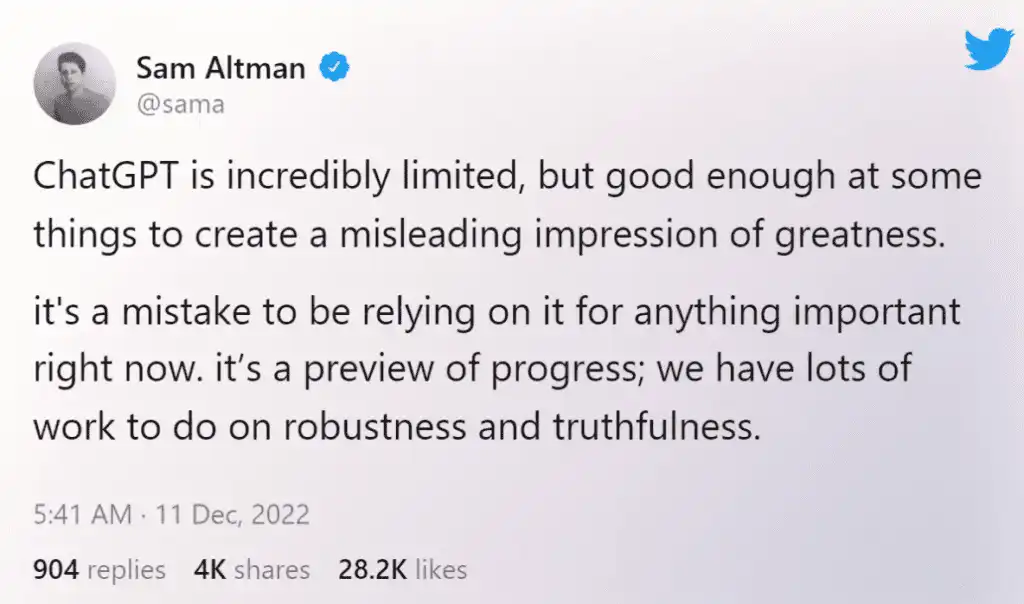
Mid-year, Cursor changed from per-request to per-compute billing, triggering massive cancellations and a public apology from the CEO—midstream rule changes failed. In the summer, Anthropic added weekly limits to Claude Code, citing users running agents 24/7 with individual compute costs in the tens of thousands of dollars—throttling only attracted fury.
After all patches failed, we got the collective showdown of these past eight weeks. OpenAI's ChatGPT lead, Nick Turley, spelled it out on the BG2 podcast: 'In this current era, offering unlimited plans might be like offering unlimited electricity plans.'
03 The Shell Remains, the Core Is Already Dead
Of course, there's a seemingly strong counterargument: Subscription models are clearly still alive and well. ChatGPT Plus is still $20/month, Claude Pro is still for sale, GitHub's code completion even retains flat-rate pricing. Is talk of demise just alarmism?
This counterargument deserves serious consideration because the phenomenon it describes is real. But it misidentifies what is dying.
The soul of a subscription was never the form of 'charging once a month,' but the promise of 'fixed price, use with peace of mind'—you don't have to calculate the cost of each use. That was the entire reason it triumphed over pay-per-use in the first place.
What's happening now is: The billing cycle remains, but the promise is being pulled away.
GitHub Pro's $10 monthly fee now contains a $10 credit, used up and done—this isn't a subscription; it's a prepaid card disguised in subscription clothing. Anthropic's credits are deducted at API rates; OpenAI's credits support auto-replenishment. Subscription models won't be canceled; they will be hollowed out. The shell remains, but the core is already dead.
There remains one true enclave: pure chat. It can still have flat-rate pricing because it's the last AI scenario where consumption is still capped by human time. But a moat cannot protect an enclave—every dollar of R&D in this industry pushes AI from 'you ask, it answers' toward 'it proactively helps you complete.'
Chat subscriptions won't be killed; they will be marginalized: left behind, watching real value and real revenue gradually migrate into the world of pay-as-you-go.
Another coincidental timing is hard to ignore. According to a TechCrunch report (June 2026), as Fable 5 launched, Anthropic was preparing for an IPO alongside OpenAI. Over the past three years, subsidies have been funded by venture capital; public market investors will not accept a P&L statement that 'loses more money with every heavy user.' The capital exit schedule dictates that the showdown cannot be postponed indefinitely.
This means different things for different parties. For enterprises, AI spending must now be managed like cloud spending—The Information reported that Uber's CTO stated in an internal memo the company burned through its entire 2026 AI budget in just four months. Budgeting, installing monitoring, and routing models per task will become required skills for every team.
For individual users, the past saw light users subsidizing heavy users. Now, everyone pays for their own meter.
To be honest, this might not be all bad. With the return of price signals, 'Is this task worth running an AI on?' becomes a real question for the first time—and when an industry starts seriously answering that question, it's often the beginning of its move away from the cash-burn narrative toward a normal business.
Writing this, I want to interject one sentence: Before the meter is installed, the current subscription model is likely the most generous moment this industry will ever offer users—use it while you still can, and cherish it.
The logic is hidden in that SemiAnalysis table. Read from the user's perspective, it's not a death sentence at all, but a still-active benefit list: You pay $200 a month, and the platform lets you burn up to $14,000 worth of compute.
The last time we saw subsidies of this magnitude was during the ride-hailing and food delivery wars—and we all remember how those ended. After the subsidies faded, prices never went back.
So run those heavy tasks now, while you can. For instance, Fable 5's window in subscriptions only lasts until June 22. Instead of carefully budgeting when the credit era arrives, better to schedule those long-running tasks you've always wanted to run but found too expensive. This isn't about gaming the system—it's about being a clear-eyed beneficiary of a pricing error that is destined to be corrected.

Turley's metaphor may run deeper than he intended. The true sign of electricity becoming infrastructure isn't that it reached every household, but that every household installed a meter—from that moment on, no one debated 'should electricity be flat-rate?', they only debated the electricity rate.
There will be no obituary for the subscription model. It will simply become a small line item on your expense report labeled 'admission fee' on some quiet billing day.
Until then—use it while you still can, and cherish it.







