XRP ETFs Are Going Crazy In May As Outflows Die Down

bitcoinistPublished on 2026-05-26Last updated on 2026-05-26

Abstract

Despite a bearish market and declining XRP price, XRP ETFs continue to see strong demand and steady net inflows, reaching $116.74 million in May with total inflows of $1.41 billion since launch. This contrasts with Bitcoin and Ethereum ETFs, which are experiencing significant outflows. Analysts attribute the institutional interest in XRP ETFs to positioning ahead of upcoming catalysts like the CLARITY Act and increased XRP Ledger tokenization, rather than short-term price movements. Meanwhile, negative crowd sentiment around XRP is viewed by some as a potential contrarian buy signal. XRP price was around $1.33 at the time of writing.

The XRP ETFs continue to see significant demand despite the current bear market conditions, with XRP on the decline. These funds are also outperforming the Bitcoin and Ethereum ETFs, which are seeing outflows as BTC and ETH trend downwards.

XRP ETFs Record Steady Inflows Even As Price Declines

SoSoValue data shows that the XRP ETFs have yet to record any outflows this month, boasting a net inflow of $116.74 million. These funds now have a total net inflow of $1.41 billion since they launched last year. Meanwhile, they hold total net assets of $1.13 billion, which represents 1.36% of XRP’s market cap.

These inflows into the XRP ETFs come despite XRP’s downtrend alongside the broader crypto market. The altcoin notably dropped to a new low of around $1.31 last week, but funds have yet to see outflows, signaling strong institutional demand. These ETFs are also notably outperforming the Bitcoin and Ethereum ETFs.

Further data from SoSoValue shows that Bitcoin ETFs have seen net outflows of $1 billion this month and are currently on a six-day streak of consecutive outflows. At the same time, the Ethereum ETFs have seen net outflows of almost $300 million and are currently on a 10-day streak of consecutive outflows.

Meanwhile, continued inflows into XRP ETFs coincide with XRP’s crowd sentiment turning negative again. The ratio of positive to negative commentary is dropping to just 1.1 bullish comments per 1 bearish comment, according to Santiment. The on-chain analytics platform noted that historically, this kind of fear and skepticism has often acted as a contrarian signal for XRP’s price. As such, this could be the perfect buy-the-dip opportunity in preparation for a potential bullish reversal.
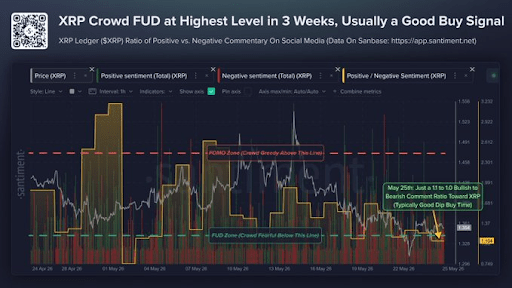
Source: Chart from Santiment on X

What Institutional Investors Are Focused On

In an X post, crypto pundit X Finance Bull said that institutions buying XRP through ETF products are not reacting to the weekly price action but are positioning ahead of catalysts. These catalysts include the CLARITY Act, Kevin Warsh as the new Fed Chair, the DTCC tokenization going live in July, Ripple Prime’s $200 million debt facility, and the JPMorgan settlement on the XRP Ledger.

X Finance Bull remarked that institutional capital is making a statement about which assets they believe in through the downturn, as Bitcoin and Ethereum ETFs see outflows while XRP ETFs see inflows. He added that smart money accumulates when the price goes down. Notably, XRP is expected to be one of the biggest beneficiaries of the CLARITY Act, especially as Ripple continues to expand its operations. Another bullish catalyst for XRP is that the XRP Ledger continues to see increased tokenization activity.

At the time of writing, the XRP price is trading at around $1.33, down in the last 24 hours, according to data from CoinMarketCap.

XRP trading at $1.34 on the 1D chart | Source: XRPUSDT on Tradingview.com

Related Questions

QWhat is the current performance trend of XRP ETFs compared to Bitcoin and Ethereum ETFs, according to the article?

AXRP ETFs are seeing continued net inflows, while Bitcoin and Ethereum ETFs are experiencing net outflows.

QHow much net inflow have XRP ETFs recorded in May (as of the article's data), and what is their total net inflow since launch?

AXRP ETFs have recorded a net inflow of $116.74 million in May and a total net inflow of $1.41 billion since their launch last year.

QWhat does the article suggest is a potential reason for institutional investors to buy XRP ETFs despite the price decline?

AThe article suggests institutions are positioning ahead of future catalysts, such as the CLARITY Act, Fed Chair changes, the DTCC tokenization launch, Ripple Prime's debt facility, and the JPMorgan settlement on the XRP Ledger.

QWhat does Santiment's data indicate about crowd sentiment towards XRP, and why might this be significant?

ASantiment's data shows XRP's crowd sentiment has turned negative, with a low ratio of positive to negative commentary. Historically, such fear and skepticism have often acted as a contrarian signal, potentially indicating a buy-the-dip opportunity.

QWhat is the total value of assets currently held by XRP ETFs, and what percentage of XRP's market cap does this represent?

AXRP ETFs hold total net assets of $1.13 billion, which represents 1.36% of XRP's market cap.

Related Reads

From Mining Pool to Mars: Why Is Wang Chun in the SpaceX Cockpit?

Title: From Mining Pool to Mars: Why Wang Chun is in the SpaceX Cockpit? When SpaceX announced that Wang Chun, co-founder of F2Pool, would command the first commercial crewed interplanetary mission, many were shocked. Why would a Bitcoin mining pool founder be on a Mars mission roster? However, understanding Wang Chun's journey over the past decade and the deepening ties between the crypto industry and SpaceX reveals this is not accidental, but an inevitable result of a new era taking shape. Today's Mars plan is no longer just a space engineering project; it is evolving into a civilization-upgrading experiment driven by global tech capital, AI, computing power, energy, and the crypto economy. Wang Chun stands precisely at the intersection of these forces. Part 1: From F2Pool to SpaceX – Wang Chun's Leap F2Pool, founded when Bitcoin was still niche, is one of the earliest large-scale mining pools and once held a significant share of global Bitcoin hash rate. Wang Chun belongs to the first generation of Chinese Bitcoin advocates and infrastructure builders—idealists and engineers who believed in a new value network independent of traditional finance. Miners like him built the hardware, energy, and computing power foundational to decentralized networks. This aligns with the long-term, high-engineering, future-oriented vision required for space civilization. Elon Musk’s space endeavors value such long-term builders over mere capital players, which explains Wang Chun's entry into the SpaceX ecosystem. Part 2: Why Crypto and SpaceX Are Growing Closer The core of global tech competition is shifting from internet applications to next-generation infrastructure. Both crypto and SpaceX are part of this. SpaceX's goal is to drastically reduce space access costs. If successful, it could enable orbital servers, space-based energy, global satellite internet, and Martian bases. These new frontiers will require new payment systems, value networks, and global financial architectures. Cryptocurrencies, inherently global and trustless, are poised to become key to off-planet economies. Moreover, crypto and SpaceX share a high-risk, long-termist ethos—believing in ambitious, world-changing goals despite early skepticism. Part 3: Human Spaceflight Enters the Commercial Era Space exploration, long dominated by state actors, is now being transformed by commercial entities like SpaceX. Wang Chun's involvement signifies that future deep-space participants may include not just career astronauts, but also entrepreneurs, engineers, and AI researchers. This mirrors the Age of Exploration, where commercial capital eventually drove global expansion. Wang Chun has emphasized that Mars colonization must not be delayed for future generations, countering a potential over-focus on nearer-term, commercial lunar projects. His presence symbolizes how new capital, technical communities, and idealists from the crypto world are now entering the interstellar age. In summary, the true significance is not an individual's journey to Mars, but the shift in the driving force of human civilization expansion from state machinery to tech companies, AI systems, and global technology capital. Wang Chun's path—from mining pool to Mars, from the Bitcoin network to starships—may be a preview of technological civilization's evolution in the coming decades.

marsbit6h ago

From Mining Pool to Mars: Why Is Wang Chun in the SpaceX Cockpit?

marsbit6h ago

Trading

Spot
Futures

Hot Articles

What is XRP 2.0

XRP 2.0: A New Frontier in the Cryptocurrency Landscape Introduction to XRP 2.0 In the ever-evolving realm of cryptocurrency, new projects continuously emerge, vying for attention and adoption. One such promising initiative is XRP 2.0, a novel cryptocurrency project designed to leverage advanced blockchain technology and robust encryption methodologies. While the name draws parallels with Ripple’s XRP, it’s crucial to note that XRP 2.0 operates independently, focusing on enhancing transaction security, privacy, and scalability. As the digital financial landscape increasingly embraces decentralized solutions, XRP 2.0 aims to contribute meaningfully to web3 and the overall expansion of crypto projects. What is XRP 2.0? At its core, XRP 2.0 is a cryptocurrency project that aims to create a secure and decentralized digital currency ecosystem. Its foundational technology integrates sophisticated blockchain principles with cutting-edge encryption techniques. The overarching goal of XRP 2.0 is to establish itself as a reliable and efficient platform enabling swift transaction execution while prioritizing enhanced privacy protections for its users. The project is promoted as a solution to many limitations faced by existing cryptocurrencies, proposing a system that can handle a higher volume of transactions with improved speed and privacy. This versatility positions XRP 2.0 as a significant contender in a marketplace riddled with various digital currencies. Who is the Creator of XRP 2.0? The identity of the creator behind XRP 2.0 has been flagged as ‘Wilbur.’ However, comprehensive details regarding Wilbur or their associated entity remain elusive. The anonymity of many cryptocurrency creators is not an uncommon phenomenon in the industry, often designed to maintain a degree of privacy and security. Who are the Investors of XRP 2.0? As of now, specific information related to the investment foundations or organizations supporting XRP 2.0 is not publicly available. In the cryptocurrency sector, the backing by reputed investors can significantly influence a project's credibility and success, yet the transparency regarding the financial supporters of XRP 2.0 has not been established. How Does XRP 2.0 Work? XRP 2.0 stands out by employing a combination of blockchain technology and advanced encryption algorithms that ensures secure and decentralized transactions. Its innovative structure includes unique features designed to foster user engagement and broaden functionalities beyond conventional cryptocurrency transactions. Among these features, XRP 2.0 incorporates AI-powered capabilities, such as text-to-image and text-to-speech functionalities. These additions are designed to enhance the interactive experience for users, promoting broader applicability across various sectors. By bridging technological advancements with user-centered design, XRP 2.0 aims to capture the attention of a diverse range of individuals and enterprises looking to integrate cryptocurrency solutions into their operational frameworks. Timeline of XRP 2.0 Understanding XRP 2.0 requires examining the milestones that have defined its journey thus far: July 23, 2023: XRP 2.0 is introduced as a novel cryptocurrency project, aiming to revolutionize secure and decentralized transaction capabilities in the blockchain domain. September 8, 2023: The launching of another project, XRP20, occurs, marking the emergence of an ERC-20 token on the Ethereum blockchain that remains unrelated to XRP 2.0. November 13, 2023: The XRP Ledger undergoes a significant update with the release of rippled server software version 2.0.0. It is essential to note that this development is disconnected from the XRP 2.0 cryptocurrency project. Key Points About XRP 2.0 To distill the essence of XRP 2.0, several critical factors emerge: Unique Features: The inclusion of features like AI-powered text-to-image and text-to-speech further diversifies the potential applications of XRP 2.0. Blockchain Technology: The framework utilizes advanced blockchain mechanisms and encryption protocols, ensuring a secure and decentralized environment for transactions. Scalability and Privacy: XRP 2.0 prioritizes enhanced privacy protections in transaction processes and the scalability necessary to accommodate a growing user base. No Affiliation with Ripple: Importantly, despite its name, XRP 2.0 does not have any allegiance or collaboration with Ripple’s XRP, distinguishing its operational framework and objectives within the cryptocurrency ecosystem. Conclusion XRP 2.0 represents an ambitious venture into the cryptocurrency sphere, aiming to offer a combination of security, privacy, and efficiency in digital transactions. By integrating sophisticated technologies and user-friendly features, the project sets out to broaden the horizons of what cryptocurrency can achieve in today's digital economy. While the anonymity of its creator and lack of disclosed investors might raise questions for some, XRP 2.0's focus on advanced functionalities and decentralisation enhances its appeal amidst an increasingly crowded crypto market. As the cryptocurrency landscape continues to evolve, XRP 2.0 may yet emerge as a pivotal player in the expansion of secure and scalable blockchain solutions.

942 Total ViewsPublished 2024.04.01Updated 2024.12.03

What is XRP 2.0

Discussions

Welcome to the HTX Community. Here, you can stay informed about the latest platform developments and gain access to professional market insights. Users' opinions on the price of XRP (XRP) are presented below.

活动图片