Hoskinson Says This Cardano App Could Become Crypto’s Most-Used By 2030

bitcoinistPublished on 2026-05-26Last updated on 2026-05-26

Abstract

Charles Hoskinson, founder of Input Output, believes Midnight.city—an interactive simulation tied to Cardano's privacy-focused Midnight blockchain—could become the most-used crypto application by 2030. The platform is preparing for a new beta-testing phase involving thousands of testers to refine its design and user experience. Midnight.city serves as a public-facing simulation layer for the Midnight network, which emphasizes programmable privacy and selective disclosure. It is designed as a live environment populated by AI agents that simulate economic activity, aiming to make zero-knowledge privacy infrastructure more tangible for users. The platform allows inspection of transactions from different disclosure perspectives (public, auditor, and simulation-only modes). The Midnight ecosystem uses a dual-state ledger and the Compact programming language to enable privacy-preserving applications. Its economic model features two tokens: NIGHT (unshielded, for governance) and DUST (shielded, for transaction costs). Hoskinson stated that rapid development sprints could accelerate Midnight.city's evolution toward a "crypto-native" civilization with privacy at its core.

Charles Hoskinson said Midnight.city, the interactive simulation tied to Cardano’s privacy-focused Midnight ecosystem, is preparing for a new beta-testing phase that he believes could put it on a path to become crypto’s most-used application by 2030.

The Input Output founder framed the next version of Midnight.city as more than a product test. In a post on X, Hoskinson said the platform would soon bring in “thousands of beta testers” to stress-test and refine its design, utility and user experience.

“I’m super excited about the next iteration of Midnight.city,” Hoskinson wrote. “We will have thousands of beta testers coming online soon and gather incredible feedback about how to improve and refine the experience and utility of the world. It’s the largest and most meaningful focus group ever done.”

He added that the team’s development cadence would be central to how quickly the product evolves. “Combined with two week sprints, within a few months we’ll be well on our way to a new civilization. One that’s crypto native, has privacy at the core, and evolves in weeks instead of decades. I predict Midnight.city will be the most used crypto application by 2030.”

Could This Cardano App Will Lead Crypto By 2030?

Midnight.city is the public-facing simulation layer for Midnight, a privacy-oriented blockchain associated with the Cardano ecosystem. The official Midnight site describes the network as a blockchain focused on programmable privacy, selective disclosure and predictable costs, with developers able to determine what information remains protected and what can be disclosed when required.

The city itself is designed as a live environment rather than a conventional block explorer or wallet interface. Midnight describes it as a simulation populated by autonomous AI agents that work, trade, interact and generate ongoing economic activity, creating sustained transaction volume intended to make zero-knowledge systems more visible to users.

That design matters because privacy infrastructure is difficult to demonstrate in consumer-facing form. The official Midnight blog says Midnight.city lets users inspect the same transaction from different disclosure perspectives, including public mode, auditor mode and a simulation-only “god mode,” showing how selective disclosure can reveal specific fields to authorized parties while keeping other data shielded.

Midnight’s broader pitch is that privacy should not mean opacity by default. The network uses zero-knowledge proofs and a dual-state ledger model to allow public on-chain state and local private state to interact, while its Compact programming language is intended to let developers build privacy-preserving applications without requiring deep specialist knowledge of ZK cryptography.

The project also uses a two-part economic model. NIGHT is the network’s unshielded native and governance token, while DUST is a shielded, non-transferable resource used to pay for transactions and execute smart contracts. Midnight says this model is intended to separate capital assets from operational costs and make application usage more predictable.

At press time, Cardano traded at $0.24.
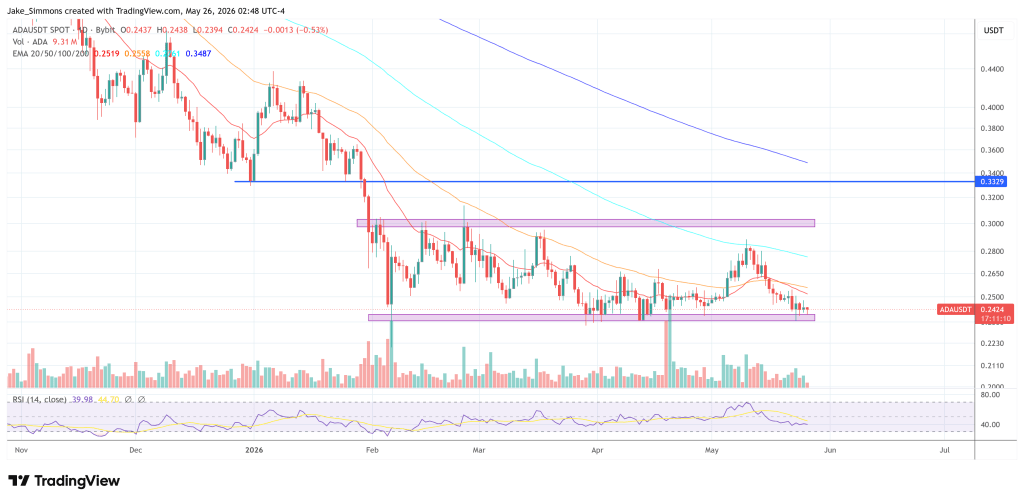
Cardano remains in sideways trend, 1-day chart | Source: ADAUSDT on TradingView.com

Related Questions

QWhat is the name of the Cardano-based app that Charles Hoskinson believes could become the most-used crypto application by 2030?

AThe app is called Midnight.city, which is the interactive simulation tied to Cardano's privacy-focused Midnight ecosystem.

QAccording to the article, what is the main purpose of the upcoming new beta-testing phase for Midnight.city?

AThe main purpose of the new beta-testing phase is to bring in thousands of beta testers to stress-test and refine the platform's design, utility, and user experience, gathering feedback to improve it.

QHow does the article describe the core function or design of the Midnight network?

AThe article describes the Midnight network as a privacy-oriented blockchain focused on programmable privacy, selective disclosure, and predictable costs. It uses zero-knowledge proofs and a dual-state ledger model, allowing developers to determine what information stays protected and what can be disclosed.

QWhat are the two distinct tokens in Midnight's economic model and what are their purposes?

AThe two tokens are NIGHT and DUST. NIGHT is the network's unshielded native and governance token. DUST is a shielded, non-transferable resource used to pay for transaction fees and execute smart contracts.

QWhat is the primary goal of creating the Midnight.city simulation environment?

AThe primary goal of Midnight.city is to serve as a live, interactive simulation environment (rather than a simple block explorer) to demonstrate privacy infrastructure in a consumer-facing way. It shows how selective disclosure works and aims to generate sustained transaction volume to make zero-knowledge systems more visible and understandable to users.

Related Reads

From Mining Pool to Mars: Why Is Wang Chun in the SpaceX Cockpit?

Title: From Mining Pool to Mars: Why Wang Chun is in the SpaceX Cockpit? When SpaceX announced that Wang Chun, co-founder of F2Pool, would command the first commercial crewed interplanetary mission, many were shocked. Why would a Bitcoin mining pool founder be on a Mars mission roster? However, understanding Wang Chun's journey over the past decade and the deepening ties between the crypto industry and SpaceX reveals this is not accidental, but an inevitable result of a new era taking shape. Today's Mars plan is no longer just a space engineering project; it is evolving into a civilization-upgrading experiment driven by global tech capital, AI, computing power, energy, and the crypto economy. Wang Chun stands precisely at the intersection of these forces. Part 1: From F2Pool to SpaceX – Wang Chun's Leap F2Pool, founded when Bitcoin was still niche, is one of the earliest large-scale mining pools and once held a significant share of global Bitcoin hash rate. Wang Chun belongs to the first generation of Chinese Bitcoin advocates and infrastructure builders—idealists and engineers who believed in a new value network independent of traditional finance. Miners like him built the hardware, energy, and computing power foundational to decentralized networks. This aligns with the long-term, high-engineering, future-oriented vision required for space civilization. Elon Musk’s space endeavors value such long-term builders over mere capital players, which explains Wang Chun's entry into the SpaceX ecosystem. Part 2: Why Crypto and SpaceX Are Growing Closer The core of global tech competition is shifting from internet applications to next-generation infrastructure. Both crypto and SpaceX are part of this. SpaceX's goal is to drastically reduce space access costs. If successful, it could enable orbital servers, space-based energy, global satellite internet, and Martian bases. These new frontiers will require new payment systems, value networks, and global financial architectures. Cryptocurrencies, inherently global and trustless, are poised to become key to off-planet economies. Moreover, crypto and SpaceX share a high-risk, long-termist ethos—believing in ambitious, world-changing goals despite early skepticism. Part 3: Human Spaceflight Enters the Commercial Era Space exploration, long dominated by state actors, is now being transformed by commercial entities like SpaceX. Wang Chun's involvement signifies that future deep-space participants may include not just career astronauts, but also entrepreneurs, engineers, and AI researchers. This mirrors the Age of Exploration, where commercial capital eventually drove global expansion. Wang Chun has emphasized that Mars colonization must not be delayed for future generations, countering a potential over-focus on nearer-term, commercial lunar projects. His presence symbolizes how new capital, technical communities, and idealists from the crypto world are now entering the interstellar age. In summary, the true significance is not an individual's journey to Mars, but the shift in the driving force of human civilization expansion from state machinery to tech companies, AI systems, and global technology capital. Wang Chun's path—from mining pool to Mars, from the Bitcoin network to starships—may be a preview of technological civilization's evolution in the coming decades.

marsbit6h ago

From Mining Pool to Mars: Why Is Wang Chun in the SpaceX Cockpit?

marsbit6h ago

Trading

Spot
Futures

Hot Articles

Discussions

Welcome to the HTX Community. Here, you can stay informed about the latest platform developments and gain access to professional market insights. Users' opinions on the price of S (S) are presented below.

活动图片