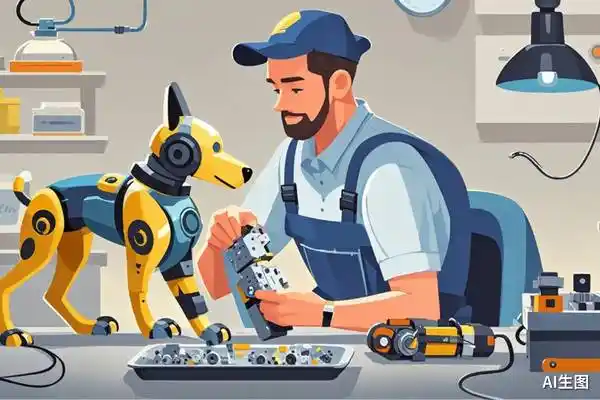
A new job has emerged in the robotics sector: the "orthopedic surgeon" for robots, earning around 6,000 RMB per month by specializing in repairing robots and robotic dogs. As the number of robots explodes, with IDC projecting 18,000 humanoid robots shipped globally in 2025 and China's MIIT predicting over 100,000 units produced domestically in 2026, demand for maintenance and repair is rising.
The repair process, as demonstrated by Zhao Xin, a former service industry worker turned self-taught repairman, involves diagnosing issues like joint noises, disassembly, and part replacement. The technical barrier is relatively low, often simpler than repairing drones, with basics learnable in a month. The real challenge is obtaining proprietary parts, which are monopolized by manufacturers, lack public schematics, and are expensive.
Currently, third-party repair shops, like those run by Zhao Xin or Nanjing Kaogong Yunji's Fang Jinghua, offer cheaper (10-15% of robot price, 20-50% cheaper than OEM) and faster (one week vs. over a month) service, mainly for out-of-warranty units used in entertainment performances. However, repair volume remains low—just 1-3 robots/month for some shops—making it unsustainable as a primary business. Most repair shops rely on other revenue streams like training, drone repair, or leasing.
Training programs are emerging, with courses from 8 to 40 days and fees from 5,000 to 30,000 RMB. Graduates often enter sales or operations roles. For pure repair jobs, salaries range from 6,000-8,000 RMB/month for beginners to over 10,000 RMB for experienced technicians. While companies like JD.com plan large-scale technician training, the robot repair market still awaits broader industry growth to become a fully viable standalone profession.