Zhejiang University Research Team Proposes New Approach: Teaching AI How the Human Brain Understands the World

marsbitPublicado em 2026-04-05Última atualização em 2026-04-05

Resumo

A research team from Zhejiang University published a paper in *Nature Communications* challenging the prevailing notion that larger AI models inherently think more like humans. They found that while model performance on recognizing concrete concepts improved as parameters increased (from 74.94% to 85.87%), performance on abstract concept tasks slightly declined (from 54.37% to 52.82%) in models like SimCLR, CLIP, and DINOv2. The key difference lies in how concepts are organized. Humans naturally form hierarchical categories (e.g., grouping a swan and an owl into "birds"), enabling them to apply past knowledge to new situations. Models, however, rely heavily on statistical patterns in data and struggle to form stable, abstract categories. The team proposed a novel solution: using human brain signals (recorded when viewing images) to supervise and guide the model's internal organization of concepts. This method, termed transferring "human conceptual structures," helped the model learn a brain-like categorical system. In experiments, the model showed improved few-shot learning and generalization, with a 20.5% average improvement on a task requiring abstract categorization like distinguishing living vs. non-living things, even outperforming much larger models. This research shifts the focus from simply scaling model size ("bigger is better") to designing smarter internal structures ("structured is smarter"). It highlights a new pathway for developing AI that possesses more hum...

Large models have been growing in size, with the mainstream view being that the more parameters a model has, the closer it gets to human-like thinking. However, a paper published by a Zhejiang University team on April 1 in Nature Communications presents a different perspective (original article link: https://www.nature.com/articles/s41467-026-71267-5). They found that as model size (primarily SimCLR, CLIP, DINOv2) increases, the ability to recognize specific objects does continue to improve, but the ability to understand abstract concepts not only fails to improve but can even decline. When parameters increased from 22.06 million to 304.37 million, performance on concrete concept tasks rose from 74.94% to 85.87%, while performance on abstract concept tasks dropped from 54.37% to 52.82%.

Differences Between Human and Model Thinking

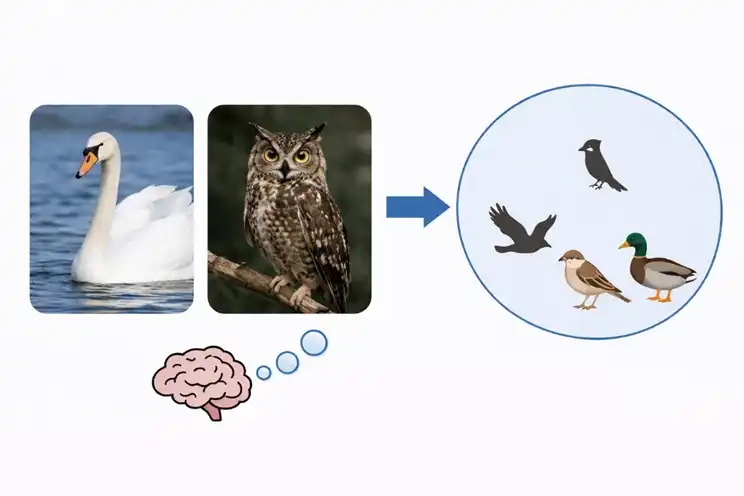
When the human brain processes concepts, it first forms a system of categorical relationships. Swans and owls look different, but humans still classify them both as birds. Moving up, birds and horses can be further grouped into the animal category. When humans encounter something new, they often first consider what it resembles from past experience and which category it might belong to. Humans continuously learn new concepts, then organize this experience, using this relational system to recognize new things and adapt to new situations.
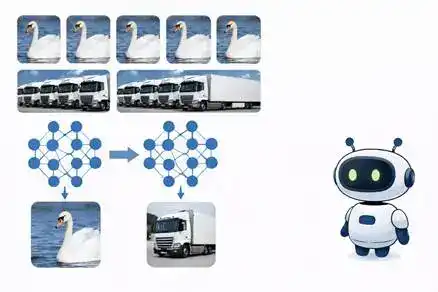
Models also classify, but they form these classifications differently. They rely primarily on patterns that repeatedly appear in large-scale data. The more frequently a specific object appears, the easier it is for the model to recognize it. When it comes to larger categories, models struggle more. They need to capture the commonalities between multiple objects and then group these commonalities into the same category. Existing models still have significant shortcomings here. As parameters continue to increase, performance on concrete concept tasks improves, while performance on abstract concept tasks sometimes even decreases.
A commonality between the human brain and models is that both internally form a system of categorical relationships. However, their emphases differ. The higher-order visual regions of the human brain naturally distinguish broad categories like living and non-living things. Models can separate specific objects but find it difficult to stably form these larger categories. This difference means the human brain more easily applies past experience to new objects, allowing for rapid categorization of unseen things. Models, conversely, rely more on existing knowledge, so when encountering new objects, they tend to focus on superficial features. The method proposed in the paper addresses this characteristic, using brain signals to constrain the model's internal structure, making it closer to the human brain's categorization method.

The Solution from the Zhejiang University Team

The team's proposed solution is also unique: instead of simply adding more parameters, they use a small amount of brain signal data for supervision. These brain signals come from recordings of brain activity while humans view images. The original paper states the goal as transferring 'human conceptual structures' to DNNs. This means teaching the model, as much as possible, how the human brain classifies, generalizes, and groups similar concepts together.
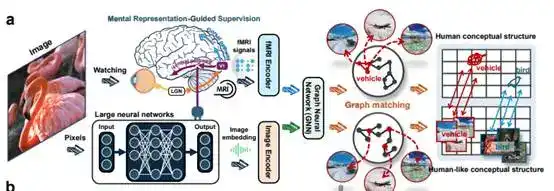
The team conducted experiments using 150 known training categories and 50 unseen test categories. The results showed that as this training progressed, the distance between the model's representations and the brain representations continuously narrowed. This change occurred for both categories, indicating that the model was learning not just individual samples but truly beginning to learn a conceptual organization method more akin to the human brain.

After this process, the model demonstrated stronger few-shot learning capabilities and performed better in novel situations. In a task requiring the model to distinguish abstract concepts like living vs. non-living things with very few examples, the model improved by an average of 20.5%, even surpassing much larger control models. The team also conducted 31 additional specialized tests, where several types of models showed improvements of nearly ten percent.

Over the past few years, the familiar path in the modeling industry has been larger model scale. The Zhejiang University team has chosen a different direction: moving from 'bigger is better' to 'structured is smarter'. Scaling up is indeed useful, but it primarily improves performance on familiar tasks. Abstract understanding and transfer capabilities, inherent to humans, are equally crucial for AI. This requires future AI thinking structures to more closely resemble the human brain. The value of this direction lies in redirecting the industry's attention from pure size expansion back to the cognitive structure itself.

Neosoul and the Future

This points to a larger possibility: AI evolution may not only occur during the model training phase. Model training can determine how AI organizes concepts and forms higher-quality judgment structures. Then, after entering the real world, another layer of AI evolution just begins: how an AI agent's judgments are recorded, tested, and how they continuously grow and evolve through real-world competition, learning and evolving on their own, much like humans. This is precisely what Neosoul is doing now. Neosoul doesn't just have AI agents produce answers; it places AI agents into a system of continuous prediction, verification, settlement, and selection, allowing them to continuously optimize themselves based on predictions and outcomes, preserving better structures and淘汰ing worse ones. What the Zhejiang University team and Neosoul jointly point towards is actually the same goal: enabling AI to not just solve problems, but to possess comprehensive thinking abilities and continuously evolve.


Perguntas relacionadas

QWhat was the key finding of the Zhejiang University team's research published in Nature Communications regarding model scaling?

AThey found that as model parameters increased (from 22.06 million to 304.37 million), performance on recognizing concrete concepts improved (74.94% to 85.87%), but performance on understanding abstract concepts not only failed to improve but actually decreased (54.37% to 52.82%).

QWhat is the fundamental difference between how the human brain and AI models form conceptual categories?

AThe human brain naturally forms a hierarchical classification system (e.g., grouping specific birds into the 'bird' category, then 'birds' and 'horses' into 'animals'). AI models primarily rely on statistical patterns from large-scale data, excelling at recognizing specific, frequently appearing objects but struggling to form stable, larger abstract categories.

QWhat was the unique solution proposed by the Zhejiang University team to improve AI's abstract reasoning?

AInstead of scaling model size, they used a small amount of brain signal data (recordings of human brain activity when viewing images) as supervision to transfer human conceptual structures to the deep neural networks (DNNs), teaching them how to classify and generalize concepts more like the human brain.

QWhat improvements were observed in the model after being trained with the brain signal supervision method?

AThe distance between the model's representations and brain representations decreased. The model showed stronger few-shot learning capabilities and performed better in novel situations. In a task requiring abstract concept discrimination with very few examples, performance improved by an average of 20.5%, even surpassing much larger control models.

QWhat broader shift in AI development philosophy does the research and Neosoul project represent, according to the article?

AIt represents a shift from the 'bigger is better' paradigm focused on scaling parameters to a 'structured is smarter' approach. The focus is on improving the AI's cognitive structure to be more human-like, enabling abstract understanding and transfer capabilities, and creating systems for continuous learning and evolution through real-world prediction, verification, and competition.

Leituras Relacionadas

CPU Makes a Comeback to the Table, A $170 Billion "Power Seizure" Drama Begins

A new era is dawning for the server CPU (Central Processing Unit), driven by the shift from AI model training to large-scale reasoning and the rise of Agentic AI. This article explores how the CPU is reclaiming a central role in the AI data center. For years, the focus has been on the GPU (Graphics Processing Unit) for AI training. However, as AI moves to the inference and Agent phase—where tasks involve complex, multi-step reasoning, tool calls, and data management—the workload balance is flipping. Studies show CPUs now handle over 70% of the workload in Agentic AI, up from 10-30% in training. This is because Agent tasks generate massive intermediate data (KV Cache) that exceeds GPU memory, forcing it to be offloaded to the CPU's larger, more scalable memory pools. This increased importance is translating into market changes. Major players are taking note: NVIDIA launched its first standalone CPU line, Vera, based on ARM architecture and optimized for Agent performance. AMD doubled its server CPU market forecast to over $1200 billion by 2030. Analyst reports project the total server CPU market could reach $1700 billion by 2030, with AI-driven demand being a primary driver. Furthermore, the classic ratio of CPUs to GPUs in AI servers is rapidly changing, converging from 1:8 toward 1:1 for Agent deployments. This surge in demand has led to a rare industry-wide price increase of 10-15% for server CPUs from Intel and AMD, breaking a decade-long trend of "more performance for the same price." Demand is bifurcating into high-core-count CPUs for in-rack GPU support and moderate-core CPUs for standalone Agent task orchestration. In China, this global trend presents an opportunity for domestic CPU manufacturers like Hygon (海光信息) and Huawei Kunpeng, who are bolstered by both growing AI infrastructure needs and national policies promoting technological self-reliance ("xin chuang"). The maturity of their software ecosystems is also accelerating, evidenced by faster adaptation to new AI models. In conclusion, the narrative is shifting from a GPU-centric view to one where CPU-GPU synergy is critical. The CPU is no longer a peripheral component but a performance-defining bottleneck and a key growth driver in the AI hardware stack, opening a massive new market estimated in the hundreds of billions of dollars.

marsbitHá 3h

CPU Makes a Comeback to the Table, A $170 Billion "Power Seizure" Drama Begins

marsbitHá 3h

TechFlow Intelligence: AMD AI Director Publicly Criticizes Claude Code for "Becoming Dumber and Lazier", Trump Claims Full Ceasefire in Hormuz But Strait Still Has 80 Unexploded Mines

TechFlow Intelligence Report: This daily digest covers key developments in AI, crypto, hardware, and geopolitics. In AI, SK Telecom faces US export control scrutiny over its partnership with Anthropic, while a Gemini user reports being misled in a scam scenario, sparking safety debates. China's Z.AI launches the GLM-5.2 model, rivaling Claude Opus without NVIDIA chips. In crypto, Bithumb lists ReProtocol, and Upbit delists KernelDAO. On the hardware front, MIT researchers build a custom OS to study chips, ASML denies US claims its advanced lithography machines are in China, and Amazon considers selling its in-house AI chips. Apple's future A21 Pro chip may use TSMC's latest N2P process. Major tech issues include 10,000 GitHub repositories distributing malware and Apple patching a critical eavesdropping flaw in Beats earbuds. US stocks rise, led by semiconductors, with Intel surging 10.6%, while SpaceX falls 3.5%. Geopolitically, despite a US-Iran deal, the Strait of Hormuz remains risky with ~80 uncleared mines, stalling 80M barrels of oil on standby tankers. Iran postpones Switzerland talks, and Trump calls the agreement an "unconditional surrender." The report highlights a contrast: temporary geopolitical calm versus the ongoing, fundamental restructuring of tech supply chains and chip independence.

marsbitHá 3h

TechFlow Intelligence: AMD AI Director Publicly Criticizes Claude Code for "Becoming Dumber and Lazier", Trump Claims Full Ceasefire in Hormuz But Strait Still Has 80 Unexploded Mines

marsbitHá 3h

Trading

Spot
Futuros
活动图片