Zcash explodes 23% – But a bigger move may be coming

ambcryptoPublished on 2026-04-09Last updated on 2026-04-09

Abstract

Zcash (ZEC) surged 23% to $329, with trading volume spiking 152% to $810 million, indicating strong demand. Capital is moving off exchanges, with wrapped ZEC supply rising to 284,680, primarily on Solana and BSC, signaling a shift toward cross-chain utility and liquidity. The rally is supported by growing institutional narrative around financial privacy and quantum resistance, as well as the Tachyon upgrade which emphasizes spending utility. Price action broke key resistance at $275, targeting higher levels like $376, though failure to hold gains could see a pullback to $240. Social engagement and sentiment remain high, but long-term sustainability depends on continued adoption rather than speculative attention.

Zcash’s [ZEC] move starts with price, yet the drivers extend beyond a simple rally.

ZEC’s price rose to $329, gaining 23% in 24 hours as volume jumped 152% to $810 million, which signaled strong demand entering quickly. However, this demand did not stay on exchanges, as capital began moving across chains.

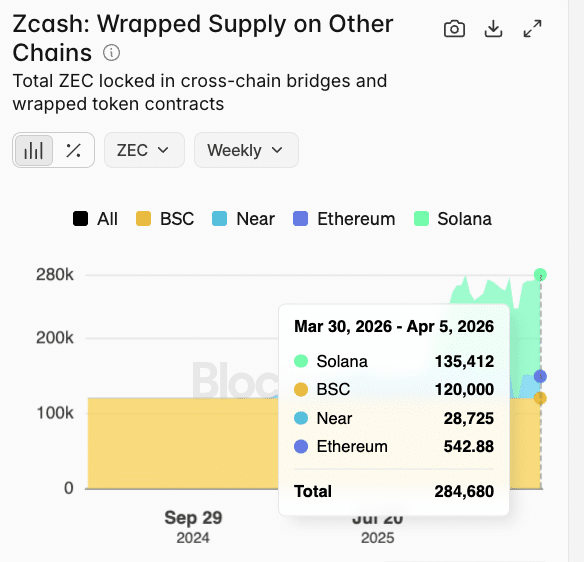
Wrapped supply rose to about 284,680 ZEC, led by Solana [SOL] at 135,412 and BSC at 120,000, while smaller flows reached Near Protocol. This shift shows users seek liquidity, utility, and access beyond a single network, which supports broader adoption rather than isolated trading.
Source: X

At the same time, narrative momentum builds, as institutional focus on privacy and fiat hedging draws attention. This creates a dual effect, where utility supports price, yet attention amplifies volatility.

In turn, sustainability depends on whether cross-chain usage continues or fades with sentiment.

Zcash momentum builds as price reclaims key levels

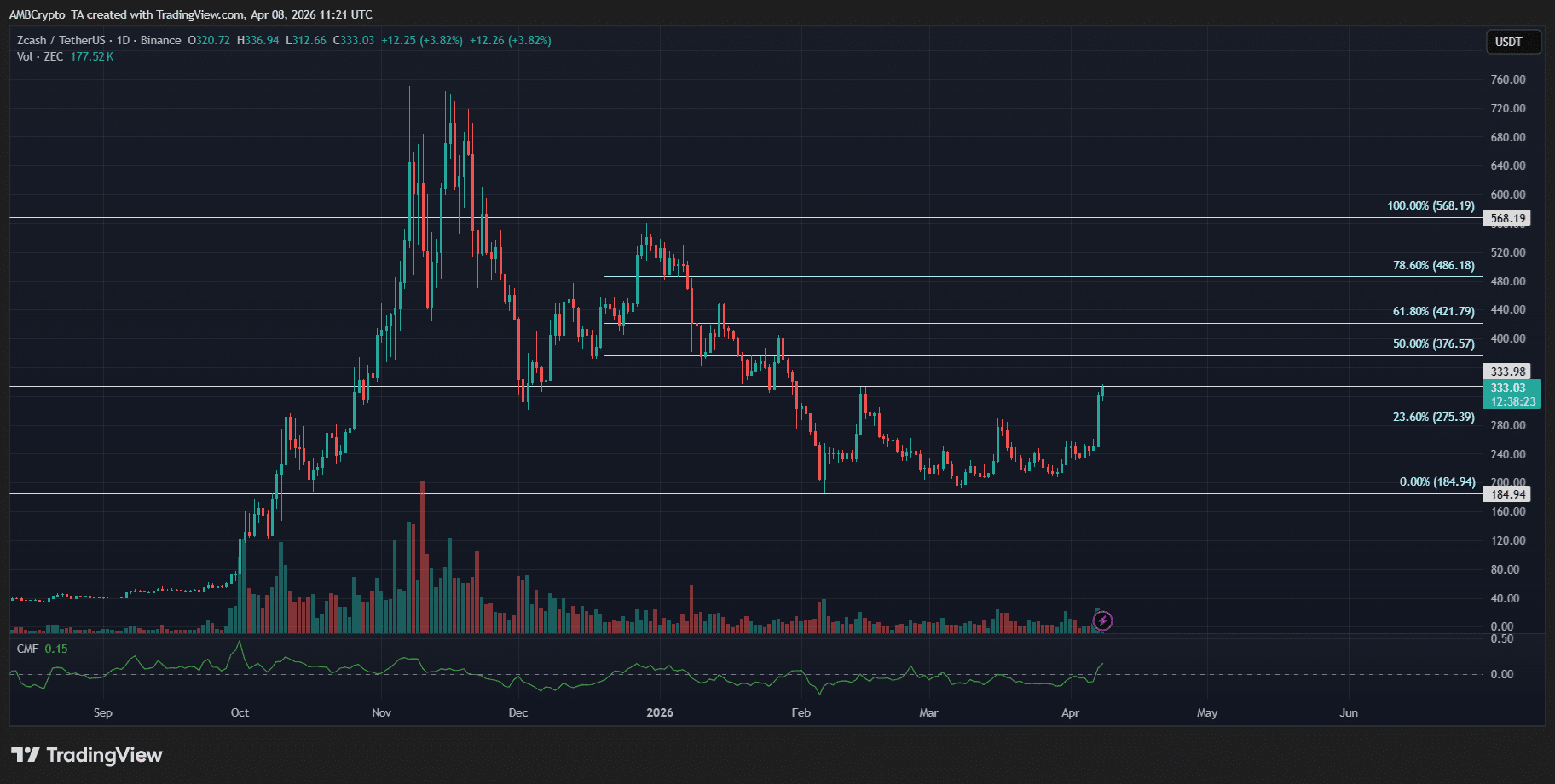
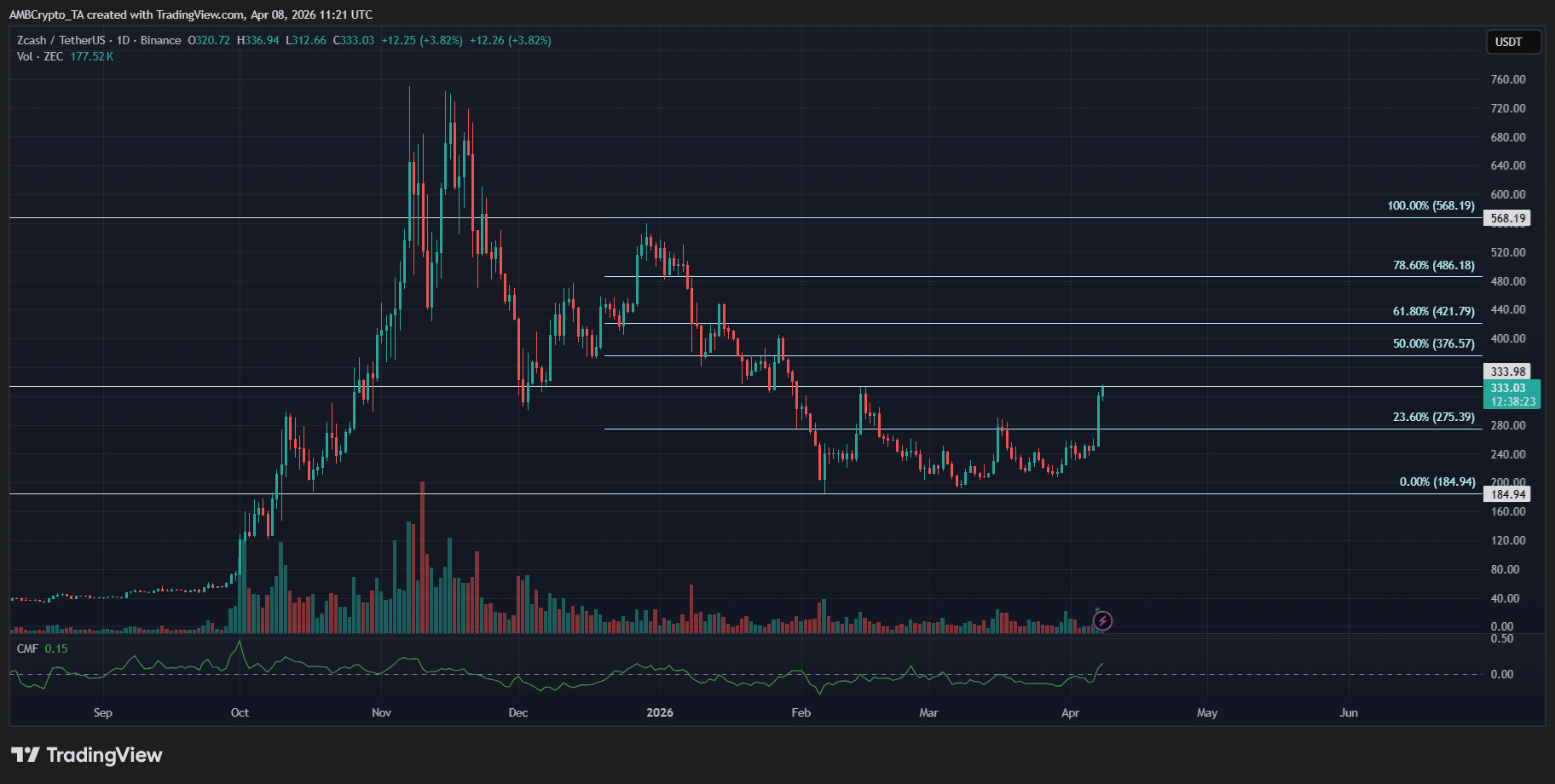
Zcash’s price action strengthened as momentum aligned with rising activity. First, ZEC rebounded from the $184 base and broke above $275, reclaiming the 23.6% level and signaling a trend reversal.

As price pushed toward $333 resistance, buyers showed intent to challenge some higher zones.
Source: ZECUSDT on TradingView

Above this, the $376 level marked the mid-range pivot, where a breakout would confirm continuation. Further up, $421 and $486 acted as supply zones, reflecting prior rejection areas where sellers may re-enter.

However, failure to hold above $275 could expose downside toward $240 and back to $184 support, weakening the structure. Meanwhile, CMF remains positive near 0.15, showing inflows.

In turn, momentum holds, yet key levels will decide if expansion continues or stalls.
Zcash gains as narrative and utility align

Zcash’s move begins with rising attention, yet it quickly feeds into price.

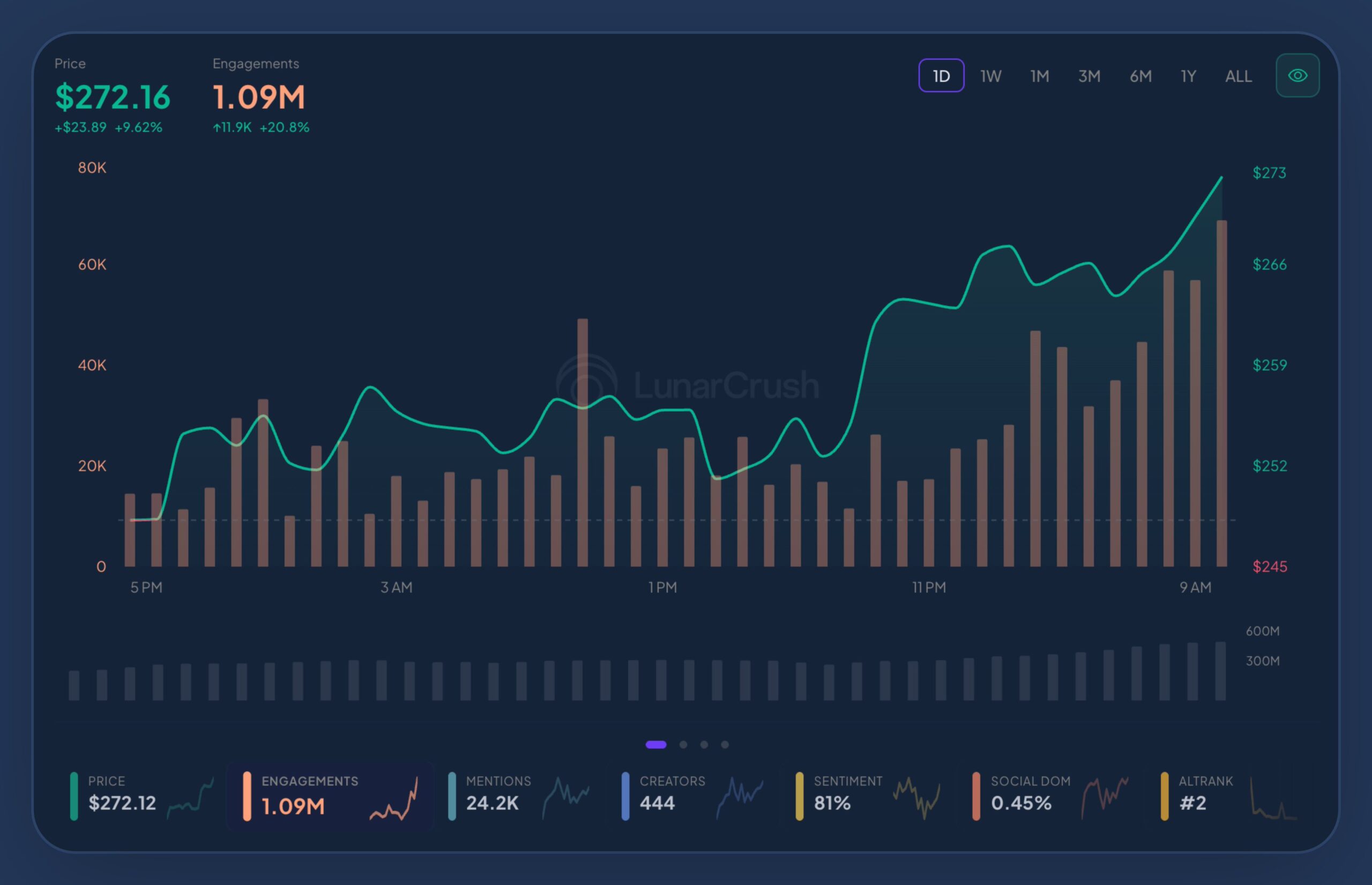
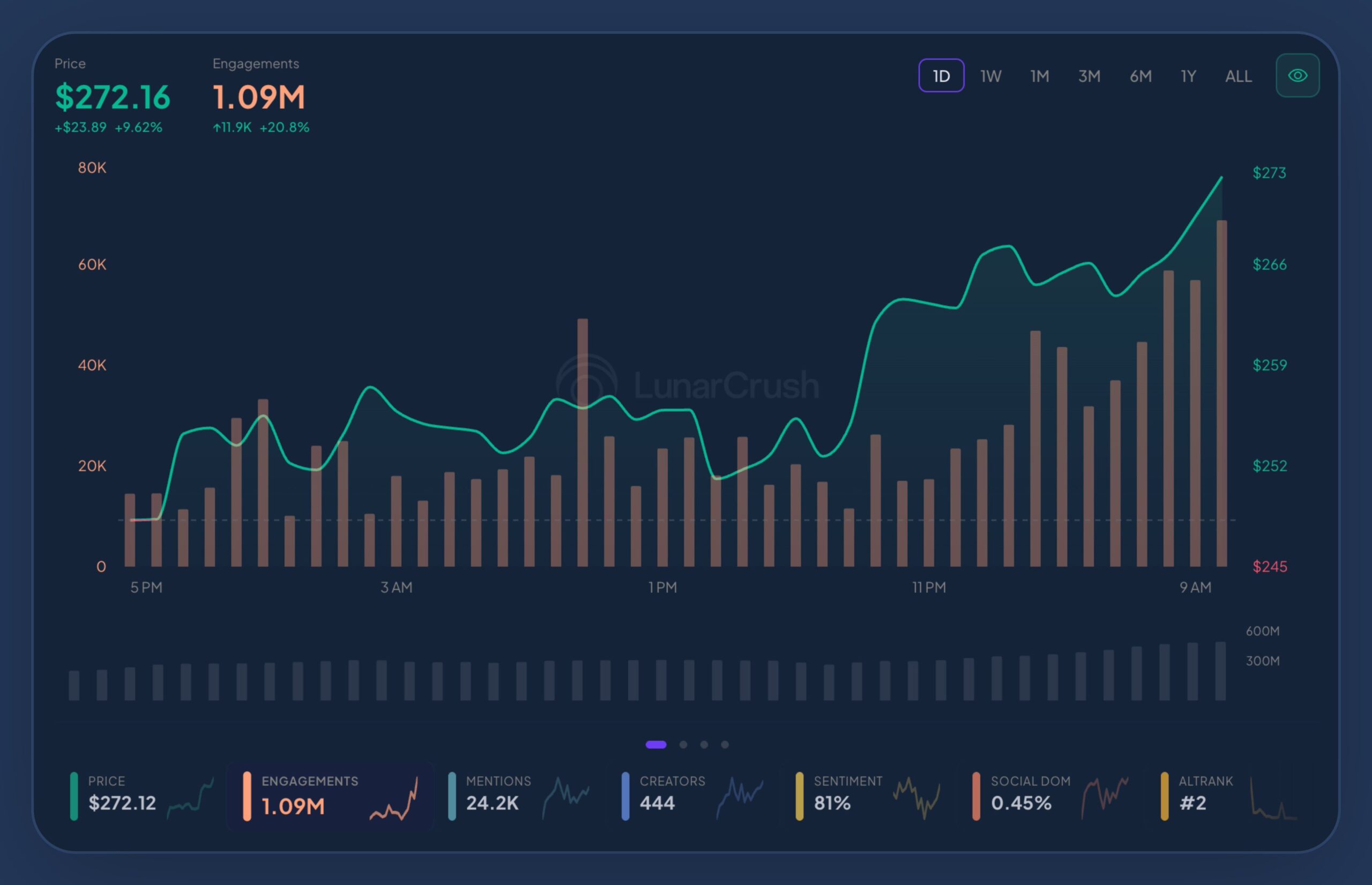
As ZEC’s price surged, engagements climbed to 1.09 million, up 20.8%, showing demand building in real time. As mentions reached 24,200 and sentiment stayed high at 81%, the narrative began to drive participation.

Source: LunarCrush

This attention does not emerge randomly. Foundry’s report on financial privacy introduces institutional validation, while quantum concerns revive Zcash’s relevance as a privacy-focused hedge.

At the same time, the Tachyon upgrade adds a usage angle, shifting the story from holding to spending. This creates tension, where narrative fuels price, yet sustainability depends on real adoption. In turn, the market now tests whether attention converts into lasting demand.


Final Summary

  • Zcash’s rally reflects cross-chain demand and narrative strength, as 284,680 wrapped supply and rising volume confirm active capital rotation beyond exchanges.
  • ZEC holds momentum above $275 with inflows and sentiment support, yet sustainability depends on real adoption rather than attention-driven volatility.

Trending Cryptos

Related Questions

QWhat was the percentage increase in Zcash's price and the volume surge mentioned in the article?

AZcash's price rose 23% in 24 hours, and its trading volume jumped 152% to $810 million.

QWhich blockchain networks saw the largest inflows of wrapped ZEC supply according to the article?

ASolana led with 135,412 wrapped ZEC, followed by BSC with 120,000 wrapped ZEC.

QWhat key price level did ZEC reclaim that signaled a trend reversal?

AZEC broke above $275, reclaiming the 23.6% level, which signaled a trend reversal.

QWhat two factors does the article suggest are creating a dual effect on Zcash's price movement?

AUtility supports the price, while attention amplifies volatility.

QWhat does the article state as the ultimate factor for the sustainability of Zcash's momentum beyond attention-driven volatility?

ASustainability depends on real adoption rather than attention-driven volatility.

Related Reads

Zhong Shanshan Invests in Liang Wenfeng

Chinese billionaire Zhong Shanshan, known for his low-profile and solitary investment style, has made a rare foray into the red-hot AI sector by indirectly investing approximately 350 million RMB into AI startup DeepSeek. This investment was executed through his private equity firm, Guānzī Venture Capital, as part of DeepSeek's first funding round in June, which also attracted major players like CATL, Tencent, JD.com, and state funds. Zhong, the founder of Nongfu Spring and a controlling shareholder of Wantai Biological, typically focuses his investments in pharmaceuticals and new materials through his investment vehicles under the Yangshengtang umbrella. These include Guānzī Venture Capital, Qiantang New Materials Laboratory, and the Kunshan Gewu Zhizhi Fund. His investment in DeepSeek marks a significant expansion into AI large models, following a previous investment in the AI optical chip company, X-Chip. The article highlights a growing trend of "Old Money" — successful entrepreneurs from traditional industries like consumer goods, healthcare, and apparel — entering the AI and hard tech investment arena. Examples from the same DeepSeek funding round include Jiuan Medical, By-Health, and Septwolves' Zhou Shaoxiong, who are all deploying capital from their industrial empires into next-generation tech companies. This shift illustrates how established wealth is seeking new growth vectors and aligning with the technological epoch, moving beyond their original sectors as those mature.

marsbit6m ago

Zhong Shanshan Invests in Liang Wenfeng

marsbit6m ago

Jackson Hole Becomes a Critical Battle for U.S. Treasuries, BofA Warns: If Warsh Doesn't Signal Rate Hikes, 30-Year Yield May Surge to 5.5%

The Jackson Hole Economic Policy Symposium is shaping up as a crucial battle for the US Treasury market, with the spotlight on Federal Reserve Chair Warsh's upcoming speech. Markets view this as the most critical near-term risk event for bond yields and the US dollar. A key concern is whether Warsh will provide clear signals on the Fed's willingness to resume interest rate hikes should inflation fail to improve. American Bank warns that if he avoids offering such forward guidance, the 30-year Treasury yield could surge toward or above 5.5%, putting further downward pressure on the dollar. This heightened sensitivity stems from fragile market conditions, including the Treasury's recent increased long-end bond buybacks and a string of weaker economic data. Analysts note that Warsh has historically been resistant to providing specific policy guidance, but sustained bond market pressure may force a shift in communication strategy. The market anticipates a framework outlining potential policy responses based on incoming inflation data. Barclays economists assign over a 50% probability to Warsh delivering a hawkish message. Historically, Jackson Hole speeches have had limited lasting market impact, but analysts suggest this year could be an exception due to the unique confluence of pressures, making Warsh's credibility and clarity paramount for stabilizing expectations.

marsbit16m ago

Jackson Hole Becomes a Critical Battle for U.S. Treasuries, BofA Warns: If Warsh Doesn't Signal Rate Hikes, 30-Year Yield May Surge to 5.5%

marsbit16m ago

“Economic Outcast”: US Treasury Takes Aim at Iran's Cryptocurrency, Technology, and Gold

On August 24, 2026, the U.S. Treasury Department, under Secretary Scott Bessent, launched "Operation Economic Outcast," a major campaign targeting the financial networks of the Islamic Republic of Iran and its affiliates. The primary goal is to cut off revenue streams supporting the Iranian regime, with a specific focus on denying funding to the Islamic Revolutionary Guard Corps (IRGC). The Office of Foreign Assets Control (OFAC) activated authorities to sanction any entities, regardless of location, operating in or servicing five key Iranian economic sectors: digital assets (cryptocurrency), technology, gold, aviation, and shipping. OFAC noted Iran's increasing use of cryptocurrency to evade sanctions, including for operations linked to the IRGC and government officials. Initial measures targeted nearly 60 organizations, individuals, and vessels across multiple jurisdictions involved in procuring nuclear/missile technology, conducting cyber operations, and facilitating illicit oil sales. The U.S. State Department joined the campaign, announcing additional sanctions against Iranian military officials, intelligence entities targeting U.S. forces, and networks moving Iranian oil. Treasury warned foreign partners that they have a specific deadline to halt identified Iran-related activities, or face unilateral U.S. action. Entities facilitating sanctions evasion risk being cut off from the U.S. financial system and the dollar economy. The operation consolidates sanctions against Iran's crypto, tech, and commodity financing into a unified campaign with clear deadlines. It expands OFAC's reach to crypto brokers and payment networks handling Iranian oil. Analysis suggests crypto tools are already embedded in Iran's trade practices, as seen with capital flight from the Nobitex exchange and discussions of Bitcoin payments for Strait of Hormuz transit, indicating new OFAC powers target existing, not hypothetical, evasion channels.

cryptonews.ru31m ago

“Economic Outcast”: US Treasury Takes Aim at Iran's Cryptocurrency, Technology, and Gold

cryptonews.ru31m ago

Trading

Spot

Hot Articles

How to Buy MOVE

Welcome to HTX.com! We've made purchasing Movement (MOVE) simple and convenient. Follow our step-by-step guide to embark on your crypto journey.Step 1: Create Your HTX AccountUse your email or phone number to sign up for a free account on HTX. Experience a hassle-free registration journey and unlock all features.Get My AccountStep 2: Go to Buy Crypto and Choose Your Payment MethodCredit/Debit Card: Use your Visa or Mastercard to buy Movement (MOVE) instantly.Balance: Use funds from your HTX account balance to trade seamlessly.Third Parties: We've added popular payment methods such as Google Pay and Apple Pay to enhance convenience.P2P: Trade directly with other users on HTX.Over-the-Counter (OTC): We offer tailor-made services and competitive exchange rates for traders.Step 3: Store Your Movement (MOVE)After purchasing your Movement (MOVE), store it in your HTX account. Alternatively, you can send it elsewhere via blockchain transfer or use it to trade other cryptocurrencies.Step 4: Trade Movement (MOVE)Easily trade Movement (MOVE) on HTX's spot market. Simply access your account, select your trading pair, execute your trades, and monitor in real-time. We offer a user-friendly experience for both beginners and seasoned traders.

5.8k Total ViewsPublished 2024.12.10Updated 2026.08.21

How to Buy MOVE

Discussions

Welcome to the HTX Community. Here, you can stay informed about the latest platform developments and gain access to professional market insights. Users' opinions on the price of MOVE (MOVE) are presented below.

活动图片