Zcash Developers Spin Out New Wallet After ECC Breakup

bitcoinistPublished on 2026-01-10Last updated on 2026-01-10

Abstract

Following the breakup of the Electric Coin Company, the team behind Zashi has formed a new Zcash-focused company and is launching a new wallet called "cashZ," built from the existing Zashi codebase. The move aims to scale Zcash to billions of users while maintaining a dedicated focus on the Zcash ecosystem. The team emphasized its commitment to full-stack Zcash development, with no plans to launch new coins. The decision to spin out was driven by three factors: Zcash's cypherpunk roots, governance and incentive alignment, and the need for scalability. The team criticized the current regulatory environment as "a decade of compliance theater," arguing that privacy is a civil-liberties issue requiring assertive leadership. They also highlighted misalignments between nonprofit and for-profit structures, advocating for a governance model free from bureaucratic constraints. The goal is to make Zcash so large that privacy cannot be marginalized. The team cited Zcash's recent resurgence and ecosystem growth, stating, "We are no longer so small they can’t see us. We now need to get so big they can’t stop us." The cashZ wallet is currently accepting waitlist sign-ups, with a full launch expected in a few weeks.

A day after the Electric Coin Company’s breakup, the team behind Zashi said it is spinning out into a new Zcash-focused company and launching a new wallet built from the existing Zashi codebase. The move is framed as an effort to “scale Zcash to billions,” while keeping the group’s work narrowly centered on the Zcash stack.

In a message signed by Josh Swihart, the developers said the new wallet is code-named “cashZ” and will reuse the codebase originally built for Zashi. The team also opened a waitlist for early access, telling existing Zashi users that “all you need to do is join the waitlist” and that a migration will be designed to feel as seamless as the current Zashi experience once cashZ is live “in a few weeks.”

The announcement attempted to answer what it expects will be the community’s first question after an organizational breakup: whether the engineers are still committed to Zcash. “The entire team that worked at Electric Coin Company and built Zashi is still 100% focused on full-stack Zcash development,” the post said. “We aren’t launching any new coins, we’re just scaling Zcash. To do that, it required that we leave and start a new Zcash-focused company.”

Why Zcash’s Core Builders Are Starting A New Company

The team said the decision to form a new company came down to three ideas: Zcash’s cypherpunk roots, governance and incentive alignment, and a need to scale.

In the longest section, the developers cast the past decade of crypto regulation as a kind of prolonged stress test for privacy, describing it as “a decade of compliance theater.” The post argued that privacy-preserving tools are not merely a technical preference but a civil-liberties issue that requires a more assertive posture from the organizations building them.

“This effort was not simply about complying with unjust laws. Of course, we must abide by the law, or else be thrown in a cage,” the message said. “But when the law is unjust, we have a moral imperative to work to change the unjust law. One tool for that is code.”

From that premise, the team connected Zcash’s mission to mainstreaming privacy online, positioning the protocol as “a peaceful global reform movement” and saying that a structure bogged down by internal friction would be poorly suited to that fight. “To do this, we need an organization that has courage,” it added, arguing for “cypherpunk leadership” and a governance model that “can’t cut through red tape.”

A second argument centered on what the post described as chronic misalignment when nonprofits and venture-style startups are intertwined. The team cited recent commentary from Andreessen Horowitz to bolster the idea that crypto’s “foundation era” is ending, while distinguishing the Zcash Foundation as an example of a standalone nonprofit that can do effective work.

The critique was not subtle: “Nonprofits are about rule-lawyering, while tech startups are about rewriting the rules,” the statement said, adding that nonprofit boards often lack the accountability mechanisms of corporate boards. The team also pointed to heightened scrutiny of US nonprofits and the risk of tax exemptions being challenged, arguing there is “no benefit in keeping a fast-growing technology company under a nonprofit when the substance of the organization is a for-profit.”

The final section placed the wallet launch inside a bigger ambition: to make Zcash large enough that privacy becomes difficult to marginalize. It framed the strategic choice as binary: “to be so small they can’t see you, or so big they can’t stop you.”

The post claimed that Zcash has undergone “a complete rebirth” over the past two years, crediting an ecosystem-wide effort and naming contributors including Sean Bowe, genzcash, and Shielded Labs, alongside “many more who prefer to remain unnamed.” That resurgence, it argued, changes the operating environment: “We are no longer so small they can’t see us. Everyone can see us. We now need to get so big they can’t stop us.”

For now, the tangible deliverable is cashZ, with the team promising more details later and signaling that execution will be the message. “Actions will speak louder than words,” Swihart wrote, urging users to join the waitlist as the developers “boot up” the new wallet and push toward what they describe as “onboarding billions to Zcash.”

At press time, the ZEC price recovered some losses from yesterday’s crash and traded at $436.
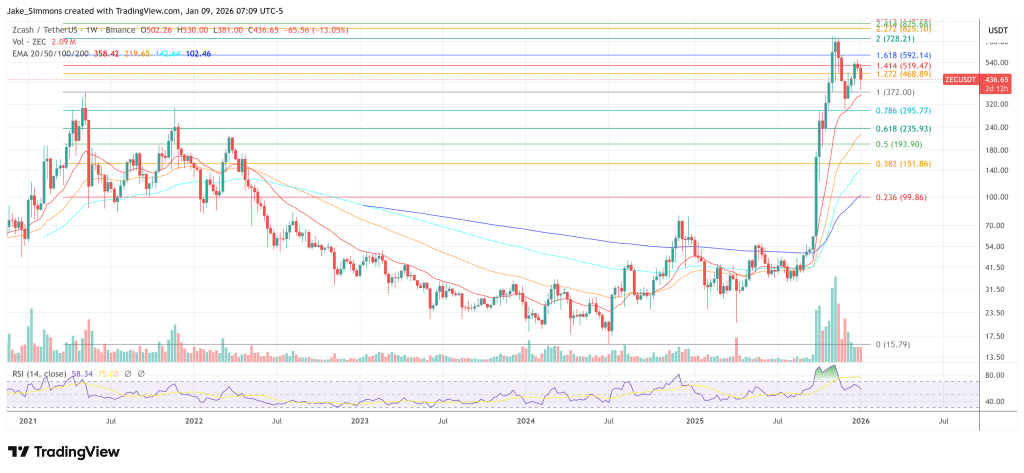
Zcash makes a higher low, 1-week chart | Source: BTCUSDT on TradingView.com

Related Questions

QWhat is the name of the new wallet being launched by the developers after the ECC breakup?

AThe new wallet is code-named 'cashZ'.

QWhy did the team decide to form a new company instead of staying with the Electric Coin Company?

AThe decision was based on three main ideas: Zcash's cypherpunk roots, governance and incentive alignment, and the need to scale Zcash to billions of users.

QAccording to the announcement, what is the team's stance on launching new coins?

AThe team stated they are not launching any new coins and are '100% focused on full-stack Zcash development' with the goal of scaling Zcash.

QWhat did the developers describe as a 'chronic misalignment' in their post?

AThey described a chronic misalignment when nonprofits and venture-style startups are intertwined, arguing that nonprofits are about 'rule-lawyering' while tech startups are about 'rewriting the rules'.

QWhat is the team's stated ultimate goal for the Zcash protocol?

AThe ultimate goal is to make Zcash so large that 'privacy becomes difficult to marginalize,' aiming to onboard billions of users and become 'so big they can’t stop us.'

Related Reads

Why Do You Always Lose Money on Polymarket? Because You're Betting on News, While the Pros Read the Rules

Why do you always lose money on Polymarket? Because you bet on news, while the pros study the rules. This article explains how top traders ("che tou") profit by meticulously analyzing market rules, not just predicting events. Polymarket, a prediction market platform, often sees disputes over event outcomes due to ambiguous rule wording. For instance, a market asking "Who will be the leader of Venezuela by the end of 2026?" was misinterpreted by many who bet on Delcy Rodríguez, assuming she held power. However, the rules specified "officially holds" as the formally appointed, sworn-in individual. Since Nicolás Maduro was still recognized as president officially, he won the market—even being in prison. To resolve such disputes, Polymarket uses a decentralized arbitration system via UMA protocol. The process involves: 1. Proposal: Anyone can propose a market outcome by staking 750 USDC, earning 5 USDC if unchallenged. 2. Dispute: A 2-hour window allows challenges with a 750 USDC stake; successful challengers earn 250 USDC. 3. Discussion: A 48-hour period on UMA Discord for evidence and debate. 4. Voting: UMA token holders vote in two 24-hour phases (blind then public). Outcomes require >65% consensus and 5M tokens voted; otherwise, four re-votes occur before Polymarket intervention. 5. Settlement: Results are final and automatic. Unlike traditional courts, Polymarket’s system lacks separation between arbitrators and stakeholders—voters often hold market positions, creating conflicts of interest. This leads to herd mentality in discussions and non-transparent outcomes without explanatory rulings, preventing precedent formation. Thus, success on Polymarket hinges on deep rule interpretation, not just event prediction, exploiting gaps between reality and contractual wording.

marsbit1h ago

Why Do You Always Lose Money on Polymarket? Because You're Betting on News, While the Pros Read the Rules

marsbit1h ago

DeepSeek Funding: Liang Wenfeng's 'Realist' Pivot

DeepSeek, a leading Chinese AI company, has initiated its first external funding round, aiming to raise at least $300 million at a valuation of no less than $10 billion. This move marks a significant shift from its founder Liang Wenfeng’s previous idealistic stance of rejecting external capital to maintain independence. Despite strong financial backing from its parent company, quantitative trading firm幻方量化 (Huanfang Quant), which provided an estimated $700 million in revenue in 2025 alone, DeepSeek faces mounting challenges. Key issues include a 15-month gap in major model updates, delays in its flagship V4 release, and the loss of several core researchers to competitors offering significantly higher compensation. The company is also undergoing a strategic pivot by migrating its infrastructure from NVIDIA’s CUDA to Huawei’s Ascend platform, a move aligned with China’s push for technological self-reliance amid U.S. export controls. However, DeepSeek lags behind rivals like智谱AI and MiniMax—both now publicly listed—in areas such as product ecosystem, multimodal capabilities, and commercialization. The funding round, though relatively small in scale, is seen as a way to establish a market-validated valuation anchor, making employee stock options more competitive and facilitating talent retention. It also signals DeepSeek’s transition from a pure research-oriented organization to a commercially-driven player in the global AI ecosystem.

marsbit2h ago

DeepSeek Funding: Liang Wenfeng's 'Realist' Pivot

marsbit2h ago

Trading

Spot
Futures
活动图片





