XRP’s Long-Term Path Gains Clarity After Major DAS Research Revelation – Here’s Where It’s Headed

bitcoinistPublished on 2025-12-10Last updated on 2025-12-10

Abstract

A fresh crypto research report from Digital Asset Solutions (DAS), highlighted by expert Stern Drew, provides a clear, data-driven outlook for XRP and Ripple. According to the analysis, XRP is no longer competing primarily within the crypto space but is instead evolving into a global payment infrastructure focused on serving banks, fintech companies, and cross-border networks. The research identifies three key factors shaping this trajectory: XRP's structural advantages (fast settlement, low cost, neutral bridge asset), Ripple's strategic integration of stablecoins like its own RLUSD (with XRP acting as the liquidity bridge), and forming catalysts such as RippleNet expansion, new RLUSD corridors, and institutional custody solutions. The report concludes that XRP is cementing its role as foundational financial infrastructure rather than a speculative asset, aiming to compete with traditional payment systems.

A fresh update from a crypto expert has emerged regarding XRP and Ripple’s next trajectory, sparking a debate in the community. In recent years, this update has turned out to be one of the most accurate in determining the future of the leading altcoin, reinforcing the significance of the update.

New Research Outlines XRP’s Direction

In a post on the X platform shared by Stern Drew, a crypto expert, Digital Asset Solutions (DAS) Research has delivered what many XRP watchers have been waiting for and finding difficult to determine. The Research seems to have offered insights and provided a clear data-driven signal that breaks through months of conjecture and market noise.

According to the expert, DAS Research just presented the most convincing evidence so far of where XRP is headed. While their analysis offers a clear view of the future direction, it shows that the altcoin and Ripple, an American-based payment firm, are no longer competing in crypto.

Ripple and XRP are shifting into a global payment infrastructure, one that is used by banks, Fintechs, and cross-border networks that seek speed, scale, and settlement transparency. Looking at the Research, there are 3 core realities that are likely to shape the next trajectory of the asset and the payment firm.
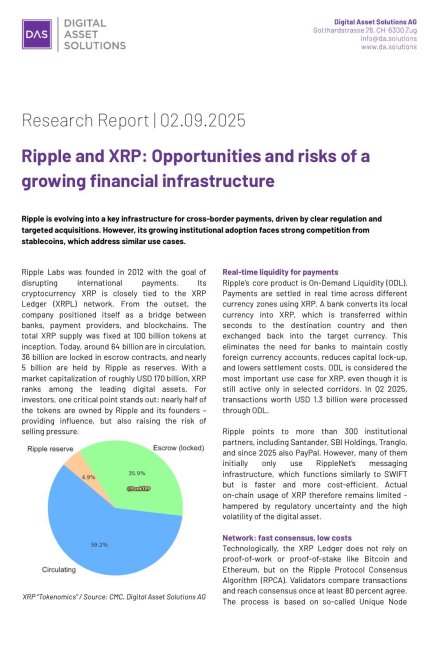
Source: Chart from Stern Drew on X

The first scenario is that XRP boosts the structural advantage, which includes fast settlement, low cost, neutral bridge asset, globally distributed ledger, and institutional-grade reliability. Drew stated that this is the reason adoption is growing in the midst of enterprises that seek predictable value transfer, and not speculation.

Secondly, the Research highlights the transformation of stablecoins, as these coins are becoming strategic assets, not competitive ones. Instead of opposing them, Ripple is absorbing stablecoins, which are becoming a key part of the crypto and financial landscape.

Ripple’s integration of stablecoins is evidenced by its RLUSD, a dollar-pegged token acting as the fiat anchor. Meanwhile, XRP serves as the liquidity and bridge asset that ties everything together. In the current landscape, this connection is precisely how scaled settlement ecosystems develop.

Catalysts To Drive The Next Future

With key updates and achievements of Ripple, the Research noted that the catalysts to spur the next phase are already forming. Some of these catalysts include RippleNet’s partnership expansion, RLUSD corridors opening, and institutional custody maturing. Even Exchange-Traded Fund (ETF) structures are entering the conversation.

Each of these catalysts raises the likelihood that regulated financial plumbing will incorporate XRP. Meanwhile, direct bank-level chain utilization is the only sector that is currently lagging behind. However, this is exactly what worldwide licensing pushes, ZK-enabled identity layers, Ripple Prime, and RLUSD are meant to open.

Drew believes that DAS is creating awareness of what investors are unable to see. Behind the scenes, XRP is cementing its position as infrastructure, not a trade, and the competition is not other tokens, but the existing payment system, which is starting to shift.

XRP trading at $2.08 on the 1D chart | Source: XRPUSDT on Tradingview.com

Trending Cryptos

Related Reads

Treasury Secretary's Move to Suppress Treasury Yields Ignites 'Currency Debasement Trade'! Gold Hits Three-Month High, Bitcoin Surges Over 25% in a Single Week

US Treasury Secretary Besant's efforts to lower long-term Treasury yields by announcing expanded buybacks had only a brief market impact. However, this move fueled a "currency devaluation trade," weakening the US dollar while boosting both gold (to a three-month high) and Bitcoin (up over 25% for the week). Analysts attribute this reaction to deepening market concerns over the massive US fiscal deficit and structural pressures keeping long-term rates elevated, including fierce competition for capital from global government borrowing and massive AI sector financing. Despite the Treasury's actions, fundamental forces like growth, inflation, and capital demand are seen as limiting its ability to sustainably suppress yields. Bitcoin's strong positive correlation with gold has reinforced its narrative as a hedge against devaluation. While equity markets have shown resilience, some strategists warn that Treasury yields nearing 5% increase pressure on the dollar and high-leverage assets. Figures like Ray Dalio have advised reducing bond exposure in favor of gold and some Bitcoin, citing US debt risks. Market opinions are divided on the sustainability of the devaluation trade, with some noting the lack of a near-term catalyst for its next leg higher. The underlying tension between the Treasury's desire for lower borrowing costs and the Federal Reserve's focus on inflation and reducing market intervention remains a key theme. Upcoming events like Nvidia's earnings and the Jackson Hole symposium will test whether AI profits can continue supporting stocks and if the Fed aligns more with Washington's preference for easier financial conditions.

华尔街日报1h ago

Treasury Secretary's Move to Suppress Treasury Yields Ignites 'Currency Debasement Trade'! Gold Hits Three-Month High, Bitcoin Surges Over 25% in a Single Week

华尔街日报1h ago

Alexander Shokhin: Business Needs an Interest Rate Below 10% and the Dollar at 90-95 Rubles

Alexander Shokhin, head of the Russian Union of Industrialists and Entrepreneurs (RSPP), has advocated for potentially using "non-market" tools to keep the ruble within a target exchange rate corridor. This, he argues on August 21, would help avoid excessive volatility, though he called the topic a separate discussion. Shokhin had previously raised the idea of a currency corridor in late May, noting the ruble's current exchange rate is not fully market-driven due to a limited currency segment and reduced foreign currency demand. He stated that many business community colleagues propose fixing a corridor, even through non-market methods, to ensure predictability. The business community's key targets, as outlined by Shokhin in late December 2025, are a Central Bank key rate of 12%, inflation of 4–5%, and a US dollar exchange rate of 90–95 rubles by the end of 2026. A turning point for investment, he said, would be lowering the rate to 12% with 6% inflation, though truly comfortable business conditions would require a rate below 10%. He stressed the critical importance of currency predictability for corporate investment decisions. From a data analysis perspective, the idea of a ruble corridor is not new. A similar mechanism was used in Russia from 1995 to 1998, where the central bank held the dollar within fixed boundaries through regular interventions. This regime lasted three years before ending abruptly during the 1998 default, illustrating the fragility of rigid targets under external shocks. The macro-economic link is clear: stricter corridors require more reserves to defend against currency pressure. The key unresolved technical aspect is the specific sources and volume of such interventions given the current market's limited liquidity. Whether this discussion remains theoretical or leads to concrete corridor parameters will be seen in the coming months.

cryptonews.ru2h ago

Alexander Shokhin: Business Needs an Interest Rate Below 10% and the Dollar at 90-95 Rubles

cryptonews.ru2h ago

Trading

Spot

Hot Articles

Discussions

Welcome to the HTX Community. Here, you can stay informed about the latest platform developments and gain access to professional market insights. Users' opinions on the price of S (S) are presented below.

活动图片














