XRP Just Hit An Infamous Liquidity Pocket, Here’s What Happened Last Time It Hit

bitcoinistPublished on 2026-01-21Last updated on 2026-01-21

Abstract

XRP has once again traded into a known liquidity pocket between $1.90 and $1.75, a key support zone since December 2024. This area has repeatedly attracted price action, including after XRP's all-time high of $3.65 in July 2025. Historical data shows visits to this zone often result in a relief bounce, such as the rebound above $2.40 in early January. Currently, the daily Stochastic RSI indicates deeply oversold conditions, which have previously aligned with rebounds. If the zone holds, a bounce is likely. However, a decisive break below with strong selling pressure could shift the outlook to bearish. Recent trading activity suggests many holders are near breakeven, which may increase selling pressure if prices don't rise.

XRP has once again traded directly into a price zone that a few traders have come to recognize as a liquidity pocket. This area has acted as a magnet for price since December 2024, causing repeated tests and reactions that stand out clearly on the price chart. In a recent technical breakdown shared on X, crypto analyst ChartNerd highlighted how XRP has repeatedly made contact with this liquidity pocket over the past year and the cryptocurrency might be approaching a relief bounce.

Liquidity Pocket: Support Or Springboard?

Technical analysis of XRP’s price action shows that the cryptocurrency is now trading within a liquidity zone that has acted as a support range since December 2024. This liquidity zone, which spans the range from $1.90 to $1.75, has acted as a price magnet for many months. Even after reaching its all-time high of $3.65 in July 2025, XRP entered into a multi-month correction that eventually found support at this liquidity zone.

According to the analysis, nearly every prior visit to this zone was followed by some form of relief, especially when momentum indicators aligned. The last time XRP returned to this level, it slowed down its decline and eventually bounced back above $2.4 in early January.

However, the most recent push downwards played out as a 20% decline after a rejection at the $2.40 zone in early January, which has essentially pushed the XRP price action back to trading within this liquidity range and has started to show tentative stabilization.

To bring further confirmation to the setup, the analyst included the daily Stochastic RSI below the price chart. This momentum indicator, which measures relative strength and conditions of overbought or oversold pressure, is currently sitting in deeply oversold territory according to the chart. These oversold conditions in the Stoch RSI aligned with rebounds off this same liquidity pocket.
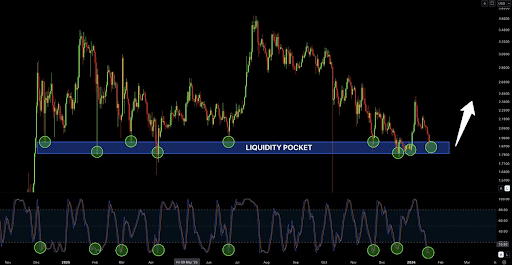
XRP Price Chart. Source: @ChartNerdTA On X

What Happens Next?

If history repeats itself, the repeated tests of this liquidity pocket and accompanying oversold signals might be clearing the road for a bounce. If XRP was underneath this pocket and rejecting at this level, that would be bearish. Holding it as support for a long duration points to a strong support strength in this area.

That said, there is another possibility that the reverse could happen. Should XRP break decisively below this zone with strong selling pressure, the technical setup would shift from supportive to bearish and leave the price action trending downwards.

Trading activity hints that recent buyers may be in a tough spot, because the mix of holders now resembles the early 2022 structure when price pressure was high. That means many participants may be below their breakeven cost basis, and this can build selling pressure over time if prices fail to move higher.

Price fails to recover | Source: XRPUSDT on Tradingview.com

Related Questions

QWhat is the specific price range of the liquidity pocket that XRP has repeatedly tested since December 2024?

AThe liquidity pocket spans the price range from $1.90 to $1.75.

QAccording to the analyst, what technical indicator is currently showing deeply oversold conditions that align with previous rebounds from this liquidity pocket?

AThe daily Stochastic RSI is currently sitting in deeply oversold territory.

QWhat was the outcome the last time XRP returned to this liquidity zone in early January?

AThe last time XRP returned to this level, it slowed down its decline and eventually bounced back above $2.4.

QWhat is the bearish scenario that could occur if XRP fails to hold the liquidity pocket as support?

AIf XRP breaks decisively below this zone with strong selling pressure, the technical setup would shift to bearish, leaving the price action trending downwards.

QWhy does the article suggest that recent buyers may be in a tough spot, comparing the current situation to early 2022?

ABecause the mix of holders resembles the early 2022 structure when price pressure was high, meaning many participants may be below their breakeven cost basis, which can build selling pressure over time if prices fail to move higher.

Related Reads

AI "Transfer Station" Earning Millions Monthly? Five Questions Uncover the Truth of Token Arbitrage

The article "AI 'Transfer Station' Earns Millions Monthly? Five Questions Uncover the Truth of Token Arbitrage" explores the emerging business of API token transfer stations, which profit from global AI service price disparities and access barriers. These intermediaries purchase low-cost tokens from overseas AI providers (e.g., OpenAI, Claude) through grey-market methods—such as exploiting enterprise credits, bulk accounts, or subscription benefits—and resell them to Chinese users at a markup. Key drivers include the high cost of using top AI models (e.g., Claude Code costs ~$5 per million tokens), the performance gap between domestic and foreign models, and mismatches between subscription and API pricing. However, the practice carries significant risks: upstream token sources may be unstable or illegal; user data passing through intermediaries can be harvested or injected with hidden prompts; and models might be downgraded without disclosure. The market is evolving, with some operators now exporting cheaper Chinese models (e.g., Qwen3.5 at ~$0.11 per million tokens) to overseas users, leveraging price gaps. Yet, sustainability is low due to compliance crackdowns, instability, and reputational risks. Users are advised to employ detection methods (e.g., prompt adherence tests) and avoid sensitive data usage. The authors caution that while transfer stations offer short-term arbitrage, they lack long-term reliability and security compared to official APIs.

marsbit9m ago

AI "Transfer Station" Earning Millions Monthly? Five Questions Uncover the Truth of Token Arbitrage

marsbit9m ago

The Cost of an 11.5% Annualized Return: Will MicroStrategy's STRC Face a Moment of Reckoning?

This article analyzes the potential risks associated with MicroStrategy's (MSTR) use of structured financial products like STRC to leverage its BTC exposure. While these tools have enabled impressive returns (e.g., 11.5% annualized) and fueled significant capital inflows ($13.5B outstanding), they also create substantial annual dividend obligations (~$400M). The author argues that this structure, while effective in a bull market, could become a liability if BTC price stagnates or declines. The core risk is a potential negative feedback loop: the growing dividend burden from continued STRC issuance may eventually outweigh the benefits of increased BTC holdings. To meet these obligations, MicroStrategy might need to use new issuance proceeds for dividends instead of buying more BTC, which could disappoint equity investors. If the market capitalization (mNAV) falls below the value of its BTC holdings, the company could be forced to sell BTC instead of issuing new shares, potentially triggering a panic. The author estimates a potential inflection point in 6 months, where annual dividend costs reach $3-4B. At that stage, CEO Michael Saylor might face a difficult choice: sell BTC to meet obligations or sacrifice the credibility of the preferred shares by halting dividends. The article concludes that this financial engineering, while powerful, could ultimately "backfire" on MicroStrategy if market conditions turn.

marsbit1h ago

The Cost of an 11.5% Annualized Return: Will MicroStrategy's STRC Face a Moment of Reckoning?

marsbit1h ago

Trading

Spot
Futures

Hot Articles

What is XRP 2.0

XRP 2.0: A New Frontier in the Cryptocurrency Landscape Introduction to XRP 2.0 In the ever-evolving realm of cryptocurrency, new projects continuously emerge, vying for attention and adoption. One such promising initiative is XRP 2.0, a novel cryptocurrency project designed to leverage advanced blockchain technology and robust encryption methodologies. While the name draws parallels with Ripple’s XRP, it’s crucial to note that XRP 2.0 operates independently, focusing on enhancing transaction security, privacy, and scalability. As the digital financial landscape increasingly embraces decentralized solutions, XRP 2.0 aims to contribute meaningfully to web3 and the overall expansion of crypto projects. What is XRP 2.0? At its core, XRP 2.0 is a cryptocurrency project that aims to create a secure and decentralized digital currency ecosystem. Its foundational technology integrates sophisticated blockchain principles with cutting-edge encryption techniques. The overarching goal of XRP 2.0 is to establish itself as a reliable and efficient platform enabling swift transaction execution while prioritizing enhanced privacy protections for its users. The project is promoted as a solution to many limitations faced by existing cryptocurrencies, proposing a system that can handle a higher volume of transactions with improved speed and privacy. This versatility positions XRP 2.0 as a significant contender in a marketplace riddled with various digital currencies. Who is the Creator of XRP 2.0? The identity of the creator behind XRP 2.0 has been flagged as ‘Wilbur.’ However, comprehensive details regarding Wilbur or their associated entity remain elusive. The anonymity of many cryptocurrency creators is not an uncommon phenomenon in the industry, often designed to maintain a degree of privacy and security. Who are the Investors of XRP 2.0? As of now, specific information related to the investment foundations or organizations supporting XRP 2.0 is not publicly available. In the cryptocurrency sector, the backing by reputed investors can significantly influence a project's credibility and success, yet the transparency regarding the financial supporters of XRP 2.0 has not been established. How Does XRP 2.0 Work? XRP 2.0 stands out by employing a combination of blockchain technology and advanced encryption algorithms that ensures secure and decentralized transactions. Its innovative structure includes unique features designed to foster user engagement and broaden functionalities beyond conventional cryptocurrency transactions. Among these features, XRP 2.0 incorporates AI-powered capabilities, such as text-to-image and text-to-speech functionalities. These additions are designed to enhance the interactive experience for users, promoting broader applicability across various sectors. By bridging technological advancements with user-centered design, XRP 2.0 aims to capture the attention of a diverse range of individuals and enterprises looking to integrate cryptocurrency solutions into their operational frameworks. Timeline of XRP 2.0 Understanding XRP 2.0 requires examining the milestones that have defined its journey thus far: July 23, 2023: XRP 2.0 is introduced as a novel cryptocurrency project, aiming to revolutionize secure and decentralized transaction capabilities in the blockchain domain. September 8, 2023: The launching of another project, XRP20, occurs, marking the emergence of an ERC-20 token on the Ethereum blockchain that remains unrelated to XRP 2.0. November 13, 2023: The XRP Ledger undergoes a significant update with the release of rippled server software version 2.0.0. It is essential to note that this development is disconnected from the XRP 2.0 cryptocurrency project. Key Points About XRP 2.0 To distill the essence of XRP 2.0, several critical factors emerge: Unique Features: The inclusion of features like AI-powered text-to-image and text-to-speech further diversifies the potential applications of XRP 2.0. Blockchain Technology: The framework utilizes advanced blockchain mechanisms and encryption protocols, ensuring a secure and decentralized environment for transactions. Scalability and Privacy: XRP 2.0 prioritizes enhanced privacy protections in transaction processes and the scalability necessary to accommodate a growing user base. No Affiliation with Ripple: Importantly, despite its name, XRP 2.0 does not have any allegiance or collaboration with Ripple’s XRP, distinguishing its operational framework and objectives within the cryptocurrency ecosystem. Conclusion XRP 2.0 represents an ambitious venture into the cryptocurrency sphere, aiming to offer a combination of security, privacy, and efficiency in digital transactions. By integrating sophisticated technologies and user-friendly features, the project sets out to broaden the horizons of what cryptocurrency can achieve in today's digital economy. While the anonymity of its creator and lack of disclosed investors might raise questions for some, XRP 2.0's focus on advanced functionalities and decentralisation enhances its appeal amidst an increasingly crowded crypto market. As the cryptocurrency landscape continues to evolve, XRP 2.0 may yet emerge as a pivotal player in the expansion of secure and scalable blockchain solutions.

941 Total ViewsPublished 2024.04.01Updated 2024.12.03

What is XRP 2.0

Discussions

Welcome to the HTX Community. Here, you can stay informed about the latest platform developments and gain access to professional market insights. Users' opinions on the price of XRP (XRP) are presented below.

活动图片