XRP Exchange Balances Just Set A Brand-New Record Since Its Launch

bitcoinistPublished on 2025-12-11Last updated on 2025-12-11

Abstract

Recent data from Glassnode reveals that XRP exchange balances have hit a record low since the cryptocurrency's launch in 2012, dropping sharply from around 3.95 billion XRP in November 2025 to 2.6 billion XRP by December—a 45% decrease in under 60 days. This decline suggests investors are withdrawing tokens from exchanges, potentially reducing sell-side liquidity. Despite the drop in supply, XRP’s price has remained weak, trading around $2.00 with significant monthly losses. Additionally, on-chain activity has cooled, with daily fees plunging 89% since February, reaching their lowest level since December 2020. The divergence between exchange balances and price action highlights unusual market behavior amid ongoing volatility.

New reports reveal that XRP exchange balances have experienced an uncharacteristic decline in recent weeks, recording a brand new low since the cryptocurrency’s launch in June 2012. While XRP’s price action has posted notable losses this year, the decline in exchange-held tokens appears to be much greater.

XRP Supply On Exchanges Falls To Historic Lows

Crypto market expert Chad Steingraber drew attention this week to fresh data from Glassnode, highlighting an unusual divergence in XRP’s market behavior. The analytics firm shared a chart tracking the amount of XRP held on crypto exchanges alongside the asset’s market price.

According to Steingraber, the chart’s readings show that exchange balances have fallen well below the XRP’s price structure for the first time since the cryptocurrency’s inception. Glassnode highlighted XRP’s exchange supply with a green line on the chart and its price with a black line. At the start of the year, the supply on exchanges was around 3.8-4 billion XRP. However, through the middle, reserves gradually trended downward but mostly stayed within the 3.2-3.6 billion range.
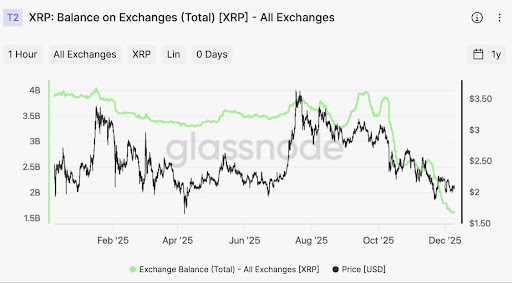
Source: Chart from Chad Steingraber on X

Notably, a Glassnode chart shared by crypto analyst ChartNerd reveals that XRP exchange balances dropped sharply from around 3.95 billion XRP to 2.6 billion XRP from November to December 2025. About 1.35 billion XRP was removed from public order books recently, representing a staggering 45% decrease in under 60 days.

Usually, exchange supply and price move together without significant divergence because the former tends to influence sell-side liquidity, which, in turn, can affect market movements. When more XRP is held on these crypto platforms, traders have a larger pool of tokens to sell, which can increase market pressure.

Conversely, when reserves shrink, it often signals that investors are withdrawing their assets, either for long-term storage or profit-taking after recent price moves. While the vast gap between XRP’s exchange balances and its price action raises concerns, whales have reportedly been selling off their holdings amid ongoing market volatility and as prices struggle to stage a meaningful rebound.

Glassnode Reports Massive Collapse In Daily XRP Fees

In addition to the collapse in XRP exchange balances, Glassnode’s data shows a steep drop in the cryptocurrency’s network activity, with average total fees falling dramatically. Since early February, the 90-day SMA of daily fees paid has decreased from about 5,900 XRP to only 650 XRP. This marks an estimated 89% drop and brings activity to its lowest point since December 2020.

The decline in daily fees suggests a cooling in on-chain demand for XRP transactions, even as the price has remained weak amid broader market uncertainty. The cryptocurrency is currently trading around $2.00, reflecting a 7.7% weekly decline and a much larger 18% crash over the past month, according to CoinMarketCap.

XRP trading at $2.01 on the 1D chart | Source: XRPUSDT on Tradingview.com

Related Reads

The Tao (τ) Law Makes EDA Go Viral

In May 2026, Huawei's semiconductor division introduced the "Tao (τ) Law" at IEEE ISCAS, shifting the industry focus from Moore's Law's geometric scaling to "time scaling." Unlike traditional approaches relying on transistor miniaturization, τ Law optimizes the time constant (τ) across device, circuit, chip, and system levels to improve information processing speed and efficiency. Huawei has already applied this principle, mass-producing 381 chips across various applications, with a target to achieve performance equivalent to 1.4nm technology by 2031. The implementation of τ Law, involving techniques like Chiplet, 3DIC, and Logic Folding, places new demands on EDA tools, highlighting gaps in current offerings. Traditional 2D or pseudo-3D EDA flows lack native support for true 3D design, cross-layer co-optimization (STCO), and coupled multi-physics analysis (thermal, power, stress), which are crucial for advanced integration. Chinese EDA companies, such as Empyrean Software, Primarius Technologies, and Xpeedic, are evolving from point-tool specialists to providing full-flow, system-level solutions. For instance, Peking University has developed a prototype "true 3D" EDA tool showing significant improvements in wirelength and timing. Empyrean Software has also launched a comprehensive 3DIC design and verification platform. The τ Law framework presents an opportunity for the domestic EDA industry to transition from achieving basic functionality to developing robust, integrated toolsets essential for next-generation chip design.

marsbit47m ago

The Tao (τ) Law Makes EDA Go Viral

marsbit47m ago

It's Not Jensen Huang Who Wants to Change the PC, But the PC That's Revolting Against Itself

The 40-year-old PC industry is undergoing a fundamental transformation, driven by the rise of AI PCs. At the GTC Taipei 2026 event, NVIDIA, backed by Microsoft and major PC OEMs, announced the RTX Spark super chip for Windows PCs, marking its official entry into the PC core processor market. This move aims to redefine the AI PC by shifting its core from the CPU to an AI-focused SoC (System on Chip). NVIDIA envisions the PC evolving from a personal computer to a "personal AI"—a platform where local AI Agents can autonomously perform tasks. While Intel pioneered the AI PC concept earlier in 2026, NVIDIA's aggressive push, leveraging its vast CUDA developer ecosystem of 6 million, positions it to potentially reshape the industry's long-standing Wintel (Windows-Intel) power structure. NVIDIA's strategy extends beyond hardware; it's about embedding its CUDA, RTX, and AI software stack into the PC platform itself. The article identifies key shifts: 1) The move from a CPU-centric to an AI SoC-centric architecture, similar to Apple's approach with its M-series chips. 2) The PC's evolution from a human-operated tool to a platform for human-Agent collaboration. 3) The extension of NVIDIA's data center-centric CUDA ecosystem to personal devices via RTX Spark. Ultimately, the change is driven by the broader trend of AI moving to personal devices. Companies like Intel, AMD, Qualcomm, and Apple are all participating in this shift. NVIDIA's entry accelerates the competition, but the core driver is the technology itself finding its optimal expression in the PC. The industry is reinventing itself, with the outcome hinging on execution, ecosystem development, and the creation of compelling local AI applications.

marsbit3h ago

It's Not Jensen Huang Who Wants to Change the PC, But the PC That's Revolting Against Itself

marsbit3h ago

Trading

Spot
Futures

Hot Articles

What is USOIL

USOILUSDT Perpetual Contract is the trading symbol for West Texas Intermediate (WTI) Crude Oil priced in US dollars, representing 1 barrel of crude oil.

713 Total ViewsPublished 2026.05.25Updated 2026.05.25

What is USOIL

How to Buy USOIL

Welcome to HTX.com! We've made purchasing WTI Crude USOil/ CL (USOIL) simple and convenient. Follow our step-by-step guide to embark on your crypto journey.Step 1: Create Your HTX AccountUse your email or phone number to sign up for a free account on HTX. Experience a hassle-free registration journey and unlock all features.Get My AccountStep 2: Go to Buy Crypto and Choose Your Payment MethodCredit/Debit Card: Use your Visa or Mastercard to buy WTI Crude USOil/ CL (USOIL) instantly.Balance: Use funds from your HTX account balance to trade seamlessly.Third Parties: We've added popular payment methods such as Google Pay and Apple Pay to enhance convenience.P2P: Trade directly with other users on HTX.Over-the-Counter (OTC): We offer tailor-made services and competitive exchange rates for traders.Step 3: Store Your WTI Crude USOil/ CL (USOIL)After purchasing your WTI Crude USOil/ CL (USOIL), store it in your HTX account. Alternatively, you can send it elsewhere via blockchain transfer or use it to trade other cryptocurrencies.Step 4: Trade WTI Crude USOil/ CL (USOIL)Easily trade WTI Crude USOil/ CL (USOIL) on HTX's spot market. Simply access your account, select your trading pair, execute your trades, and monitor in real-time. We offer a user-friendly experience for both beginners and seasoned traders.

556 Total ViewsPublished 2026.05.25Updated 2026.05.25

How to Buy USOIL

Discussions

Welcome to the HTX Community. Here, you can stay informed about the latest platform developments and gain access to professional market insights. Users' opinions on the price of A (A) are presented below.

活动图片














