WLFI's Deletion Sparks Crash Speculation: Trust Crisis in a Bear Market

比推Published on 2026-02-24Last updated on 2026-02-24

Abstract

Amid a bearish market sentiment, the deletion of a tweet by Eric Trump, co-founder of World Liberty Financial (WLFI), triggered widespread speculation and panic. On February 23, Eric Trump retweeted and then deleted a post about Binance listing more USD1 trading pairs. This action led to a temporary depegging of USD1 to 0.9802 against USDT and a nearly 10% drop in WLFI’s price, though both later recovered. The incident fueled FUD (fear, uncertainty, and doubt) on social media, with rumors suggesting Eric had purged all crypto-related tweets or that internal issues plagued the Trump family. WLFI quickly responded, claiming it was a coordinated attack where hackers breached multiple co-founders’ accounts, spread panic, and attempted to profit by shorting WLFI. They later clarified that only X accounts were compromised, not WLFI or USD1 contracts. However, skepticism arose. Observers noted that only one retweet was removed—not a mass deletion—and no significant shorting activity was detected. Some linked the event to an upcoming major investigation announcement by on-chain detective ZachXBT, though market data did not strongly tie it to WLFI. Critics also questioned WLFI’s narrative, suggesting the “hack” claim might be a cover-up or misdirection. The event highlights the crypto community’s heightened sensitivity and distrust during bear markets, where minor actions can spark exaggerated reactions and conspiracy theories.

Author: Eric, Foresight News

Original Title: WLFI's FUD Farce, from Bear Market's Nerves


On the evening of February 23, Beijing time, Eric Trump, son of U.S. President Trump and co-founder of World Liberty Financial (WLFI), retweeted a post about Binance listing more USD1 trading pairs. However, shortly after, Eric Trump deleted the retweet.

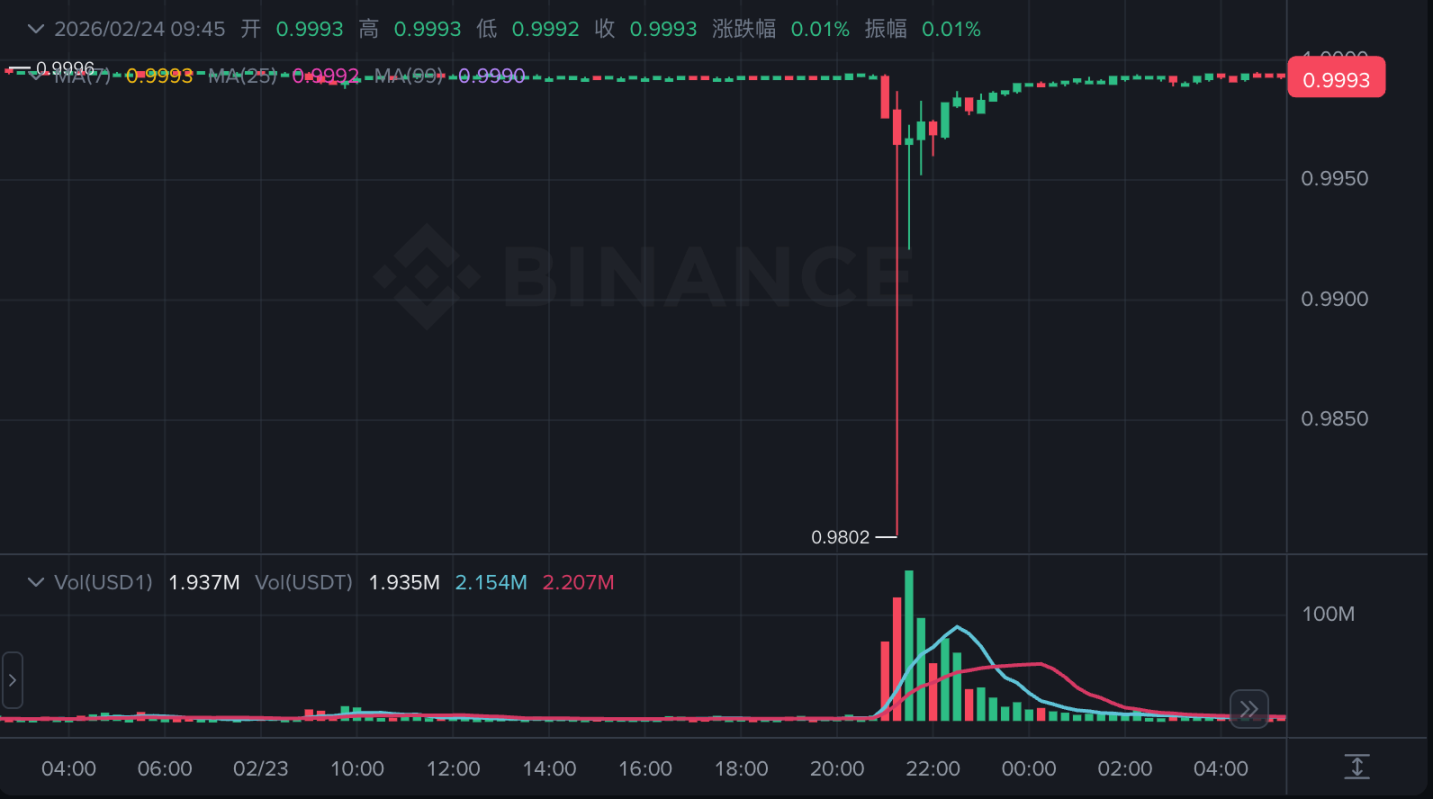
Amid the pessimistic atmosphere of the bear market, speculation about this simple action was magnified endlessly. The exchange rate between USD1 and USDT on Binance briefly depegged to 0.9802, and the price of WLFI also dropped nearly 10% temporarily. As of the time of writing, the price fluctuations of USD1 and WLFI have returned to normal.
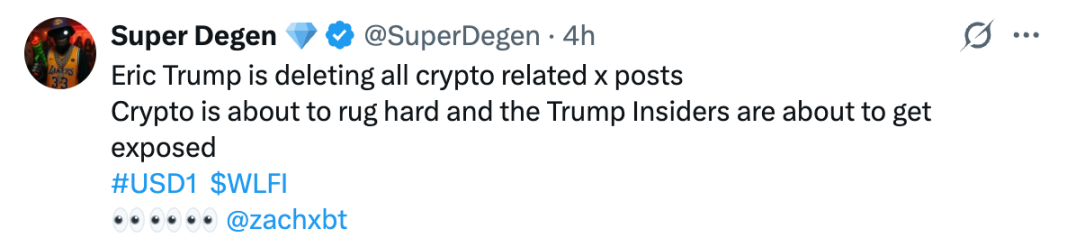
As prices fell, a large amount of FUD (Fear, Uncertainty, Doubt) emerged on X, such as claims that Eric Trump had deleted all Crypto-related tweets, or that there might be internal issues within the Trump family.
Soon, WLFI stepped in to debunk the rumors, stating that World Liberty Financial had been targeted by a coordinated attack. The attackers had hacked into the accounts of several WLFI co-founders, bribed KOLs to spread panic, and heavily shorted WLFI in an attempt to profit from the artificially created chaos. Later, the WLFI official account tweeted again to clarify that the WLFI and USD1 contracts had not been attacked; only the X accounts were compromised, and USD1 still had sufficient backing.

But is that really the case?

After this "bloodshed caused by a deleted retweet," some WLFI supporters or onlookers noted that while they did see many posts on X claiming that "Eric Trump" had deleted all Crypto-related tweets, in reality, Eric's account had merely un-retweeted the WLFI official post about "more USD1 trading pairs being listed on Binance," and had not mass-deleted tweets.

Many users joked self-deprecatingly that the industry is on the verge of being disproven, and any slight movement could lead to unexpected outcomes—everyone's nerves are on edge. WLFI, as a Crypto project endorsed by the U.S. President's family, if even they were to abandon it, might indicate that Crypto truly has no hope.

Although the WLFI incident itself did not cause significant impact, it raised considerable skepticism. Foremost among these are speculations about the true internal situation of WLFI.

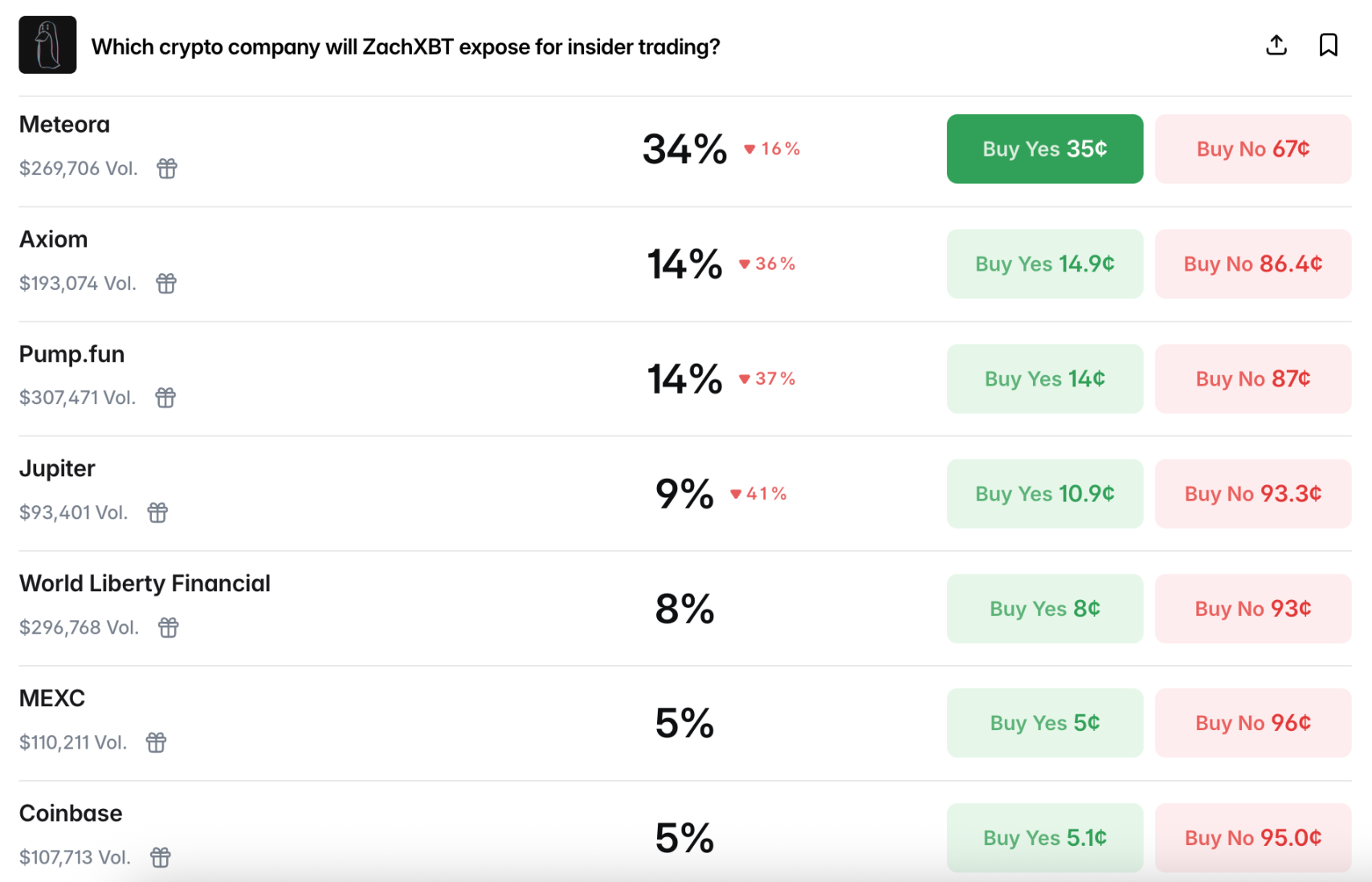
Just before this "attack" began, the well-known on-chain detective ZachXBT posted a cryptic message, announcing that on February 26, he would release a major investigation into one of the most profitable enterprises in the cryptocurrency space, which found that multiple employees of the company had engaged in insider trading using internal data over an extended period.

Given the timing, many naturally linked "ZachXBT's爆料" with "Eric Trump's deleted retweet," suggesting that WLFI might be preemptively deleting evidence. However, data from Polymarket shows that people do not seem to believe WLFI is the target of the爆料.
Some also argue that WLFI stepped in to debunk the rumors because Eric Trump's deletion caused negative consequences, and they wanted to shift the blame to "non-existent hackers" to quell public anger. The most direct reason is that if hackers truly "hacked" the X accounts of multiple WLFI co-founders, merely un-retweeting would be highly unreasonable.
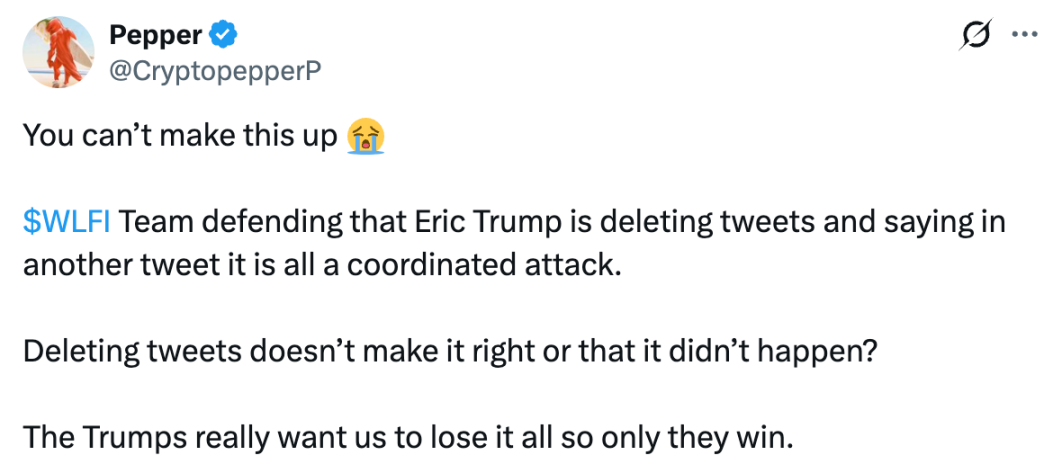
Additionally, WLFI's claim of "heavy shorting of WLFI" has been questioned. There is currently no data showing that anyone shorted WLFI tokens in advance; at the time of the incident, there were only small sell-offs of USD1 on-chain. Thus, the idea that someone preemptively shorted WLFI might be entirely baseless. Given these facts, it is understandable that conspiracy theories emerged, suggesting that WLFI's debunking was an attempt to cover up other facts (such as deleting evidence related to ZachXBT's爆料) by shifting blame.

From a completely neutral perspective, this farce seems more like a concentrated outbreak of the mutual distrust prevalent in the current crypto space.

Before the Lunar New Year, Binance launched a highly lucrative USD1 savings campaign, which not only successfully increased USD1's issuance to a position second only to USDT and USDC but also provided substantial liquidity for USD1 and other token trading. However, such large-scale subsidy activities also planted seeds of doubt in many users' minds: could such massive subsidies be a precursor to bad news?

Perhaps Eric Trump simply accidentally un-retweeted, but Crypto Twitter (CT) imagined countless conspiracy theories, attributing numerous "underlying reasons" to Eric Trump's action. Crypto retail investors have been tormented to the point of "once bitten, twice shy." If not for the current market environment, flawed debunking like WLFI's official response might not have gained traction.


Twitter:https://twitter.com/BitpushNewsCN

Bitpush TG Discussion Group:https://t.me/BitPushCommunity

Bitpush TG Subscription: https://t.me/bitpush

Original link:https://www.bitpush.news/articles/7614153

Related Questions

QWhat event triggered the WLFI price drop and USD1 depegging on February 23rd?

AThe price drop and temporary depegging of USD1 were triggered after Eric Trump, co-founder of World Liberty Financial (WLFI), deleted a retweet about Binance listing more USD1 trading pairs.

QHow did WLFI officially respond to the FUD and market panic?

AWLFI claimed that it was a coordinated attack where hackers invaded multiple co-founders' X (Twitter) accounts, bribed KOLs to spread panic, and shorted WLFI to profit from the chaos. They later clarified that only X accounts were compromised, and the USD1 contract remained secure with sufficient funds.

QWhat role did the crypto investigator ZachXBT play in the speculation surrounding WLFI?

AZachXBT announced a major investigation into insider trading at a top crypto company, scheduled for release on February 26. The timing led some to speculate a connection with Eric Trump's deleted retweet, though Polymarket data showed low belief that WLFI was the target.

QWhy did the market react so strongly to a simple deleted retweet?

AThe market's extreme sensitivity was due to bearish sentiment and widespread distrust. Investors, already nervous, interpreted the deletion as a potential sign of loss of support from the Trump family, fueling FUD and panic selling.

QWhat doubts did skeptics raise about WLFI's explanation of the incident?

ASkeptics questioned WLFI's claims, noting that no evidence of large short positions existed, the hackers' action (only unretweeting) seemed illogical, and the response might be an attempt to cover up internal issues or preempt ZachXBT's findings.

Related Reads

$9.4 Billion: The Largest Robotics Funding This Year Has Emerged

Munich-based humanoid robotics company Neura has completed a $1.4 billion (approximately RMB 94.9 billion) Series C funding round, valuing the company at around $7 billion and positioning it among the global leaders in the sector. The investment round is notable not just for its size—reportedly the largest in robotics this year—but also for its strategic backers, which include tech giants like NVIDIA and Amazon, alongside established industrial players such as German engineering firms Bosch and Schaeffler. This mix of investors signals a significant shift in the industry's focus from technological demonstrations and general-purpose narratives toward practical, industrial deployment and commercialization. Neura's approach centers on developing humanoid robots for defined, high-value industrial tasks rather than pursuing a general-purpose model. Its early validation comes from a partnership with BMW, where its robots are being tested on actual production lines. The involvement of Bosch and Schaeffler, companies deeply embedded in global manufacturing, underscores a growing belief that humanoid robots are transitioning from labs to viable factory-floor solutions. The article highlights two converging trends driving investment: advancements in AI and large language models, which enhance robots' perception and decision-making in unstructured environments, and mounting pressure from labor shortages and rising costs in major manufacturing regions. The funding landscape is now bifurcating between companies like Figure AI, focusing on versatile general-purpose robots, and firms like Neura, targeting specific vertical industrial applications with clearer, shorter paths to ROI. While technical hurdles remain, the core challenges for widespread adoption are increasingly seen as engineering and commercial in nature: managing the high integration and customization costs for different factory environments and establishing robust, localized maintenance and service networks. The record investment in Neura, particularly from industrial capital, indicates the industry's growing confidence in moving from proving feasibility to solving the practical problems of scalability, reliability, and building sustainable business models around humanoid robots in real-world settings like automotive manufacturing and hazardous labor environments.

marsbit5h ago

$9.4 Billion: The Largest Robotics Funding This Year Has Emerged

marsbit5h ago

Trading

Spot
Futures

Hot Articles

Discussions

Welcome to the HTX Community. Here, you can stay informed about the latest platform developments and gain access to professional market insights. Users' opinions on the price of S (S) are presented below.

活动图片