Will UNI Reach $100 in Four Years? Will Standard Chartered's Prediction Come True?

Foresight NewsPublished on 2026-06-17Last updated on 2026-06-17

Abstract

TL;DR: - According to reports, Standard Chartered Bank has published a research report on Uniswap, setting a 2030 price target of $100 for the UNI token. - The bank's core logic is that the tokenization of assets will drive demand for open DeFi liquidity, and Uniswap could capture significant trading volume and fee revenue. - However, most institutional-grade tokenized products are permissioned, and the example of BlackRock's BUIDL shows that DeFi still faces significant access barriers. Standard Chartered's $100 target for UNI by 2030 is based on the hypothesis that tokenized assets will grow massively and a significant portion will flow into open DeFi markets, requiring decentralized exchange platforms like Uniswap for liquidity. The bank forecasts tokenized assets could reach $4 trillion by 2028, with up to 30% in DeFi by 2030. The key question is whether tokenized assets like treasuries and funds will trade in open, decentralized markets or remain within closed, permissioned institutional systems. This directly impacts Uniswap's potential growth. A real-world example is BlackRock's BUIDL fund, which, while using UniswapX for trading, is strictly limited to pre-approved, whitelisted institutional participants. This highlights the current trend: institutions may leverage DeFi infrastructure but maintain strict control over access and transfers. Furthermore, for UNI's value to rise significantly, Uniswap must establish a clear value-capture mechanism, such as the approv...


By: Liam Akiba Wright

Compiled by: Luffy, Foresight News


TL;DR:


  • It is reported that Standard Chartered Bank has released a research report on Uniswap, setting a $100 price target for the UNI token by 2030.
  • Standard Chartered's core logic is that tokenized assets will drive demand for open DeFi liquidity, and Uniswap is expected to capture a large volume of trades and earn transaction fees.
  • However, most institutional-grade tokenized products are permissioned, and BlackRock's BUIDL product demonstrates that the DeFi sector still faces entry barriers.


Standard Chartered Bank has set a year-end 2030 price target for the UNI token at $100. This prediction suggests that the price of this leading decentralized exchange governance token will far exceed its current market valuation.


Standard Chartered's argument is that future tokenized assets will require decentralized trading platforms to convert fragmented on-chain financial instruments into tradable liquidity.


Standard Chartered estimates that by 2028, the global total value of tokenized assets could reach $4 trillion; and by 2030, the proportion of tokenized assets flowing into the DeFi market may increase from the current approximately 3.5% to 30%. Based on this projection, the DeFi market could hold over $2 trillion in assets by 2030.


Currently, banks, asset managers, transfer agents, and compliant platforms are all entering the asset tokenization space. However, if these assets require 24/7 trading, flexible collateralization, and cross-product portfolio capabilities that a single institution's proprietary system cannot provide, then open, decentralized protocols will capture the liquidity dividend.


Within the current market environment, a core industry question emerges: Will on-chain assets such as tokenized treasuries, fund tokens, stock tokens, and stablecoins become liquidity instruments in open, decentralized markets, or will they remain confined to closed, strictly permissioned systems with fully controlled settlement and transfers?


Growth Prospects Depend on Open Liquidity


The valuation target set by Standard Chartered is built upon multiple layers of assumptions: First, the tokenized asset market achieves significant expansion. Second, a substantial portion of tokenized assets cease to be merely compliant, on-chain ownership records and instead become actively traded within DeFi markets. Finally, Uniswap can capture a sufficient share of relevant trading volume, driving up the value of the UNI token. The core of this entire logic shifts the focus from the asset issuance phase to the liquidity trading phase.


Standard Chartered had previously identified asset tokenization as a major long-term opportunity. In a 2024 report co-published with consulting firm Synpulse, the bank predicted that the global tokenization of real-world assets would reach $30.1 trillion by 2034, with trade finance being a core application area. The report also mentioned that tokenization would give rise to new DeFi applications and business models.


Citi's tokenization report from June 2026 presented a similar market size forecast but also highlighted countervailing factors: Its base case predicted tokenized assets would reach $5.5 trillion by 2030, with an optimistic scenario of $8.2 trillion. The report also noted that hybrid models might dominate, with institutions controlling issuance, distribution, and settlement channels.


The divergence between these two paths directly determines Uniswap's growth potential. If the scale of tokenized assets continues to grow but their value remains locked within bank platforms, transfer agent systems, brokerage networks, and compliant trading markets, the room for open DeFi development will be severely limited.


Conversely, if various tokenized financial instruments, stablecoins, and collateral assets require cross-category free trading, the status of protocols like Uniswap would rise significantly.


Data from DeFiLlama confirms Uniswap's foundation for meeting this demand. At the time of writing, the protocol's multi-chain Total Value Locked (TVL) is approximately $2.89 billion, with fee revenue exceeding $50 million in the past 30 days.


While existing data only represents the base operational scale, it is sufficient to illustrate that Uniswap's positioning is that of liquidity infrastructure.


For institutions, there is a clear operational difference between the two. Issuing a fund token is one process; building a trading venue where that token can be freely exchanged for stablecoins, collateral, and other tokenized assets is an entirely separate business.


The gap between these two processes determines whether automated market makers like Uniswap become essential infrastructure or merely peripheral access channels.


It is evident, therefore, that the choice of trading channel is as important as asset issuance. Liquidity determines whether tokenized products can form a tradable market, reusable collateral, and settleable assets; otherwise, they risk becoming static ownership certificates within compliant systems.


BlackRock's BUIDL: Connecting to DeFi, But Erecting Permissioned Gateways


BlackRock's BUIDL (BlackRock USD Institutional Digital Liquidity Fund) is a current real-world case highlighting this tension. In February of this year, Uniswap Labs and the compliant platform Securitize jointly announced that BlackRock's BUIDL fund would be accessible via the UniswapX trading channel.


This integration uses a Request for Quote (RFQ) mechanism and is only open to whitelisted users and pre-approved eligible participants.


Previous reporting by CryptoSlate on BUIDL pinpointed the core contradiction: While BUIDL holders can exchange for USDC via UniswapX, trading access is subject to strict permissioning.


The trading process leverages DeFi technology, but asset circulation is restricted to vetted institutional participants.


BlackRock's initial issuance rules for BUIDL fully embody this controlled model: The product is only for accredited investors, with a minimum investment of $5 million. Assets can only be transferred to pre-approved parties, and the fund is not listed on any exchange.


Data from RWA.xyz shows that as of June 16, BUIDL's total assets under management were approximately $2.37 billion, held by only 108 entities.


Combined with the permissioning rules, this illustrates the current state of the tokenization industry: large-scale tokenized products can emerge on-chain, but participation is highly concentrated and subject to full-cycle access controls.


Standard Chartered's investor roadshow materials from May 2026 also cited BUIDL's connection to Uniswap as a case study, arguing that decentralized platforms could be used for asset distribution and trading.


Even though the complete UNI valuation research report has not been made public, this roadshow material already categorized Uniswap as part of the institutional digital asset supporting infrastructure—the foundational support for the $100 price target.
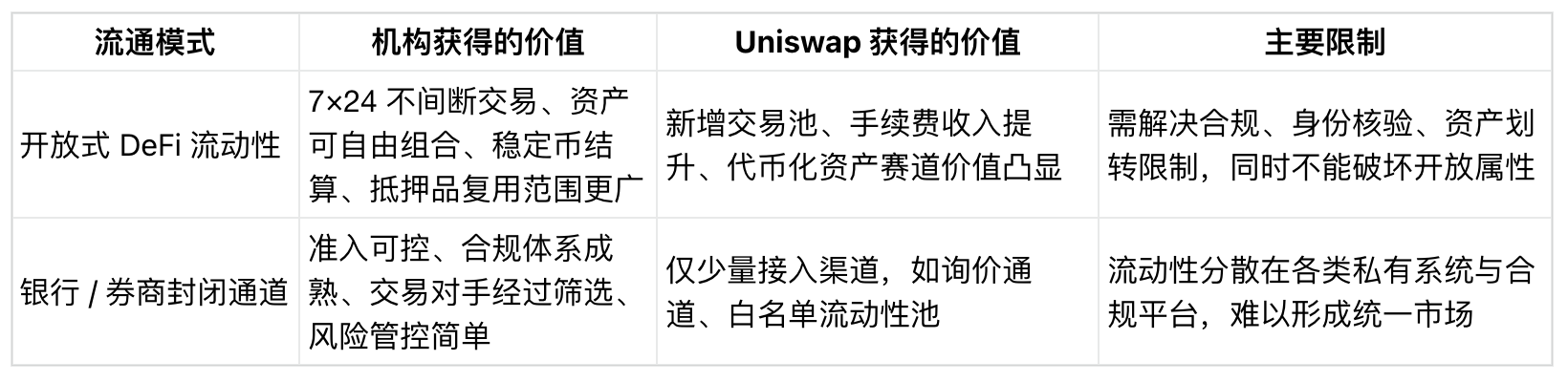


The BlackRock BUIDL model sits between the two extremes: it utilizes Uniswap technology at its base but maintains full institutional permissioning controls throughout. This design builds a bridge to DeFi infrastructure without fully placing the tokenized assets into a permissionless, open liquidity pool.


It is highly likely that institutional asset liquidity solutions will initially adopt this hybrid model: leveraging DeFi infrastructure for trading and settlement while imposing strict controls on user identity, asset transfers, and counterparties.


UNI Still Lacks a Value Capture Mechanism


Even if Uniswap handles more real-world tokenized asset trading, it doesn't guarantee direct benefits for UNI holders. The protocol still lacks a stable value capture mechanism.


A previous UNI tokenomics upgrade proposal passed by the community on the Tally platform clarified protocol fee distribution and UNI burn mechanisms, while also proposing that Uniswap become the default trading hub for tokenized assets.


This plan provides a path for the valuation logic, but it depends on multiple prerequisites: community governance decisions, fee adjustments, institutional business partnerships, and growth in actual trading volume—all are indispensable.


The $100 price target given by Standard Chartered not only far exceeds current market prices but also surpasses UNI's all-time high from 2021. Achieving this target cannot rely solely on growth in asset issuance; it must be supported by real, sustained trading volume, stable fee income, and a clear mechanism linking protocol development to token value.


The core tension in the institutional tokenization space is that banks and asset managers need decentralized capabilities like on-chain settlement, 24/7 transfers, programmable collateral, and stablecoin payments, yet they simultaneously insist on KYC identity verification, asset transfer restrictions, designated counterparties, and maintaining control over secondary market strategy.


The Financial Stability Board's research report on tokenization also reflects this cautious stance. The report points out that the current overall scale of tokenization remains small, and the industry faces multiple challenges, including permissioned access, insufficient cross-platform interoperability, limited settlement assets, and fragmented trading venues.


These frictions are precisely the core obstacles preventing tokenized assets from becoming general liquidity instruments in DeFi.


If these industry barriers persist, Uniswap will remain merely a peripheral integration channel for institutional tokenization systems. If these pain points are gradually alleviated, the protocol could become the central trading venue where tokenized funds, stablecoins, and native crypto assets converge.


Ultimately, the core of Standard Chartered's valuation prediction depends on where tokenized liquidity ultimately flows. The $100 target represents significant upside potential. However, the more critical signal is that a traditional Wall Street investment bank has acknowledged that DeFi protocols have a chance to share in the institutional tokenization wave.


The BlackRock BUIDL case has proven that asset managers can use DeFi technology while maintaining strict circulation controls. Citi's outlook on the tokenization industry also suggests that Wall Street is likely to build hybrid systems, keeping issuance, distribution, and settlement firmly in institutional hands. Meanwhile, the various industry pain points raised by the Financial Stability Board highlight that interoperability and settlement systems remain core challenges.


Future market signals will come from more cases of tokenized asset integration. If new assets all adopt isolated, whitelisted RFQ channels, open DeFi will only capture a small market share. If cross-asset unified liquidity pools gradually materialize and custom control rules diminish, Uniswap's position in the tokenization space will no longer be confined to native cryptocurrency swaps.


Trending Cryptos

Related Questions

QWhat is Standard Chartered's price target for UNI by 2030 and what is the core logic behind this prediction?

AStandard Chartered has set a price target of $100 for UNI by the end of 2030. The core logic is that tokenized real-world assets will create significant demand for open DeFi liquidity. Uniswap, as a leading DEX, is positioned to capture a large share of the trading volume and fees generated from these tokenized assets as they become a significant part of the DeFi ecosystem.

QWhat is the key challenge for Uniswap to benefit from the growth of tokenized assets according to the article?

AThe key challenge is whether tokenized assets like treasury bonds, funds, and stocks will flow into open, permissionless DeFi markets or remain confined within closed, permissioned systems controlled by institutions. The article cites the example of BlackRock's BUIDL, which uses UniswapX technology but restricts trading to pre-approved, whitelisted participants, illustrating the current barriers to open liquidity.

QHow does the article describe the current state of the tokenized asset industry using BlackRock's BUIDL as an example?

AThe article uses BlackRock's BUIDL to illustrate that the current state of the tokenized asset industry is one of controlled access. While the product is on-chain and utilizes DeFi infrastructure (UniswapX) for transactions, participation is highly restricted. It's only available to qualified investors with a minimum investment of $5 million, and assets can only be transferred to pre-approved parties, showing a model that adopts DeFi technology while maintaining strict institutional control over distribution and trading.

QWhat limitation does UNI still face in capturing value from Uniswap's growth, even if it processes more tokenized asset trades?

AEven if Uniswap processes more trades from tokenized assets, the UNI token itself currently lacks a stable value capture mechanism. Although a community governance proposal has outlined plans for fee distribution and token burns, the realization of value for UNI holders depends on the successful execution of these governance decisions, fee adjustments, institutional partnerships, and genuine growth in trading volume.

QWhat is the fundamental question that will determine whether Standard Chartered's $100 UNI price target is realistic?

AThe fundamental question is where the liquidity from tokenized assets will ultimately flow. The prediction's validity depends on whether these assets will be traded in open, permissionless liquidity pools on platforms like Uniswap or if they will predominantly remain in closed, permissioned institutional systems. The future market signals will come from whether new tokenized asset integrations favor isolated, whitelisted channels or embrace open, cross-asset liquidity pools with fewer custom controls.

Related Reads

A New Scaling Variable for Text-to-Image Generation, Discovered by ByteDance's Seed Team

ByteDance's SEED team investigated a crucial but often overlooked scaling variable in text-to-image diffusion models: the amount of image-grounded information in training captions. They found that simply increasing caption length with natural language does not improve model performance, as it often adds redundancy without new, usable visual supervision. The core discovery is that the final training loss of a diffusion model can be predicted by the *information content* of its text condition, measured by two complementary metrics: Grounded Perplexity Gain (GPG) and Effective Detailness (ED). This establishes a scaling relationship for text conditioning. To systematically increase information content, the team proposed **Structured Prompt (SP)**, a JSON-based representation that organizes visual variables (global scene, object attributes, spatial relationships) into clear fields, enhancing **Diffusability**—the model's ability to learn from captions. For inference, an LLM **Prompter** is trained to convert user queries into detailed SP instances, defining **Promptability**. The overall generation quality is viewed as a product of Diffusability and Promptability. A three-stage training strategy (SFT, cold-start reasoning distillation, and verifier-guided reinforcement) significantly improves the prompter's capability. The structured format also enables efficient iterative refinement through a *refine-render-judge* loop. In matched-control experiments using the same Qwen-Image backbone, data, and compute, the SP-based system substantially outperformed its natural-language counterpart, demonstrating that gains stem from the structured information interface, not just more training. The work shows that scaling text-to-image models requires scaling the *usable visual information* in conditions, not just model size or data volume.

marsbit15m ago

A New Scaling Variable for Text-to-Image Generation, Discovered by ByteDance's Seed Team

marsbit15m ago

In Just 6 Months, 4 Rounds of Funding: West Lake University Professor's Venture Takes Off

Westlake Robotics, an embodied artificial intelligence company, has completed its Series A financing round within just six months and a total of four rounds, raising a cumulative 5 billion RMB. The investor lineup includes prominent institutions such as SAIF Partners, Xiaomiao Langcheng, Henan Investment Group Huirong Fund, and Haiyuan Fund, forming a high-quality capital matrix comprising state-owned, industrial, and leading venture capital. The rapid and intensive capital injection reflects strong market confidence in the company's technological approach, product deployment capabilities, and long-term potential. The newly acquired funds will be primarily allocated to the research and development of a unified large model for humanoid robots and the establishment of a talent cultivation base for embodied AI. Founded in 2024, Westlake Robotics originated from the industrial transformation of pioneering achievements in AI and robotics at Westlake University. The founding team is led by Wang Donglin, a leading figure in China's embodied AI and robot learning field, and co-founder Zhang Yue, an expert in natural language processing. The core R&D members hail from top-tier tech companies like Alibaba, ByteDance, Tencent, and Huawei, as well as prestigious global universities. The company follows a fully self-developed strategy integrating a "universal brain + humanoid body-specific cerebellum + proprietary humanoid hardware." It is one of the few domestic enterprises capable of holistically connecting the three core areas of embodied AGI cognitive reasoning, full-body motion control, and humanoid hardware. Its proprietary technologies include the General Motion Model-GAE system for low-latency teleoperation and motion generalization, and a dual pre-trained architecture for general and body-specific processing to bridge cognitive reasoning and physical movement. In 2026, Westlake Robotics launched its self-developed humanoid robot "Westlake o1," completing the full technology chain from underlying algorithms to pre-trained models and hardware. The company has secured nearly 100 million RMB in orders, with applications in scientific research, education, data collection, and power inspection. Future targets include high-risk industrial inspection, post-disaster search and rescue, and remote precision assembly. The company has also partnered with the Longyou County government to establish a county-wide real-scenario training base for humanoid robots, aimed at collecting high-quality motion data and validating technology in authentic environments. With the latest funding, Westlake Robotics plans to further advance its core model development and talent acquisition strategy, accelerating progress toward the "GPT moment" for embodied intelligence in China.

marsbit39m ago

In Just 6 Months, 4 Rounds of Funding: West Lake University Professor's Venture Takes Off

marsbit39m ago

Volatility Plummets to Historic Lows, When Will Bitcoin's 'Summer Sideways Move' End?

Bitcoin is experiencing a classic summer of stagnant price action, trapped in a tight range between approximately $62,000 and $66,000. Analysts point to historically low implied volatility and thin summer liquidity as key characteristics of the current market. The consensus among traders is that the catalyst for a decisive breakout will come from macroeconomic factors, not internal crypto dynamics. The immediate focus is on upcoming U.S. CPI data, which could influence Federal Reserve policy expectations. A softer inflation print is seen as potentially supportive for risk assets like Bitcoin. Furthermore, the pending *Clarity Act* legislation is identified as a crucial long-term catalyst that could boost institutional participation by providing regulatory clarity. While U.S. spot Bitcoin ETFs, led by BlackRock's IBIT, have seen their strongest inflows since April, providing underlying support, this buying pressure is being offset by selling from miners and other large holders. This has resulted in continued consolidation even as global crypto trading volumes hit multi-year lows. Market participants expect the range-bound, low-volatility environment to persist for several more weeks, at least until there is clearer progress on macro policy or regulatory fronts. Any sustained break above or below the current range is likely to trigger a significant expansion in volatility. Long-term bullish narratives around adoption, institutional demand, and Bitcoin's unique attributes as collateral remain intact, but the short-term path depends on external macroeconomic catalysts.

marsbit43m ago

Volatility Plummets to Historic Lows, When Will Bitcoin's 'Summer Sideways Move' End?

marsbit43m ago

Trading

Spot

Hot Articles

Discussions

Welcome to the HTX Community. Here, you can stay informed about the latest platform developments and gain access to professional market insights. Users' opinions on the price of S (S) are presented below.

活动图片