Will the Fed’s $8B liquidity injection create a turning point for crypto?

ambcryptoPublished on 2026-03-27Last updated on 2026-03-27

Abstract

Given the current macro environment marked by geopolitical tensions and rising oil prices, investors are closely monitoring Federal Reserve signals. The Fed's recent $8 billion liquidity injection is drawing significant attention, as shifts in liquidity often directly impact crypto markets. Technically, crypto showed early resilience but momentum is fading, with the total market cap dropping 3.4% in a day, erasing nearly $100 billion. Rising Treasury yields and a risk-off shift are pulling capital into safe havens, reminiscent of the 2022 cycle that triggered a major crypto bear market. The Fed's intervention may provide short-term support and slow the flight to safety, potentially acting as a key catalyst in the current cycle.

Given the current macro setup, investors are closely tracking every signal coming from the Federal Reserve.

The logic is simple: the ongoing West Asia crisis shows no signs of de-escalation. Instead, geopolitical tensions continue to spill into energy markets, pushing oil prices back above the $100/barrel mark. Consequently, countries are being forced to consider targeted fiscal responses to stabilize their economies.

Within this environment, liquidity has become the central narrative. That’s why the Federal Reserve’s recent decision to inject $8 billion into the financial system is drawing increased attention from investors, particularly for crypto traders, where shifts in liquidity often translate directly into price action.
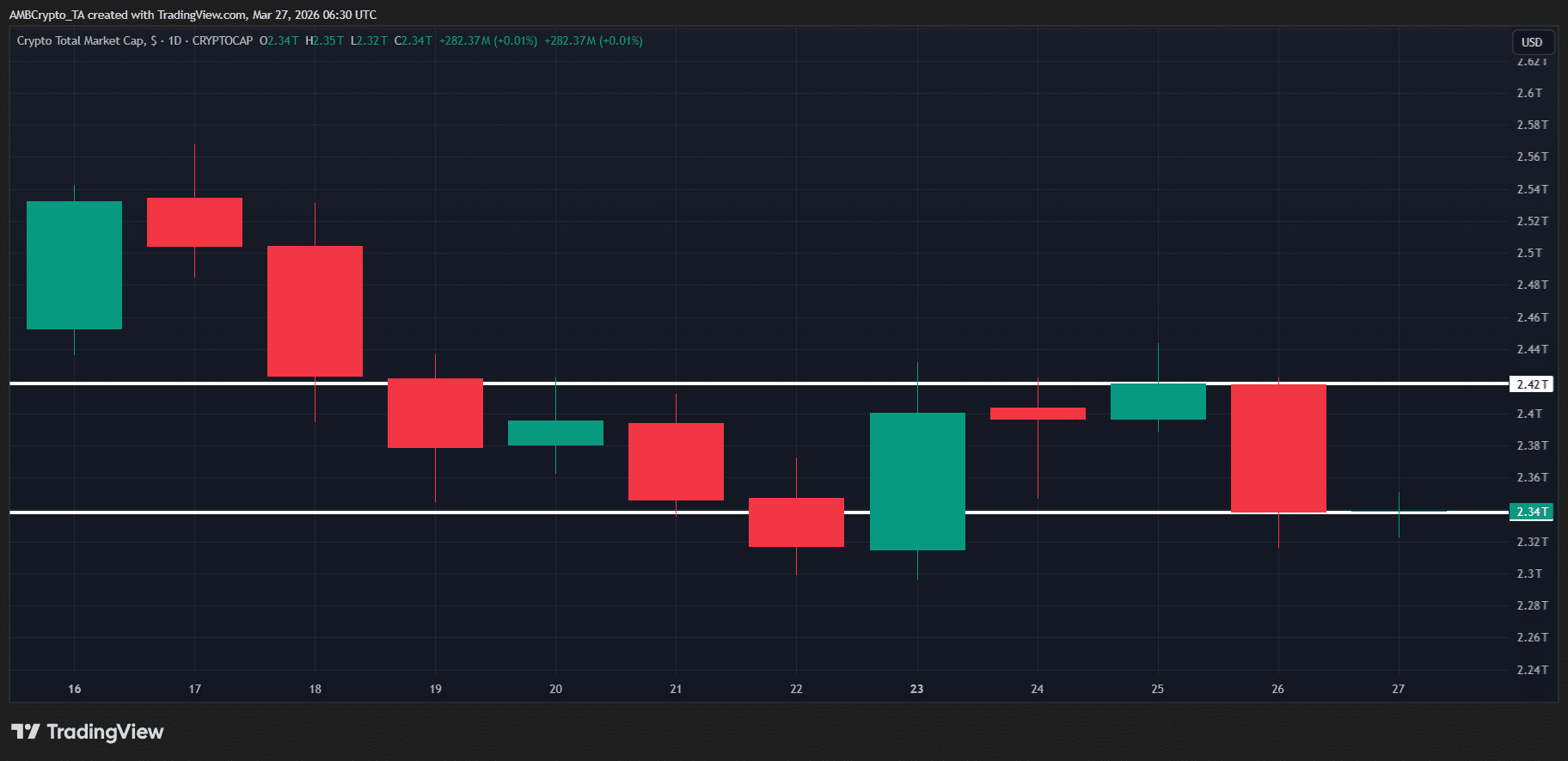
Source: TradingView (TOTAL/USDT)

From a technical perspective, the timing looks increasingly relevant.

While the crypto market initially showed resilience when the conflict first escalated, momentum now appears to be fading. Patience seems to be thinning, with the TOTAL crypto market cap closing 3.4% lower on the 26th of March, marking one of the sharper weekly pullbacks and wiping out nearly $100 billion in value.

Against this backdrop, the Federal Reserve’s liquidity injection could provide short-term support. The bigger question, however, is whether it will be enough to stabilize market sentiment if the conflict continues to drag on, especially as geopolitical uncertainty pushes investors toward safer assets.

If it does, this intervention could evolve into a key catalyst shaping the current crypto cycle.

Crypto markets fear a 2022 repeat as investors rotate into safety

In the current macro setup, risk management has naturally become the dominant trading priority.

From a technical angle, this shift reflects investors rotating back into cash and low-risk positions instead of actively deploying capital into risk assets, as they wait for clearer macro signals before increasing exposure.

Notably, this caution is most visible in the bond market. Real yields on 10-year Treasuries have climbed to their highest levels in nearly a year, signaling tightening financial conditions. At the same time, renewed geopolitical tensions with Iran have pushed the 10-year Treasury yield up to around 4.43%, reinforcing the broader risk-off tone across markets.
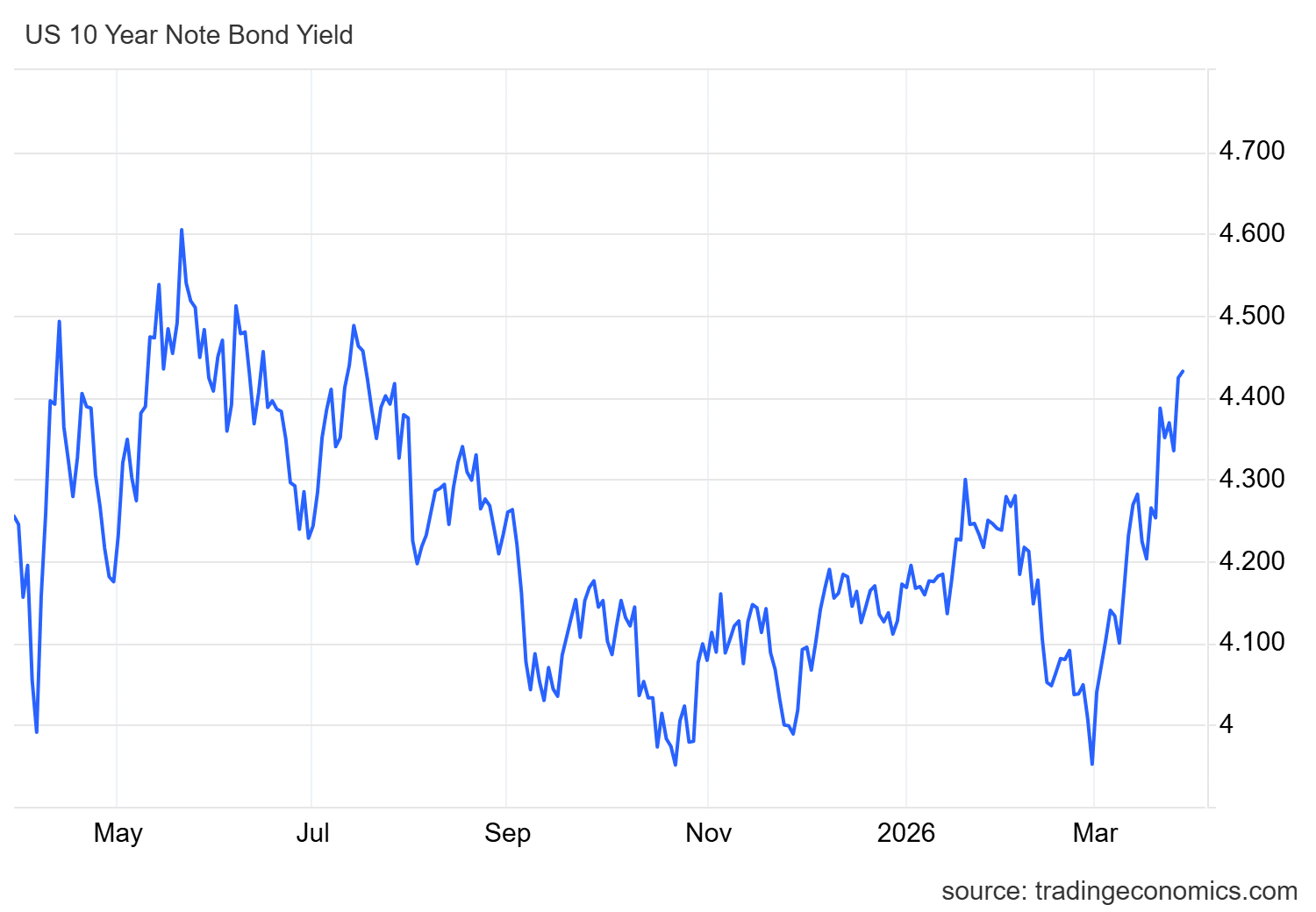
Source: TradingEconomics

In essence, higher yields are pulling liquidity away from risk assets.

And it doesn’t stop there. JPMorgan has pointed out that the ongoing rotation of capital into safe havens like cash is starting to resemble the 2022 setup. Back then, the shift toward safety triggered crypto’s first major bear market, sending the total crypto market cap down 65%+ and wiping out roughly $1.4 trillion in value.

In this context, the Federal Reserve’s $8 billion liquidity injection doesn’t just fit the technical picture. Instead, it also aligns with the broader “fundamental” backdrop too. As investors grow more risk-averse, this liquidity could help relieve pressure on risk assets and slow the flow into safe havens, making it a key signal for the current crypto cycle.


Final Summary

  • Rising yields and geopolitical tensions are driving capital toward safe havens, mirroring the 2022 cycle that triggered crypto’s first major bear market.
  • The Fed’s $8 billion injection provides support, easing pressure on risk assets and acting as a key signal in the current macro cycle.


Related Questions

QWhat is the main reason investors are closely watching the Federal Reserve's actions according to the article?

AInvestors are closely tracking every signal from the Federal Reserve because liquidity has become the central narrative, and shifts in liquidity often translate directly into price action in the crypto markets.

QHow did the crypto market perform on March 26th, as mentioned in the article?

AThe TOTAL crypto market cap closed 3.4% lower on March 26th, marking one of the sharper weekly pullbacks and wiping out nearly $100 billion in value.

QWhat specific action did the Federal Reserve take that is drawing attention from crypto traders?

AThe Federal Reserve decided to inject $8 billion into the financial system, which is drawing increased attention as it could provide short-term support to risk assets.

QWhy are rising yields on 10-year Treasuries significant for the crypto market?

ARising real yields on 10-year Treasuries signal tightening financial conditions and a risk-off tone, which pulls liquidity away from risk assets like crypto, mirroring the setup that triggered the 2022 bear market.

QWhat broader macroeconomic factor is contributing to the current risk-averse sentiment among investors?

ARenewed geopolitical tensions, particularly the ongoing West Asia crisis with no signs of de-escalation, are spilling into energy markets and pushing investors toward safer assets, contributing to the risk-averse sentiment.

Related Reads

Only 153 Venture Capital Firms Invested in July: Is the Crypto VC Industry Experiencing a 'Mass Extinction'?

In July 2026, only 153 unique venture capital firms participated in disclosed crypto funding rounds, marking the lowest monthly count since November 2020. This figure represents an 87% decline from the peak of 1,177 firms in 2022. Overall, the first seven months of 2026 saw crypto projects raise approximately $11.78 billion across 481 rounds. This crypto VC contraction contrasts sharply with the broader venture capital landscape, where global VC investment reached a record $560.4 billion in H1 2026, heavily fueled by major AI company financings. This shift in capital allocation has drawn funds away from the crypto sector. Within crypto, funding is highly concentrated. Trading platforms, prediction markets, and payment sectors absorbed 53% of the total capital. While early-stage deals remain frequent, the largest sums flow to a few late-stage rounds and mergers & acquisitions, which surged to $7.23 billion in Q2 2026. The market is consolidating around top funds like a16z crypto and Dragonfly, which successfully raised new multi-billion dollar funds, while many smaller firms have retreated. Analysts describe this as a "great extinction" for crypto VCs, where capital is becoming more selective, favoring proven business models and assets over early-stage speculation. This raises the bar for project quality, funding efficiency, and viable exit paths.

marsbit18m ago

Only 153 Venture Capital Firms Invested in July: Is the Crypto VC Industry Experiencing a 'Mass Extinction'?

marsbit18m ago

Strategy's Loss in the Second Quarter Reaches $8.22 Billion Amid Bitcoin Decline

Strategy, the largest corporate holder of Bitcoin, reported a net loss of $8.22 billion for the second quarter. This loss was primarily driven by an $8.32 billion unrealized loss on its Bitcoin holdings due to a decline in the asset's price during the period. Despite these paper losses, the company increased its Bitcoin holdings to 843,775 BTC, a 25% growth since the start of the year. As part of a new monetization strategy, Strategy sold approximately $218.4 million worth of Bitcoin, mainly to fund dividends for preferred shareholders, with $216 million of that sold after Q2 ended. The company also built a $3.75 billion cash reserve, which it claims is sufficient to cover over two years of dividend and interest payments, aiming to insulate itself from Bitcoin's volatility while meeting obligations. Following the earnings release, Strategy's stock (MSTR) rose 4.7% in regular trading but corrected slightly after-hours. This pattern reflects how the company's accounting results are heavily tied to Bitcoin's price swings, even as its long-term strategy remains unchanged. The report indicates that Strategy is maintaining its core strategy of accumulating Bitcoin while building a financial buffer. This quarterly loss follows a recognizable pattern, with the company posting significant unrealized losses in previous quarters (e.g., $12.4 billion in Q4 2025 and ~$12.5 billion in Q1 2026) due to fair-value accounting. A key technical shift is its new monetization program, which introduces periodic selling pressure on the market, transitioning Strategy from a pure accumulator to a participant that occasionally adds supply. A critical question remains: how long can the cash reserve cover dividend obligations if a Bitcoin price downturn persists beyond two years?

cryptonews.ru37m ago

Strategy's Loss in the Second Quarter Reaches $8.22 Billion Amid Bitcoin Decline

cryptonews.ru37m ago

Will Terrorist Durov Ban Russian Officials?

Telegram founder Pavel Durov publicly reacted to being labeled a "terrorist" by Russian authorities, stating the designation came after he refused demands for mass surveillance and censorship on the platform. In a Telegram post, he highlighted that this status formally bans him from "publishing information online." Durov concluded with a statement widely circulated: Russian officials "clearly don't understand who can ban whom on the internet." This remark suggests Durov could potentially restrict official Russian government and officials' channels on Telegram, which continue to operate on the platform despite its formal blocking in Russia. The situation parallels previous, slow-moving state directives, like switching officials to domestic cars, contrasted with the current push to migrate all government communication to the Russian-made messenger MAX by 2030. However, reports indicate many officials still use Telegram via workarounds, fearing surveillance on MAX, while alternatives like BiP and KakaoTalk recently became inaccessible in Russia without a VPN. Durov has not specified any immediate actions against state channels. His statement is an initial response, with further developments depending on the authorities' reaction. The dynamic differs from 2020 when Russian regulators lifted a block on Telegram; now, Durov implies control from within the platform itself over the official accounts that persisted through that earlier blockade.

cryptonews.ru38m ago

Will Terrorist Durov Ban Russian Officials?

cryptonews.ru38m ago

DeepSeek V4 Official Version Arrives, New Capabilities Emerge, Value-for-Money King Enters the Fray

On July 31st, DeepSeek officially launched the public API beta for its DeepSeek-V4-Flash model. A key highlight is its performance on multiple Agent benchmark tests, reportedly nearing or even surpassing the level of the V4-Pro preview version from three months ago. Notably, the Flash model achieves this with significantly smaller scale (130B active parameters vs. Pro's 490B), suggesting that post-training optimization and data quality may be as crucial as raw model size. DeepSeek emphasized that the V4-Flash-0731 uses the same model architecture and size as its preview version, with improvements attributed solely to "re-trained post-training." The update also marks the official debut of DeepSeek's self-developed Agent framework, "Harness." The move signals DeepSeek's strategic push to position its cost-effective Flash model as a competitive base for Agent applications—scenarios requiring autonomous planning, tool usage, and complex task execution—where inference speed and cost are critical. By natively supporting OpenAI's Responses API format and adapting for code-generation scenarios, DeepSeek aims not just to be a cheaper alternative but to establish its own ecosystem in the Agent era. This release follows DeepSeek's record-breaking ~$50 billion fundraising round roughly two months prior, underscoring market confidence in its technology and commercialization prospects. The company is reportedly preparing for another funding round at a valuation of approximately $71 billion. The Flash model's advancement represents a step in fulfilling the high expectations that come with this valuation, setting the stage for the impending release of the V4-Pro official version and intensifying competition in the global Agent landscape.

marsbit42m ago

DeepSeek V4 Official Version Arrives, New Capabilities Emerge, Value-for-Money King Enters the Fray

marsbit42m ago

Trading

Spot
活动图片