Will SpaceX's First Quarterly Report Rescue Its Stock Price Under the Pressure of 1.2 Billion Shares Unlocking?

marsbitPublished on 2026-08-03Last updated on 2026-08-03

Abstract

SpaceX is set to release its first quarterly earnings report since going public, a key test for its stock which has declined 20% from its IPO price. Approximately 9.12 billion shares are set to unlock on August 6, with an additional 3.19 billion following a week later, creating potential selling pressure from early investors. A strong report may be the only catalyst to reverse the downtrend. The report will cover three segments: Space, Connectivity (Starlink), and AI. The AI business, centered on the merged xAI, is the biggest uncertainty. While it generated $818 million in revenue last quarter, it also reported a $2.5 billion operating loss and $7.7 billion in capital expenditures. New data center rental agreements with Anthropic and Google, particularly the substantial $1.25 billion monthly deal with Anthropic, add significant revenue variability this quarter. Investors await guidance on AI's future outlook and the timeline for launching AI computing satellites via Starship. Starlink remains the stable profit driver, ending last quarter with 10.3 million subscribers. Key metrics will be user growth, average revenue per user (ARPU), and enterprise/government contract backlogs. The Space segment, which posted a $657 million operating loss last quarter, will be scrutinized for updates on Starship development following its 13th test flight and the pace of Falcon 9 launches, many of which support internal Starlink deployment. Wall Street expects Q2 revenue of around $6.9 bil...

SpaceX is about to release its first quarterly financial report since going public, presenting a critical test for the market.

SpaceX will announce its second-quarter results after the market close on Wednesday, August 4th, Eastern Time. As of Monday's opening, its stock price has declined for four consecutive weeks, dropping approximately 20% from the IPO price of $135 and falling 46% cumulatively from its closing high of $201.80 on June 16th.
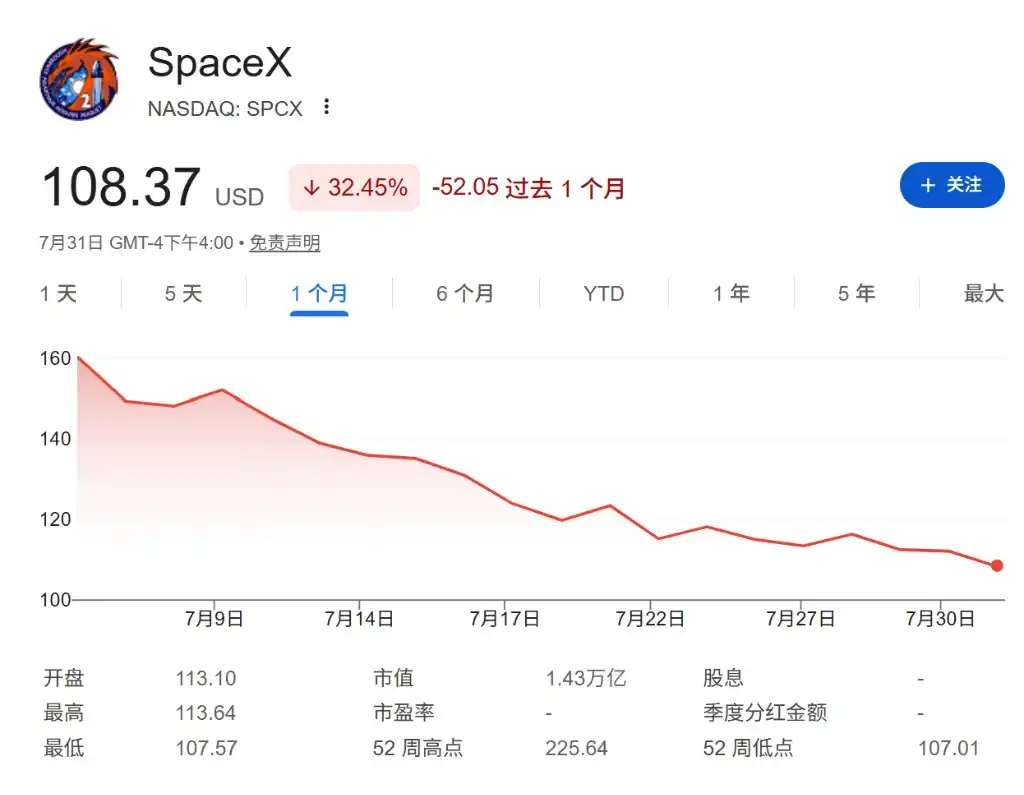
In a preview report, Cantor Fitzgerald analyst Colin Canfield noted, "There may be extreme deviation in earnings expectations for the initial quarter," suggesting that the direction of performance is nearly impossible to gauge from the outside.

Simultaneously, unlocking pressure looms over the stock price. Approximately 912 million shares will become eligible for public trading on August 6th, with another roughly 319 million shares unlocking about a week later. This means potential selling pressure from early investors cannot be ignored, and market attention will focus on the stock's reaction on Thursday and Friday—a strong earnings report might be the only catalyst to break the losing streak.

AI Business Has Huge Revenue Potential, But Highest Uncertainty

SpaceX's financial report discloses three main business segments: Space, Connectivity, and Artificial Intelligence (AI). The AI segment is the biggest question mark this quarter.

The core asset of the AI business is xAI, which SpaceX completed merging with in February of this year. xAI currently operates two land-based data centers: Colossus I in Tennessee and Colossus II in Mississippi. In the first quarter, the AI business generated $818 million in revenue but recorded a $2.5 billion operating loss, with capital expenditures reaching $7.7 billion.

Entering the second quarter, a significant variable emerged on the revenue side. SpaceX has signed AI data center leasing agreements with Anthropic and Google. The agreement with Anthropic amounts to $1.25 billion monthly and began ramping up between May and June; the Google agreement has not yet commenced. This means the actual revenue for the AI business this quarter has significant elasticity, and the direction of profit margins along with the pace of new capital expenditures is equally difficult to predict.

Guidance most anticipated by investors includes: the company's outlook for the AI business in the second half of this year and for 2027, as well as the projected timeline for advancing the concept of using Starship to deploy low-cost AI computing satellites into orbit.

Starlink: User Growth is the Core Metric

The Connectivity business, Starlink, is SpaceX's most stable profit engine. At the end of the first quarter, Starlink subscription users reached 10.3 million, more than doubling from 5 million 12 months prior; the segment achieved $11.4 billion in revenue and $4.4 billion in operating profit for the quarter.

In this quarter's report, user growth data will be a key market focus. Colin Canfield expects the company to disclose the Average Revenue Per User (ARPU) metric and the contract backlog for enterprise and government businesses. These data points will help investors assess the commercialization depth and future growth space of Starlink.

Space Business: Starship Progress Under Scrutiny

The Space segment carries SpaceX's core technology narrative. In the first quarter, this segment achieved $4.1 billion in revenue, an operating loss of $657 million, and $1.1 billion in new capital expenditures for property, plant, and equipment. In the second quarter, Falcon 9 completed approximately 36 launches, with the majority serving its own Starlink constellation deployment; such launches are not counted as revenue for the Space segment.

Progress on Starship is also closely watched. In July, Starship completed its 13th flight test. Investors will seek updates on the timing of the 14th test and the scale of the company's continued investment in this rocket—Starship is the key launch vehicle for future commercial payload launches and AI satellite deployment.

Earnings Expectations and Market Outlook

Wall Street currently estimates SpaceX's total Q2 revenue to be approximately $6.9 billion, with Earnings Before Interest, Taxes, Depreciation, and Amortization (EBITDA) around $2.1 billion; full-year revenue expectations are $39 billion, with EBITDA expectations of $17.3 billion. Colin Canfield is relatively optimistic about this quarter, expecting results to beat expectations accompanied by positive guidance.

However, the reference value of these forecasts is questionable. As this is SpaceX's first quarterly report since going public, analysts lack historical data for calibration, making significant deviations in the actual numbers possible.

The stock price movement is equally full of variables. The supply pressure from unlocking shares, market concerns about Elon Musk's divided attention, and the valuation debate itself—at a current market cap of approximately $1.4 trillion, it trades at about 35 times the estimated 2026 revenue—will all be key factors influencing the market's post-earnings reaction. For investors, this weekend could be extremely volatile.


Trending Cryptos

Related Questions

QWhen will SpaceX release its first quarterly earnings report since going public, and what challenge does the stock face around that time?

ASpaceX will release its Q2 earnings after the market closes on Wednesday, August 4 (Eastern Time). The stock faces a significant challenge from lock-up expirations, with approximately 912 million shares becoming eligible for sale on August 6 and another ~319 million shares unlocking about a week later.

QWhat are the three business segments in SpaceX's earnings report, and which one is highlighted as having the greatest uncertainty?

ASpaceX's earnings report breaks down performance into three segments: Space, Connectivity, and AI. The AI segment is highlighted as having the greatest uncertainty due to its high-stakes investments, variable revenue from new data center leasing deals, and significant operating losses.

QAccording to the article, what is the key metric investors will focus on for the Starlink (Connectivity) business in the upcoming report?

AFor the Starlink (Connectivity) business, user growth data will be the core metric investors focus on. Analysts also expect details on Average Revenue Per User (ARPU) and the contract backlog for enterprise and government business.

QWhat are Wall Street's current estimates for SpaceX's Q2 2026 total revenue and EBITDA?

AWall Street currently estimates SpaceX's Q2 2026 total revenue to be approximately $6.9 billion, with an EBITDA (Earnings Before Interest, Taxes, Depreciation, and Amortization) of around $2.1 billion.

QWhy does the analyst Colin Canfield suggest that initial earnings estimates for SpaceX might have 'extreme dispersion'?

AColin Canfield suggests that initial earnings estimates may have 'extreme dispersion' because this is SpaceX's first quarterly report since going public. Analysts have no historical financial data from the public company to use as a baseline for calibration, making forecasts highly uncertain and prone to large deviations from actual results.

Related Reads

In-depth: The Foreign Guest Genspark

The article "The Foreign Guest: Genspark" investigates the identity and business practices of AI startup Genspark, which presents itself as a Palo Alto-based "AI Costco" offering a subscription bundle of over 70 models and numerous AI agent tools. Despite its official Silicon Valley narrative, Genspark's founding team has deep roots in Chinese tech giant Baidu, a history systematically downplayed in its branding. The company actively cultivates an image as an elite US firm, heavily publicizing partnerships and endorsements from OpenAI, Anthropic, and Microsoft, while distancing itself from the Chinese AI community and obscuring its connections to Chinese investors and open-weight models (like those from DeepSeek, Moonshot AI, and MiniMax) that power its services. Genspark's core strategy involves rapidly cloning and integrating successful AI product concepts (e.g., from Perplexity, Manus, Plaud) into its unified platform, supported by aggressive marketing, including Super Bowl ads and paid native content in publications like The Wall Street Journal. Critically, the article suggests a significant portion of its engineering and product development is conducted by a team in Beijing, operating outside its official US corporate structure. This duality allows Genspark to leverage Chinese talent and models for efficiency and cost reduction while constructing a public facade as a purely American success story. The piece concludes that Genspark's most effective agent is its own corporate identity, meticulously engineered to obscure its Chinese underpinnings and be perceived solely as a Silicon Valley company.

marsbit44m ago

In-depth: The Foreign Guest Genspark

marsbit44m ago

Debate: Korean Workers Fear Unemployment, While Musk Envisions a Society 'Without Work'?

While South Korean auto workers fear job losses from robotics, Elon Musk envisions a future where AI and robots render most work optional. This article explores the growing tension between immediate anxieties over automation and long-term visions of a post-work society. The piece begins with recent strikes at Hyundai's Korean plants, where unions, amid standard wage negotiations, also sought job guarantees against advancing robotics—specifically mentioning Boston Dynamics' Atlas. This reflects how anxiety about technological displacement is emerging even before robots are fully capable of replacing skilled labor on assembly lines. The author argues that while current robotics still struggle with the nuanced, experiential knowledge of veteran workers, the *perception* of imminent replacement is fueling social conflict prematurely. This modern "Luddite" sentiment is compared to the 19th-century English textile workers who smashed machines. Historically, Luddites weren't simply anti-technology; they were protesting the rapid devaluation of their skills and the unequal distribution of productivity gains. Similarly, today's workers ask who will bear the cost of transition and share in the new wealth created by machines. In contrast, figures like Elon Musk propose an optimistic endpoint: with AI and robotics driving extreme abundance, the link between work and survival could break. He suggests concepts like "Universal High Income" could allow society to share the technological bounty, transforming work from a necessity into a choice. The core challenge, however, lies in the transition. The author notes that technology's benefits diffuse slowly, while its disruptive costs—job losses, skill obsolescence—can be concentrated and immediate. The risk is a painful interim period where productivity gains are captured by a few before new social contracts, safety nets, and retraining systems are established. The conclusion calls for proactive governance. Just as past industrial revolutions gave rise to labor standards and social safety nets, the robotics era needs its own frameworks. These should address job transition support, distribution of productivity gains, safety liability, and ethical deployment. Embracing such "constraints" is not opposition to progress but a necessary step to ensure technology benefits society broadly. The discussion sparked by Hyundai's workers, therefore, is not premature but essential.

marsbit57m ago

Debate: Korean Workers Fear Unemployment, While Musk Envisions a Society 'Without Work'?

marsbit57m ago

Trading

Spot

Hot Articles

Discussions

Welcome to the HTX Community. Here, you can stay informed about the latest platform developments and gain access to professional market insights. Users' opinions on the price of S (S) are presented below.

活动图片