Why Robinhood Chain’s memecoin boom has 63% of traders losing money

ambcryptoPublished on 2026-07-20Last updated on 2026-07-20

Abstract

Robinhood Chain's memecoin market is experiencing high activity but unequal rewards. An analysis of 164,538 wallets shows 63% are unprofitable, with only a small fraction of traders capturing most gains. The net realized profit across all tracked activity is minimal at $1.87 million. This highlights a concentration of profits where the majority often provides exit liquidity for a few winners. The market's reliance on narratives over fundamentals is evident, as seen with the DADDY token's sharp decline following negative headlines. However, more established memecoins like Pepe (PEPE), Dogecoin (DOGE), and Shiba Inu (SHIB) demonstrate greater resilience due to strong communities, utility, and liquidity. The trend suggests future cycles will favor these enduring qualities over temporary hype.

Robinhood Chain’s memecoin boom is creating plenty of activity. Despite that boom, there are fewer winners than many investors expect. Beneath the trading frenzy, profits remain concentrated, while losses spread across most participants.

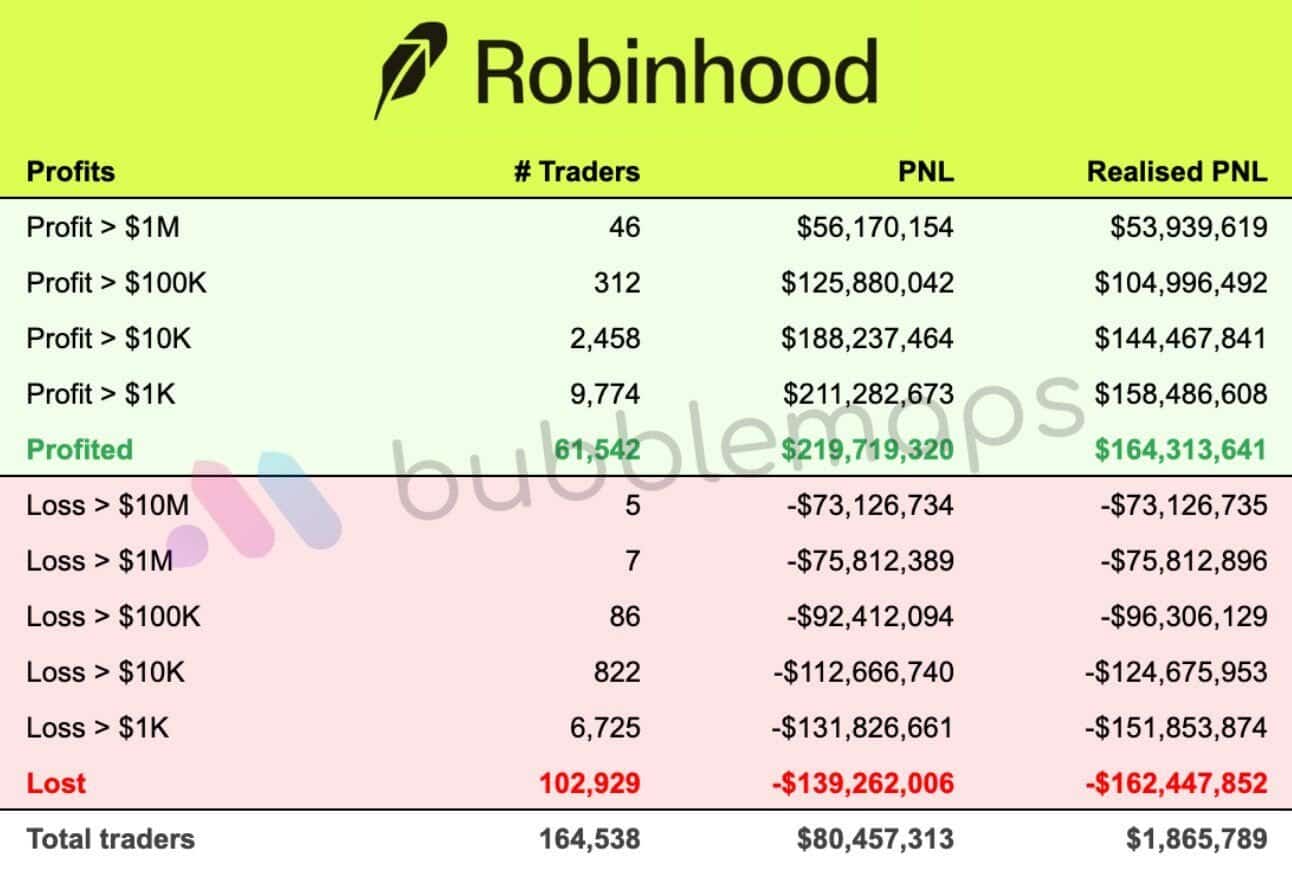
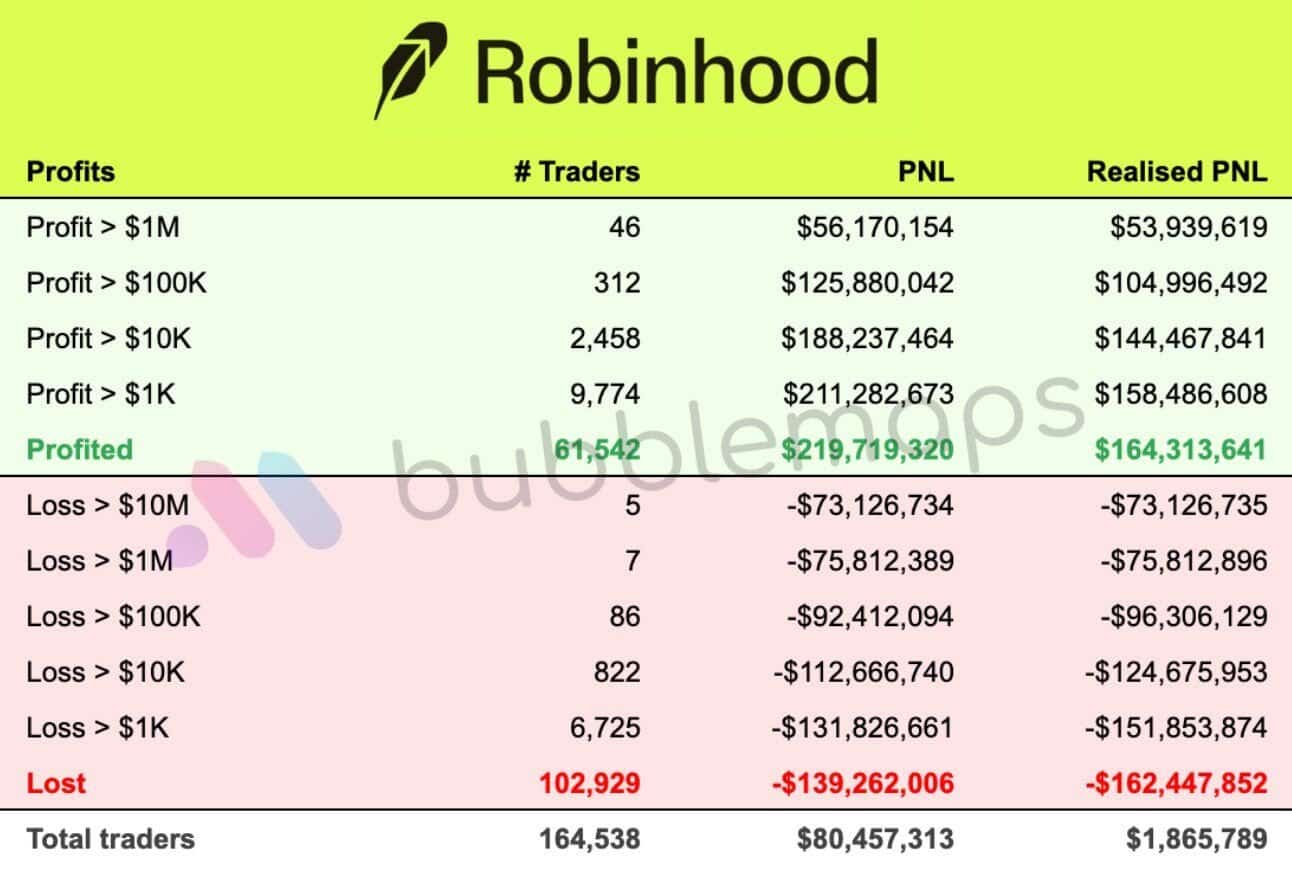
Of the 164,538 wallets tracked, 102,929 remain unprofitable, leaving 63% of traders at a loss. Meanwhile, just 61,542 wallets remain profitable, highlighting the market’s uneven reward structure. As a result, only 46 traders made more than $1 million, whereas five lost over $10 million.
Source: X

Consequently, profitable traders realized $164.3 million in gains, while losing traders realized $162.4 million in losses. That left only $1.87 million in net realized profit despite significant trading activity.

This imbalance suggests a small group continues capturing most returns as the majority provides exit liquidity.

Unless profitability spreads beyond a handful of traders, speculative enthusiasm could fade, weakening participation across Robinhood Chain’s memecoin market.

How narratives drive prices

That imbalance becomes even more apparent when external events suddenly reshape investor sentiment. The DADDY token demonstrated the fragility of narrative-driven tokens under headline risk conditions.

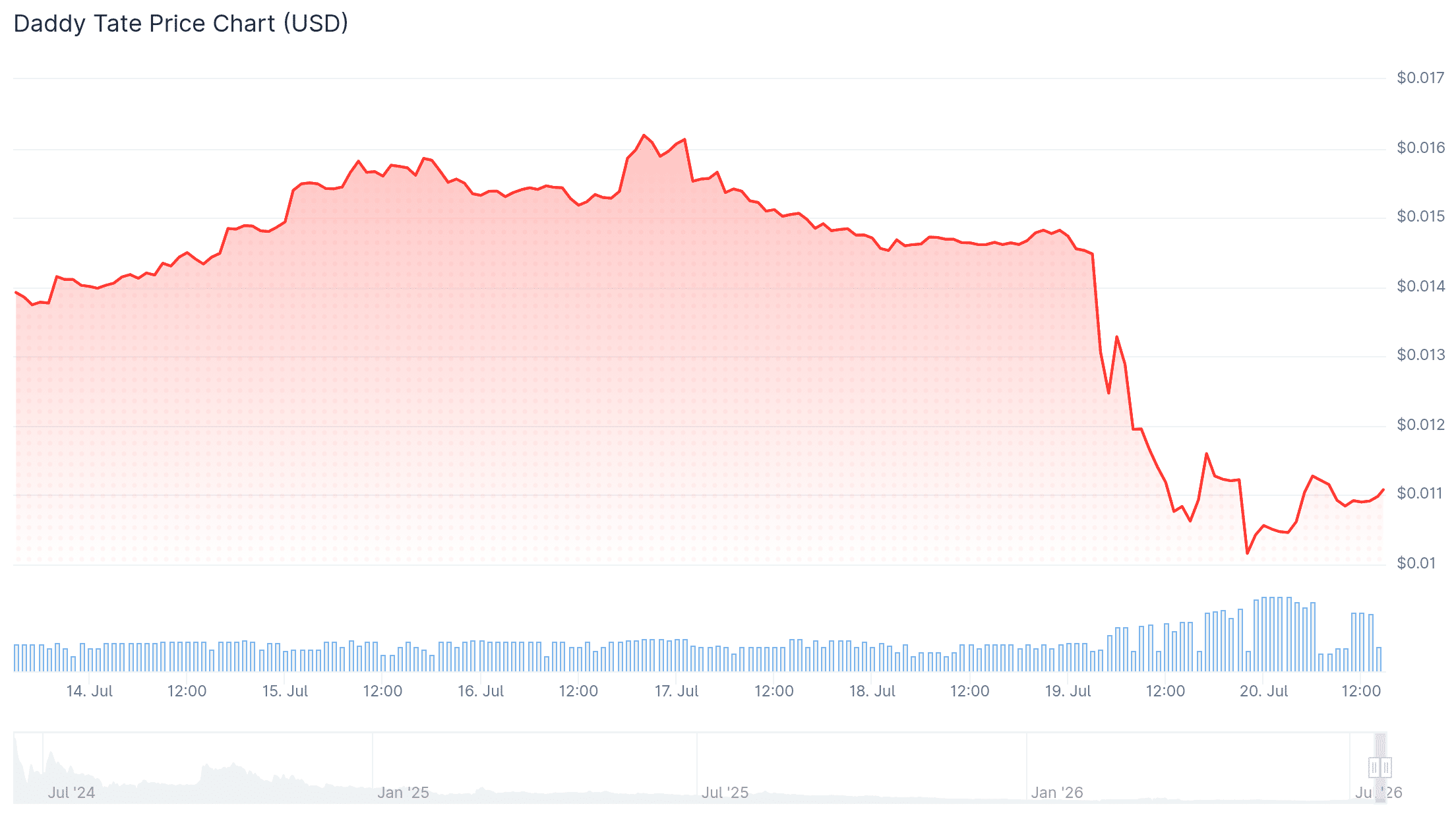
Reports linking Andrew Tate to renewed legal proceedings triggered immediate selling pressure after the token traded near $0.0145 and briefly tested $0.016. However, sentiment reversed sharply as DADDY declined by more than 20%, sliding toward $0.010.
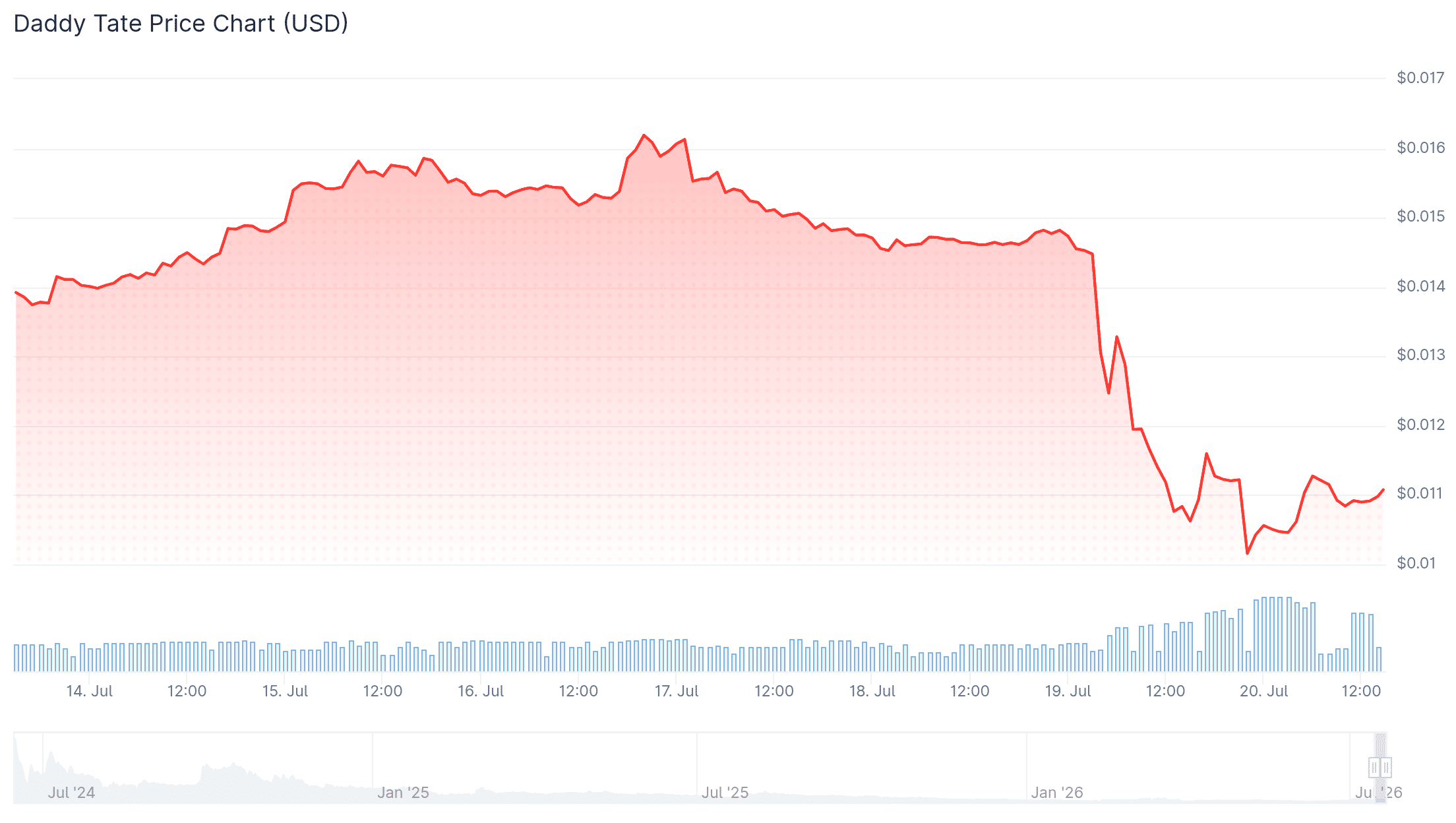
Source: CoinGecko

The sharp increase in selling volume as the price declined indicated a loss of liquidity. After the token stabilized slightly to trade for approximately $0.011, buyers were unable to regain control of the price.

More importantly, DADDY remains down more than 95% from its peak, indicating that confidence in the token will take longer to recover.

This reaction reinforces how memecoin valuations often depend more on narrative than fundamentals. Consequently, headlines continue to generate volatility and influence short-term price discovery and liquidity flow through the entire sector.

As attention shifts, resilient memecoins increasingly outperform short-lived rallies. For instance, Pepe [PEPE] demonstrates resilient holder retention, active addresses, and whale accumulation.

Similarly, Dogecoin [DOGE] is supported by a large base of users who provide significant levels of liquidity. Meanwhile, Shiba Inu [SHIB] leverages Shibarium activity and whale inflows to stabilize demand.

Together, these strengths suggest future memecoin cycles will reward utility, community loyalty, and liquidity depth over temporary viral narratives and hype.


Final Summary

  • Robinhood Chain’s memecoin market remains concentrated, with most traders still unprofitable.
  • PEPE, DOGE, and SHIB show resilience now outweighing hype in memecoin cycles.

Related Questions

QWhat percentage of traders are losing money in Robinhood Chain's memecoin boom according to the tracked wallets?

AAccording to the tracked wallets, 63% of traders (102,929 out of 164,538 wallets) are unprofitable and losing money.

QHow does the article describe the distribution of profits and losses among traders in the Robinhood Chain memecoin market?

AThe article describes the profit distribution as highly uneven and concentrated. While profitable traders realized $164.3 million in gains, losing traders realized $162.4 million in losses, resulting in a net realized profit of only $1.87 million. A very small group captures most returns while the majority provides exit liquidity.

QWhat event caused the DADDY token's price to decline sharply, and what does this demonstrate about memecoins?

AReports linking Andrew Tate to renewed legal proceedings caused the DADDY token's price to decline sharply by more than 20%. This demonstrates how memecoin valuations are often fragile and depend more on narrative and sentiment than fundamentals, making them highly susceptible to headline risk and volatility.

QWhich three memecoins does the article cite as examples of resilience, and what are their key strengths?

AThe article cites Pepe (PEPE), Dogecoin (DOGE), and Shiba Inu (SHIB) as examples of resilience. Their key strengths are: PEPE has resilient holder retention, active addresses, and whale accumulation; DOGE is supported by a large user base providing significant liquidity; SHIB leverages Shibarium activity and whale inflows to stabilize demand.

QWhat does the article suggest future memecoin cycles will reward, according to its conclusion?

AThe article suggests that future memecoin cycles will reward utility, community loyalty, and liquidity depth over temporary viral narratives and hype.

Related Reads

Trump Backs Down on Ethics Provision, as 'CLARITY Act' Enters Senate's Critical Window

On July 21st, sources report President Trump has agreed to include ethics provisions in the *CLARITY Act*, a major digital asset market structure bill, clearing a key obstacle after months of negotiation. The bill, which has already passed the House, aims to establish federal regulatory clarity for crypto by defining SEC and CFTC roles. The text is expected imminently, with a narrow window for Senate passage before the August recess. However, passage remains uncertain due to potential Democratic opposition over the ethics rules and the absence of key Republican senators. The ethics clause, a major sticking point, seeks to restrict federal officials, including the president, from profiting from digital assets while in office. This directly addresses controversies around Trump's own crypto holdings. While industry lobbyists urge Congress not to let ethics derail the broader bill, several Democratic senators have demanded stricter provisions covering family members and stronger consumer protections. Amid this legislative push, on-chain data shows significant Bitcoin accumulation by large holders ("whales") in recent weeks. After extended outflows, U.S. Bitcoin and Ethereum spot ETFs have seen two consecutive weeks of net inflows. Major corporate holders like Strategy and Metaplanet continue to accumulate or hold significant Bitcoin reserves. Notably, BitMEX co-founder Arthur Hayes recently made substantial Ethereum purchases, expressing a view that while AI is absorbing market liquidity, crypto markets have room for a rebound.

marsbit41m ago

Trump Backs Down on Ethics Provision, as 'CLARITY Act' Enters Senate's Critical Window

marsbit41m ago

Trading

Spot
活动图片