Why Only Dollar-Cost Averaging Can Capture Bitcoin's Long-Term Dividends?

比推Published on 2026-03-06Last updated on 2026-03-06

Abstract

This article argues that dollar-cost averaging (DCA) is the optimal strategy for capturing Bitcoin's long-term gains, supported by historical backtesting and forward-looking models. The strategy involves investing a fixed amount regularly, regardless of market conditions. A five-year DCA simulation, starting in January 2021 with weekly $250 investments, resulted in a total investment of $67,500, acquiring approximately 1.65 BTC at an average price of $40,884. At a price of $71,000, the portfolio was worth ~$120,500, a 76% gain. Projections show even higher returns at $100,000 and the expected 2025 cycle peak of ~$126,000. A shorter-term DCA example starting in January 2024 showed an initial paper loss at current prices but significant projected profits at higher future price points. A comparison over five years also demonstrated that DCA into Bitcoin outperformed DCA into the S&P 500. Long-term modeling, based on Bitcoin's power-law growth curve, projects a median price of around $430,000 by 2030. A four-year DCA plan starting in 2026 could accumulate roughly 0.30 BTC, leading to substantial returns even under conservative price estimates. The key conclusion is that while entry timing affects the magnitude of gains, the duration of the holding period is the most critical factor for maximizing returns.

Written by: Cointelegraph

Compiled by: AididiaoJP, Foresight News

Original title: Why Only Dollar-Cost Averaging Can Capture Bitcoin's Long-Term Dividends?


Both backtest data and forward-looking models indicate that using a dollar-cost averaging (DCA) strategy to buy Bitcoin is the best way to invest in BTC. Will this method still work in the next bull market?

Bitcoin has experienced a 50% plunge over the past 5 months, and savvy investors adjust their strategies during such bear markets and correction periods. This strategy is called dollar-cost averaging (DCA), which involves investing a fixed amount regularly, regardless of market conditions.

By examining historical market cycle data and BTC price forward simulations, we can more clearly see how this steady investment approach performs across different entry times and investment horizons.

Five Years of DCA in Bitcoin Yields Substantial Net Gains

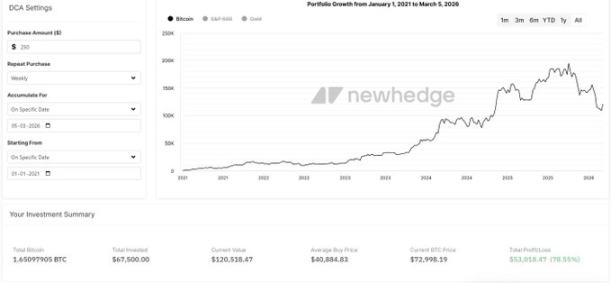
Starting from January 2021, investing $250 weekly in Bitcoin via DCA, the total investment over five years would be $67,500. According to DCA simulation data, this strategy would have accumulated 1.65097905 BTC, with an average purchase price of $40,884.

At Bitcoin's current price of nearly $71,000, this 1.65097905 BTC is worth approximately $120,500, resulting in a profit of $53,000 (a 76% increase). If Bitcoin rises to $100,000, the holdings would be worth about $165,000; and at the cycle peak of nearly $126,000 in October 2025, the holdings would reach a value of $208,000.

Bitcoin DCA Cycle 2021-2026 Source: Newhedge

Now consider a shorter investment period to see the impact of entry timing on early returns. Starting weekly $250 DCA from January 2024, the total investment is $28,500, accumulating 0.36863166 BTC with an average purchase price of $77,312.

At the current price of $71,000, this Bitcoin is worth approximately $26,909, representing a 6% paper loss. At a price of $100,000, the holdings would be worth $36,863; at the cycle peak of $126,000, the holdings would be worth $46,448.

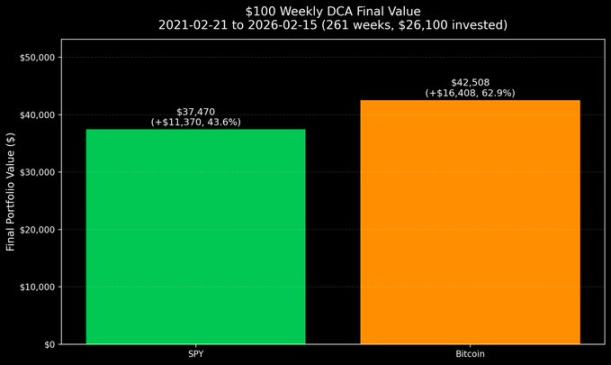
In February this year, Swan Bitcoin analyst Adam Livingston compared on platform X the returns of DCA into BTC versus the S&P 500 index over the past five years. Investing $100 weekly resulted in $42,508 for BTC and $37,470 for the S&P 500, with returns of 62.9% and 43.6% respectively.

Livingston noted that although Bitcoin is highly volatile, historical data shows that persisting with DCA during downturns leads to higher long-term gains.

Weekly $100 DCA: BTC vs. S&P 500 Source: Adam Livingston/X

Long-Term Models: Time is the Key

Forward-looking simulation studies have also tested the effectiveness of DCA starting in 2026. Starting a weekly $250 DCA from January 2026 until March 2030 would mean a total investment of approximately $54,250.

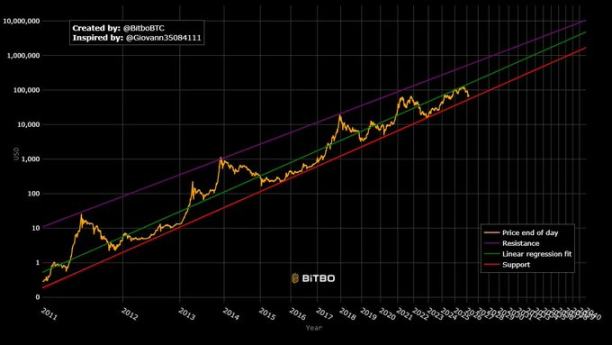
The price prediction is based on Bitcoin's long-term power law growth curve (which tracks the historical relationship between Bitcoin's price and time on a logarithmic scale). This model generates a rising support band and a median trendline, largely consistent with previous market cycles.

Bitcoin Power Law Growth Curve Source: Bitbo.io

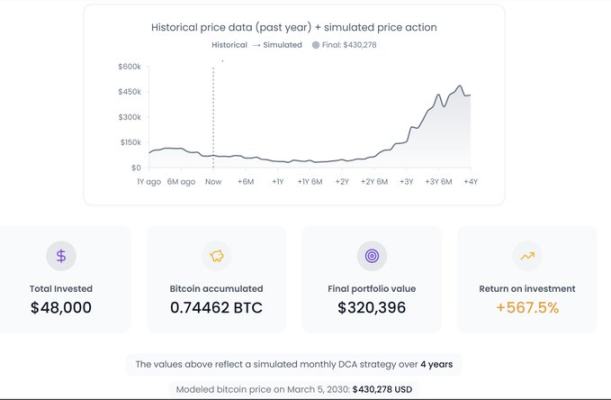
Based on this model, analysts estimate the long-term trend support could break above $100,000 by 2028, which also serves as the foundational assumption for future DCA modeling. Bitcoin Well's simulation shows that by March 2030, the median price projection is approximately $430,000.

Accounting for potential price deviations, the model also considers the upper and lower bounds of the power law channel, providing a lower estimate (approx. $274,000) and a higher estimate (approx. $900,000).

Based on these assumptions, four years of DCA would accumulate roughly 0.30 BTC:

  • If BTC price is $274,000, holdings value ~$82,200.

  • If BTC price is $430,000 (median projection), holdings value ~$129,000.

  • If BTC price is $900,000, holdings value ~$270,000.

DCA Investment Results as of March 2030 Source: Bitcoin Well

In November 2025, Bitcoin researcher Sminston With conducted a study using a similar predictive model to test the impact of entry time on long-term returns. The findings revealed that even buying at a price 20% higher than the then price of $94,000 and selling at a price 20% lower than the projected 2035 median price, the remaining holdings after ten years would still yield a profit of nearly 300%.

In this simulation, the final total assets were 7.7 times the initial investment.

The study concluded: Entry timing affects the level of returns, but the duration of holding is the key determinant of the magnitude of gains.


Original link:https://www.bitpush.news/articles/7617498

Related Questions

QWhat is the main investment strategy discussed in the article for capturing Bitcoin's long-term gains?

AThe main investment strategy discussed is Dollar-Cost Averaging (DCA), which involves investing a fixed amount of money at regular intervals, regardless of market conditions.

QAccording to the backtest data, how much profit was generated from a 5-year DCA strategy starting in January 2021 with a weekly investment of $250?

AThe 5-year DCA strategy generated a profit of $53,000, a 76% increase, with the total investment of $67,500 growing to approximately $120,500 at a Bitcoin price of $71,000.

QWhat model is used to predict Bitcoin's future price in the long-term simulations mentioned in the article?

AThe long-term price predictions are based on Bitcoin's power-law growth curve model, which tracks the historical relationship between Bitcoin's price and time on a logarithmic scale.

QHow does the performance of a DCA strategy compare to investing in the S&P 500 index over a five-year period, as cited in the article?

AOver a five-year period, a weekly DCA investment of $100 in Bitcoin yielded $42,508 (a 62.9% return), outperforming the S&P 500 index, which yielded $37,470 (a 43.6% return).

QWhat is the key conclusion from the research by Bitcoin researcher Sminston With regarding the timing of entry and long-term holding?

AThe key conclusion is that while the timing of entry affects the magnitude of returns, the duration of holding (long-term holding) is the primary determinant of the overall profit size.

Related Reads

China's First Embodied Data Compliance Outbound: How Does Paxini Become a Game-Changer for Industry Development?

"Embodied Intelligence Data Compliance Goes Global: A Breakthrough Moment. At the 2026 World Intelligent Industry Expo, Paxini, the sole Chinese company authorized for cross-border embodied data transfer, launched a pioneering project in Tianjin. This marks the first officially approved case of its kind in China, resolving a major industry bottleneck for compliant international data flow. As the ultimate direction of AI evolution, embodied intelligence relies on vast, multi-modal physical world interaction data. Despite booming global demand, stringent compliance had previously trapped the domestic industry. Paxini's breakthrough establishes a formal compliance framework, setting a benchmark for standardized development. The core of Paxini's success lies in its industry-leading data infrastructure and compliant security architecture, aligning with national data strategy. It operates a large-scale 'data collection factory' for high-quality, multi-modal data and has established a full-chain compliant pathway from 'collection-processing-certification-outbound transfer'. This dual advantage in data scale/quality and compliance secures its leadership. Beyond immediate commercial impact, the project signifies long-term strategic value: international market validation from top-tier financial institutions and the compounding benefits of ecosystem building. High-quality physical world data possesses enduring value. By solving fundamental infrastructure and compliance challenges, Paxini not only contributes a 'Chinese model' to the global embodied intelligence industry but also solidifies a key competitive moat for the long haul. This enables safe, efficient global flow of China's quality embodied data, amplifying its influence in the intelligent manufacturing landscape."

marsbit3m ago

China's First Embodied Data Compliance Outbound: How Does Paxini Become a Game-Changer for Industry Development?

marsbit3m ago

Macroeconomic Origins of the African Payments Market Structure

Africa’s payment landscape exhibits the world’s highest mobile money penetration and fastest cryptocurrency adoption. This is not a market anomaly but a macroeconomic inevitability driven by deep structural factors: a vast, young population, heavy reliance on commodity exports and remittances generating massive cross‑border payment needs, and a chronically underdeveloped formal banking system plagued by de‑risking, high inflation, and currency instability. This vacuum has allowed mobile money (e.g., M‑Pesa) to become the primary payment channel domestically, while cryptocurrencies—particularly stablecoins—serve as a store of value against local‑currency depreciation and a lower‑cost cross‑border medium. The key divide is the Sahara: North Africa integrates with the MENA oil‑centric financial system, while Sub‑Saharan Africa, facing acute dollar shortages and fragmented currencies, is the epicenter of this fintech surge. Structural reliance on dollars, driven by trade deficits and weak local currency credibility, creates persistent dollar scarcity, which crypto and mobile payments effectively address. Efforts like the Pan‑African Payment and Settlement System (PAPSS) aim at de‑dollarization, but these alternatives will remain essential as long as underlying economic constraints—commodity dependence, limited industrialization, and financial exclusion—persist.

marsbit15m ago

Macroeconomic Origins of the African Payments Market Structure

marsbit15m ago

AAOI Defies Trend with Over 10% Surge, 'New Stock God' Serenity Predicts Potential to Double Again

On June 4th, despite a significant sell-off in the broader AI and semiconductor sector triggered by Broadcom's disappointing guidance, Applied Optoelectronics (AAOI) surged over 11%, showcasing a sharp divergence in market sentiment. Broadcom's warning about potential supply chain diversification by key customer Google and a weaker-than-expected outlook punctured the high-flying AI valuation narrative. This led to heavy selling in names like Broadcom (-12.6%) and Micron (-7%), with funds rotating into traditional industrial stocks. AAOI defied this trend. The stock has experienced high volatility recently, driven by bullish analyst coverage, notably from Rosenblatt which raised its price target to $220. Key catalysts include initial 800G optical module revenue from Amazon, potential certification from Oracle, and strong demand across its product portfolio. The company has reported cumulative orders for 800G/1.6T modules exceeding $324 million and is aggressively expanding manufacturing capacity in Texas, targeting an annualized run-rate of $1.4 billion for its module business by Q3 2027. However, AAOI's fundamentals present a mixed picture. Its Q1 2026 results missed expectations, showing a GAAP net loss, and Q2 guidance points to merely breakeven adjusted EPS. Risks include a delayed 800G production ramp to the second half of the year and high dependence on a few key cloud customers. Recent stock sales by company executives near price highs also noted. The article suggests AAOI's rally reflects a market beginning to differentiate within the AI ecosystem. While Broadcom's issues prompted a reassessment of custom ASIC and customer concentration risks, funds flowing into AAOI indicate a belief that the "physical bottleneck" narrative for optical connectivity—where supply remains tight—remains intact and is somewhat decoupled from the current sector weakness. The sustainability of AAOI's premium valuation now hinges on the successful execution of its production plans and upcoming quarterly results.

marsbit22m ago

AAOI Defies Trend with Over 10% Surge, 'New Stock God' Serenity Predicts Potential to Double Again

marsbit22m ago

Trading

Spot
Futures
活动图片