Why analysts believe Bittensor’s ‘income desert’ could trigger TAO rerating

ambcryptoPublished on 2026-03-25Last updated on 2026-03-25

Abstract

Pine Analytics warns that Bittensor's native token TAO, despite recent significant price appreciation, faces a fundamental risk due to its economic model. The analysis indicates that many of Bittensor's AI subnets, like the top subnet Chutes (SN64), are heavily subsidized by token emissions rather than genuine user demand. Without these subsidies, their services would be 1.6-3.5x more expensive than centralized competitors, completely inverting their cost advantage. The report projects that when emissions halve (estimated late 2026 or 2027), the network will face a critical challenge: either prices for AI services must double, miners will leave due to lower rewards, or the gap between subsidy and actual revenue will widen. This "income desert" scenario, with no verifiable demand data available, could trigger a major reassessment (rerating) of TAO's value as users seek cheaper alternatives and participants exit the network. Despite this bearish fundamental outlook, TAO's market sentiment had recovered to neutral at the time of writing following a substantial short-term price increase.

TAO, the native token to decentralized AI platform Bittensor, has more than doubled from its Q1 2026 low of $145 to over $320, at the time of writing. Some of the major bullish catalysts have been institutional interest via the Spot TAO ETF and the narrative of AI and crypto convergence.

However, the chain’s fundamentals may be staring at a crisis that may force a rerating of the altcoin. According to crypto research firm Pine Analytics, most subnets (AI marketplaces) are heavily subsidized by token emissions, rather than by operational efficiency.

Without the subsidy, some of the top subnets, like Chutes (SN64), would be way more expensive than rival, centralized alternatives like Deepseek and Together AI. According to Pine Analytics,

An unsubsidized Chutes pricing would be 1.6-3.5x more expensive than centralized alternatives. The cost advantage does not narrow. It inverts entirely.
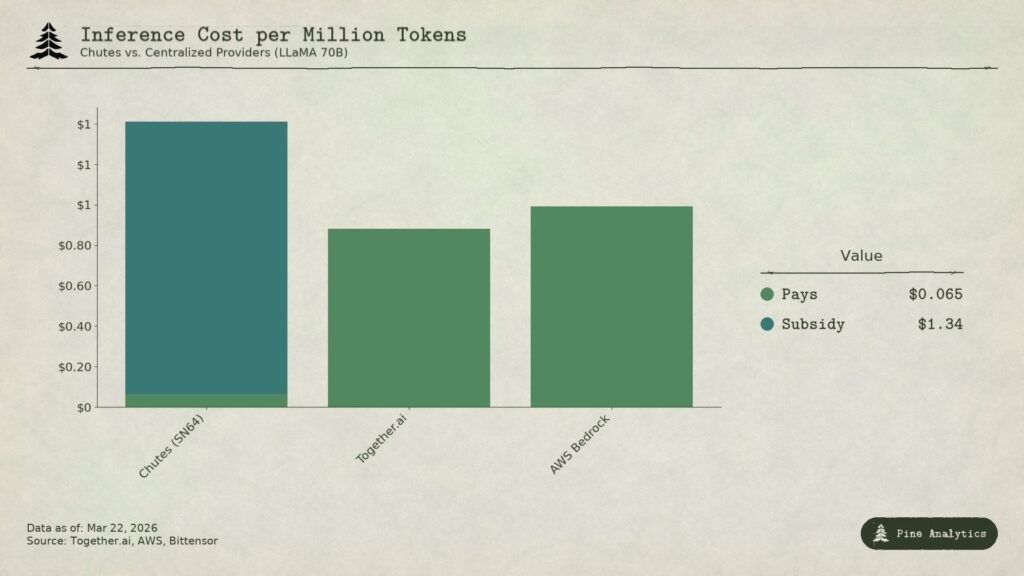
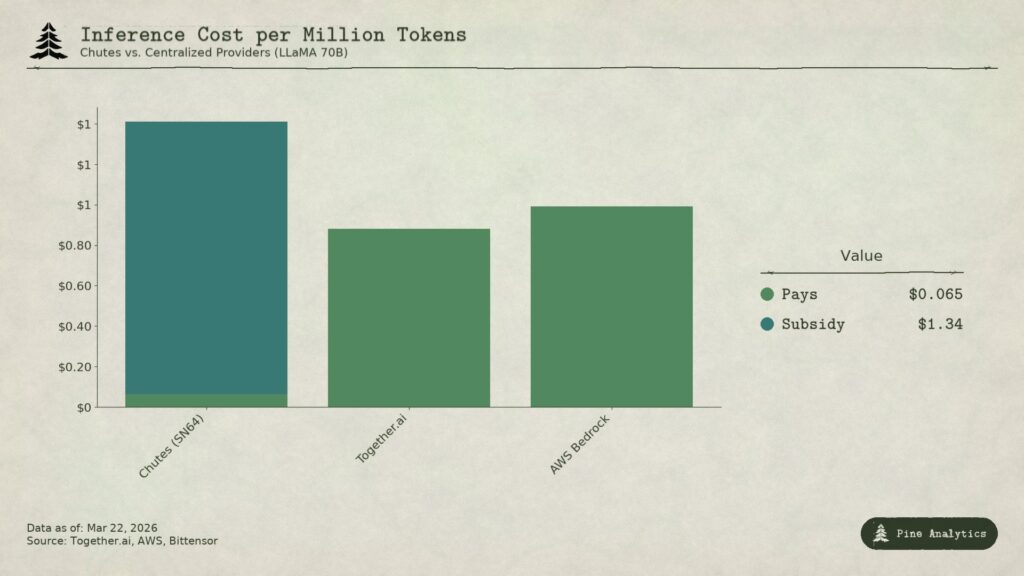
Source: Pine Analytics

Will Bittensor’s model hold?

For perspective, each subnet serves as a self-contained system for a specific AI service, such as image generation or price prediction.

At the core of this ecosystem are miners and validators. Miners act as producers, aiming to achieve the subnet’s set tasks by running AI models and other activities. The higher the quality of the work, the greater the chance of receiving more TAO rewards.

Likewise, validators are paid through TAO rewards for their quality control or auditing work. They supervise miners’ work and score them accordingly.

Now, back to Bittensor top subnet Chutes. It gets 14.4% of emissions, annualized at $52 million (or 518 TAO per day). This is shared among the subnet creator, miners, and validators. However, there is no publicly available data on demand for these subnets, Pine Analytics noted.

However, the research firm warned that the model could fall apart if the subsidy is cut.

When emissions halve again (projected late 2026 or 2027), either pricing roughly doubles, miners leave the subnet, or the gap between subsidy and revenue widens further.

In other words, most of the Bittensor subnets could become expensive, leading them to hike prices for AI services. This could likely force users to seek cheaper alternatives. Consequently, such a scenario would also trigger miner and validator exits.

With no current verifiable demand for Bittensor, Pine Analytics called this an “income desert” thesis that could force a TAO rerating.

Despite the bearish call though, TAO’s market sentiment recovered to neutral at press time. Especially on the back of the altcoin climbing by 25% in just 24 hours. Overall, TAO was up nearly 130% from its February lows.
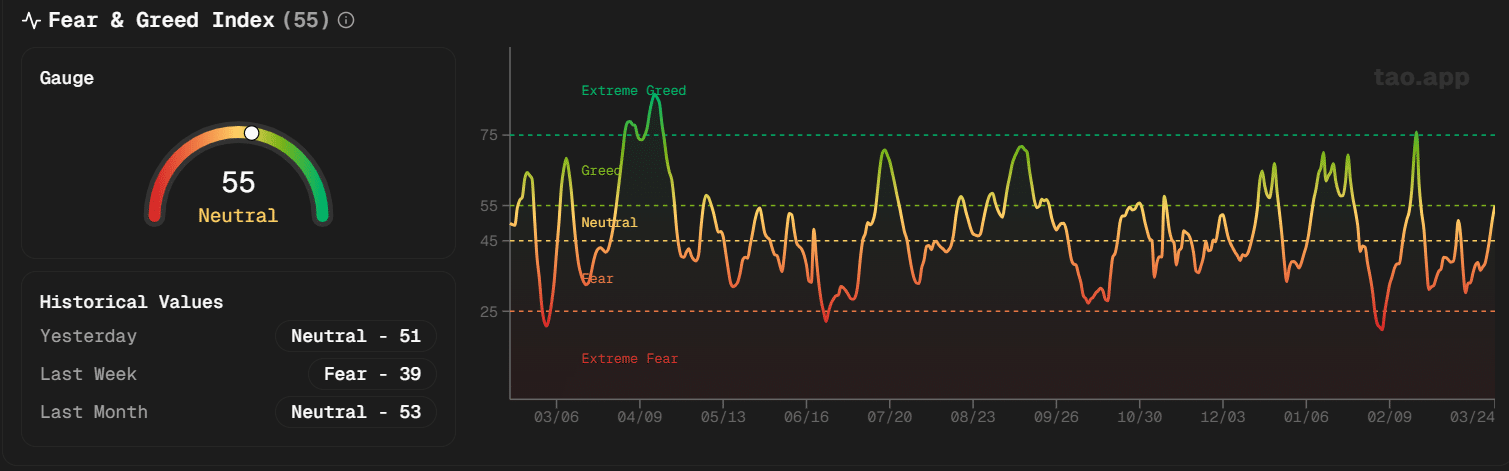
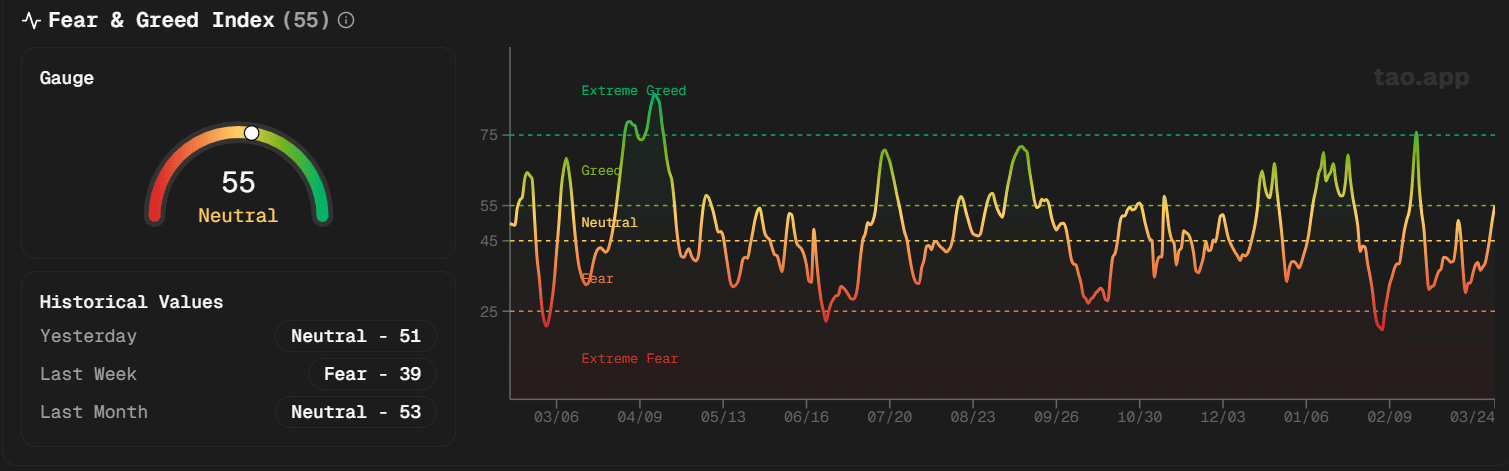
Source: Tao App

Final Summary

  • Pine Analytics projected that Bittensor AI services relied more on subsidies than on real demand.
  • Should the subsidies be cut in half later in 2026 or early 2027, the Bittensor model could face a massive reckoning.


Related Questions

QWhat is the main concern raised by Pine Analytics regarding Bittensor's subnets?

APine Analytics warns that most Bittensor subnets are heavily subsidized by token emissions rather than operational efficiency or real demand, and could become unsustainable if subsidies are reduced.

QHow much more expensive would an unsubsidized Chutes (SN64) subnet be compared to centralized alternatives?

AAn unsubsidized Chutes pricing would be 1.6 to 3.5 times more expensive than centralized alternatives like Deepseek and Together AI.

QWhat are the potential consequences when Bittensor's emissions halve in late 2026 or 2027?

AWhen emissions halve, either pricing for AI services would roughly double, miners would leave the subnet, or the gap between subsidy and revenue would widen further.

QWhat roles do miners and validators play in the Bittensor ecosystem?

AMiners act as producers running AI models to complete subnet tasks, earning TAO rewards based on work quality. Validators perform quality control by auditing and scoring miners' work, also paid in TAO rewards.

QDespite the bearish analysis, what was TAO's recent price performance mentioned in the article?

ATAO had climbed 25% in 24 hours and was up nearly 130% from its February lows, with market sentiment recovering to neutral at press time.

Related Reads

Dialogue with a Macro Analyst: AI Drains All Liquidity from U.S. Stocks, $40K Bitcoin is the True Bottom

In a recent discussion, macro strategist Luke Groman, founder of FFT LC, presented a sobering analysis of current markets. He argues that while the S&P 500 hits new highs, this is largely driven by just seven AI stocks, which are "sucking all the oxygen and liquidity out of the room." Bitcoin, which he calls the "last working smoke alarm for liquidity," is signaling trouble, having entered a difficult period. Groman explains that the AI boom is fueled by accounting practices that front-load revenue, creating an illusion of high profits while cash is being depleted. He warns this cycle could reverse sharply when construction slows. His base case is that stocks will rise in dollar terms but fall significantly when measured in gold or Bitcoin, highlighting that long-term US Treasury futures have already lost 90% of their value against gold over the past decade. He points to major structural risks, including China's dominance in rare earths—a small commodity market underpinning trillions in tech stock value—and the prolonged closure of the Strait of Hormuz, which he calls a "Suez Moment" for the US. This, combined with a shift towards a "no ticky, no washy" proof-of-work system for settling trade (using gold, not trust), signals deeper systemic distrust. Regarding US debt, Groman notes that historically, all 58 countries that reached a 130% debt-to-GDP ratio defaulted, primarily through inflation. The US crossed this threshold in 2020. He also highlights a contradiction in the AI narrative: if it's as transformative as claimed, it must destroy white-collar jobs, threatening half of US tax revenue—a reality at odds with the "no job loss" messaging from tech leaders. On Bitcoin, Groman sold most of his position near the top and hasn't fully re-entered. Citing technical analysis from Northstar Bad Charts, he suggests a potential bottom around $40,000 could materialize in Q3 or Q4. He concludes that while he may be labeled a doomsayer, his view is simply realistic, grounded in historical precedents and current macro pressures.

marsbit4h ago

Dialogue with a Macro Analyst: AI Drains All Liquidity from U.S. Stocks, $40K Bitcoin is the True Bottom

marsbit4h ago

Trading

Spot
Futures

Hot Articles

Discussions

Welcome to the HTX Community. Here, you can stay informed about the latest platform developments and gain access to professional market insights. Users' opinions on the price of S (S) are presented below.

活动图片