When Tether No Longer Clings to the Dollar...

比推Published on 2025-12-09Last updated on 2025-12-09

Abstract

Tether, the issuer of the world's largest stablecoin USDT, is shifting its reserve strategy in anticipation of lower interest rates. While its business model thrived during high-rate periods—earning billions from U.S. Treasury holdings—future Fed rate cuts could reduce its interest income significantly. To adapt, Tether has diversified into gold (over 100 tons) and Bitcoin (over 90,000 BTC), which together make up 12-13% of its reserves. These assets historically perform well in low-rate, high-liquidity environments, potentially offsetting lost Treasury yield. However, rating agencies like S&P have expressed concern, downgrading Tether’s stability rating due to increased exposure to volatile assets like Bitcoin and reduced transparency. The key challenge remains maintaining USDT’s dollar peg while navigating this new macroeconomic phase.

Author: Prathik Desai

Original Title: Gold, Bills, Thrills

Compiled and Edited by: BitpushNews


When I think of stablecoins, I often see them merely as a bridge between the US dollar and the blockchain, nothing more. They can be powerful infrastructure components, silently supporting the operation of on-chain products in ways that are often easily overlooked.

As a business model, stablecoin issuers have direct revenue, which is tied to the interest rates published by the US Federal Reserve. The higher the interest rates, the more income the US Treasury bonds backing their stablecoin circulation bring to the issuers.

However, in recent years, the world's largest stablecoin issuer by circulation has adjusted its reserve strategy to better adapt to the macroeconomic environment.

In this quantitative analysis, I will explore why and how Tether (Tether) is partially replacing its massive interest-earning engine with gold and Bitcoin to cope with the upcoming shift in the interest rate cycle.

Let's begin.
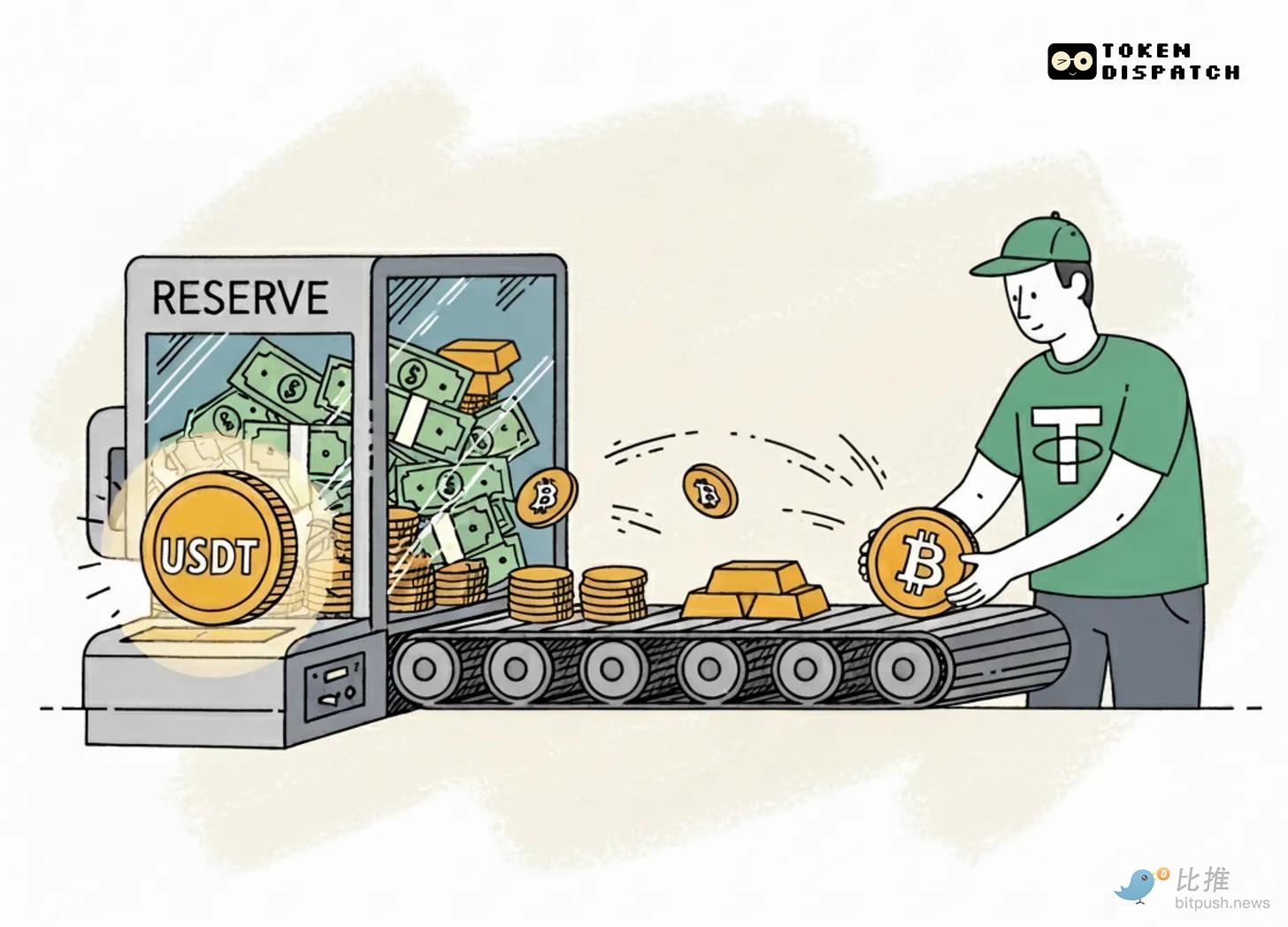
The US Treasury Machine

A glance at Tether's US Treasury reserves reveals how it became a profit machine during periods of high interest rates.

Over the past few years, USDT holders earned 0%, while Tether earned about 5% on approximately $1 trillion in US Treasury bonds.

Even with average interest rates relatively low for most of 2025, around 4.25%, as of September 30, 2025, Tether reported a net profit of over $10 billion for the year. In contrast, the second-largest stablecoin issuer, Circle, reported a net loss of $202 million for the same period.

For most of the past three years, Tether's business model perfectly aligned with the macroeconomic backdrop. The Federal Reserve maintained interest rates between 4.5% and 5.5%, and Tether held over $1 trillion in US bonds, with each percentage point of yield bringing in approximately $1 billion in annual revenue.

While most cryptocurrency companies struggled with operational losses, Tether accumulated tens of billions in surplus simply by going long on short-term government debt.

But what happens when the interest rate cycle turns, and rate cuts are expected in the coming years?

The Interest Rate Cycle Problem

CME FedWatch data shows that by December 2026, there is over a 75% probability that the federal funds rate will drop from the current 3.75-4% range to between 2.75-3% and 3.25-3.50%. This is already a significant drop from the 5% level that Tether relied on for profits in 2024.
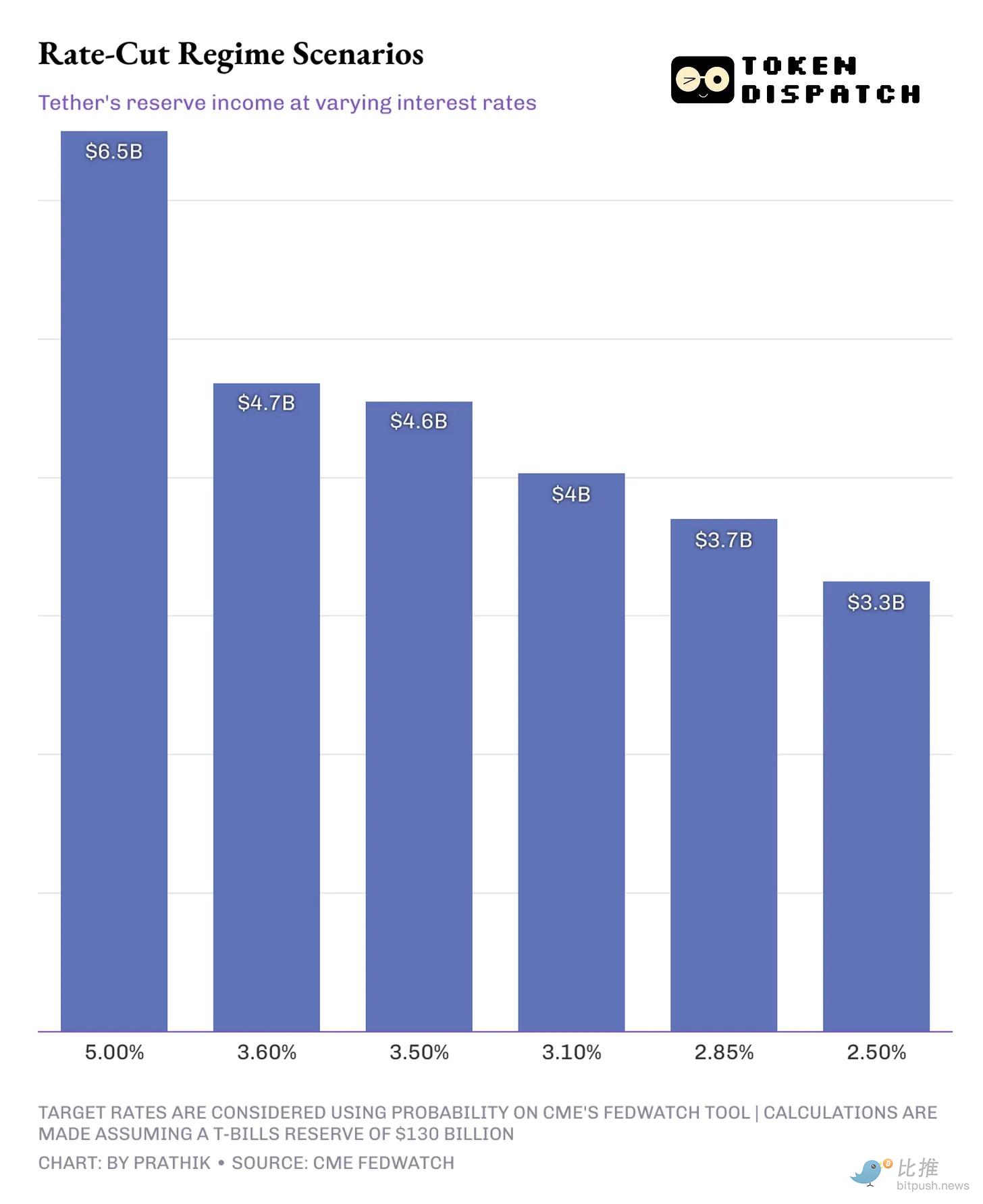
Lower interest rates could compress the interest income Tether earns from its US Treasury holdings.

A one-percentage-point drop in overall US economic liquidity could reduce Tether's annual income by at least $15 billion. This exceeds 10% of its annualized net profit for 2025.

So, how will Tether protect its profitability in this world? After Jerome Powell's term ends in 2026, a new Fed Chair is more likely to follow the expectations of US President Donald Trump for more significant and faster rate cuts.

It is at this point that Tether's reserve strategy diverges most significantly from any other stablecoin issuer.

Diversification Strategy

Between September 2021 and October 2022, Tether reduced its reliance on commercial paper (unsecured short-term debt instruments issued by large corporations) by over 99%. From over $30 billion in September 2021, it was cut to almost zero.

It replaced these assets with US-backed Treasury bonds to increase transparency for investors.
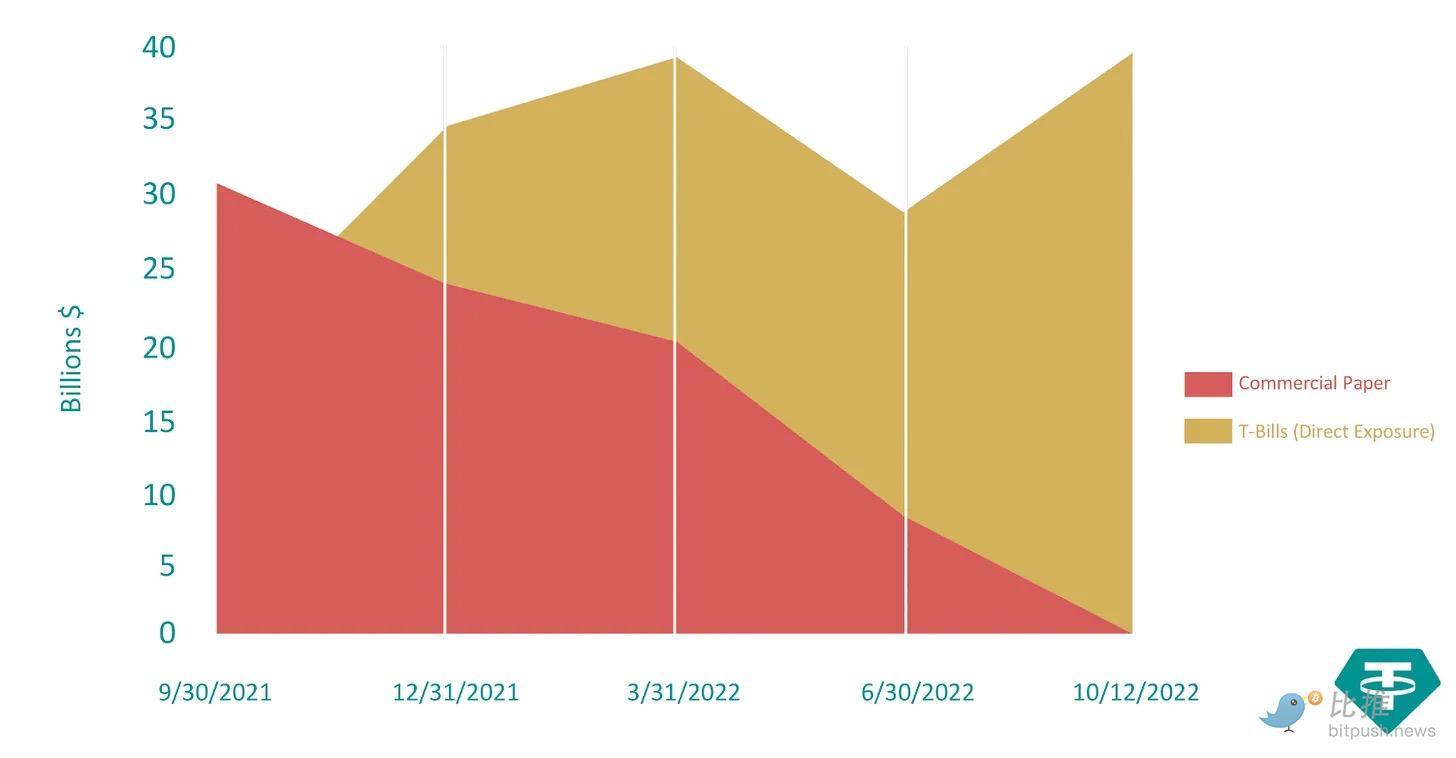
During the same period, Tether's US Treasury reserves grew from less than $25 billion to $40 billion.

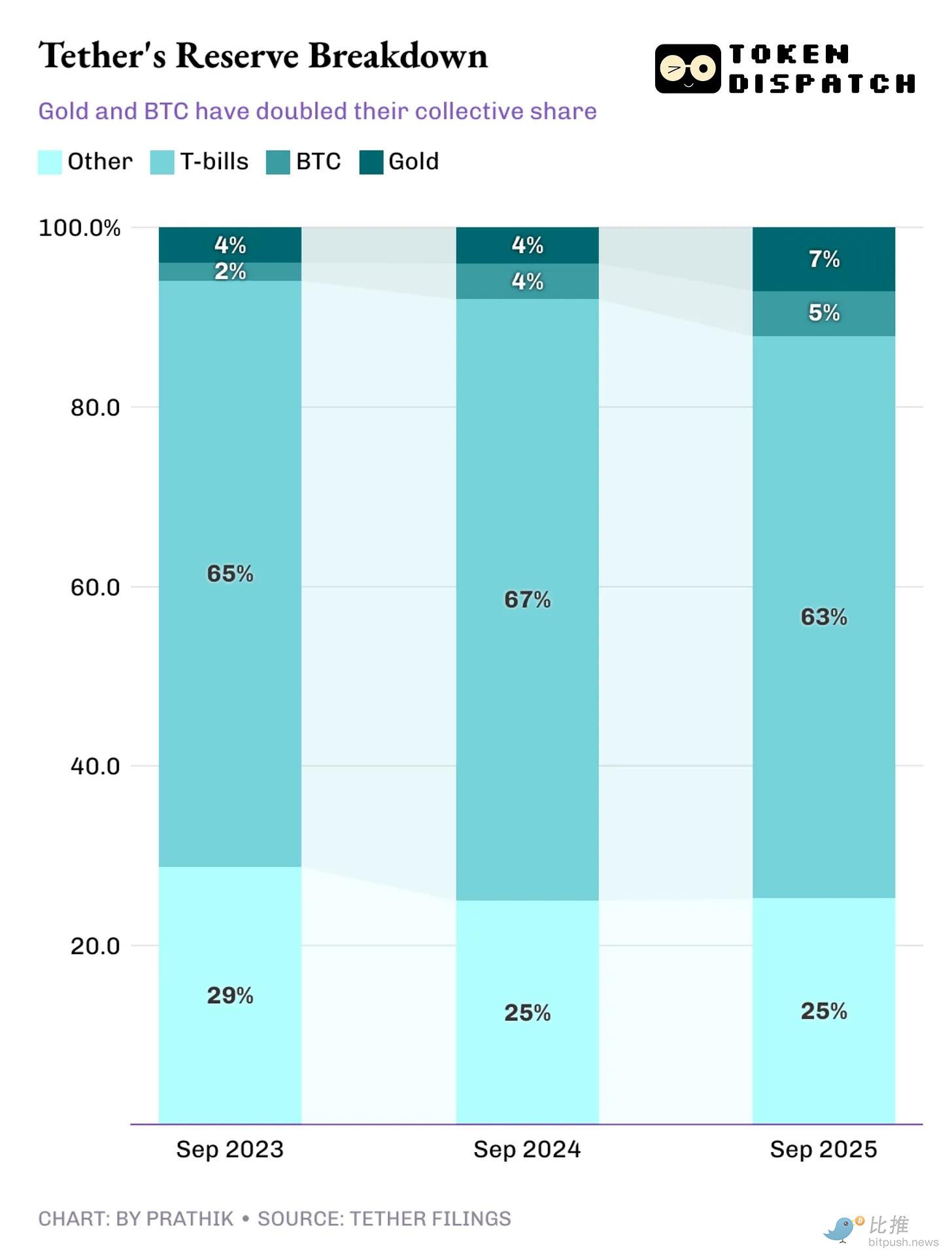
Between Q3 2023 and Q3 2025, the composition of Tether's reserve assets changed, incorporating asset classes rarely seen on the balance sheets of other stablecoin issuers.

As of September 2025, Tether had accumulated approximately over 100 tons of gold, valued at around $13 billion. It also held over 90,000 BTC, worth nearly $10 billion. Together, these account for about 12-13% of its reserves.

In contrast, its competitor Circle held only 74 Bitcoin, worth about $8 million.
Why the Shift Now?

The increase in gold and Bitcoin allocations coincided with the period when the forward rate curve no longer predicted rate hikes.

In response to rising inflation, interest rates jumped from less than 1% to over 5% between May 2022 and August 2023. During this time, maximizing income by investing in US Treasuries made economic sense. But once interest rates peaked in 2023 and no further hikes were expected, Tether saw it as the right moment to start preparing for the turn in the interest rate cycle.

Why Choose Gold and Bitcoin When Yields Fall?

Gold tends to perform well when US Treasury yields fall. This is driven by expectations of rising inflation and the reduced opportunity cost of holding gold instead of low-yielding US Treasuries.
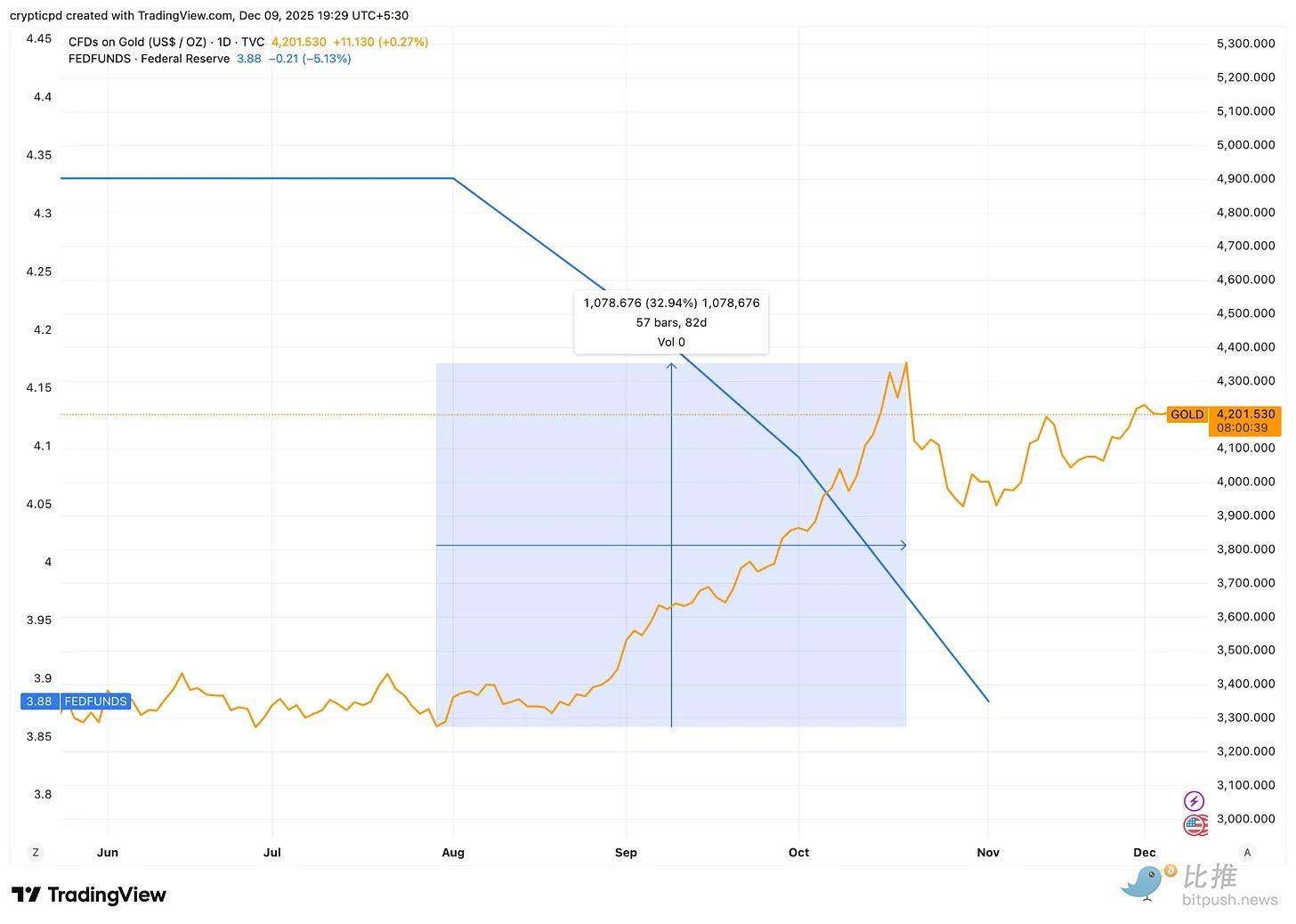
We saw this happen this year; when the Fed cut rates by 50 basis points, gold prices rose over 30% between August and November.

Even during the COVID-19 pandemic, when the Fed cut rates by 1.5 percentage points to inject liquidity into the economy, gold prices rose 40% in the subsequent five months.

Bitcoin has recently exhibited similar macro behavior. As monetary policy eases and liquidity expands, Bitcoin typically reacts like a high-beta asset.
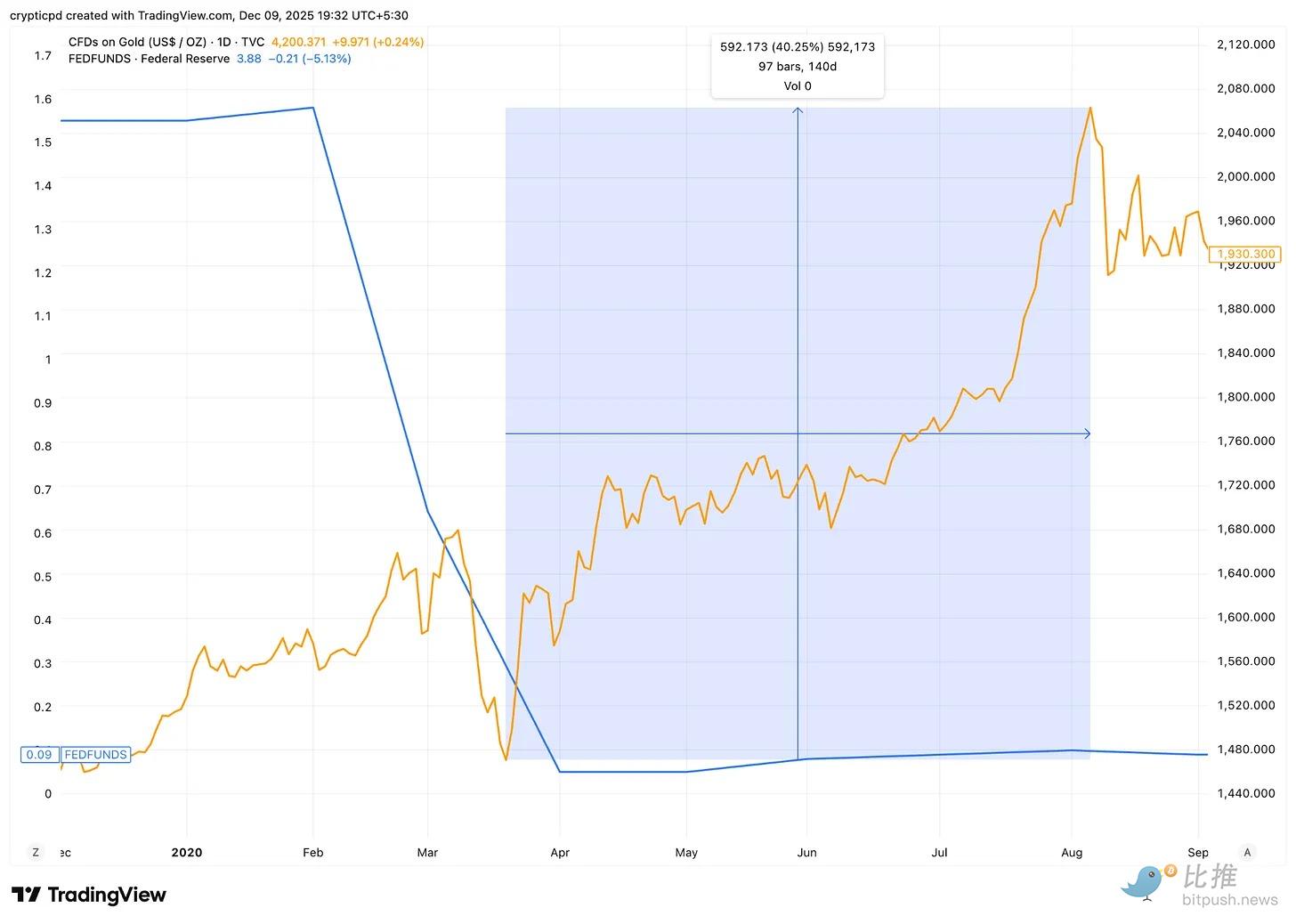
Therefore, while a high-interest-rate environment allows for income through US Treasuries, allocating to Bitcoin and gold can provide potential upside in a low-interest-rate environment.

This allows Tether to book unrealized gains and even realize some profits by selling gold or Bitcoin from its vault, particularly during phases when interest rates are low and income is squeezed.

However, not everyone approves of the increased exposure to gold and Bitcoin on Tether's balance sheet.

The Peg Problem

Although US Treasuries still account for 63% of Tether's reserves, the increased exposure to riskier assets like Bitcoin and unsecured loans has raised concerns among rating agencies.

Two weeks ago, S&P Global Ratings reassessed Tether's ability to maintain the USDT peg to the US dollar from Tier 4 (Constrained) to Tier 5 (Weak). It noted the increased exposure to corporate bonds, precious metals, Bitcoin, and secured loans in its reserves.

The agency pointed out that these assets account for almost 24% of the total reserves. More troubling for the agency is that, although US Treasuries still back most of the reserves, the USDT issuer provides limited transparency and disclosure regarding the composition of these riskier asset classes.

Furthermore, there are concerns about undermining the peg of the USDT token to the US dollar.

S&P stated in its report: "Bitcoin now accounts for about 5.6% of USDT's circulation, exceeding the 3.9% over-collateralization margin, indicating that the reserves can no longer fully absorb the impact of its value decline. Therefore, a decline in Bitcoin's value combined with a decline in the value of other high-risk assets could reduce reserve coverage and lead to USDT being undercollateralized."

On one hand, Tether's shift in reserve strategy seems a reasonable measure to cope with the upcoming low-interest-rate environment. When rate cuts come—and they will—this $13 billion profit engine will struggle to sustain itself. The upside potential of the held gold and Bitcoin could help offset some of the income loss.

On the other hand, this shift has also rightly made rating agencies nervous. The primary task of a stablecoin issuer is to protect its peg to the underlying currency (in this case, the US dollar). Everything else, including the revenue it generates, its reserve diversification strategy, and the unrealized gains it can obtain, becomes secondary. If the peg fails, the business collapses.

When circulating tokens are backed by volatile assets, the risk profile of the peg changes. A sufficiently large impairment of Bitcoin—which we have been experiencing over the past two months—would not necessarily break the USDT peg but would narrow the buffer between the two.

Tether's story will unfold with the upcoming monetary policy easing. This week's rate cut decision will be the first indicator to measure this stablecoin giant's ability to defend its peg and signal its future trajectory.

Let's wait and see.


Twitter:https://twitter.com/BitpushNewsCN

Bitpush TG Discussion Group:https://t.me/BitPushCommunity

Bitpush TG Subscription: https://t.me/bitpush

Original article link:https://www.bitpush.news/articles/7594373

Related Questions

QWhy has Tether started diversifying its reserves to include assets like gold and Bitcoin?

ATether is diversifying its reserves to prepare for the upcoming shift in the interest rate cycle. As the Federal Reserve is expected to lower interest rates, the yield on U.S. Treasuries will decrease, compressing Tether's interest income. Gold and Bitcoin have historically performed well in low-rate environments, offering potential upside to offset this income loss.

QWhat is the current composition of Tether's reserves, and how does it differ from its competitor Circle?

AAs of September 2025, Tether's reserves consist of approximately 63% U.S. Treasuries, over 100 tons of gold (worth ~$13B), and over 90,000 BTC (worth ~$10B). In contrast, its competitor Circle holds only 74 Bitcoin, worth $8 million, showing a vastly different and more conservative strategy.

QWhat concerns have rating agencies like S&P Global raised about Tether's new reserve strategy?

AS&P Global Ratings downgraded its assessment of Tether's ability to maintain the USDT peg from 'constrained' to 'weak.' The agency is concerned about the increased exposure to higher-risk asset classes like corporate bonds, precious metals, Bitcoin, and secured loans, which now make up nearly 24% of its reserves. It also cited limited transparency and the risk that a drop in Bitcoin's value could reduce reserve coverage and lead to USDT being undercollateralized.

QHow did Tether's business model perform during the period of high interest rates?

ADuring the high-interest-rate period, Tether's business model was extremely profitable. It held over $1 trillion in U.S. Treasuries and earned a yield of around 5%. Even with lower average rates of about 4.25% for much of 2025, Tether reported a net profit exceeding $10 billion for the first nine months of the year, far outperforming competitors like Circle, which reported a net loss.

QHow do gold and Bitcoin typically behave in a low interest rate environment, and why is this beneficial for Tether?

AGold tends to perform well when U.S. Treasury yields fall, as it is driven by expectations of rising inflation and a lower opportunity cost of holding non-yielding assets. Bitcoin often acts as a high-beta asset, reacting positively to expansionary monetary policy and increased liquidity. This potential for price appreciation allows Tether to book unrealized gains or realize profits by selling these assets, helping to offset the squeezed income from lower-yielding Treasuries.

Related Reads

If the AI Bubble Is Already Bursting, Who Will Truly Survive?

If the AI Bubble is Bursting, Who Will Remain? The debate over an AI bubble is intensifying, with figures like Ray Dalio warning of high levels and Jensen Huang seeing immense, early-stage opportunity. Both views hold truth: a speculative bubble in capital markets likely exists, mirroring the dot-com era, but the underlying technological shift is real and transformative. History shows that while bubbles burst—wiping out overvalued companies and speculative capital—they often leave behind critical physical and digital infrastructure. The dot-com bust, for instance, eliminated many firms but left the global fiber optic networks and data centers that enabled the rise of Amazon, Netflix, and cloud computing. Today's massive AI infrastructure investments (projected at trillions by 2030) in data centers, power, cooling, and GPUs may follow a similar path, creating the foundation for future applications. A key divergence from past bubbles is the "Jevons Paradox" effect in AI. As the cost of AI inference has plummeted by over 99.7% since 2023, enterprise spending on AI has skyrocketed. Cheap "tokens" have unlocked vast, previously uneconomical use cases, moving AI from simple chatbots into core business workflows—code generation, legal document review, scientific simulation, and financial analysis. The market is now in a phase of self-correction, weeding out superficial "API-wrapper" startups, but this cleansing process strengthens the ecosystem. The long-term trajectory is clear. The value is gradually shifting from capital expenditure (CapEx) on hardware to operational expenditure (OpEx) on transformative applications. As AI becomes a utility, the winners will be firms that deeply integrate it to solve vertical industry problems in law, healthcare, finance, and manufacturing. The泡沫 will recede, but the foundational shift towards an AI-powered era across all sectors is irreversible. The underlying productive force of AI contains no bubble.

marsbit16m ago

If the AI Bubble Is Already Bursting, Who Will Truly Survive?

marsbit16m ago

If the AI Bubble Is Already Bursting, Who Will Truly Remain?

**Summary: If the AI Bubble is Bursting, What Will Remain?** The debate around an AI bubble is intensifying, with figures like Ray Dalio warning of high valuations while Jensen Huang sees immense opportunity. This echoes the dot-com bubble, which saw massive wealth destruction but ultimately left behind critical infrastructure like undersea cables and broadband, enabling future giants like Amazon and Netflix. Similarly, today's AI boom involves trillions invested in data centers, power, cooling, and GPUs, while application-layer revenue remains comparatively modest. This investment-disparity signals a bubble. However, the core technological progress is real and accelerating. AI inference costs have plummeted by over 99.7% since 2023, making intelligence increasingly cheap and accessible. This cost collapse is unlocking vast new demand. Instead of reducing spending, enterprises are tripling their AI cloud expenditure. Cheap "tokens" enable AI to move beyond simple chatbots into complex workflows—automating code writing, legal document review, financial analysis, and scientific research. This follows "Jevons's paradox": improved efficiency leads to greater total consumption. The market is now undergoing a necessary purification, weeding out "API-wrapper" startups with no real moat. The deeper evolution involves a shift from capital expenditure (CapEx) on infrastructure to operational expenditure (OpEx) on value-creation in applications. While hardware vendors currently profit most, long-term value will migrate to AI-native firms solving vertical industry problems. Ultimately, a market correction will cleanse speculative excess but will not reverse the AI+ trend. The massive physical and algorithmic infrastructure being built will endure, becoming a cheap, utility-like foundation. Just as the internet became indispensable to all industries post-2000, AI is poised to empower and redefine every sector, moving society irreversibly toward an intelligence-augmented era. The bubble may burst, but the underlying productive momentum is solid.

链捕手22m ago

If the AI Bubble Is Already Bursting, Who Will Truly Remain?

链捕手22m ago

Microsoft CEO: In the AI Era, How Do You Define a Company's Moat?

Microsoft CEO Satya Nadella argues that in the AI era, a company's true competitive edge, or "moat," is not determined by choosing the single most powerful model, but by its ability to build a continuous "learning loop." This system integrates and evolves by connecting human workflows, domain expertise, organizational judgment, and employee experience. He posits that future companies will accumulate two types of capital: Human Capital (employee knowledge, judgment, creativity) and "Token Capital" (a firm's own built and owned AI capabilities). Importantly, AI amplifies rather than devalues human capital. Human direction is essential to guide progress, as computational power alone is aimless. The core opportunity lies in creating a closed-loop system where human and token capital reinforce each other in a compound, self-improving cycle. A company must be able to preserve its unique institutional knowledge—its "company veteran" expertise—even if it switches underlying general-purpose AI models. This requires private evaluation benchmarks, reinforcement learning environments based on internal data, and queryable knowledge bases. Nadella warns against a future where economic value is concentrated by a few dominant models that commoditize entire industries' knowledge. Instead, the priority should be building a broad "frontier ecosystem" where every company, industry, and nation can own its learning loop. This allows organizations to retain control of their intellectual property, amplify employee capabilities, and ensure the economic value created by AI is captured within their own businesses and communities. True corporate sovereignty in the AI age comes from turning organizational knowledge into a compounding system that creates enduring, defensible value.

marsbit57m ago

Microsoft CEO: In the AI Era, How Do You Define a Company's Moat?

marsbit57m ago

ETFs Are Just the Ticket: The True Institutionalization of Bitcoin Is Happening Where You Can't See It

Beyond the Bitcoin ETF spotlight, a deeper institutionalization is underway, leveraging Bitcoin as a foundational financial primitive. Institutions are using Bitcoin for purposes long reserved for assets like U.S. Treasuries and gold: as collateral for loans, insurance reserves, and the backbone of rated bonds. Examples include a Barbados-based insurer capitalizing with $40M in Bitcoin reserves and Ledn's $188M securitization of Bitcoin-backed loans, which received the first-ever investment-grade rating (BBB-) from S&P for a digital asset-backed security. This structure was stress-tested during a 27% price drop in early 2026, triggering automatic liquidations that functioned as designed but revealed the systemic risk of synchronized selling across leveraged positions. Infrastructure is evolving to support this, with platforms like Anchorage Digital's Atlas network enabling secure, institutional-grade settlement and collateral management. Strategies like basis trades and corporate treasuries (exemplified by companies like MicroStrategy issuing billions in equity and debt to fund Bitcoin acquisitions) further integrate Bitcoin into financial mechanics. While ETFs solved "how to own" Bitcoin, these developments answer "what to do with it," embedding the asset into the working machinery of finance—as collateral upon which loans, derivatives, and structured products are built. The real, enduring institutional shift is happening in these largely invisible plumbing and financing systems.

marsbit1h ago

ETFs Are Just the Ticket: The True Institutionalization of Bitcoin Is Happening Where You Can't See It

marsbit1h ago

ZEC Co-Founder Responds to Orchard Vulnerability: No Signs of Theft, Orchard Pool to Be Sealed

ZEC Co-Founder Addresses Orchard Vulnerability: No Signs of Theft, Plans to Sunset Orchard Pool A security vulnerability was recently discovered in Zcash's Orchard shielded pool, raising key concerns. The primary questions are whether the flaw was exploited, if user funds are safe, whether users can verify the total ZEC supply, and if other similar vulnerabilities exist. Analysis suggests the vulnerability was likely not exploited prior to its discovery. It was found proactively by a researcher using specialized tools, not due to an active breach. The development team and mining pools acted quickly to contain the issue. Typical financially-motivated attacks would likely have left visible on-chain evidence, which has not been observed. User funds in Orchard are considered safe and should be recoverable, assuming no prior exploitation. If the flaw was never used, all legitimate funds can be withdrawn. The article outlines risks associated with moving funds to transparent addresses or other pools, but concludes that leaving assets in place is a reasonable option. Currently, users cannot independently verify that the total ZEC supply hasn't been inflated due to this bug. However, the planned Ironwood network upgrade is designed to resolve this. It will permanently close the Orchard pool to new deposits and internal transfers, allowing only withdrawals. This mechanism will cap total withdrawals at the amount of legitimately deposited funds, enabling anyone to cryptographically verify the supply post-upgrade. Multiple teams, including Shielded Labs, have conducted extensive audits focused on counterfeiting vulnerabilities, assisted by advanced AI tools. No additional flaws of this type have been found so far, increasing confidence that no other similar undisclosed vulnerabilities exist. In summary, evidence indicates the Orchard bug was probably not used, user funds are secure, and no other counterfeiting flaws are currently known. The upcoming Ironwood upgrade will restore users' ability to independently verify the total ZEC supply, closing this chapter.

Foresight News1h ago

ZEC Co-Founder Responds to Orchard Vulnerability: No Signs of Theft, Orchard Pool to Be Sealed

Foresight News1h ago

Trading

Spot
Futures
活动图片