Most people never see it, never interact with it, and rarely hear about it. Yet this specialized chip is responsible for protecting the private keys that give owners control over their digital assets. Without it, many modern hardware wallets would be much more vulnerable to physical theft and sophisticated attacks. Understanding what a secure element is and how it actually works helps explain why hardware wallets have become one of the most secure ways to store cryptocurrency.
Secure Elements Were Created to Protect Secrets
A secure element is a specialized computer chip designed for one primary purpose: protecting extremely confidential information.
Unlike the processor in a regular laptop or smartphone, a secure element is built specifically for storing secret information and performing cryptographic operations without revealing the protected data. Instead of trying to perform many different computational tasks, it focuses on isolating confidential data from everything else inside the device.
This particular technology didn't originate with cryptocurrencies. Secure elements have been used for a long time in payment cards, SIM cards, electronic passports, and government identification systems. These industries faced the same problem many years ago: protecting digital credentials even if the device is physically taken.
Hardware wallets apply the same concept to cryptocurrencies.
Why Hardware Wallets Need It
Any cryptocurrency wallet depends on private keys.
A private key is essentially the secret that proves ownership of digital assets. Anyone with access to this key can authorize transactions and transfer funds. Protecting it is the most important task of any wallet.
Software wallets store keys on internet-connected devices, making them vulnerable if the computer or smartphone is infected with malware. Hardware wallets largely solve this problem by keeping the private key in a separate device isolated from the internet. The secure element enhances this protection by creating an additional layer of isolation within the hardware wallet itself.
Instead of allowing the wallet's main processor to directly access the private key, the secure element keeps the secret locked away within its own protected environment. Even other components inside the wallet cannot simply read the key at any time at will.
Storing Private Keys Inside the Secure Element
One of the most common misconceptions about hardware wallets concerns how transactions are signed.
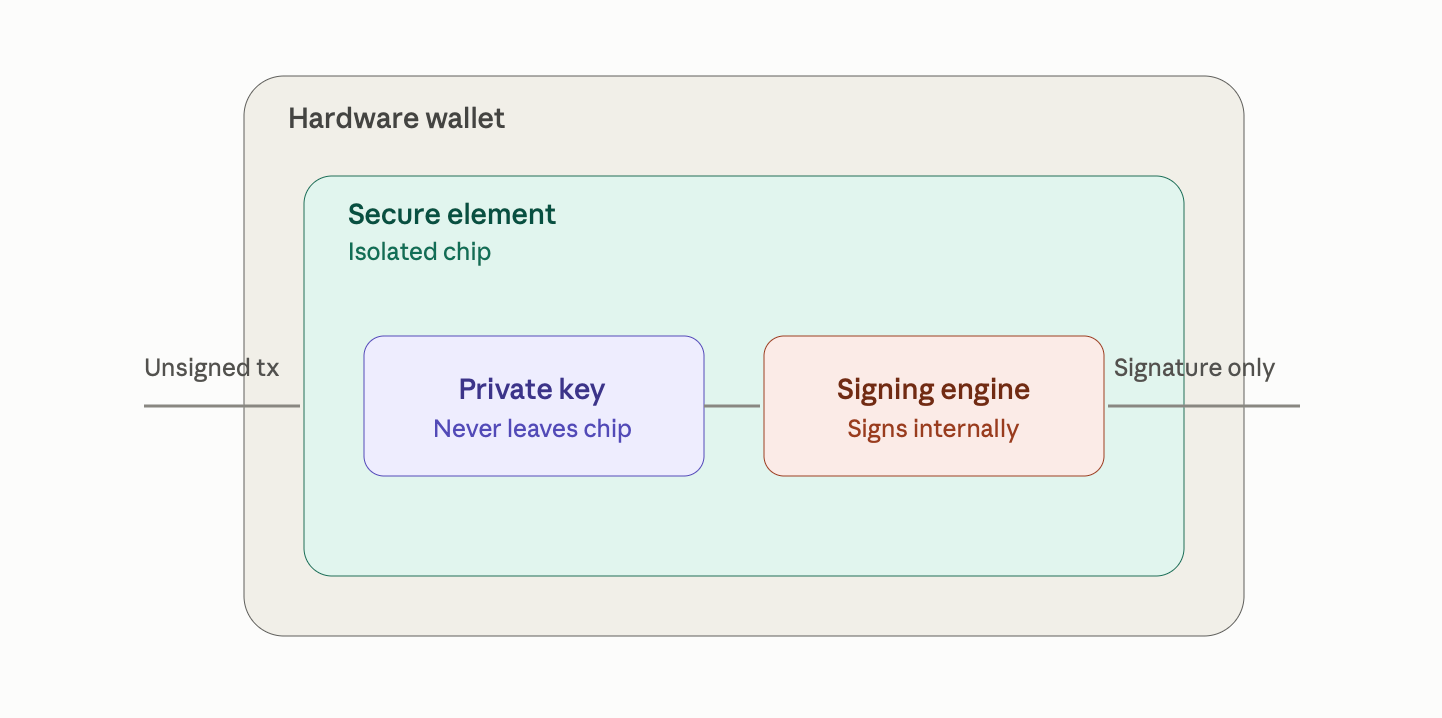
When someone sends cryptocurrency, the wallet does not copy the private key to the computer before authorizing the transaction. Instead, the unsigned transaction is sent to the hardware wallet for verification.
After the owner confirms the transaction details on the wallet's trusted screen, the secure element internally performs the signing mathematical operation. Only the finished digital signature leaves the chip. The private key itself never leaves the chip. This separation significantly reduces the chance that malware running on the connected computer can steal the information needed to access the funds.
Built to Defend Against Physical Attacks
Isolating the private key is only part of the job. The secure element is also engineered to make stealing that information extremely difficult, even if someone gets hold of the hardware wallet itself.
Unlike a regular computer chip, a secure element includes protective features built directly into its silicon die. These protections are designed to detect or slow down attempts to tamper with the chip, probe its internal circuits, or manipulate its operation. If the chip detects unusual conditions, such as abnormal voltage, unexpected temperatures, or other signs of tampering, it may shut down, reset, or protect the information stored inside.
Another threat comes from attacks aimed at obtaining secret information by meticulously measuring the chip's behavior while performing computations. Researchers call such attacks 'side-channel attacks' because they analyze parameters like power consumption, timing characteristics, or electromagnetic signals, instead of attacking the software directly.
Secure elements are specifically designed to make applying these methods significantly more difficult by masking or randomizing the information attackers try to track.
Randomness Matters More Than Most People Think
Security begins long before the first transaction is signed.
During the initial setup of a hardware wallet, it must generate the seed phrase, upon which all the private keys used by the wallet will ultimately be based. This process depends on randomness. If the random numbers are weak or predictable, then the resulting keys can also become predictable. A recent vulnerability in the Coldcard hardware wallet shed much brighter light on this problem due to a firmware defect that completely bypassed hardware entropy.
To prevent such situations, secure elements contain hardware random number generators that extract entropy from physical processes inside the chip, rather than relying solely on software. Some wallet models also combine multiple sources of randomness, further reducing the likelihood that a single failure could weaken the security of the generated keys.
Independent Testing Adds Another Layer of Confidence
A secure element is not simply declared secure by its manufacturer.
Many chips used to protect confidential information undergo independent security evaluations as part of an international system known as Common Criteria. During this process, specialized testing laboratories attempt to bypass the chip's security using advanced methods before it can be certified.

Many secure elements used in hardware wallets receive EAL 5+ or EAL 6+ security evaluation level certificates, indicating they have been tested for resistance to sophisticated attack methods within a defined scope. These certificates do not guarantee that the chip cannot be hacked. Instead, they show that independent experts have evaluated the claimed security features using rigorous testing standards.
The Secure Element Is Not a Magic Shield
Despite the high level of protection, secure elements cannot eliminate all possible risks.
If someone is tricked or even coerced into approving a fraudulent transaction, if a person voluntarily reveals their recovery phrase or stores backups in an insecure manner, the secure element cannot prevent these mistakes. Similarly, no commercial security technology can promise complete protection against highly specialized laboratory attacks conducted by well-funded adversaries with unlimited time and resources.
The secure element is designed to raise the cost and complexity of an attack so high that it becomes impractical for the vast majority of real-world criminals. It is just one layer in a broader security strategy, not a complete solution on its own.
Robust Security Depends on Multiple Layers
The greatest security of a hardware wallet comes from the combination of several protective measures, not reliance on any single feature.
Using a strong passphrase, carefully verifying transaction details on the device's screen, protecting recovery phrase backups, and employing additional security measures like a multi-signature scheme—all of this helps reduce risks. The secure element complements these measures by providing isolation for the wallet's most confidential information throughout its normal operation.
Why Secure Elements Remain Important
As the number of cryptocurrency owners grows and the value of digital assets increases, malicious actors continue to search for new ways to hack wallets. This has made secure elements an increasingly important part of modern hardware wallet design. Older hardware wallets from earlier models might not have used secure elements, but currently it has become the standard.
Their task is simple but critical. They generate confidential secret keys, protect them in a secure environment, and perform cryptographic operations without revealing the information that gives owners control over their funds. While no security technology is perfect, secure elements significantly raise the barrier for those attempting to steal private keys through physical or technical attacks.
For those choosing cold storage via a hardware wallet, understanding the role of the secure element provides a clearer picture of how modern self-custody works. The chip does not make users invulnerable, but it is one of the most crucial components for protecting digital assets, allowing people to control their cryptocurrency while keeping the most important keys secure behind specialized hardware protection mechanisms.
end-content