What Exactly Is a16z's 'New Media'? New Media Is a Migration of Power

marsbitPublished on 2026-01-23Last updated on 2026-01-23

Abstract

The article explores a16z's concept of "new media," arguing it represents a fundamental shift in power dynamics rather than just new content formats. It posits that in an era of content oversupply and near-zero distribution costs, attention and trust have become the new scarcities. The core value is no longer mere exposure but the ability to influence decisions—termed "agency"—the power to make others act based on your judgment. The piece contrasts old media (centralized, institution-owned, creators as employees) with new media (decentralized, individual-as-node, creators building direct influence). This transforms media from an institutional asset into personal capital and a tool of power. a16z treats this media capability as core infrastructure, recognizing that the traditional model of "capital → company → market" has flipped. Now, "agency → community → market → capital" is key, as capital alone no longer guarantees action. The article concludes by introducing Internet Capital Markets (ICM) as the next evolution, solving new media's flaw by turning influence and consensus into tradable, ownable capital structures—moving from "right to distribute" to "right to price." The ultimate leverage shifts from code to new media: scalable narrative, judgment, and taste.

Original Author: Julie Chen(@0xJuliechen)

a16z raised $1.5 billion. What exactly is the 'new media' they are betting on?

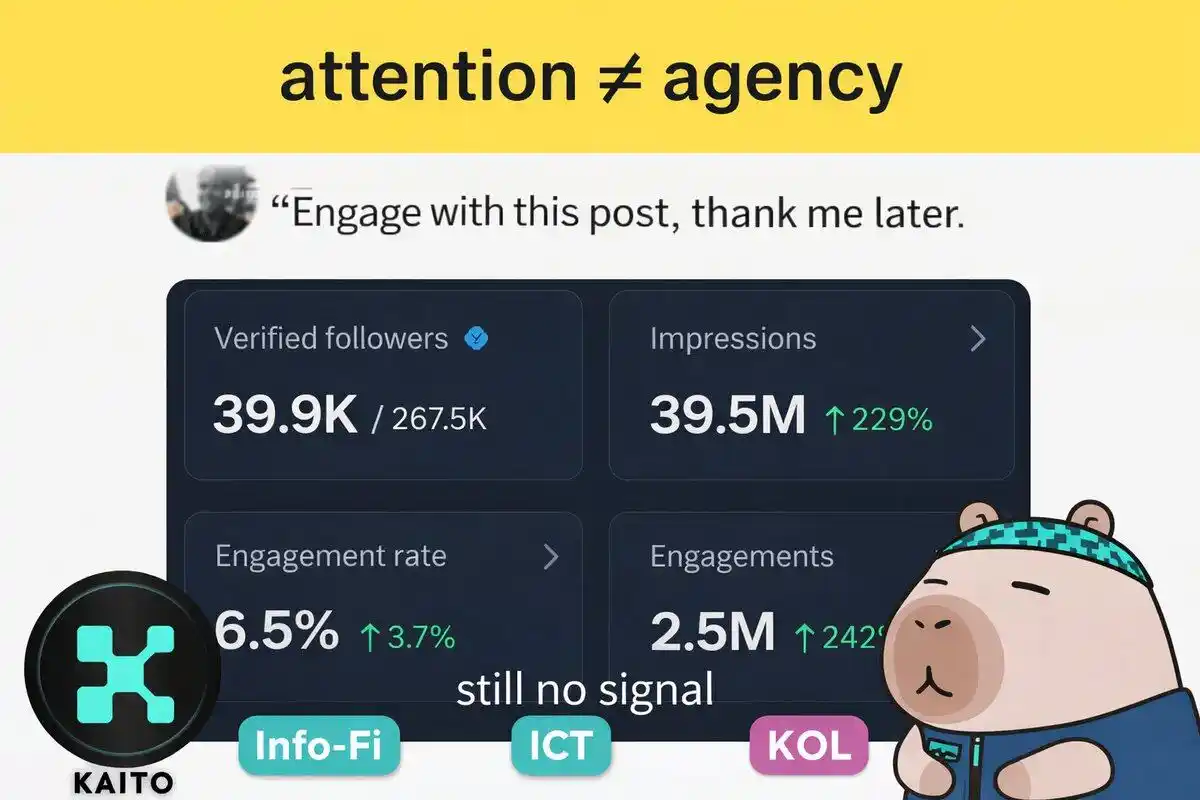
On X, everyone is a KOL, with millions of traffic every month. Traffic is no longer valuable. What is valuable is attention, the power of 'belief,' and the right to scarcity.

This article explains a16z's new media, agency (the power to act), how to make traffic meaningful on Twitter, and ICM.

🌟🌟

@a16z raised $1.5 billion at the beginning of the year, making headlines across major platforms. They raised so much money to tell a story of "all in on America, believing in AI + crypto and technology."

Two months ago, they specifically established a new media team to help a16z itself and its portfolio companies do "new media."

In Silicon Valley's AI/Web3 companies, there have been recent hires, with heavy rewards for finding a "storyteller"—someone who can write threads, shitpost, and tell stories.

a16z's new media partner directly stated: Marketing majors have replaced computer science as the "hot commodity."

What a16z has truly valued in recent years is not the content itself, but the way power is restructured.

New media is just the surface.

The real change is: Who has the qualification to make people act (agency).

1️⃣ Why has 'New Media' been elevated so highly in the past two years?

Because the path of the attention economy has basically run out of tricks.

  • Extreme content surplus
  • Distribution costs are nearly zero
  • Being seen no longer constitutes an advantage

What is truly scarce now is not exposure.

It's two things:

  • Is your judgment trustworthy?
  • Can you turn "belief" into "action"?

This is also why you can clearly feel a change:

In the past, media was about telling stories and setting narratives;

Now, media is starting to directly influence decisions and trigger actions.

When content is no longer scarce,

What becomes truly valuable is no longer 'what you said,'

but—what happens next.

This is the core meaning behind a16z's repeated discussion of new media.

It's not about the forms like threads, podcasts, or short videos,

but that the distribution structure has changed, and the power structure has changed along with it.

A simplest comparison:

Old Media

  • Scarce distribution (TV, newspapers, platforms)
  • Value concentrated in institutions
  • Creators are essentially employees

New Media

  • Decentralized distribution (X / YouTube / Substack / Podcasts)
  • Individuals themselves become nodes
  • Creators directly accumulate influence and bargaining power

The real change can actually be summed up in one sentence:

Media has changed from an institutional asset to personal capital.

And once media becomes personal capital,

it is no longer just an "exposure tool,"

but begins to become a tool of power.

When media belongs to an institution, it is your exposure tool;

When media belongs to an individual, it becomes your ability to influence others' decisions.

And influencing decisions is power.

2️⃣ Agency (The Power to Act)

The end goal of new media is not page views,

but agency (the power to act).

Agency means others are willing to act with you, trust your judgment, and pay for your concepts.
Packy mentioned in 《The Power Brokers》:

The goal of a Fund is to earn carry with as few people as possible, in as short a time as possible.
A Firm's goal is to continuously compound long-term advantages through scale.

This distinction explains one thing:

Why in traditional VC, media capability has always been "icing on the cake";

While at a16z, this has been directly made into infrastructure.

For a long time, the default order was:

Money → Company → Market

Money came first, deciding everything.

But in a world of extreme media saturation, this order has flipped:

Agency → Community → Market → Capital

Why is it that now "there is a lot of money, but things are hard to do"?

Because capital no longer automatically translates into action.

  • Distribution is not scarce
  • Attention is extremely noisy
  • Trust cannot be bought with budget

We've seen this many times in the crypto world (won't give examples to avoid offending people):

There's a lot of money, but projects still fail to cold start.

Valuations are high, but no one is really willing to participate.

The narrative is complete, but no one follows up with execution.

It's not because of insufficient money.

It's because there is no agency.

The truly scarce resource now is not capital.

It is:

  • The ability to make a group of people believe in the same thing simultaneously
  • The ability to make them act at the same point in time

Whoever can do this,

holds the real leverage.

So I am not praising, but using a16z to explain a structural change that is happening.

3️⃣ What does New Media solve? What is it still missing?

If media can form consensus, and consensus can drive action, then the market is the settlement layer of consensus.

Why ICM (Internet Capital Markets) necessarily appears after new media:

Because new media has a natural structural defect:

  • Influence ≠ Ownership
  • Traffic can be monetized, but it is not composable, not holdable long-term
  • Creators still rely on platform revenue sharing, brand partnerships, advertising cycles

The concept of ICM was first proposed by @solana. It fills in precisely this gap:

  • Transforming narrative / consensus / culture
  • Into a tradable, holdable, collaborative capital structure

ICM solves the next-step problem for new media:

How is influence priced, traded, and sustained?

To differentiate in one sentence:

  • new media:→ Who can gain attention
  • ICM:→ How attention becomes a capital structure
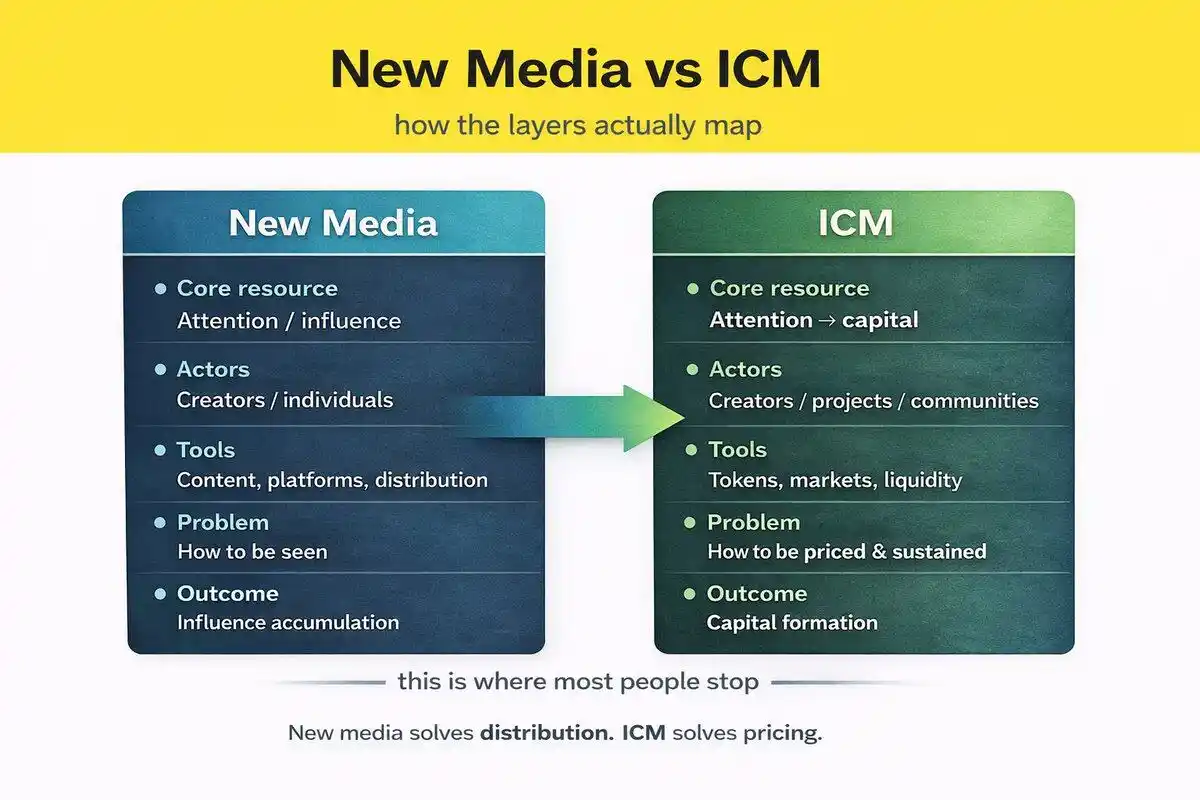
Conclusion:

New media solves the "right to disseminate," ICM solves the "right to price."

The essence of ICM:

  • Turning attention → agency → pricing → capital formation
  • Not a speculative tool, but coordination infrastructure

Closing

Finally, I want to quote my favorite saying from Naval Ravikant to echo this point and conclude the article.

Naval said: Code and media are the leverage behind the new wealthy class.

Indeed, over the past 10 years, Silicon Valley's nouveau riche and big tech companies (internet / software / AI) have essentially relied on "code leverage" to create wealth.

With the proliferation of Cursor and Claude, everyone can vibe code; the ability to code is becoming less scarce. There are even predictions that all entry-level programming jobs will be replaced by AI within the next 10 years.

The truly scarce leverage in the next cycle is new media:

Namely, the scalable dissemination of narrative × judgment × taste. Good leverage can continuously generate compound interest while you sleep, influence others in your absence, and help you build "trust + reputation + opportunity access."

code is law

New media is the law.

Original article link

Related Questions

QWhat is the core concept of 'new media' as discussed in the a16z context?

AThe core concept is not about the format (like threads or podcasts), but a shift in power structure. It's about media transforming from an institutional asset into personal capital, where the ability to influence decisions and trigger action (agency) becomes the new scarce resource, replacing mere attention or exposure.

QAccording to the article, what is the key difference between 'old media' and 'new media'?

AOld media is characterized by scarce distribution (TV, newspapers), value concentrated in institutions, and creators as essentially employees. New media is defined by decentralized distribution (X, YouTube), individuals becoming nodes themselves, and creators directly accumulating influence and bargaining power.

QWhat does the term 'agency' mean in this article, and why is it important?

A'Agency' refers to the power to make others act, to have them believe in your judgment and pay for your concepts. It is important because in a world of abundant capital and content, the true scarcity is no longer money or exposure, but the ability to coordinate belief and trigger simultaneous action among a group of people.

QWhat problem does ICM (Internet Capital Markets) solve in relation to new media?

AICM solves the structural defect of new media, where influence does not equal ownership and attention is monetizable but not composable or long-term holdable. It transforms narrative, consensus, and culture into tradable, ownable, and collaborative capital structures, essentially solving the 'pricing power' for the 'propagation power' that new media creates.

QWhy does the article suggest that 'new media' is becoming the most important lever in the next cycle?

AAs AI tools make coding skills less scarce, the next cycle's truly scarce lever will be new media—the scalable propagation of narrative, judgment, and taste. It builds a lever that generates compound interest while you sleep, influences others in your absence, and establishes trust, reputation, and opportunity gateways.

Related Reads

In Conversation with Ray Dalio: We Are Currently in an AI Bubble, with 1% of My Portfolio in Bitcoin

Ray Dalio, founder of Bridgewater Associates, warns in an interview that the current AI boom shows classic bubble characteristics, which could lead to significant economic downturns as seen in past cycles like 1929 or 2000. He explains that speculative enthusiasm, fueled by debt and overvaluation, often precedes a crash when rising rates or taxation force asset sales, causing widespread losses and recession. Dalio also outlines his "Big Cycle" theory, describing an approximate 80-year pattern where widening wealth gaps, massive government deficits, and shifting geopolitical power (like China's rise) create internal conflict and global instability. He emphasizes that we are in a late-cycle, transitional phase where traditional powers like the US and UK face decline. For personal wealth protection, Dalio advises diversification beyond cash into assets like stocks, bonds, real estate, and particularly gold, which he prefers over Bitcoin. While he holds about 1% of his portfolio in Bitcoin as a non-printable hard asset, he views gold as more secure from technological or governmental threats. Regarding AI's impact, Dalio believes it will disproportionately benefit capital owners, worsening inequality by replacing both physical and cognitive labor. He suggests that human intuition and emotional intelligence, combined with AI, will be key for future workers. On taxation, Dalio argues that wealth taxes are impractical and risk triggering asset sell-offs, reducing productive investment. He points to the UK as a cautionary example of debt, low productivity, and political strife. Geopolitically, Dalio foresees a more regionalized world, with the US showing weakness in prolonged conflicts like with Iran, akin to past imperial declines. The ideal outcome, he suggests, is coexisting powerful blocs (e.g., Americas, China-Asia Pacific) without major war.

marsbit2h ago

In Conversation with Ray Dalio: We Are Currently in an AI Bubble, with 1% of My Portfolio in Bitcoin

marsbit2h ago

Daily 7.2 Trillion KRW: Foreign Capital's Record Net Buying on Friday! Wall Street Says Headwinds for Korean Stock Fund Flows Have Subsided

South Korean stock market sees a dramatic shift in fund flows. On July 31, foreign investors made a record net purchase of approximately KRW 7.2 trillion in KOSPI stocks, marking a fundamental reversal from the persistent large-scale net outflows seen in previous months. This contributed to a significant narrowing of foreign net selling in July to KRW 9.8 trillion, down sharply from KRW 48.4 trillion in June and KRW 44.5 trillion in May. Simultaneously, domestic institutional pressure eased. South Korean pension funds and asset managers turned to a net buying position in July, purchasing KRW 1.0 trillion worth of KOSPI shares, contrasting with net sales in May and June. Market volatility is expected to be dampened by new financial regulations. Effective July 31, the Financial Services Commission tightened access for retail investors to single-stock leveraged ETFs by raising the minimum cash deposit requirement. Trading volumes for these products subsequently dropped to about 50% of their monthly average. Citigroup Research maintains its year-end KOSPI target of 10,000 points. The firm cites several supportive factors: the substantial easing of headwinds from capital outflows, a robust fundamental outlook for the semiconductor sector, historically low market valuations, strong economic fundamentals, and the potential for policy support from financial authorities if needed.

marsbit2h ago

Daily 7.2 Trillion KRW: Foreign Capital's Record Net Buying on Friday! Wall Street Says Headwinds for Korean Stock Fund Flows Have Subsided

marsbit2h ago

Thanks to Dice Rolls, Bitcoin Keys Are Stored Offline, But Not Everyone Will Do It

The article discusses using dice rolls to generate secure Bitcoin wallet seeds, providing entropy independent of potentially flawed hardware random number generators. It explains that each fair dice roll offers about 2.585 bits of entropy, with around 50 rolls needed for a standard 12-word seed phrase and 99+ recommended for higher security. This method gained attention after a vulnerability was revealed in some Coldcard hardware wallets, where a faulty firmware RNG (dating back to 2021) compromised generated keys. The analysis notes that while a dice-generated main seed was safe from this specific flaw, other Coldcard functions (like creating paper wallets, backup keys, or passwords) could still be vulnerable if they used the defective RNG. The piece argues that while dice-based entropy is technically robust, the manual process is error-prone, tedious, and unrealistic for most new users, who might make mistakes in recording or inputting rolls. It concludes that while manual entropy generation should remain an option for advanced users, the long-term goal is to develop reliable, user-friendly hardware and software that securely generates randomness without requiring specialized knowledge. Coldcard users are advised to check their firmware version and replace any secondary secrets (like paper wallet keys) created with vulnerable devices, while also considering multi-signature setups with devices from different manufacturers for added security.

cryptonews.ru7h ago

Thanks to Dice Rolls, Bitcoin Keys Are Stored Offline, But Not Everyone Will Do It

cryptonews.ru7h ago

Trading

Spot
活动图片





