What Are the Highlights of Ethereum's Most Important Glamsterdam Upgrade This Year?

marsbitPublished on 2026-03-06Last updated on 2026-03-06

Abstract

Ethereum's upcoming Glamsterdam upgrade, a major mid-year update, focuses on execution-layer improvements, building upon the data-layer enhancements of the previous Fusaka upgrade. The core features include ePBS (enshrined Proposer-Builder Separation) and BAL (Block Access List). ePBS (EIP-7732) formally bakes the separation of block building and validation roles into the protocol, moving away from reliance on third-party relays. This aims to reduce trust assumptions, prevent centralization at the validator level, and improve network efficiency. BAL allows block builders to pre-declare which accounts and storage locations a block's transactions will access, enabling validators to prepare data and verify transactions in parallel, significantly boosting throughput. Additional changes include gas fee re-pricing and multi-dimensional gas, which are expected to lower costs for average users while increasing overall network capacity (though potentially raising costs for some developers). For stakers, the upgrade promises a clearer income model and greater block selection power, smoothing out MEV rewards. However, the full potential of ePBS is dependent on a future upgrade (Hegotá) to implement FOCIL (Fork Choice-Enforced Inclusion Lists), which would give validators a final tool to combat transaction censorship. Potential challenges include the upgrade's high complexity, the risk of new forms of validator centralization, and the fact that toxic MEV (e.g., front-running) may pe...

Ethereum founder Vitalik Buterin has been quite active on social media lately, first reflecting on the previous direction of Layer2 and then outlining a new roadmap for Ethereum's future.

This has generated even more anticipation for the upcoming Ethereum Glamsterdam upgrade in the first half of this year. What are the key components of Glamsterdam, the most important update for Ethereum in the first half of this year?

Understanding the 'Current' by Looking at the 'Previous'

To understand Glamsterdam, we first need to understand its 'predecessor'—the Fusaka upgrade.

Fusaka was a data layer upgrade for Ethereum. It introduced two key features: PeerDAS and EOF.

PeerDAS: Instead of downloading all the data, you only need to download a small portion. It's like a sample survey; you don't need to ask everyone, just a small group to infer the situation of the whole population. Combined with ZK proofs, even if only 1/16th of the total data is downloaded, data integrity can be confirmed, significantly increasing Ethereum's network throughput.

EOF: This can be understood as an internal reform of the EVM. It makes the EVM's code structure clearer, more modular, and easier to optimize. EOF is like giving the EVM a 'renovation,' making its internal structure more rational.

If Fusaka was a 'data layer upgrade,' then Glamsterdam is an 'execution layer upgrade.' Fusaka primarily addressed 'how to transmit data,' while Glamsterdam aims to address 'who produces the blocks.'

The Core of Glamsterdam—ePBS and BAL

ePBS separates the block packaging and validation processes—block builders are responsible for packaging transactions, proposers for proposing blocks, and validators for validating blocks. If each role performs its part diligently, block builders can more aggressively package more transactions because proposers and validators will check their work, alleviating security concerns.

Can't Ethereum do this now? It can, but it relies on relays like Flashbots to separate 'proposing' and 'building.' Validators are only responsible for 'proposing blocks,' while builders package transactions to earn MEV (Maximal Extractable Value).

This creates a black box; the consequence of having to trust a third-party relay can lead to failures, censorship, attacks, or centralization.

ePBS makes this power separation mechanism protocol-native (EIP-7732), turning it into an 'on-chain auction + protocol enforcement,' solving the trust issue while also improving network efficiency.

The Block Access List (BAL) allows block packagers to inform validators in advance: 'The transactions in this block will access these accounts and storage locations.' With this information, validators can prepare in advance, loading this data from disk into memory. Then, validators can check multiple transactions in parallel instead of one by one. It's like an assembly line in a factory: previously, one worker was responsible for the entire product; now, multiple workers handle different parts simultaneously.

The combination of these two creates a dual reinforcement—efficiency improvement and anti-censorship.

However, for ePBS to reach its full potential, it needs another piece of the puzzle—the Fork Choice Forced Inclusion List (FOCIL). FOCIL allows validators to publish a 'must-include' list of transactions. If a builder does not include these transactions, validators can reject the block through the fork choice rule. This gives validators a 'last line of defense' against excessive censorship by builders.

However, launching ePBS and FOCIL simultaneously would be highly complex. Therefore, FOCIL's arrival will have to wait for the second upgrade this year, Hegotá.

Potential Impacts of Glamsterdam

In addition to ePBS and BAL, Gas repricing + multi-dimensional Gas will also be included in the Glamsterdam upgrade. This will make transactions cheaper for ordinary users and further increase the network's overall capacity, but it will correspondingly increase fees for some developers (those who need to build new state).

For stakers, the income model becomes clearer, block selection rights increase, and MEV earnings become smoother. This also means the MEV ecosystem will change, and some applications that rely on current methods to earn MEV may need to adapt.

As validator power increases, new application opportunities will emerge. For example, new 'validator service' applications might appear to help validators better select blocks.

But the Glamsterdam upgrade is certainly not perfect. As mentioned earlier, while ePBS will arrive in this upgrade, it is not the complete version with FOCIL. The complexity of this update is quite high, and it also gives validators more power. Besides the post-launch stability, whether this decentralization of power will lead to a new form of centralization at the validator level is also a point worth watching.

Vitalik also admitted, 'ePBS only prevents builder centralization from spreading to the staking layer, but the problem of block builder centralization itself remains.' Toxic MEV (sandwich attacks, front-running) might just 'move elsewhere' and continue to exist.

However, in the long run, the greatest significance of the Glamsterdam upgrade might be 'decentralization.' Vitalik's persistence and idealism regarding decentralization theory might make traditional finance and even the world trust Ethereum's adoption more. Time may provide the true answer to the value of this persistence in Ethereum's price.

Since last year, Ethereum's major updates have increased to twice a year. No longer complacent, Ethereum, now 'racing against time,' might truly regain its glory.


Trending Cryptos

Related Questions

QWhat are the two main components of the Glamsterdam upgrade, and what do they address?

AThe two main components of the Glamsterdam upgrade are ePBS (Enshrined Proposer-Builder Separation) and BAL (Block Access List). ePBS addresses the separation of block production roles (builders, proposers, validators) by making it a protocol-level feature to reduce reliance on trusted third parties and improve network efficiency. BAL addresses execution efficiency by allowing block builders to provide a list of accounts and storage locations that transactions will access, enabling validators to preload data and verify transactions in parallel.

QHow does the ePBS mechanism in Glamsterdam differ from the current system using relays like Flashbots?

AThe current system relies on external, trusted relays like Flashbots to separate the roles of block proposers and builders, which creates a potential single point of failure, vulnerability to censorship, attacks, or centralization. ePBS makes this separation a native, enshrined protocol feature (via EIP-7732) with on-chain auction and protocol enforcement, eliminating the need to trust a third party and improving security and decentralization.

QWhat is the purpose of the Block Access List (BAL) introduced in the Glamsterdam upgrade?

AThe Block Access List (BAL) allows a block builder to provide validators with a list of accounts and storage locations that the transactions in the block will access. This enables validators to preload the necessary data from disk into memory, allowing them to perform parallel transaction verification instead of sequential checking, significantly improving the efficiency of block validation.

QWhy is the FOCIL (Fork Choice Forced Inclusion List) mechanism not included in the Glamsterdam upgrade, and what is its intended role?

AFOCIL is not included in Glamsterdam due to the high complexity of implementing both ePBS and FOCIL simultaneously. Its intended role is to serve as a 'last line of defense' against censorship by allowing validators to publish a list of transactions that must be included in a block. If a builder refuses to include them, validators can use the fork-choice rule to reject that block. It is scheduled for a subsequent upgrade called Hegotá.

QAccording to the article, what is a potential long-term concern regarding MEV (Maximal Extractable Value) even after the ePBS implementation?

AA potential long-term concern is that while ePBS prevents builder centralization from spreading to the staking layer, the centralization of block builders themselves remains an unresolved issue. Furthermore, toxic MEV practices, such as sandwich attacks and front-running, may not be eliminated but could instead 'move elsewhere' and continue to exist in the ecosystem.

Related Reads

Wall Street's Most Famous 'Cassandra' Now Has His Sights Set on Nvidia

Michael Burry, the famed "Big Short" investor, has once again captured Wall Street's attention with a series of short positions against major tech and semiconductor stocks, most notably Nvidia. In late June and July, through his "Cassandra Unchained" newsletter, Burry disclosed short bets against Nvidia, Tesla, Applied Materials, Caterpillar, the SOXX semiconductor ETF, and later, Micron Technology. His core thesis revolves around potential distortions in the AI infrastructure boom, specifically questioning whether extended depreciation schedules (e.g., 6 years vs. a realistic 2-3 years for AI chips) by cloud giants like Microsoft and Google artificially inflate profits. He also raises concerns about possible "off-balance-sheet circular financing," where chip demand might be propped up by vendor-backed funding to clients. Nvidia's stock experienced volatility following these disclosures, briefly dipping but largely holding near Burry's reported entry points, leaving his positions roughly flat or slightly underwater as of late July. This move is part of a pattern for Burry, whose track record since his legendary 2008 bet is mixed. He has faced notable losses, such as on Tesla in 2021, while scoring on broader market turns like the 2020 pandemic crash. His methodology focuses intensely on free cash flow and scrutinizing original financial documents to spot overvaluation and structural risks, but it often struggles with timing the market. The article contrasts Burry's stance with other prominent investors. Steve Eisman, another "Big Short" figure, is not shorting Nvidia, citing strong fundamentals but expressing nervousness about sustainability. Jim Chanos agrees with the broad "accounting mismatch" concern—comparing it to the dot-com bubble—but targets financial leverage in private equity firms rather than the chip stocks themselves. While Nvidia's short interest remains relatively low at 1.3-1.4% of float, the massive stock size means absolute short losses have been significant, exceeding $5 billion earlier this year. The piece concludes that for ordinary investors, the key takeaway is not replicating specific short bets but learning from the critical frameworks these investors use: questioning rosy accounting, identifying structural vulnerabilities, and maintaining skepticism during market euphoria, even if pinpointing the exact catalyst for a downturn remains elusive.

marsbit21m ago

Wall Street's Most Famous 'Cassandra' Now Has His Sights Set on Nvidia

marsbit21m ago

Weekly Selection丨Epic Stock Market Volatility, Changxin Tech's IPO Reshapes Storage Landscape, Saylor Aims to Re-Anchor STRC Around September 8th

PANews Weekly Digest: Market Turmoil, Tech Breakthroughs, and Crypto Developments. The week saw significant volatility across global markets. South Korea's KOSPI index experienced extreme turbulence, including multiple trading halts, largely driven by sharp declines in AI hardware stocks like SK Hynix. In contrast, China's Changxin Xinqiao (CXC) achieved a landmark IPO with a market cap surpassing 4 trillion yuan, marking a major success for the domestic DRAM industry after a decade of losses. In the crypto and Web3 space, several key narratives emerged. AI is driving demand for new infrastructure, with projects like AI agent wallets and programmable payments gaining traction, attracting interest from firms like Coinbase. The Bitcoin mining sector is pivoting, with companies like MARA focusing on energy management as electricity becomes a core AI-era asset. Meanwhile, the RWA (Real World Assets) sector faces a "utilization puzzle," with hundreds of billions in on-chain assets remaining dormant. Notable market movements included a historic single-day surge of over 17% for the KOSPI index and a significant migration of $16.5 billion in staked ETH within the Lido ecosystem. Michael Saylor announced a target to re-peg the STRC stablecoin around September 8th. Other highlights include discussions on Ethereum's ambitious 2030 roadmap for scaling and privacy, analysis showing high protocol revenues not always translating to token price gains, and warnings from Citi about potential extreme commodity price shocks by late 2026.

marsbit26m ago

Weekly Selection丨Epic Stock Market Volatility, Changxin Tech's IPO Reshapes Storage Landscape, Saylor Aims to Re-Anchor STRC Around September 8th

marsbit26m ago

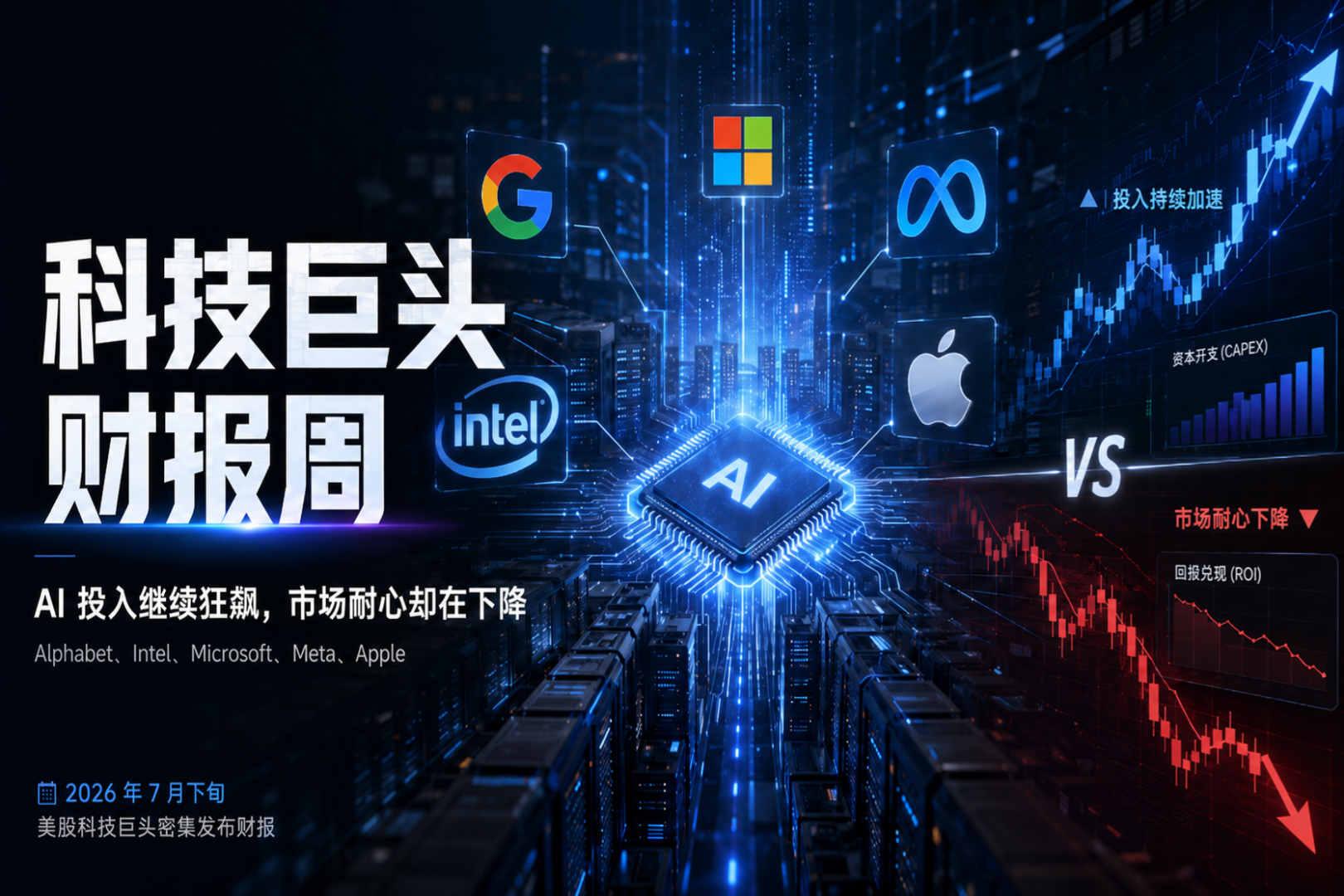
When the Market Begins to Question AI Capex: A Full Analysis of Q2 Earnings Reports from Five Tech Giants

In late July 2026, five major US tech giants—Alphabet, Intel, Microsoft, Meta, and Apple—released their Q2 earnings reports. While all companies exceeded revenue and profit expectations, driven by strong AI-related business growth, investor reactions diverged sharply due to concerns over escalating AI capital expenditures (capex) and their impact on free cash flow. Alphabet reported strong revenue growth and a surging cloud business, but its stock fell after announcing a doubled year-on-year capex and negative quarterly free cash flow for the first time. Intel posted its strongest revenue growth in over 15 years, but its stock experienced volatile trading after significantly raising its full-year capex guidance. Microsoft saw its stock surge after beating estimates and, crucially, lowering its capex forecast while projecting positive free cash flow. Meta faced the most severe sell-off as its profits declined despite revenue beats, with free cash flow plunging over 90% and its capex guidance raised. Apple reported record June-quarter results, but its stock plummeted after providing Q4 revenue guidance that fell short of expectations, citing supply chain constraints and forex headwinds. The overall takeaway is that the market's focus has shifted from validating AI demand to scrutinizing the timeline for returns on massive AI investments. Companies demonstrating a clearer path to managing capex and preserving free cash flow, like Microsoft, were rewarded, while those signaling continued aggressive spending faced investor skepticism.

Odaily星球日报35m ago

When the Market Begins to Question AI Capex: A Full Analysis of Q2 Earnings Reports from Five Tech Giants

Odaily星球日报35m ago

a16z: From Companies to DAOs, DUNA May Become the Next Generation Organizational Form

This article, "From Companies to DAOs: How DUNA Could Become the Next Organizational Form," traces the 500-year evolution of business collaboration. It begins with medieval structures like the *commenda* and Florentine *compagnia*, which exposed partners to personal risk. The modern corporation, exemplified by the Dutch East India Company (VOC), was a revolutionary leap, enabling large-scale, capital-intensive ventures by offering limited liability and reducing coordination costs. However, corporations introduced new challenges like principal-agent problems and bureaucratic overhead. The piece argues that software and internet-native protocols are now reducing these traditional overheads. Decentralized Autonomous Organizations (DAOs) emerged as a new model for coordination without centralized management. Yet, DAOs face a significant legal vacuum: they lack legal recognition, leaving members exposed to unlimited personal liability, and their tokens are vulnerable to being classified as securities under unclear regulations (e.g., the Howey Test). This has forced projects into suboptimal workarounds like offshore foundations. The article identifies the Decentralized Unincorporated Nonprofit Association (DUNA) as a potential solution. Recently legalized in states like Wyoming, the DUNA provides a legal wrapper for decentralized networks. It grants key protections—legal personality, limited liability, and perpetual existence—to a group without imposing a traditional hierarchical management structure. This allows token-holder communities to govern, hold assets, and contract as a single legal entity, aligning with their decentralized nature. While DUNA doesn't solve all governance challenges or magically resolve securities law questions, it represents a crucial step. It fills the legal recognition gap, offering a native legal form for internet-scale, decentralized collaboration and extending the separation of personal risk from organizational venture into a new domain.

marsbit1h ago

a16z: From Companies to DAOs, DUNA May Become the Next Generation Organizational Form

marsbit1h ago

2026 Mid-Year Report On-Chain RWA: Tokenized Stock Market Cap Doubles in a Year, But 90% of Rights Are Hollow Shells

The 2026 Mid-Year Report on On-Chain RWA highlights a significant growth in tokenized stock market capitalization, which nearly doubled from $951 million in March to $1.89 billion by July. However, the report reveals a fundamental contradiction in this "layer 2.5" ecosystem: products with the strongest legal foundation (like regulated U.S. infrastructure) lack liquidity and distribution, while freely tradable offshored wrapper products often lack substantive ownership rights. The increase is driven largely by a few products (SECZ, FGRS, STRCx) and platforms (Ondo, xStocks, Securitize collectively hold over 85% share). While distributed value across networks like Ethereum, Solana, and BNB Chain has grown, the market remains fragmented. Products referencing the same underlying asset (e.g., Apple stock) are distinct legal liabilities with different intermediaries and jurisdictional rules, offering varying degrees of legal claim. The report cautions that headline numbers are misleading, as they reflect changes in distributed token value—driven by issuance, conversions, and price movements—not pure investor inflows. True "canonical shares" with legal ownership, wide wallet distribution, institutional liquidity, and independent on-chain price discovery do not yet exist at scale. Tokenized treasuries show stronger product-market fit, and ETFs may be easier to scale than single stocks. The core takeaway is a trade-off: legal certainty versus liquidity and composability.

marsbit2h ago

2026 Mid-Year Report On-Chain RWA: Tokenized Stock Market Cap Doubles in a Year, But 90% of Rights Are Hollow Shells

marsbit2h ago

Trading

Spot

Hot Articles

Discussions

Welcome to the HTX Community. Here, you can stay informed about the latest platform developments and gain access to professional market insights. Users' opinions on the price of S (S) are presented below.

活动图片