WEEX Completes $2 Million WXT Buyback, Rewarding User Support for 'Futures Mining'

marsbitPublished on 2025-12-16Last updated on 2025-12-16

Abstract

Global cryptocurrency exchange WEEX has completed a $2 million buyback of its native token WXT, repurchasing 72,571,028 WXT tokens. The move is part of the platform’s effort to reward users for their participation in the "Futures Mining" campaign, which offers up to 30% trading fee rebates in WXT. The campaign, originally scheduled to end on December 15, has been extended by 10 days to December 25 due to high user demand. Participants receive real-time WXT rewards for each futures trade, with higher trading volumes unlocking greater rebate tiers, ranging from Bronze to King Miner levels. To prevent inflation and support token value, WEEX used its own funds for the buyback, maintaining WXT’s scarcity. Since its launch in July 2024, WXT has seen significant growth, with year-to-date gains of around 70%, making it one of the top-performing exchange tokens. WEEX has conducted four buybacks to date, burning 41.24% of WXT’s total supply. Additional token utility includes fee discounts, airdrops, and membership benefits, offering holders an estimated annualized return of 660.61%.

On December 16, globally leading cryptocurrency trading platform WEEX announced the completion of a new round of WXT buyback worth $2 million, totaling 72,571,028 WXT tokens repurchased.

This WXT buyback aims to reward global users for their support of WEEX's 'Futures Mining' campaign. The event offers up to 30% trading fee rebate rewards for users participating in futures trading, with rewards distributed in real-time via WXT tokens.

In other words, 'Futures Mining' transforms users' daily futures trading into a novel, fully trading volume-driven 'mining' model—the higher the trading volume, the higher the fee rebate ratio, with all WXT rewards credited instantly.

'Futures Mining' Continues to Boom, Event Extended by 10 Days

WEEX 'Futures Mining' aims to return platform growth dividends to users through the innovative incentive model of 'trading is mining'. During the event, users receive real-time WXT-based fee rebates for each futures open/close order, with rebates up to 30%.

Since its launch on November 26, the event has attracted active participation from global users, with trading heat continuously rising. According to WEEX official data, as of 18:00 on December 16 (UTC+8), the top 100 users on the 'Futures Mining' leaderboard have accumulated a total futures trading volume of $9.172 billion, with total mining rewards of 3,015,047.7 WXT (data updating in real-time).
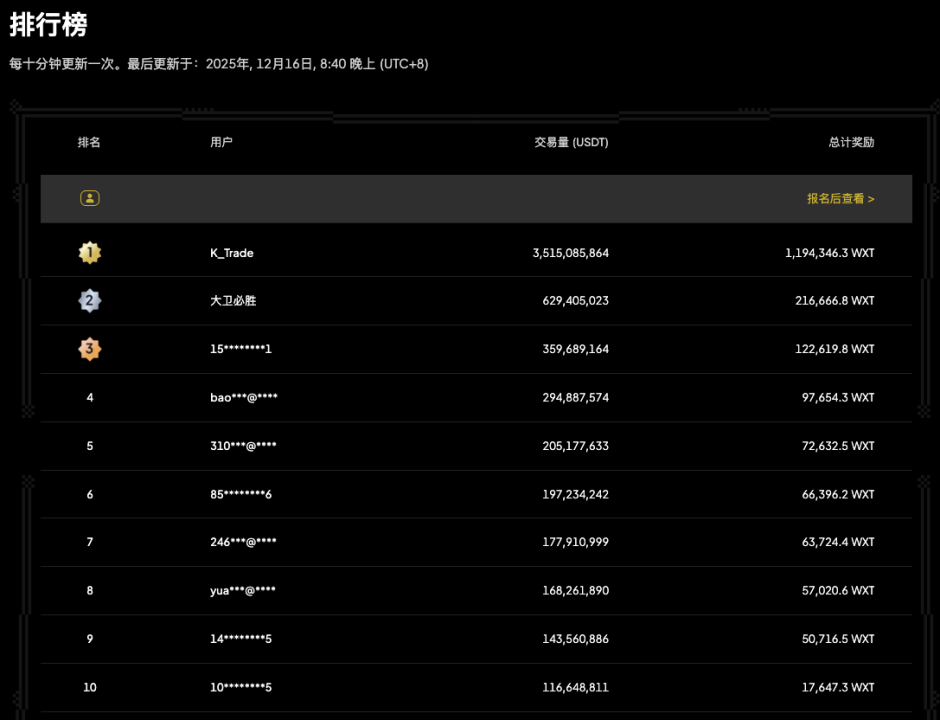
Due to the novel mechanism, generous rewards, and support for second-level settlement with instant rewards, the event has seen daily new participants and trading volumes repeatedly hit record highs after launch, with many users requesting an extension. Therefore, WEEX has extended the event by 10 days, moving the deadline from the original December 15 to December 25, allowing more users sufficient time to participate and continue enjoying mining rebate benefits.

This adjustment only extends the event duration; the rules remain unchanged: users click to register and participate in futures trading to receive WXT-based fee rebates, with WXT rewards credited in real-time after each open/close order.

Based on the miner tier mechanism of the 'Futures Mining' event, users start at the 'Copper Miner' tier. After trading begins, they can unlock Copper, Silver, Gold, Platinum, Diamond, and King tiers sequentially based on cumulative trading volume. The higher the trading volume, the higher the miner tier and fee rebate ratio, up to 30%. After the extension, users' unlocked miner tiers and rebate ratios remain effective. Trading fees generated during the extension will still be rebated in real-time at the corresponding ratio. Users can check their reward amounts and status in real-time via the WEEX App or official website.

72.57 Million WXT Buyback Completed, Ensuring Deflationary Effect

Unlike the token inflation issues faced by trading mining launched by other CEXs or liquidity mining on DeFi platforms, WEEX 'Futures Mining' not only maintains WXT's deflation but also genuinely demonstrates 'user rewards' sincerity through the $2 million WXT buyback supporting mechanism.

As previously announced, WEEX used platform funds to conduct a WXT buyback on the open market on December 16. By 17:00 (UTC) on December 16, the buyback plan was completed as scheduled, totaling 72,571,028 WXT repurchased at an average price of 0.027559 USDT/WXT.

Thus, the circulating supply of WXT will not increase due to the 'Futures Mining' event, maintaining WXT's scarcity and value stability, ensuring users' mining收益. Long-term, as WEEX's user base and trading volume continue to grow, the platform can invest more resources to further empower the WXT ecosystem, enhancing WXT's long-term appreciation potential.

Since its launch in July 2024, WXT has seen a maximum increase of over 358%, with a cumulative increase of over 180% to date. According to CMC data, WXT has risen about 70% year-to-date, ranking among the top 5 CEX platform tokens for yearly gains.

This outstanding performance is attributed to WEEX's long-term empowerment of the WXT ecosystem. To date, WEEX has completed 4 WXT buybacks via open market operations, cumulatively repurchasing 4,196,774,851 WXT tokens. The first three buybacks have been burned, with the burned amount accounting for 41.24% of WXT's total issuance, fully demonstrating WEEX's long-term support and confidence in the WXT token ecosystem.

In addition to buyback and burn, WEEX continues to empower WXT through various mechanisms such as WE-Launch new token listing airdrops, trading fee discounts, and trader权益 upgrades, resulting in a comprehensive annualized yield of up to 660.61% for WXT holders.

As the core of the WEEX ecosystem, WXT is dedicated to incentivizing partners, contributors, and active users of the exchange community. Through the 'Futures Mining' event and WXT buyback mechanism, WEEX not only creates more profit opportunities for users but also further consolidates WXT's market position.

Join WEEX now to experience the new 'Futures Mining' model and easily unlock more profits: https://www.weex.com/zh-CN/events/futures-trading/trade-to-earn


Related Questions

QWhat is the total amount and value of WXT tokens repurchased by WEEX in this round?

AWEEX repurchased a total of 72,571,028 WXT tokens, valued at $2 million.

QWhat is the main purpose of the 'Futures Mining' event launched by WEEX?

AThe main purpose of the 'Futures Mining' event is to reward users for their contract trading by providing up to 30% fee rebates, distributed in real-time with WXT tokens.

QHow does the miner ranking system work in the 'Futures Mining' event?

AUsers start as 'Copper Miners' and can unlock higher ranks (Silver, Gold, Platinum, Diamond, King) based on their cumulative trading volume. A higher rank grants a higher fee rebate percentage, up to 30%.

QHow does WEEX ensure the WXT token remains deflationary despite the mining rewards?

AWEEX uses its own funds to repurchase WXT tokens from the open market, which offsets the new tokens issued as mining incentives, thus maintaining the token's scarcity and deflationary nature.

QWhat is the cumulative amount of WXT tokens that WEEX has repurchased and burned to date?

AWEEX has repurchased a cumulative total of 4,196,774,851 WXT tokens, with the first three batches already burned, accounting for 41.24% of the total WXT issuance.

Related Reads

How Difficult is Chip Making? A Division Error Costs 475 Million Dollars

How Hard Is It to Make a Chip? A Division Error Cost $475 Million Chip expert Shi Kan, a researcher at the Chinese Academy of Sciences and a popular tech creator, explains the immense challenges of chip development. Chips are foundational to modern technology, but their creation is extraordinarily difficult. The journey from sand to a functional chip involves complex design and manufacturing, but a critical bottleneck is verification—ensuring the design works flawlessly before costly production. A single, undetected bug can have catastrophic consequences, as illustrated by the infamous 1994 Intel Pentium FDIV bug. A flaw in the floating-point division unit forced a recall costing $475 million. Unlike software, chips cannot be easily patched after manufacture, making "first-time success" paramount. However, industry surveys show only 24% of chip projects achieve this; over three-quarters require at least one costly re-spin due to design flaws. Verification has thus become the dominant phase, consuming up to 70% of the design cycle. The core challenge is a "verification impossible triangle" between high performance, good debuggability, and low cost. Exhaustively verifying a modern CPU core could take 15,000 years with software simulation, or 30 years with advanced hardware emulation—timeframes utterly impractical for development. Despite being essential, verification is often seen as unglamorous "dirty work," receiving less academic attention than fields like AI. Shi and his team are tackling this by developing an agile verification research framework called ENCORE, based on FPGA technology, to improve verification efficiency and debug capability. Beyond research, Shi engages in public science communication through long-form video content, aiming to demystify chip technology, AI, and computer science. He argues for the value of pursuing "hard and long-term" endeavors, whether in the meticulous world of chip verification or in creating substantive educational content, believing such sustained effort is likely the right path forward.

marsbit9m ago

How Difficult is Chip Making? A Division Error Costs 475 Million Dollars

marsbit9m ago

Blockchain Has Finally Started to Sail into the Mainstream After 18 Years

Blockchain Finds Its True Path After 18 Years: Becoming the Financial Backbone for AI Agents and Autonomy This analysis explores a pivotal shift in the blockchain and crypto investment landscape, driven by the dominance of AI. Major venture capital firms, including Variant, Paradigm, Haun Ventures, and YZi Labs, are moving beyond pure "crypto" investment theses. They are expanding their focus to AI, robotics, and frontier tech, signaling that blockchain is no longer seen as a standalone sector but as an underlying infrastructure layer. The core argument is that blockchain's killer application may not be user-facing apps, but rather providing the economic rails for the coming wave of AI agents, autonomous robots, and automated systems. Key capabilities like self-custody wallets, programmable stablecoins for micropayments, on-chain identity, and verifiable smart contracts are positioned as essential for a future where machines conduct economic activity. The recent $1.4 billion investment by Tether (via its venture arm) in German robotics company NEURA Robotics exemplifies this, aiming to embed Tether's wallet tools directly into robots for autonomous transactions. While many "AI + Crypto" projects remain superficial, the article concludes that true value lies where crypto is a necessary component—enabling machine-to-machine payments, agent autonomy, verifiable data provenance, and open financial settlement for the AI era. For crypto venture capital, this convergence with AI represents both an adaptation to shifting capital flows and a potential path to unlocking the large-scale, non-speculative utility the industry has long sought.

marsbit29m ago

Blockchain Has Finally Started to Sail into the Mainstream After 18 Years

marsbit29m ago

Blockchain has finally begun sailing toward the main channel after 18 years

After 18 years of development, blockchain technology is beginning to move from a specialized niche into mainstream adoption, according to a recent industry analysis. The shift is reflected in the changing strategies of major crypto venture capital firms, which are expanding their focus beyond pure "digital ownership" towards broader themes like "autonomy." The report highlights that leading VC firms like Variant, Paradigm, Haun Ventures, and YZi Labs are broadening their investment mandates to include not only crypto but also artificial intelligence (AI), robotics, biotech, and other frontier technologies. This reflects a recognition that the isolated "crypto investment" narrative is losing appeal to limited partners (LPs) as capital and attention increasingly flow toward AI and other high-growth tech sectors. A key emerging thesis is that blockchain's most significant future application may not be as a consumer-facing product, but as the underlying economic and settlement infrastructure for the AI era. As AI agents and autonomous systems become more prevalent, they will require programmable, global, and low-cost payment networks (like stablecoins), verifiable digital identities, and secure wallets to manage transactions and assets on behalf of users. The investment by stablecoin issuer Tether into robotics company NEURA, with plans to integrate its wallet technology, is cited as a prime example of this convergence. However, the article cautions that simply labeling projects as "AI + Crypto" is insufficient. True value lies in integrations where blockchain technology is essential—such as enabling machine-to-machine micropayments, verifiable data provenance for AI, or transparent governance for autonomous organizations—rather than being a superficial marketing add-on. In conclusion, while AI currently dominates the tech narrative and capital flows, it may ultimately create the real-world, high-frequency demand that the crypto industry has long sought. For crypto VCs and projects, the path forward is to position blockchain not as a competing sector, but as a critical foundational layer powering autonomy and economic activity in an AI-driven future.

链捕手36m ago

Blockchain has finally begun sailing toward the main channel after 18 years

链捕手36m ago

Y Combinator Co-founder: How to Make a Billion Dollars?

The Y Combinator co-founder argues that becoming a billionaire by founding a successful startup is not only possible but demonstrably achievable without unfair or unethical practices. He disputes a politician's claim to the contrary, using the example of a founder whose company grew at 93% monthly solely through creating a product users loved and recommended. The core mechanism is exponential growth. A conservative 15% monthly growth rate compounds to a 4384x increase over five years, which can easily lead to billion-dollar valuations and founder wealth. The process depends on two key variables: the growth rate and the duration it can be sustained. A high growth rate stems from a great product that users naturally promote, while a long duration requires a large enough market. For aspiring founders, especially young ones, the simplest path is to build something they and their friends genuinely need. Young people's current needs often predict future mass-market trends. He advises against actively "searching" for ideas, as this tends to filter out unconventional but promising ones. Instead, inspiration should come from working on interesting projects with friends, as many iconic companies (e.g., Apple, Facebook) started this way. Ultimately, building a massively valuable startup is not about exploitation but empathy: deeply understanding a user group and building a product that significantly improves their lives. This, powered by exponential growth in a large market, is the legitimate path to immense wealth creation.

Foresight News38m ago

Y Combinator Co-founder: How to Make a Billion Dollars?

Foresight News38m ago

Trading

Spot
Futures
活动图片