Web3 Teams, Stop Wasting Your Marketing Budget on Platform X

marsbitPublished on 2026-03-12Last updated on 2026-03-12

Abstract

Web3 marketing teams are wasting budgets on ineffective X platform campaigns, as traditional promotion strategies have become obsolete. The classic model—announcement, followed by coordinated KOL posts, and then community discussion—no longer works due to X's new partnership disclosure rules, which make paid promotions obvious to users. This triggers ad avoidance instead of organic engagement. X rewards drama, memes, and debates, not formal announcements. Using Starknet's recent strkBTC campaign as a case study, the author notes that their promotional efforts resulted in low organic mentions and engagement. The solution is to flip the strategy: start by creating narrative tension through debates and comparisons (e.g., "Ethereum L2 vs. Bitcoin L2"), encourage community-generated content, and only then release the official announcement. The goal is to dominate conversations, not just broadcast messages. For developer outreach, building ecosystem prestige and showcasing success stories is more effective than announcement-led campaigns. The key takeaway: marketing must prioritize sparking discussion rather than controlling the message.

Original Author / Stacy Muur

Compiled by / Odaily Planet Daily Golem(@web 3_golem)

Every month, Green Dots conducts research on KOL promotional campaigns on Platform X to understand the strategies of other Web3 marketing teams and track which strategies and post styles are truly effective. However, due to the new paid partnership policy introduced by X, which has changed the marketing landscape on Platform X(Related reading: Musk casually overturns the rice bowl of crypto KOLs), most Web3 projects' promotional strategies are no longer suitable. Stacy Muur reveals in this article the common problems in many recent Web3 promotional activities, using Starknet as the case study for this analysis.

Author's statement: This is not targeting Starknet; their technical strength remains strong. Despite the many doubts and suspicions from the outside world after the airdrop and TGE, the team continues to release and develop products, which deserves respect. But this article focuses only on one aspect: marketing strategy. Starknet's recent new product promotion is just a typical example.

How did Starknet conduct its advertising promotion?

Starknet recently launched strkBTC [₿] and invited some content creators on Platform X to promote this event. They adopted a very classic promotion model:

  1. First, release an announcement with a promotional video;
  2. Within 12-48 hours of the announcement, KOLs will post collaborative promotional posts;
  3. Subsequently, publish articles to specifically explain the advantages of the product.

Even though this promotion was conducted in late February, to comply with Platform X's paid partnership policy, some creators included the paid partnership label when posting related content. But the focus of this article is not on the disclosure of payments, but on the effectiveness of this promotion strategy itself.

On February 10th, around another announcement released by Starknet, their marketing team conducted another KOL promotion. Exactly the same routine: first release a video announcement, then promote it through KOLs.

Of course, Starknet also has other promotional methods, such as publishing several long articles and conducting some promotional activities in the Korean language region.
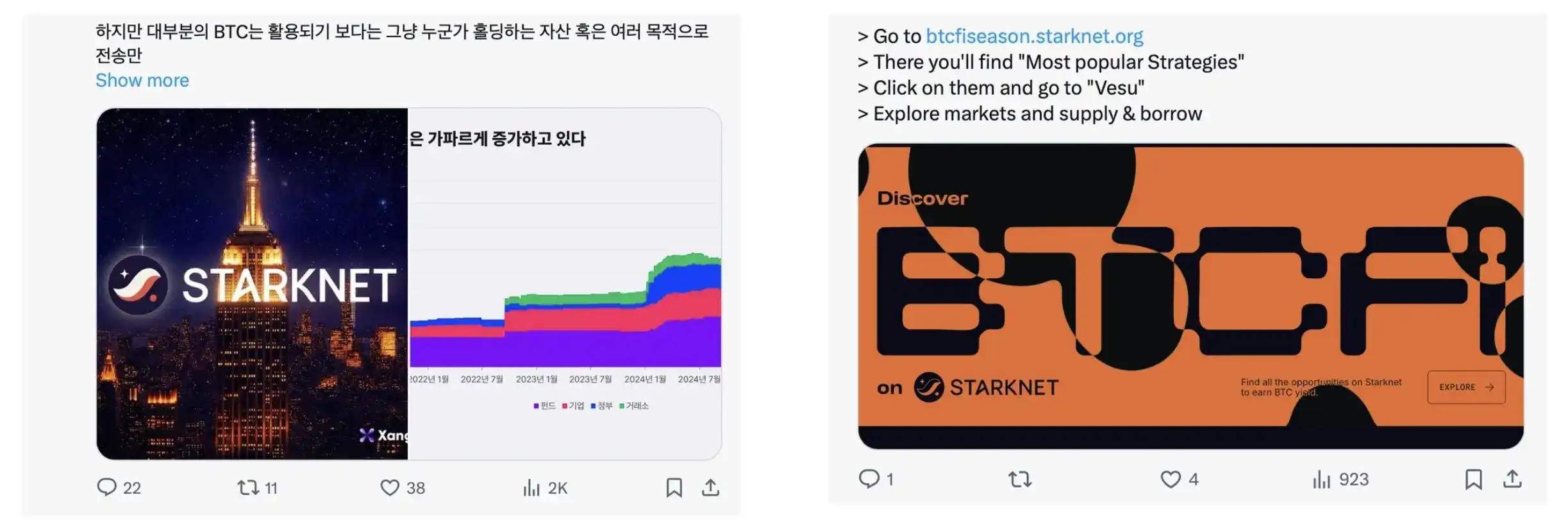
For the record, I don't know who was responsible for managing this campaign, nor whether any agency was involved. I am merely providing some thoughts from an outsider's perspective, from a marketer's point of view.

One problem is obvious throughout the promotion: the screening of creators participating in the promotion is weak.

X is essentially a perception layer. Ideally, creator promotions on X should bring:

  • More discussion about the brand
  • Trigger more voluntary posts from independent creators
  • Drive the production of more community content
  • Stronger ecosystem activation

But is that what we see? Not really.

If you use simple filtering conditions on X to view popular posts mentioning Starknet in February, the results are obvious.
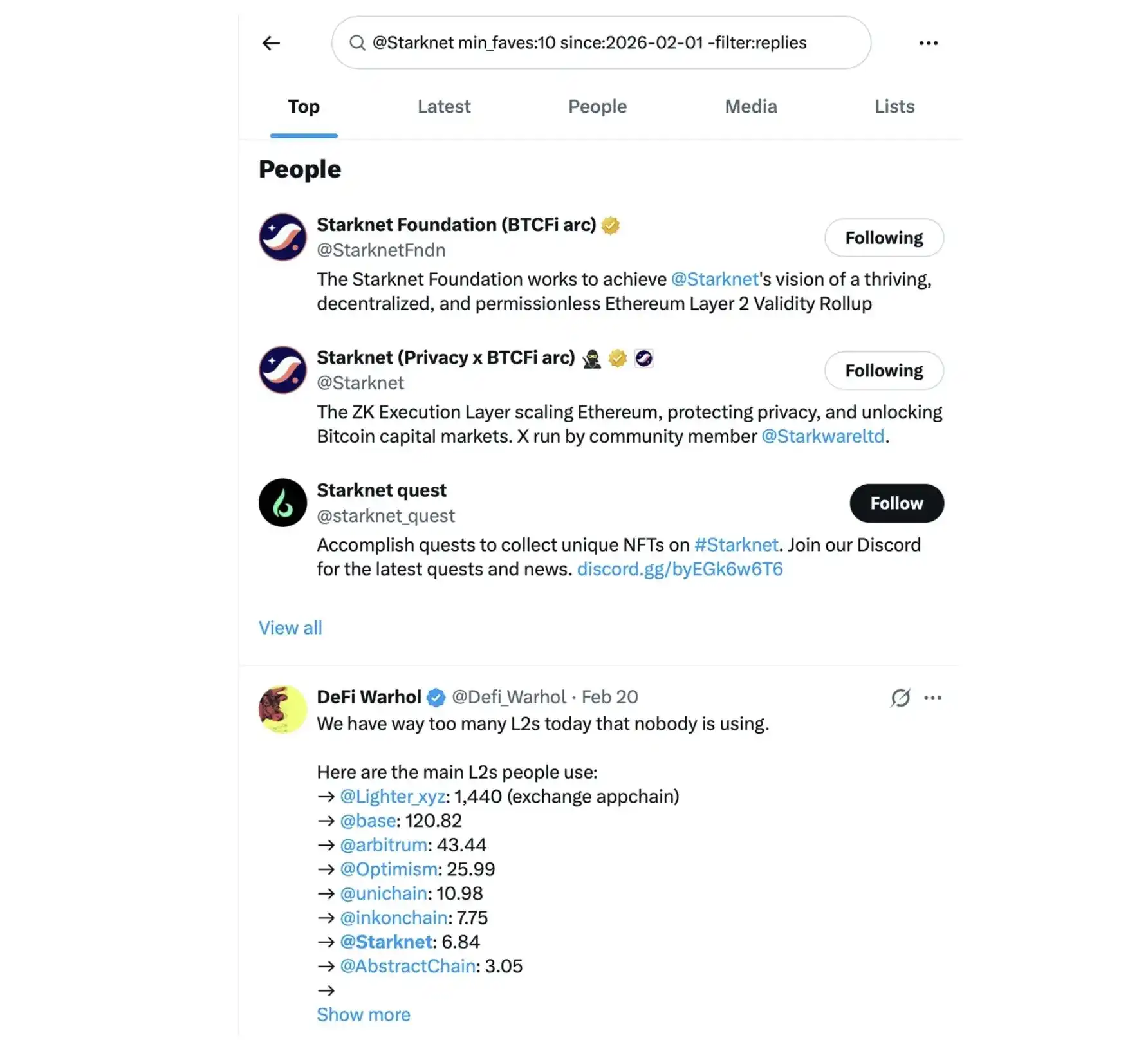
The most mentioned post was actually from Warhol. Overall, in February, only a little over 100 independent posts mentioning Starknet received more than 10 likes. For a well-known L2 ecosystem, this number is not high.

Some popular organic mentions of Starknet included:

  • Mookie's post about token unlocks (approx. 10k views)
  • Warhol's post about the best internship brands in the crypto industry (approx. 16k views)
  • Warhol's L2 rating list (approx. 30k views)
  • santiment's post ranking L2s by developer activity (approx. 50k views)
  • mztacat's post about the "Big Four companies" (approx. 82k views)

The above roughly constitutes Starknet's mention volume on Platform X in February. This leads to a more important question, not just concerning Starknet, but concerning the fact that the classic Web3 marketing strategy is gradually failing on Platform X.

Why is the classic Web3 advertising strategy failing?

For years, the default mode of Web3 marketing has been this: Announcement -> KOL promotion -> Community discussion.

This classic model worked when X's timeline was less crowded, narratives were strong, and most promotions were not easily identifiable as paid promotions. But it started failing after the following changes occurred.

Paid disclosure kills implicit virality

Once creators started adding paid disclosure information, this promotion model became obvious to followers.

First, users see an announcement, then within the next 24 hours, 5-10 similar promotional posts appear, all with largely identical content. Users can immediately recognize this structure. It doesn't trigger community discussion; instead, it sends a signal that "this is an ad campaign."

In the environment of Crypto Twitter, ads rarely spark community discussion; they are usually just scrolled past.

KOL behavior is now very easy to identify

Crypto Twitter has matured; people understand how KOL marketing works.

When the same group of creators quotes the same announcement with slightly different wording, it's easily interpreted as a coordinated promotion. And once KOL content is clearly identified as a promotion, user engagement drops because the audience switches from curiosity mode to ad-filtering mode.

X rewards buzz, not announcements

X is not a distribution channel; it's a narrative space. Unless a Web3 project's announcement can trigger the following, they rarely become trending topics:

  • Arguments and debates
  • Meme coins
  • Hot takes
  • Competition between KOLs

Without these dynamic factors, dissemination can only bring brief user reach but cannot truly win users' minds. Therefore, to truly gain buzz, Web3 projects should change the sequence of their marketing campaigns.

The old promotion flow was: Announcement -> KOL promotion -> Community discussion. The new promotion structure should be: First build the topic -> Spark creator debate -> Generate community content -> Finally announce, so the announcement becomes the final confirmation moment, not the starting point.

If the project skips the narrative stage, promotion has nothing to build on.

How to redesign a promotion campaign for Starknet

Let's get back to reality. Starknet carries heavy baggage. The previous airdrop phase triggered a lot of fear, uncertainty, and doubt. Explanations and promotional videos alone cannot solve this problem; the project needs to control the conversation to resolve it. Different goals also require different marketing strategies.

If the goal is to win mindshare

The strategy should be to actively engage in controversy. Don't try to suppress critics; design topics that can spark debate.

For example:

  • "Which L2 is better for developing BTCFi?"
  • "Ethereum L2 vs Bitcoin L2"
  • "Top 5 ecosystems for BTCFi developers"

Then sponsor posts related to ranking lists, posts comparing Starknet with other projects, and posts with debates. Maybe half the timeline will support Starknet, and the other half will attack Starknet, but both sides increase exposure. Creating drama is not bad marketing; marketing that goes unnoticed is bad.

If the goal is to dominate the narrative

Then stop publishing lengthy PR articles; few people read them. Instead, publish visual infographics, ecosystem maps, competitor comparisons, and short frameworks that KOLs can reuse. Giving creators space to remix content is far more powerful than content they can only quote.

The goal of dominating the narrative is not one good article, but dozens of derivative articles. This is how narratives spread.

If the goal is to attract developers

Then remember that developer acquisition is a B2B model. Posting announcements on X is not effective for developer onboarding. What projects should do is:

  • Build topic momentum
  • Build ecosystem prestige
  • Showcase developers who have already found success there

Once this trend forms, onboarding developers becomes much easier. Because developers also chase hotspots.

Conclusion

The traditional Web3 promotion model (Announcement -> KOL promotion) is dying on X. The new model is more like: Design the topic -> Spark creator interest -> Trigger discussion -> Let the community run with it.

The project's announcement is still important, but it should no longer be the beginning of the promotion campaign; it should be the end point.


Related Questions

QAccording to the article, why is the classic Web3 marketing strategy of 'announcement → KOL promotion' no longer effective on platform X?

AThe strategy is no longer effective due to several key changes: paid disclosure labels make the promotional nature obvious to users, the coordinated posting by KOLs is easily recognized as a campaign, and the X platform's algorithm rewards engaging topics and drama rather than simple announcements.

QWhat does the author suggest is the new, more effective structure for a marketing campaign on X?

AThe author suggests the new structure should be: design a debatable topic → spark creator debate → generate community content → and finally, publish the official announcement as the confirmation point, not the starting point.

QWhat was identified as a major problem with Starknet's recent promotional campaign on X?

AA major problem was the weak vetting of the creators involved in the promotion, which failed to generate significant independent discussion, community content, or ecosystem activation.

QWhat specific type of content does the author recommend creating to dominate public opinion, instead of long PR articles?

AThe author recommends creating visual infographics, ecosystem maps, competitor comparisons, and short, reusable frameworks that creators can easily remix and build upon, leading to dozens of derivative posts.

QFor the goal of attracting developers, what does the article say is more effective than making announcements on X?

AFor attracting developers, it is more effective to build topic momentum, create ecosystem prestige, and showcase developers who have already found success on the platform, as developer acquisition is a B2B process that follows trends.

Related Reads

As Consensus Accelerates, What Are Young Investors Betting On?

Title: As Consensus Forms Faster, What Are Young Investors Betting On? In the rapid evolution of tech investment, a new generation of young investors is navigating a landscape where AI, robotics, commercial aerospace, and quantum computing are advancing simultaneously. Traditional investment logic based on financial models is giving way to a need for deep technical understanding and the ability to act before industry consensus forms. An analysis of trends from the "WAIC FUTURE TECH" list of young investment leaders reveals key shifts in focus. The first major trend is the movement of AI from the digital screen into the physical world. Investment is shifting from large language models and chatbots towards embodied AI, robotics, AI hardware, and edge computing. While demonstrations generate excitement, the real challenge lies in achieving scalable, reliable, and cost-effective delivery in complex real-world environments like factories and logistics. Success depends not just on algorithms but on the integration of sensors, actuators, and control systems. Second, the competitive focus for large models is moving beyond raw capability toward building an "intelligence flywheel." The goal is to create self-reinforcing systems where user interaction generates data, improving the model, which in turn enhances the user experience and attracts more engagement. Companies that successfully embed AI into workflows to create these closed-loop systems can build lasting value that isn't easily erased by the next model upgrade. Third, facing a potential bottleneck in high-quality human-generated data, investors are looking at new underlying technologies. Reinforcement learning and self-play, as demonstrated by AlphaGo Zero, offer paths for AI to generate its own experience. Scientific foundation models, which aim to build general AI capabilities for fields like life sciences and materials discovery, represent a non-consensus direction that could unlock new frontiers of knowledge and data. Finally, in deep-tech areas like quantum computing, commercial aerospace, and space-based infrastructure, patient capital is essential. These fields have long, uncertain development and validation cycles involving complex engineering, supply chains, and regulations. Investment here requires a long-term view, focusing on foundational team capabilities and the eventual emergence of market demand, even if commercial returns are distant. Collectively, these trends illustrate how young investors are adapting to a new era. They are learning to make earlier, technically-informed judgments, balance hype with real-world viability, and provide the patient capital needed to build the deep-tech foundations of the future.

marsbit23m ago

As Consensus Accelerates, What Are Young Investors Betting On?

marsbit23m ago

Can Japan Buy Growth with AI? Will the Bond Market Believe It?

Japan's cabinet has introduced the 2026 Basic Policy on Economic and Fiscal Management and Reform, shifting its primary fiscal target. The new framework moves away from the traditional annual primary balance goal and instead prioritizes a stable reduction of the debt-to-GDP ratio. This change is tied to a strategy of increased "responsible proactive fiscal" spending, aiming to boost long-term growth through investments in strategic sectors like AI, semiconductors, energy, and robotics. The government estimates total public and private investment in 62 key technologies could exceed 370 trillion yen by 2040. The market reaction has been mixed and cautious. While equity markets may respond to policy signals, bond markets are focused on fiscal credibility. Concerns center on whether the weakening of the clear primary balance anchor could lead to looser fiscal discipline. If investors doubt that these strategic investments will generate sufficient productivity gains, tax revenue, and nominal growth to outpace rising interest costs, they may demand higher yields on Japanese Government Bonds (JGBs). Recent volatility in the yen and JGB yields, with the 10-year yield briefly reaching 2.9%, reflects this skepticism. The success of this new framework hinges on two factors: whether Japan can achieve a nominal growth rate consistently higher than its long-term interest rates, and whether future budgets demonstrate disciplined control over bond issuance. The government's narrative is that strategic investment is essential to break Japan's cycle of low growth, aging, and labor shortages. However, the bond market will continuously assess the credibility of this plan, pricing the risk that it may represent fiscal expansion rather than a viable growth strategy.

marsbit1h ago

Can Japan Buy Growth with AI? Will the Bond Market Believe It?

marsbit1h ago

Misjudged A-Shares: Resilience, Expectations, and Confidence

China's A-share market recently faced selling pressure, especially in tech sectors, initially triggered by a global tech sell-off that began in South Korea. However, the article argues this is a case of "mistaken injury" and highlights the market's underlying resilience. This resilience stems from three main pillars: **1) Tech Sector Fundamentals:** Unlike Korea's market dominated by a few memory chip stocks, China's tech sector is diversified across computing, communications, electronics, and semiconductors, supported by dual narratives of global AI supply chains and domestic substitution. Core areas like optical modules and fiber optics continue to show strong earnings growth. **2) "National Team" Support:** State-backed institutions and large corporations have made significant market purchases and announced buybacks, providing liquidity and signaling confidence. This is seen as a stabilizing policy signal, often associated with market bottoms. **3) Broader Market Pillars:** Other major sectors are showing endogenous recovery momentum. Consumer stocks benefit from stabilizing CPI and signs of sector recovery (e.g., liquor price hikes). Cyclical sectors like aluminum have high earnings, potential price increases due to tight supply, and low valuations. The financial sector offers stable dividends and low valuations. The conclusion is that the sell-off was driven by external contagion, not a collapse in fundamentals. With strong policy support and recovering momentum across key sectors, the A-share market possesses the toughness to regain stability.

marsbit1h ago

Misjudged A-Shares: Resilience, Expectations, and Confidence

marsbit1h ago

Trading

Spot
活动图片




