Web3 Social: Still Dominated by the Chinese

marsbitPublished on 2026-01-22Last updated on 2026-01-22

Abstract

In a span of two days, two major decentralized social protocols, Lens Protocol and Farcaster, changed ownership. Lens was taken over by Mask Network, led by Chinese founder Suji Yan, while Farcaster was acquired by Neynar, one of its clients. Combined, these protocols had raised over $200 million, with Farcaster valued at $1 billion last year. This follows the earlier acquisition of Steem by Tron’s Justin Sun in 2020, meaning two out of three prominent decentralized social protocols are now been taken over by Chinese-led teams. The author suggests that Western founders often approach decentralized social with idealism—emphasizing user-owned data and censorship resistance—while Chinese acquirers tend to view it as a business opportunity. Both Lens and Farcaster have seen declining engagement, making them attractive targets for pragmatic operators focused on usability rather than ideology. However, past acquisitions like Steem—which led to a community fork—highlight the risks of centralized control over “decentralized” protocols. Mask Network has framed its role as “stewardship” rather than outright ownership, but the very idea of a “decentralized” protocol being acquired raises questions about how much these platforms are truly user-governed. Ultimately, the piece questions whether these acquisitions will lead to a more practical and widely adopted social web or simply repeat past conflicts between idealism and commercial reality.

Written by: David, TechFlow

Within two days, two decentralized social protocols changed hands.

On January 20th, Lens Protocol announced it was being taken over by Mask Network. On January 21st, Farcaster announced it was acquired by Neynar, one of its clients.

These two protocols have raised over $200 million combined. Farcaster was valued at $1 billion last year, with investors including a16z and Paradigm. Lens is backed by DeFi giant Aave.

Now, the founders have "stepped back from day-to-day operations to work on new projects."
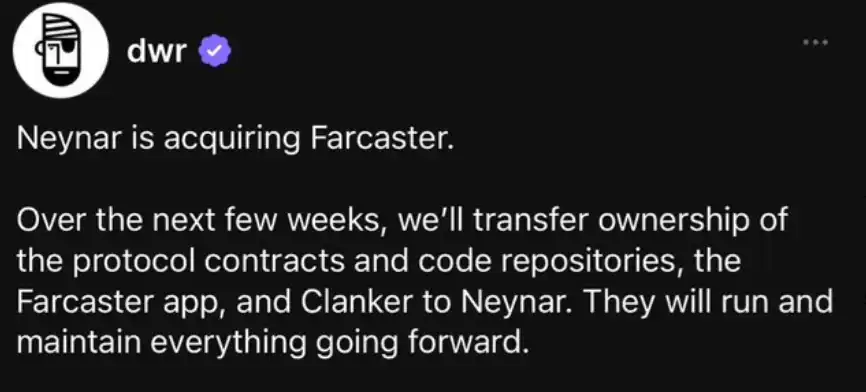
Including Steem, another high-profile project acquired by Tron in 2020, two out of these three phenomenal decentralized social protocols have been taken over by Chinese teams.

You might have forgotten about Steem. It was the pioneer of "writing to earn" launched in 2016, a benchmark project for the entire Web3 social track at its peak. After being acquired by Justin Sun, the community forked and left, but more on that later.

The Mask Network taking over Lens was founded by Suji Yan. Chinese, dropped out of UIUC at 20 to start a business, previously wrote articles for Caixin and Jiemian.

Founded Mask in 2017, focusing on overlaying Web3 features on traditional social platforms like Twitter.

Mask has been on an acquisition spree: acquired two large Japanese instances of Mastodon in 2022, bought Orb, the most active client on Lens, last year, and now has taken over Lens itself.

Suji Yan positions himself as the "Tencent of Web3".

On the Farcaster side, the acquiring Neynar was founded by two Indian-origin former Coinbase employees. But the reality that two out of three protocols were taken over by Chinese teams still holds.

Why the Chinese?

One possible explanation is capability endowment. The two most successful countries globally in making social products are the US and China. WeChat, Douyin (TikTok), Xiaohongshu (Little Red Book) – Chinese teams have proven they can build social platforms for billions of users.

But this explanation has a problem. Building products and acquiring protocols are not the same. Protocols are infrastructure, not directly facing users. You can build products on them, but the protocol itself doesn't generate the user experience.

Another reasonable explanation is price.

Looking at Brother Sun's (Justin Sun) acquisition list: bought BitTorrent for $140 million in 2018, Poloniex in 2019, Steemit in 2020, and HTX in 2022.

These targets have a common trait:

They were all once glorious but are on a downward trend. BitTorrent was the pioneer of P2P downloads, Poloniex was once a top US exchange, HTX was once one of China's top three exchanges.

Justin Sun isn't buying the best; he's buying the cheapest good stuff.

Now Farcaster is valued at $1 billion but its monthly revenue has dropped to $10,000, down over 95% year-over-year. Founder Dan Romero admitted last month in a post that "tried the social-first approach for 4.5 years, didn't succeed";

Lens has only 50,000 monthly active users, and the Aave team wants to offload it to focus on its core DeFi business.

The most valuable time for these protocols has passed, but the technical foundation and brand remain. In A-share market terms, this is called:

Fallen out of value.

There's a more subtle line of thought: decentralized social is a belief in the West, but a business in China.

Western founders in this space often carry idealism. Users should own their data, social graphs should be portable, platforms shouldn't have censorship power... Farcaster's slogan is "sufficiently decentralized", Lens's is "user-owned social".

But after five years, users don't care.

Ordinary people don't care who owns the data, or if the social graph is portable. They care if there are people to chat with, if there is interesting content, if there are associated assets that can skyrocket.

Chinese buyers taking over, to some extent, is taking this business from the idealists and handing it to the pragmatists.

Suji Yan says Mask's goal is to "bring decentralized social from the lab into daily life". Translating that:

Stop talking about ideals, first make people want to use it.

Of course, the last time a Chinese entity acquired a decentralized social protocol, the outcome wasn't pretty.

In 2020, Justin Sun acquired Steem. After the acquisition, he collaborated with exchanges to take control of Steem's network governance. The original community's reaction was a collective fork to create a new chain, Hive, using code to exclude Justin Sun's wallet.
A fork is the most extreme form of protest in the blockchain world – we're not playing with you anymore, we'll copy everything and leave.

Steemit is still running, but most active users moved to Hive long ago.

So the question is, will it be different this time?

Mask taking over Lens is officially termed "stewardship" in Chinese, meaning caretaker or custodian, not the word acquisition. The founder will continue as an advisor, and the protocol remains open.

But the fact that a "decentralized protocol" can be acquired itself says something. Contracts can be transferred, codebases can be transferred, Apps can be transferred. So where is the "decentralization"?

After the disenchantment, decentralization is just a technical architecture, not a business model. Technically decentralized doesn't prevent someone from calling the shots commercially.

After the change of leadership at Lens, Vitalik posted. He said every post he made in 2026 was through Firefly, which is precisely the multi-platform client under Mask Network.

He also said: "If we want a better society, we need better tools for mass communication."

That's true. But who builds this tool, who operates it, who decides what it looks like – decentralization doesn't answer these questions.

The answer now might be the Chinese will build it.

Then again, maybe nothing will happen. After all, there aren't many active users left.

Related Questions

QWhat are the two decentralized social protocols that changed ownership within two days, as mentioned in the article?

ALens Protocol and Farcaster.

QWhich Chinese company took over Lens Protocol, and what is its founder's background?

AMask Network took over Lens Protocol. Its founder, Suji Yan, is Chinese, dropped out of UIUC at age 20, and previously wrote articles for Caixin and Jiemian.

QWhat is one possible reason suggested in the article for why Chinese teams are acquiring these protocols?

AOne reason is price, as these protocols have declined in value but still retain technical foundations and brand recognition, making them affordable acquisitions with potential.

QHow did the Steem community react when it was acquired by Justin Sun in 2020?

AThe Steem community forked the chain to create Hive, effectively excluding Justin Sun's wallet and moving active users away from Steemit.

QWhat does the article suggest is the key mindset difference between Western founders and Chinese acquirers regarding decentralized social protocols?

AWestern founders often approach it with idealism (e.g., user-owned data, anti-censorship), while Chinese acquirers view it as a practical business, focusing on usability and adoption rather than ideological goals.

Related Reads

U.S. Stock Market Trend: Nasdaq Plunges 3.5% Intraday Before a Remarkable Recovery, All Eyes on CPI Tomorrow

"US Stock Market Trends: Nasdaq Plunges 3.5% Before Dramatic Recovery, Eyes on Tomorrow's CPI" On Tuesday, US markets experienced a wild swing. The Nasdaq initially surged nearly 0.7% before plummeting to a 3.5% intraday loss following a post by Donald Trump on Truth Social. He stated that Iran had shot down a US Apache helicopter in the Strait of Hormuz and that the US "must...respond." The index, however, staged a remarkable recovery in the final two hours, closing down only 0.97%, as subsequent remarks from Trump and Vice President Vance suggested a potential Iran deal within days. The S&P 500 fell 0.26%, while the Dow Jones gained 0.17%, supported by its non-tech components. This incident marked the first loss of a US military asset since tensions with Iran escalated in late February. Despite the event, crude oil prices fell sharply (WTI -3.93%) due to expectations of a near-term deal, OPEC+ plans to increase output, and fears that strong jobs data could lead to Fed rate hikes. Market attention is now laser-focused on the May CPI data release Wednesday morning. This report is seen as critical evidence for whether hot job growth is fueling inflation and will heavily influence expectations for the Federal Reserve's upcoming meeting. A hotter-than-expected reading could trigger further sell-offs, particularly in tech, while a cooler print could spark a significant rebound. The article notes a clear sector rotation, with money flowing out of tech (Nasdaq down over 5% in a week) into defensive sectors like healthcare and consumer staples. Other assets like gold and Bitcoin also remain under pressure. The overarching sentiment is one of "war fatigue," with markets desperately awaiting concrete results from the prolonged Iran negotiations rather than reacting to each new headline.

marsbit5m ago

U.S. Stock Market Trend: Nasdaq Plunges 3.5% Intraday Before a Remarkable Recovery, All Eyes on CPI Tomorrow

marsbit5m ago

Second Only to GPUs and Memory: MLCCs Are Becoming the Next Billion-Dollar Windfall for AI Computing Power

After GPU and memory, MLCC (Multi-Layer Ceramic Capacitors) is emerging as the next critical component in AI compute, potentially a multi-billion-dollar market. The article highlights a significant, industry-wide price increase for MLCCs, driven not by inventory cycles but by a fundamental, structural demand surge from AI and automotive sectors. AI servers require exponentially more MLCCs than traditional servers—from 2,000 to over 350,000 units per high-end AI rack—primarily to stabilize power for increasingly powerful, low-voltage GPUs. A key AI server's MLCC cost can reach thousands of dollars, making it the third-largest cost component after GPUs and memory. This demand is compounded by the automotive shift to EVs and advanced ADAS. Supply, however, struggles to keep up. Manufacturing high-end MLCCs involves extreme precision and faces six major barriers: proprietary technology, long customer certification cycles (12-18 months for AI), high capital intensity, patent thickets, specialized talent, and massive scale. Industry capacity grows at only ~10% annually, creating a persistent supply-demand gap projected to last until 2030. Three companies dominate this high-end market. **Murata** (40% global share) is the stable leader. **Samsung Electro-Mechanics** offers the highest growth elasticity with aggressive expansion. **Taiyo Yuden** is the purest MLCC play. While their current P/E ratios appear high, they are expected to compress rapidly as earnings surge, powered by significant pricing power and operational leverage. Key risks include a potential slowdown in AI capex, high valuations, competition from Chinese manufacturers in lower tiers, yen appreciation, and consumer electronics weakness. The article concludes that MLCCs are transforming from a commoditized component into a strategic, capacity-constrained asset essential for the AI-powered future.

marsbit35m ago

Second Only to GPUs and Memory: MLCCs Are Becoming the Next Billion-Dollar Windfall for AI Computing Power

marsbit35m ago

The First to Bring an AI OS to 1.4 Billion People Might Actually Be WeChat?

WeChat has introduced a significant AI update, allowing mini-program developers to integrate their services with WeChat AI. Developers can choose an "automatic mode," where WeChat AI autonomously analyzes and operates mini-programs without additional coding, or a "development mode" for creating customized skills. This move effectively transforms WeChat's vast ecosystem—including millions of mini-programs, WeChat Pay, and official accounts—into an execution layer for AI. The technical documentation reveals that WeChat's approach aligns with industry standards like MCP (Model Context Protocol) and incorporates practical lessons from AI-agent development. Key design principles include a clear "attention weight" system for API calls and a "fact + action" response structure to ensure reliable operations. Unlike Apple's Siri, which struggles with third-party app integration, WeChat's centralized control over mini-program code provides a "God's-eye view," enabling seamless AI orchestration across services. This development revives the concept of "WeChat OS," where the app could function as a natural-language-operated platform for daily tasks—from booking flights to ordering food—all within a chat interface. While challenges remain in areas like payment security and user trust, WeChat's existing service network and massive user base position it uniquely to advance AI agents from conversation to actionable assistance, potentially making complex tasks feel effortless for its 1.432 billion monthly active users.

marsbit1h ago

The First to Bring an AI OS to 1.4 Billion People Might Actually Be WeChat?

marsbit1h ago

Trading

Spot
Futures
活动图片