Wall Street goes on-chain: JPMorgan executes landmark debt issuance on Solana

ambcryptoPublished on 2025-12-11Last updated on 2025-12-11

Abstract

J.P. Morgan has executed a landmark $50 million commercial paper issuance for Galaxy Digital on the Solana blockchain, with Coinbase and Franklin Templeton as buyers. This represents one of the first U.S. debt issuances on a public blockchain, signaling growing institutional adoption of open networks. The transaction was settled entirely in USDC, highlighting Solana’s capability to support high-throughput, low-cost institutional settlements. The move underscores a shift toward tokenized real-world assets and positions Solana as a leading infrastructure for next-generation capital markets.

J.P. Morgan has completed one of the first-ever U.S. commercial paper issuances on a public blockchain — and it chose the Solana network to do it.

The bank arranged a U.S. Commercial Paper [USCP] issuance for Galaxy Digital Holdings LP, with Coinbase and Franklin Templeton purchasing the tokenized security.

The move marks one of the earliest debt issuances executed on a public blockchain and a major milestone in the institutional adoption of open networks.

The official publication didn’t mention the value of the issuance, but Reuters reported that it’s worth $50 million.

“This trade demonstrates institutional appetite for digital assets and our capability to securely bring new instruments on-chain using Solana,”

said Scott Lucas, Head of Markets Digital Assets at J.P. Morgan.

Why Solana? Data shows a network ready for institutions

Solana has spent most of 2025 building a compelling case for enterprise-level finance. According to DeFiLlama data, Solana’s TVL and transaction activity have climbed steadily throughout the year, even as volatility hit broader crypto markets.

The chart shows:

  • TVL rising from ~$6B at the start of 2025 toward ~$10–12B mid-year
  • Transaction counts remaining consistently high
  • A clear upward shift into Q4, coinciding with growing institutional experimentation

For a bank like JPMorgan, which requires throughput, cost efficiency, and deterministic settlement, Solana offers the lowest-latency public infrastructure currently available.

This issuance confirms that the chain is now being utilized for real-world financial instruments, not just crypto-native activities.

USDC settlement, tokenized debt, and a new playbook for money markets

J.P. Morgan not only created the USCP token but also facilitated on-chain delivery-versus-payment settlement.

Crucially, both issuance and redemption are settled directly in USDC, which is issued by Circle.

The bank emphasized the significance of this design:

“Both the issuance and redemption proceeds will be paid in USDC stablecoins issued by Circle, representing another market first for the USCP market.”

For Galaxy, this marks its first-ever commercial paper issuance — now executed entirely on a public blockchain.

Galaxy’s Jason Urban said:

“This issuance is a clear example of how public blockchains can improve the way capital markets operate.”

He added:

“We’re putting into practice the model we’ve long believed in: open, programmable infrastructure that supports institutional-grade financial products.”

Franklin Templeton echoed the same shift:

“We’ve entered a new era where institutions are no longer just experimenting with blockchain — we’re transacting on it in a big way.”

A watershed moment for public blockchains

JPMorgan’s decision to use Solana — instead of a permissioned or private chain — signals a turning point in institutional confidence.

With stablecoin settlement, tokenized money-market instruments, and support from global asset managers, the deal positions Solana as a foundation layer for next-generation capital markets.


Final Thoughts

  • JPMorgan’s $50M pilot on Solana signals that public blockchains are entering mainstream capital-markets infrastructure, not just crypto-native use cases.
  • If more issuers adopt tokenized debt, Solana could become a preferred platform for high-throughput institutional settlement, accelerating the RWA narrative heading into 2026.


Trending Cryptos

Related Reads

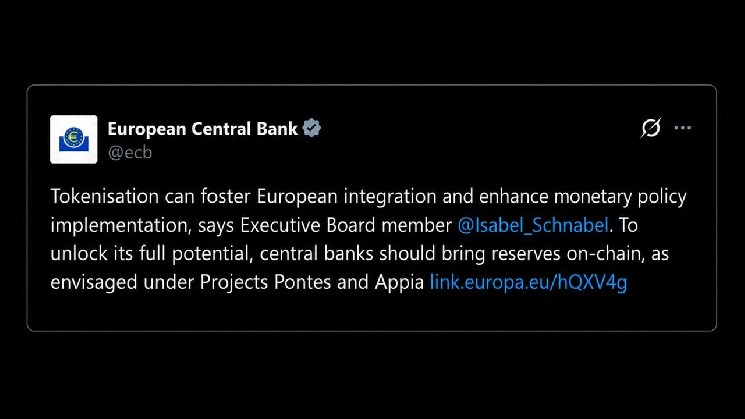
ECB's Schnabel says central bank money 'should move to blockchain'

ECB Executive Board member Isabel Schnabel stated that central bank money "must move onto the blockchain." She argued that stablecoins lack the independent ability to scale liquidity during financial stress—a gap only a central bank can fill. Her proposed solution involves tokenization, which she says can make transactions faster, safer, and more programmable, but only if the safest asset (central bank money) is on the same "rails" as other tokenized assets. This marks a notable shift for the Eurosystem, which had previously viewed Distributed Ledger Technology (DLT) mainly as a tool for regulating stablecoins and crypto, not as infrastructure to adopt directly. The first step is Project Pontes, launching in September. It will initially synchronize the ECB’s existing TARGET services with private DLT platforms. Eventually, it aims to enable settlement finality on a Eurosystem-managed DLT platform with smart contract functionality and 24/7 operation. The long-term strategy is Project Appia, tasked with developing the architecture, standards, and legal framework for a genuine European tokenized asset market by 2028. Trials have already processed around €1.6 billion, and since March 2026, the ECB accepts DLT-based assets as collateral. While not directly impacting Bitcoin's price, these developments signal that a major G7 central bank is preparing to settle transactions on-chain, lending legitimacy to the underlying infrastructure of crypto markets. The ECB's move to avoid "disintermediation" by private tokenization shows that debates in central bank boardrooms are now aligning with discussions long followed in the crypto space.

cryptonews.ru13m ago

ECB's Schnabel says central bank money 'should move to blockchain'

cryptonews.ru13m ago

Ripple Labs Warns of a New Challenge for Blockchains

Ripple Labs is preparing the XRP Ledger for quantum threats but now emphasizes a broader challenge: ensuring financial infrastructure can adapt simultaneously to quantum computing and artificial intelligence. Senior Director of Engineering Ayo Akinyele states the goal is not merely anticipating a "Q-Day" but building infrastructure capable of preemptively adopting new security mechanisms without network disruption. The shift to post-quantum cryptography involves more than swapping algorithms; it requires flexible infrastructure, improved key management, and clear upgrade paths. Financial systems were not designed with quantum computers in mind, necessitating a rethink of transaction, identity, asset, and data protection. This is underscored by significant investments, such as the $2 billion U.S.-IBM quantum factory initiative and a 2030 U.S. government mandate for post-quantum cryptography adoption. AI introduces distinct risks by driving automation and autonomous economic activity, increasing demand for an always-on, internet-oriented payment infrastructure. AI agents could soon conduct transactions independently, creating new security requirements. Ripple Labs advocates for proactive, orderly preparation rather than a crisis-driven transition, having outlined a four-phase strategy aiming for a full XRP Ledger transition by 2028, now expanded to address both quantum and AI-driven challenges.

cryptonews.ru13m ago

Ripple Labs Warns of a New Challenge for Blockchains

cryptonews.ru13m ago

Trading

Spot

Hot Articles

Discussions

Welcome to the HTX Community. Here, you can stay informed about the latest platform developments and gain access to professional market insights. Users' opinions on the price of SOL (SOL) are presented below.

活动图片