Visa Revelation: The 50-Year Cycle of Stablecoin 'Fragmentation Dilemma'

marsbitPublished on 2026-01-15Last updated on 2026-01-15

Abstract

In the 1960s, the credit card industry was fragmented networks with limited interoperability. Visa succeeded not just through technology, but by creating a cooperative structure that unified banks under a shared network, aligning incentives, distributing ownership, and enabling compound network effects. It operated as a neutral third party, granted members profit shares and governance rights, and enforced exclusivity to consolidate growth. Today, stablecoins face a similar fragmentation issue, with over 300 stablecoins listed on Defillama, each confined to its own ecosystem, limiting network effects and liquidity. Services like Anchorage Digital and Ethena enable new issuers to create stablecoins, but this exacerbates fragmentation rather than solving it. The solution lies in adopting a Visa-like model: a neutral, cooperative structure where issuers and protocols unite under a single stablecoin standard. Members would share reserve yields and participate in governance, fostering widespread adoption and retaining value within the network instead of fragmenting liquidity. This approach could drive the mainstream integration stablecoins need.

Original Author: Nishil Jain

Original Compilation: Block unicorn

Preface

In the 1960s, the credit card industry was in chaos. Banks across the United States were trying to establish their own payment networks, but each network operated independently. If you held a Bank of America credit card, you could only use it at merchants that had a cooperation agreement with Bank of America. And when banks tried to expand their business to other banks, all credit card payments encountered the problem of inter-bank settlement.

If a merchant accepted a card issued by another bank, the transaction had to be settled through its original check settlement system. The more banks that joined, the more settlement problems arose.

Then Visa emerged. Although the technology it introduced undoubtedly played a huge role in the bank card payment revolution, the more important key to its success was its global universality and its success in getting global banks to join its network. Today, almost every bank in the world has become a member of the Visa network.

While this seems very normal today, imagine trying to convince the first thousand banks, both inside and outside the United States, that joining a cooperation agreement instead of building their own network was a wise move, and you begin to realize the scale of this endeavor.

By 1980, Visa had become the dominant payment network, processing about 60% of credit card transactions in the United States. Currently, Visa operates in more than 200 countries.

The key was not more advanced technology or more capital, but structure: a model that could coordinate incentives, decentralize ownership, and create compound network effects.

Today, stablecoins face the same fragmentation problem. And the solution may be exactly the same as what Visa did fifty years ago.

Pre-Visa Experiments

Other companies that appeared before Visa failed to develop.

American Express (AMEX) tried to expand its credit card business as an independent bank, but its scale expansion was limited to continuously adding new merchants to its bank network. On the other hand, BankAmericard was different; Bank of America owned its credit card network, and other banks only leveraged its network effects and brand value.

American Express had to approach each merchant and user individually to open their bank accounts; whereas Visa achieved scale by accepting banks itself. Every bank that joined the Visa cooperative network automatically gained thousands of new customers and hundreds of new merchants.

On the other hand, BankAmericard had infrastructure problems. They didn't know how to efficiently settle credit card transactions from one consumer bank account to another merchant bank account. There was no efficient settlement system between them.

The more banks that joined, the worse this problem became. Thus, Visa was born.

The Four Pillars of Visa's Network Effects

From the story of Visa, we learn about 2-3 important factors that led to the accumulation of its network effects:

Visa benefited from its status as an independent third party. To ensure that no bank felt threatened by competition, Visa was designed as a cooperative independent organization. Visa does not participate in competing for the distribution pie; the banks are the ones competing for the pie.

This incentivized the participating banks to strive for a larger share of the profits. Each bank is entitled to a portion of the total profits, proportional to the total transaction volume it processes.

Banks have a say in network functions. Visa's rules and changes must be voted on by all relevant banks and require 80% approval to pass.

Visa had exclusivity clauses with each bank (at least initially); anyone joining the cooperative could only use Visa cards and the network, and could not join other networks—therefore, to interact with a Visa bank, you also needed to be part of its network.

When Visa's founder, Dee Hock, lobbied banks across the United States to join the Visa network, he had to explain to each bank that joining the Visa network was more beneficial than building their own credit card network.
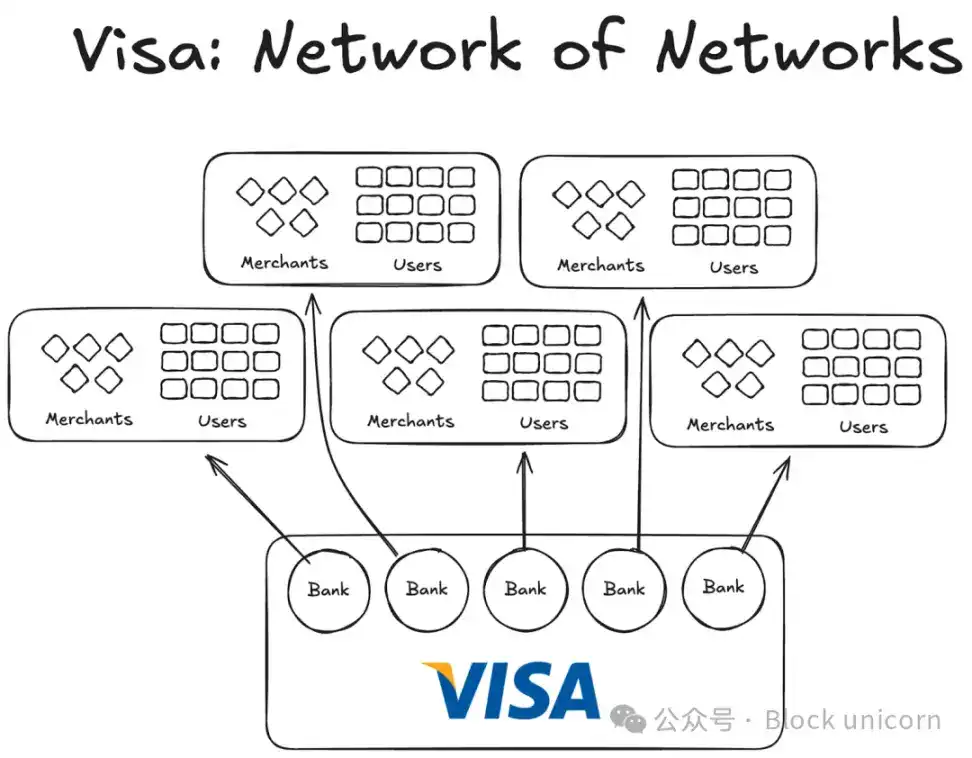
He had to explain that joining Visa meant more users and more merchants would be connected to the same network, which would facilitate more digital transactions globally and bring more benefits to all participants. He also had to explain that if they built their own credit card network, their user base would be very limited.

Implications for Stablecoins

In a sense, Anchorage Digital and other companies now offering stablecoin-as-a-service are replaying the BankAmericard story in the stablecoin space. They provide the underlying infrastructure for new issuers to build stablecoins, while liquidity continues to fragment into new tokens.

Currently, there are over 300 stablecoins listed on Defillama. Moreover, each newly created stablecoin is limited to its own ecosystem. Therefore, no single stablecoin can generate the network effects needed to go mainstream.

Since the same underlying assets back these new coins, why do we need more coins with new code?

In our Visa story, these are like BankAmericards. Ethena, Anchorage Digital, M0, or Bridge—each allows a protocol to issue its own stablecoin, but this only exacerbates industry fragmentation.

Ethena is another similar protocol that allows yield pass-through and white-label customization of its stablecoin. Just like MegaETH issuing USDm—they issued USDm through tools that support USDtb.

However, this model failed. It only fragments the ecosystem.

In the credit card case, the brand differences between banks were not important because it did not create any friction in user-to-merchant payments. The underlying issuance and payment layer was always Visa.

However, for stablecoins, this is not the case. Different token codes mean an infinite number of liquidity pools.

Merchants (or in this case, applications or protocols) will not add all stablecoins issued by M0 or Bridge to their list of accepted stablecoins. They will decide whether to accept them based on the liquidity of these stablecoins in the open market; the coins with the most holders and the strongest liquidity should be accepted, the others will not.

The Way Forward: The Visa Model for Stablecoins

We need independent third-party institutions to manage stablecoins for different asset classes. Issuers and applications supporting these assets should be able to join the cooperative and access reserve earnings. At the same time, they should also have governance rights and be able to vote on the direction of their chosen stablecoin.

From a network effects perspective, this would be a superior model. As more and more issuers and protocols join the same token, it will facilitate the widespread adoption of a token that can retain earnings internally rather than flowing into others' pockets.


Related Questions

QWhat was the main problem with the credit card industry in the 1960s that Visa solved?

AThe main problem was fragmentation, where each bank had its own payment network, leading to interoperability issues and inefficient interbank settlements. Visa created a universal network that allowed banks to cooperate, solving the settlement problems and enabling global scalability.

QHow did Visa's cooperative structure differ from competitors like American Express and BankAmericard?

AVisa acted as an independent third-party cooperative, allowing banks to join without competition fears, share profits proportionally, and have voting rights. In contrast, American Express operated as a standalone bank, and BankAmericard was owned by a single bank with infrastructure limitations.

QWhat is the 'fragmentation problem' facing stablecoins today, as described in the article?

AStablecoins face fragmentation due to the proliferation of numerous stablecoins issued by different protocols (e.g., via services like Ethena or Anchorage Digital), each with its own token code and liquidity pool, preventing network effects and universal adoption.

QHow does the article suggest applying Visa's model to solve stablecoin fragmentation?

AIt proposes an independent third-party cooperative model for stablecoins, where issuers and protocols join a shared network, earn reserve yields, and participate in governance, thereby consolidating liquidity and creating compound network effects for a universally accepted stablecoin.

QWhy did the 'stablecoin as a service' model (e.g., by Anchorage Digital) fail to achieve scalability, according to the article?

AIt failed because it perpetuated fragmentation by creating multiple stablecoins with separate liquidity pools, limiting adoption to their own networks rather than enabling universal acceptance, similar to the pre-Visa BankAmericard issue.

Related Reads

The Value Distribution of Stablecoins

**Summary: The Value Distribution of Stablecoins** The article argues that stablecoins are evolving from mere trading tools into broader channels for dollar access. It divides the stablecoin ecosystem into four layers to analyze how value is distributed: 1. **Issuance Layer:** Mints stablecoins, holds reserve assets, and captures the spread between reserve yield and user costs (e.g., Tether, Circle). This layer currently earns the largest profit margin. 2. **Infrastructure Layer:** Connects stablecoins to the traditional financial system, handling fiat on/off-ramps, banking integration, compliance (KYC/AML), and asset management (e.g., Bridge, BVNK). This is the "unglamorous" but critical work, building the essential bridges between crypto and real-world finance. 3. **Acquiring/Distribution Layer:** Integrates stablecoins into merchant systems, manages payment flows, and provides enterprise financial software (e.g., Stripe, Coinbase). They act as the access point for businesses. 4. **Application Layer:** The end-users and businesses that ultimately use stablecoins for payments, settlements, or as a store of value. They benefit from convenience but have little pricing power. The core thesis is that while the issuance layer currently dominates profits, the often-overlooked **infrastructure layer holds significant long-term potential**. The real challenge and barrier to mass adoption is not the on-chain transfer of stablecoins (which is simple), but the complex "last mile" integration into existing business workflows, banking systems, and regulatory frameworks across different countries. Companies in this layer are currently in a "land grab" phase, investing heavily to build networks, secure bank partnerships, and establish compliance pathways. While their position is currently pressured by the profitable issuers above and distribution platforms below, the article suggests that if stablecoins become a default financial rail for businesses, the infrastructure providers who have done the hard work of integration will ultimately gain strong pricing power and become entrenched, essential players.

marsbit5h ago

The Value Distribution of Stablecoins

marsbit5h ago

The Value Distribution of Stablecoins

The Value Distribution of Stablecoins The article argues that stablecoins are evolving from a mere trading tool into a broad "dollar channel." It analyzes the industry's value chain through four layers: 1. **Issuance Layer (e.g., Tether, Circle):** The top layer that mints stablecoins, holds reserve assets, and captures the thickest interest rate spread. 2. **Infrastructure Layer (e.g., Bridge, BVNK):** Connects stablecoins to the traditional financial system, handling critical but complex "dirty work" like fiat on/off-ramps, banking integration, compliance (KYC/AML), and cross-border settlement. 3. **Acquiring/Distribution Layer (e.g., Stripe, Coinbase):** Embeds stablecoins into merchant systems, manages payment flows, and integrates with enterprise software. 4. **Application Layer:** End-users and businesses that ultimately use stablecoins for payments, settlement, or storing value. The author posits that while the issuance layer currently captures the most profit, the most overlooked and potentially critical layer is infrastructure. The core challenge for stablecoin adoption isn't the on-chain transfer (which is simple), but bridging the gap between blockchain and the real-world financial system. This involves solving practical problems for businesses: fiat conversion, reconciliation, tax handling, and user onboarding. Infrastructure companies are currently in a difficult "land-grab" phase—building networks, securing banking relationships, and achieving compliance country-by-country. They face pressure from both the profitable issuance layer above and distribution platforms below. However, the author suggests this layer is building a crucial moat. Once stablecoins become a default business rail, the infrastructure players who have done the hard work of integration may gain significant, durable value and pricing power.

链捕手5h ago

The Value Distribution of Stablecoins

链捕手5h ago

How to Do Research Well: Deliberately Practice the Real Skills That Matter

No one truly teaches you how to do research. You're often given a desk, a pre-selected problem, and vague instructions to "create something new." Consequently, many people reverse-engineer the job based on visible outputs—papers, posts, announcements—learning only how to *appear* like a researcher rather than how to *become* one. True research capability is built from stacking small, trainable skills, nearly all of which can be developed through deliberate practice. **Pick Your Own Problem:** Most researchers absorb problems from advisors or trends, lacking the underlying reasoning. Choosing a problem you genuinely care about, as John Schulman advises, leads to original work. Develop "taste" like a muscle: predict experiment outcomes, guess paper results from methods, and track which findings remain important over time. **Upgrade Your Inputs:** Relying on shared reading lists (arXiv hot lists, filtered group chats) leads to unoriginal conclusions. Undervalued old literature often holds crucial insights (e.g., MoE, LSTM, backpropagation). Richard Sutton's "The Bitter Lesson" or Claude Shannon's 1952 talk on creative thinking are more predictive than lengthy modern surveys. Breadth matters as much as depth: draw from neuroscience, mechanism design, hardware knowledge, and honest statistics. Read papers directly, especially appendices and limitations sections. **Write Everything Down:** As Paul Graham noted, writing exposes flaws in seemingly mature ideas. Writing is the cheapest defense against self-deception. Following Feynman's principle, Darwin programmatically wrote down facts contradicting his theory to combat memory bias. Maintain a detailed log of hypotheses, setups, predictions, results, and updated understandings. Reviewing past logs fosters essential humility.

marsbit7h ago

How to Do Research Well: Deliberately Practice the Real Skills That Matter

marsbit7h ago

Trading

Spot
Futures
活动图片




