US lawmakers propose tax break for small stablecoin payments, staking rewards

cointelegraphPublicado a 2025-12-21Actualizado a 2025-12-21

Resumen

US lawmakers have introduced a discussion draft proposing tax exemptions for small stablecoin payments and deferral options for staking and mining rewards. The bill, introduced by Representatives Max Miller and Steven Horsford, aims to amend the Internal Revenue Code to accommodate the growing use of digital assets in everyday transactions. It would exempt gains or losses on stablecoin transactions under $200, provided the stablecoin is dollar-pegged and issued under the GENIUS Act. Additionally, taxpayers could defer income recognition from staking and mining rewards for up to five years, addressing concerns around "phantom income." The draft also includes anti-abuse measures and extends certain securities rules to digital assets. Meanwhile, crypto industry groups are urging the Senate to reconsider proposed restrictions on stablecoin rewards.

US lawmakers have introduced a discussion draft that would ease the tax burden on everyday crypto users by exempting small stablecoin transactions from capital gains taxes and offering a new deferral option for staking and mining rewards.

The proposal, introduced by Representatives Max Miller of Ohio and Steven Horsford of Nevada, seeks to amend the Internal Revenue Code to reflect the growing use of digital assets in payments. The draft is set “to eliminate low-value gain recognition arising from routine consumer payment use of regulated payment stablecoins,” per the draft.

Under the draft, users would not be required to recognize gains or losses on stablecoin transactions of up to $200, provided the asset is issued by a permitted issuer under the GENIUS Act, pegged to the US dollar and maintains a tight trading range around $1.

The bill includes safeguards to prevent abuse. The exemption would not apply if a stablecoin trades outside a narrow price band, and brokers or dealers would be excluded from the benefit. Treasury would also retain authority to issue anti-abuse rules and reporting requirements.
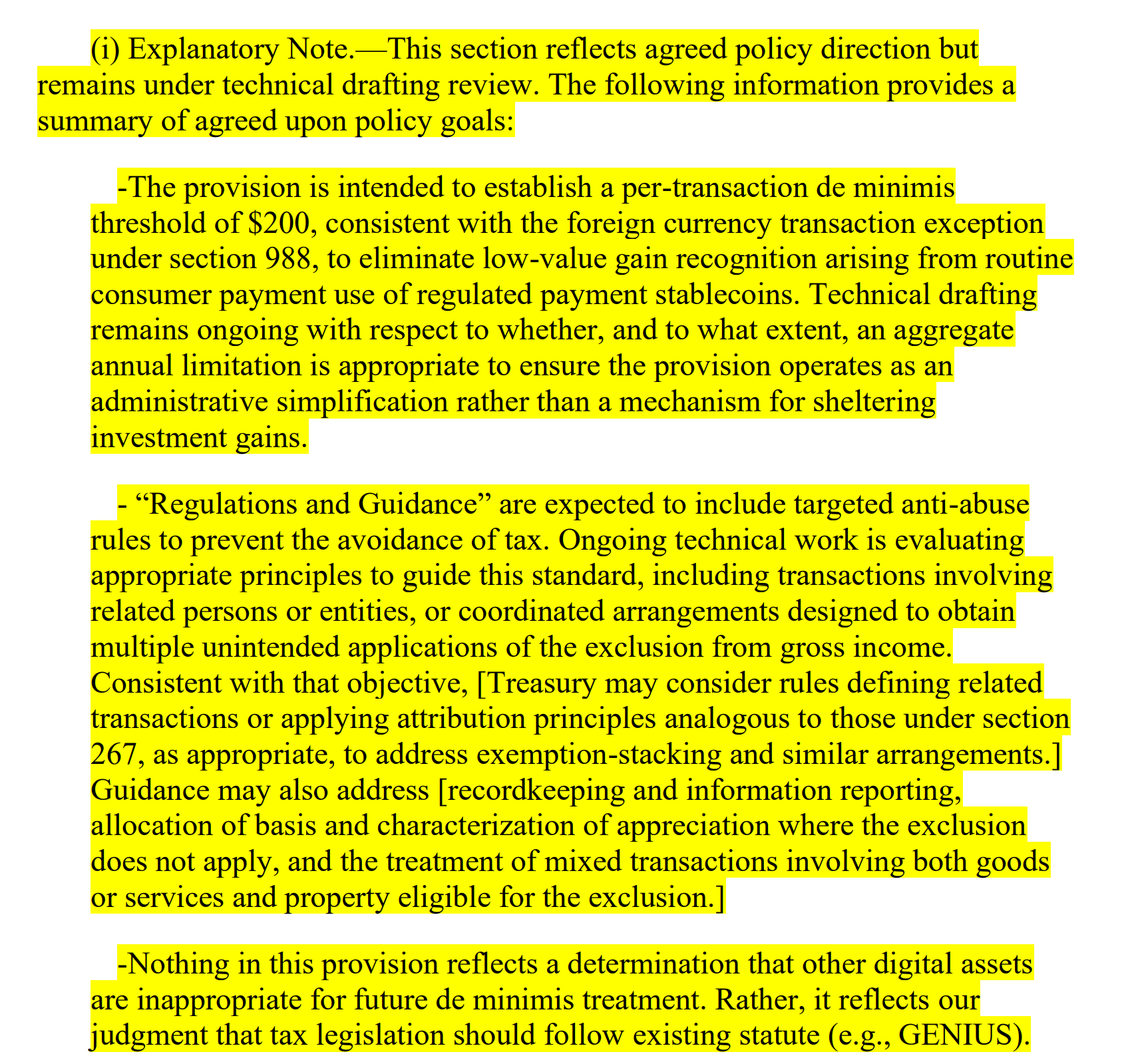
Draft bill explains the reasoning behind tax breaks. Source: House

Related: Crypto Biz: Bank stablecoins get a rulebook; Bitcoin gets a land grab

US bill defers taxes on crypto staking rewards

Beyond payments, the proposal addresses long-standing concerns around “phantom income” from staking and mining. Taxpayers would be allowed to elect to defer income recognition on staking or mining rewards for up to five years, rather than being taxed immediately upon receipt.

“This provision is intended to reflect a necessary compromise between immediate taxation upon dominion & control and full deferral until disposition,” the draft said.

The draft also extends existing securities lending tax treatment to certain digital asset lending arrangements, applies wash sale rules to actively traded crypto assets, and allows traders and dealers to elect mark-to-market accounting for digital assets.

Related: Galaxy predicts stablecoins will overtake ACH transaction volume in 2026

Crypto groups urge Senate to rethink stablecoin rewards ban

Last week, the Blockchain Association sent a letter to the US Senate Banking Committee, signed by more than 125 crypto companies and industry groups, opposing efforts to extend restrictions on stablecoin rewards to third-party platforms.

The group argued that expanding the GENIUS Act’s limits beyond stablecoin issuers would curb innovation and increase market concentration in favor of large incumbents. The letter compared crypto rewards to incentives commonly offered by banks and credit card companies, warning that banning similar features for stablecoins would undermine fair competition.

Magazine: 2026 is the year of pragmatic privacy in crypto — Canton, Zcash and more

Preguntas relacionadas

QWhat is the main purpose of the tax proposal introduced by US lawmakers regarding stablecoins?

AThe proposal aims to ease the tax burden on everyday crypto users by exempting small stablecoin transactions (up to $200) from capital gains taxes and offering a deferral option for staking and mining rewards.

QWhich US representatives introduced the discussion draft to amend the Internal Revenue Code for digital assets?

ARepresentatives Max Miller of Ohio and Steven Horsford of Nevada introduced the discussion draft.

QWhat are the conditions under which a stablecoin transaction would be exempt from capital gains taxes under the draft bill?

AThe exemption applies to stablecoin transactions of up to $200, provided the asset is issued by a permitted issuer under the GENIUS Act, pegged to the US dollar, and maintains a tight trading range around $1.

QHow does the proposal address the issue of 'phantom income' from staking and mining rewards?

ATaxpayers would be allowed to elect to defer income recognition on staking or mining rewards for up to five years, instead of being taxed immediately upon receipt.

QWhy did the Blockchain Association and over 125 crypto companies oppose extending restrictions on stablecoin rewards to third-party platforms?

AThey argued that expanding the GENIUS Act’s limits beyond stablecoin issuers would curb innovation, increase market concentration in favor of large incumbents, and undermine fair competition by banning features similar to incentives offered by banks and credit card companies.

Lecturas Relacionadas

Trading

Spot
Futuros

Artículos destacados

Cómo comprar US

¡Bienvenido a HTX.com! Hemos hecho que comprar Talus Network (US) sea simple y conveniente. Sigue nuestra guía paso a paso para iniciar tu viaje de criptos.Paso 1: crea tu cuenta HTXUtiliza tu correo electrónico o número de teléfono para registrarte y obtener una cuenta gratuita en HTX. Experimenta un proceso de registro sin complicaciones y desbloquea todas las funciones.Obtener mi cuentaPaso 2: ve a Comprar cripto y elige tu método de pagoTarjeta de crédito/débito: usa tu Visa o Mastercard para comprar Talus Network (US) al instante.Saldo: utiliza fondos del saldo de tu cuenta HTX para tradear sin problemas.Terceros: hemos agregado métodos de pago populares como Google Pay y Apple Pay para mejorar la comodidad.P2P: tradear directamente con otros usuarios en HTX.Over-the-Counter (OTC): ofrecemos servicios personalizados y tipos de cambio competitivos para los traders.Paso 3: guarda tu Talus Network (US)Después de comprar tu Talus Network (US), guárdalo en tu cuenta HTX. Alternativamente, puedes enviarlo a otro lugar mediante transferencia blockchain o utilizarlo para tradear otras criptomonedas.Paso 4: tradear Talus Network (US)Tradear fácilmente con Talus Network (US) en HTX's mercado spot. Simplemente accede a tu cuenta, selecciona tu par de trading, ejecuta tus trades y monitorea en tiempo real. Ofrecemos una experiencia fácil de usar tanto para principiantes como para traders experimentados.

522 Vistas totalesPublicado en 2025.12.11Actualizado en 2025.12.11

Cómo comprar US

Discusiones

Bienvenido a la comunidad de HTX. Aquí puedes mantenerte informado sobre los últimos desarrollos de la plataforma y acceder a análisis profesionales del mercado. A continuación se presentan las opiniones de los usuarios sobre el precio de US (US).

活动图片