Amazon Invests Additional $25 Billion in Anthropic, AI Infrastructure 'Arms Race' Escalates

marsbitPublicado a 2026-04-21Actualizado a 2026-04-21

Resumen

Amazon announces an additional investment of up to $25 billion in Anthropic, with $5 billion delivered immediately and the remaining contingent on performance milestones. This follows a recent $50 billion investment in OpenAI, highlighting Amazon's strategy of backing leading AI labs. The deal includes a commitment from Anthropic to spend over $100 billion on AWS infrastructure over the next decade, securing up to 5 gigawatts of computing power to address growing demand and capacity constraints. Anthropic’s annualized revenue has surpassed $30 billion, but the company faces infrastructure strain due to rapid user growth. The investment will support scaling Claude’s capabilities using Amazon’s custom Trainium and Graviton chips. The move deepens integration between Anthropic and AWS, allowing Claude to be accessed natively within AWS services. Over 100,000 organizations already use Claude via Amazon Bedrock. This investment is part of a broader AI infrastructure race, with Amazon planning around $200 billion in capital expenditures this year, largely focused on expanding AI compute capacity.

Author: Claude, Deep Tide TechFlow

Deep Tide Guide: Amazon announced on Monday an additional investment of up to $25 billion in Anthropic (with $5 billion immediately available), securing a commitment from the latter for over $100 billion in AWS spending over the next decade.

This is Amazon's second hundred-billion-dollar check to a leading AI lab within two months—it had just invested $50 billion in OpenAI.

Anthropic's annualized revenue has exceeded $30 billion, but computing power bottlenecks are hampering the user experience; the core goal of this deal is to resolve the capacity crisis.
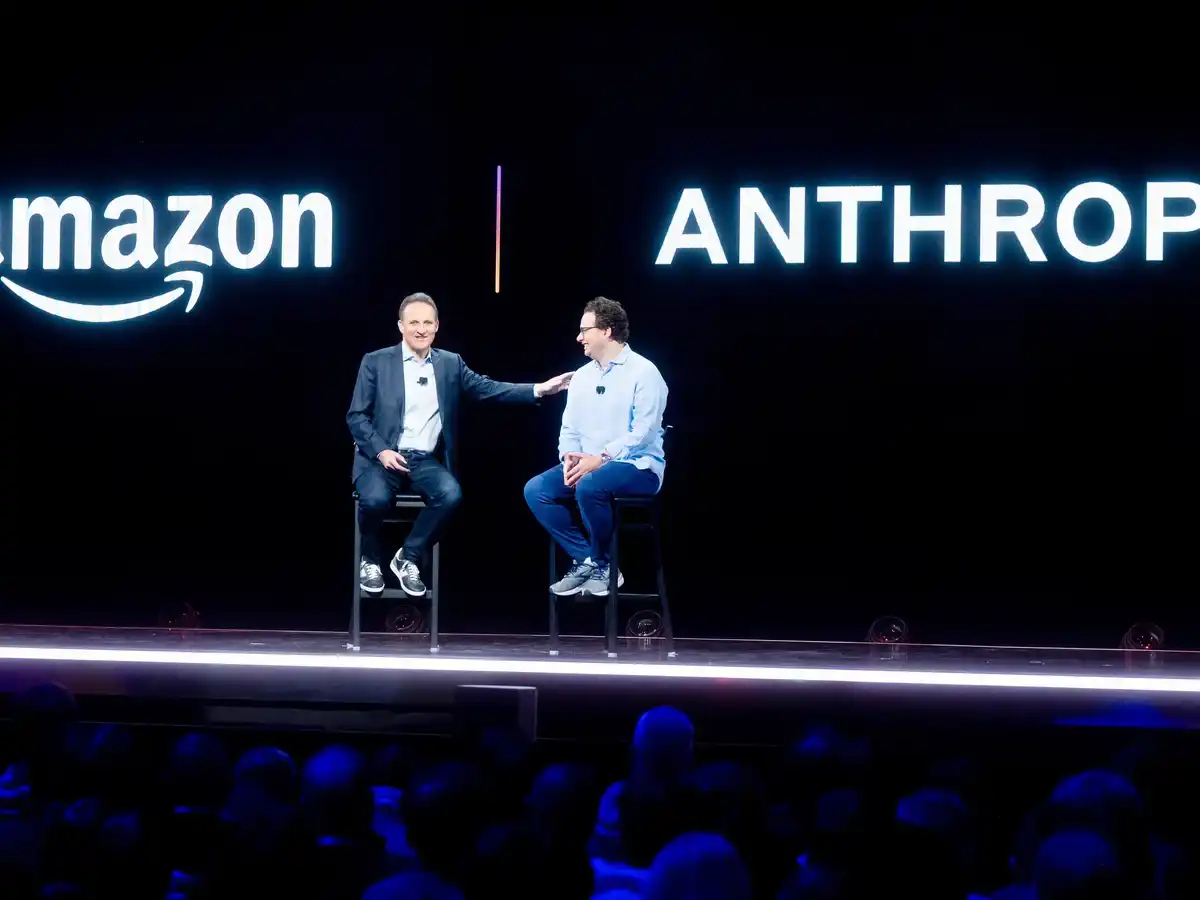
Amazon is placing bets on both of the AI field's top labs simultaneously, and the stakes are getting larger.

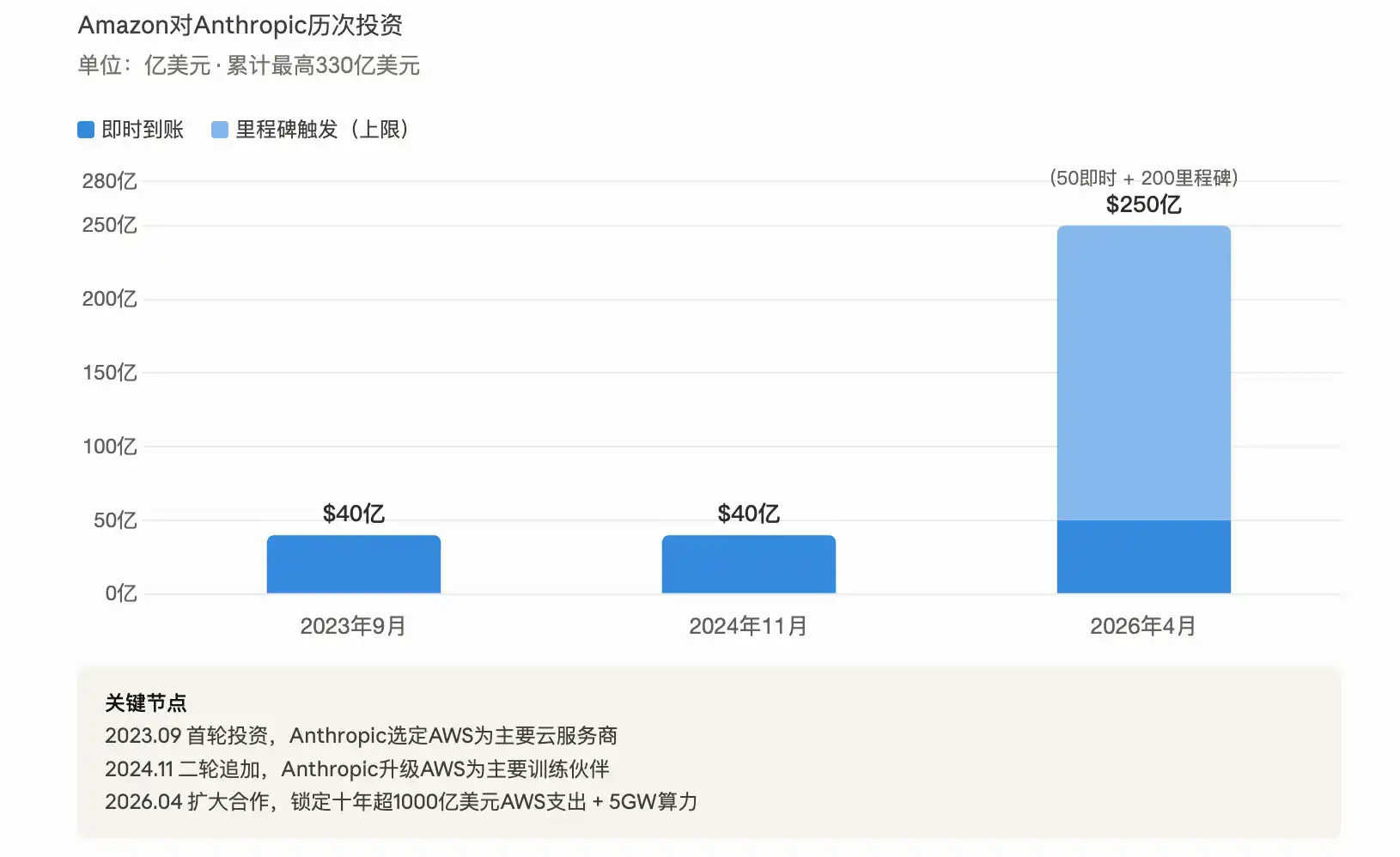
According to reports from CNBC, Bloomberg, and other media outlets on April 20, Amazon announced an additional investment of up to $25 billion in Anthropic, with $5 billion available immediately and the remaining $20 billion tied to specific business milestones. This investment is executed at Anthropic's $380 billion valuation from its Series G financing in February of this year. Combined with the previous cumulative investment of $8 billion, Amazon's total investment commitment to Anthropic now reaches a cap of $33 billion.

Two months ago, Amazon had just invested $50 billion in OpenAI, Anthropic's main competitor, and reached a cloud services agreement of a similar scale. Amazon CEO Andy Jassy stated in an announcement that Anthropic's commitment to running its large language models on AWS Trainium for up to ten years "reflects the progress we have made in the field of custom chips."

Following the news, Amazon's stock price rose approximately 2.5% in after-hours trading.

$100 Billion Cloud Commitment for 5 Gigawatts of Compute Power, Responding to OpenAI's 'Insufficient Compute' Allegations

The core of this deal is not just equity investment but a deeply binding infrastructure agreement.

Anthropic has committed to investing over $100 billion in AWS technology over the next decade, covering Amazon's custom AI chips Trainium (from Trainium2 to Trainium4 and future generations) and tens of millions of Graviton CPU cores. In exchange, Anthropic will receive up to 5 gigawatts of computing capacity for training and deploying Claude models. According to Anthropic's blog disclosure, the company currently uses over 1 million Trainium2 chips to train and serve Claude and plans to put nearly 1 gigawatt of Trainium2 and Trainium3 capacity into operation by the end of 2026.

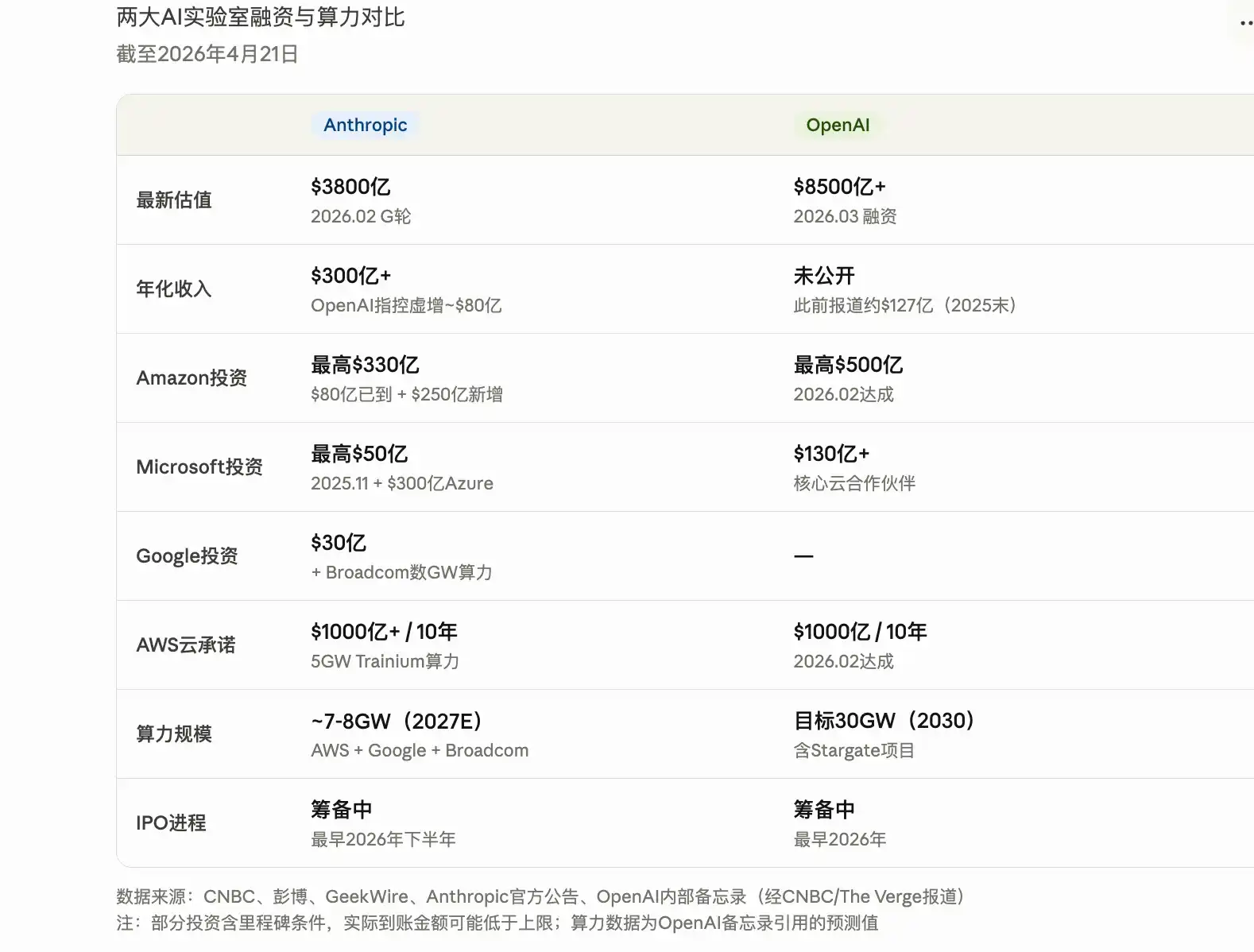
This expansion in computing scale directly responds to recent public attacks from OpenAI. OpenAI's Chief Revenue Officer, Denise Dresser, claimed in an internal memo last week that Anthropic made a "strategic error by failing to secure sufficient computing power" and predicted that OpenAI would have 30 gigawatts of computing power by 2030, while Anthropic would have only 7 to 8 gigawatts by the end of 2027. In its announcement that day, Anthropic frankly admitted that demand for Claude from enterprises and developers is accelerating, and consumer usage has seen a "sharp increase," putting "inevitable pressure" on infrastructure and affecting reliability and performance during peak periods.

Anthropic CEO Dario Amodei stated in a declaration: "Users tell us that Claude is becoming increasingly important to their work, and we need to build infrastructure to keep up with the rapidly growing demand."
Amazon Writes Hundred-Billion-Dollar Checks to Two AI Labs in Two Months

Amazon's investment strategy is now very clear: bet on both top players in the AI race simultaneously.

In February of this year, Amazon announced an investment of up to $50 billion in OpenAI, also accompanied by a $100 billion AWS cloud service commitment. The structure of the deal with Anthropic is almost identical—$25 billion in investment plus a lock on over $100 billion in cloud spending. According to GeekWire, Amazon is executing the "same playbook" for both labs.

The two major AI companies are also racing to prove their strength to investors. According to CNBC, both Anthropic and OpenAI are preparing for potential IPOs that could land as early as this year. OpenAI's latest funding round valued it at over $850 billion, while Anthropic is valued at $380 billion. Anthropic claims its annualized revenue has exceeded $30 billion (approximately $9 billion at the end of 2025), while OpenAI's memo alleged that this figure was inflated by about $8 billion because Anthropic accounted for revenue from cloud partnerships with Amazon and Google on a gross rather than net basis.

Microsoft is also betting on both sides—it had already invested over $13 billion in OpenAI and in November 2025 invested up to $5 billion in Anthropic, which committed to purchasing $30 billion in Azure computing power.
Claude Platform Integrates with AWS, Battle for Over 100,000 Customers

Beyond investment, integration at the product level is also deepening.

According to the announcement, the native Claude platform will be directly embedded into AWS. Users will be able to access the full Claude console through their existing AWS accounts, permission controls, and billing systems, without needing additional registration or new contracts. This goes a step further than the previous offering of Claude services through the Amazon Bedrock marketplace. Amazon disclosed that over 100,000 organizations are currently running Claude models on Amazon Bedrock.

Anthropic also emphasized in its blog that Claude is the only frontier AI model simultaneously available on all three major global cloud platforms (AWS Bedrock, Google Cloud Vertex AI, Microsoft Azure Foundry). This multi-platform strategy allows enterprise customers to flexibly choose their deployment path based on needs and is also one of Anthropic's differentiated advantages in competing with OpenAI.

On the client side, after Lyft used Claude via Amazon Bedrock to power its customer service AI assistant, the average resolution time for customer service was reduced by 87%. Pfizer uses Claude to help scientists perform voice searches in drug development documents, saving approximately 16,000 hours of retrieval time per year.

AI Infrastructure Race: Amazon's Capital Expenditure Expected to Reach $200 Billion This Year

The larger context embedding this deal is the AI infrastructure arms race among cloud computing giants.

Amazon stated in February that it expects capital expenditure to reach approximately $200 billion in 2026, with the vast majority directed toward AI infrastructure. The previously co-developed Project Rainier (a super-large-scale computing cluster with nearly 500,000 Trainium2 chips) was once one of the world's largest AI computing clusters, which Anthropic is using to train and deploy current and future versions of Claude.

Earlier this month, Anthropic also expanded its cooperation with Google and Broadcom, locking in computing power on the scale of "several gigawatts," expected to come online starting in 2027. Combined with this 5-gigawatt agreement with Amazon, Anthropic is expanding its computing power reserves across multiple lines simultaneously.

Amazon's custom chip business itself is also accelerating. Jassy recently revealed that the business's annualized revenue has exceeded $20 billion, doubling from the $10 billion reported earlier this year, which in his words is "on fire."


Preguntas relacionadas

QWhat is the total maximum investment commitment Amazon has made to Anthropic after the latest $25 billion addition?

AAmazon's total investment commitment to Anthropic has reached a maximum of $33 billion, which includes the previous $8 billion and the newly added up to $25 billion.

QWhat is the core infrastructure agreement between Amazon and Anthropic, and what does Anthropic receive in exchange?

AAnthropic commits to spending over $100 billion on AWS technology over the next decade, including Amazon's custom AI chips and CPU cores. In exchange, Anthropic will receive up to 5 gigawatts of computing capacity for training and deploying Claude models.

QHow does Amazon's investment strategy in AI labs appear, based on recent deals with Anthropic and OpenAI?

AAmazon is simultaneously betting on both leading AI labs, having invested up to $50 billion in OpenAI and up to $25 billion in Anthropic, each accompanied by a $100 billion cloud service commitment, following a similar playbook.

QWhat product integration advancement was announced between Anthropic's Claude platform and AWS?

AThe native Claude platform will be directly embedded into AWS, allowing users to access the full Claude console through their existing AWS accounts, permissions, and billing systems without needing separate registration or contracts.

QWhat is Amazon's projected capital expenditure for 2026, and what is the primary focus of this spending?

AAmazon expects its capital expenditure to reach approximately $200 billion in 2026, with the majority allocated towards AI infrastructure investments.

Lecturas Relacionadas

How Difficult is Chip Making? A Division Error Costs 475 Million Dollars

How Hard Is It to Make a Chip? A Division Error Cost $475 Million Chip expert Shi Kan, a researcher at the Chinese Academy of Sciences and a popular tech creator, explains the immense challenges of chip development. Chips are foundational to modern technology, but their creation is extraordinarily difficult. The journey from sand to a functional chip involves complex design and manufacturing, but a critical bottleneck is verification—ensuring the design works flawlessly before costly production. A single, undetected bug can have catastrophic consequences, as illustrated by the infamous 1994 Intel Pentium FDIV bug. A flaw in the floating-point division unit forced a recall costing $475 million. Unlike software, chips cannot be easily patched after manufacture, making "first-time success" paramount. However, industry surveys show only 24% of chip projects achieve this; over three-quarters require at least one costly re-spin due to design flaws. Verification has thus become the dominant phase, consuming up to 70% of the design cycle. The core challenge is a "verification impossible triangle" between high performance, good debuggability, and low cost. Exhaustively verifying a modern CPU core could take 15,000 years with software simulation, or 30 years with advanced hardware emulation—timeframes utterly impractical for development. Despite being essential, verification is often seen as unglamorous "dirty work," receiving less academic attention than fields like AI. Shi and his team are tackling this by developing an agile verification research framework called ENCORE, based on FPGA technology, to improve verification efficiency and debug capability. Beyond research, Shi engages in public science communication through long-form video content, aiming to demystify chip technology, AI, and computer science. He argues for the value of pursuing "hard and long-term" endeavors, whether in the meticulous world of chip verification or in creating substantive educational content, believing such sustained effort is likely the right path forward.

marsbitHace 11 min(s)

How Difficult is Chip Making? A Division Error Costs 475 Million Dollars

marsbitHace 11 min(s)

Blockchain Has Finally Started to Sail into the Mainstream After 18 Years

Blockchain Finds Its True Path After 18 Years: Becoming the Financial Backbone for AI Agents and Autonomy This analysis explores a pivotal shift in the blockchain and crypto investment landscape, driven by the dominance of AI. Major venture capital firms, including Variant, Paradigm, Haun Ventures, and YZi Labs, are moving beyond pure "crypto" investment theses. They are expanding their focus to AI, robotics, and frontier tech, signaling that blockchain is no longer seen as a standalone sector but as an underlying infrastructure layer. The core argument is that blockchain's killer application may not be user-facing apps, but rather providing the economic rails for the coming wave of AI agents, autonomous robots, and automated systems. Key capabilities like self-custody wallets, programmable stablecoins for micropayments, on-chain identity, and verifiable smart contracts are positioned as essential for a future where machines conduct economic activity. The recent $1.4 billion investment by Tether (via its venture arm) in German robotics company NEURA Robotics exemplifies this, aiming to embed Tether's wallet tools directly into robots for autonomous transactions. While many "AI + Crypto" projects remain superficial, the article concludes that true value lies where crypto is a necessary component—enabling machine-to-machine payments, agent autonomy, verifiable data provenance, and open financial settlement for the AI era. For crypto venture capital, this convergence with AI represents both an adaptation to shifting capital flows and a potential path to unlocking the large-scale, non-speculative utility the industry has long sought.

marsbitHace 31 min(s)

Blockchain Has Finally Started to Sail into the Mainstream After 18 Years

marsbitHace 31 min(s)

Blockchain has finally begun sailing toward the main channel after 18 years

After 18 years of development, blockchain technology is beginning to move from a specialized niche into mainstream adoption, according to a recent industry analysis. The shift is reflected in the changing strategies of major crypto venture capital firms, which are expanding their focus beyond pure "digital ownership" towards broader themes like "autonomy." The report highlights that leading VC firms like Variant, Paradigm, Haun Ventures, and YZi Labs are broadening their investment mandates to include not only crypto but also artificial intelligence (AI), robotics, biotech, and other frontier technologies. This reflects a recognition that the isolated "crypto investment" narrative is losing appeal to limited partners (LPs) as capital and attention increasingly flow toward AI and other high-growth tech sectors. A key emerging thesis is that blockchain's most significant future application may not be as a consumer-facing product, but as the underlying economic and settlement infrastructure for the AI era. As AI agents and autonomous systems become more prevalent, they will require programmable, global, and low-cost payment networks (like stablecoins), verifiable digital identities, and secure wallets to manage transactions and assets on behalf of users. The investment by stablecoin issuer Tether into robotics company NEURA, with plans to integrate its wallet technology, is cited as a prime example of this convergence. However, the article cautions that simply labeling projects as "AI + Crypto" is insufficient. True value lies in integrations where blockchain technology is essential—such as enabling machine-to-machine micropayments, verifiable data provenance for AI, or transparent governance for autonomous organizations—rather than being a superficial marketing add-on. In conclusion, while AI currently dominates the tech narrative and capital flows, it may ultimately create the real-world, high-frequency demand that the crypto industry has long sought. For crypto VCs and projects, the path forward is to position blockchain not as a competing sector, but as a critical foundational layer powering autonomy and economic activity in an AI-driven future.

链捕手Hace 38 min(s)

Blockchain has finally begun sailing toward the main channel after 18 years

链捕手Hace 38 min(s)

Y Combinator Co-founder: How to Make a Billion Dollars?

The Y Combinator co-founder argues that becoming a billionaire by founding a successful startup is not only possible but demonstrably achievable without unfair or unethical practices. He disputes a politician's claim to the contrary, using the example of a founder whose company grew at 93% monthly solely through creating a product users loved and recommended. The core mechanism is exponential growth. A conservative 15% monthly growth rate compounds to a 4384x increase over five years, which can easily lead to billion-dollar valuations and founder wealth. The process depends on two key variables: the growth rate and the duration it can be sustained. A high growth rate stems from a great product that users naturally promote, while a long duration requires a large enough market. For aspiring founders, especially young ones, the simplest path is to build something they and their friends genuinely need. Young people's current needs often predict future mass-market trends. He advises against actively "searching" for ideas, as this tends to filter out unconventional but promising ones. Instead, inspiration should come from working on interesting projects with friends, as many iconic companies (e.g., Apple, Facebook) started this way. Ultimately, building a massively valuable startup is not about exploitation but empathy: deeply understanding a user group and building a product that significantly improves their lives. This, powered by exponential growth in a large market, is the legitimate path to immense wealth creation.

Foresight NewsHace 40 min(s)

Y Combinator Co-founder: How to Make a Billion Dollars?

Foresight NewsHace 40 min(s)

Trading

Spot
Futuros
活动图片