Not a Price Hike, but a Supply Cut? Oil Prices Have Crossed the Tipping Point

marsbitPublicado a 2026-04-21Actualizado a 2026-04-21

Resumen

The global oil market has passed a critical point, shifting the focus from price increases to potential physical supply shortages. The core issue is a time mismatch: even if the Strait of Hormuz reopens, shipping disruptions have already caused significant delays, which will continue to deplete onshore crude inventories for weeks. Refinery behavior acts as an amplifier. Reduced runs in Asia and Europe don’t reflect weaker demand but instead shrink product inventories, raising fuel prices and refining margins, which in turn encourages higher runs—creating a self-reinforcing cycle. If the Strait remains closed beyond April, traditional pricing models may fail. The market could face an unprecedented physical shortfall of 11-13 million barrels per day—roughly four times historical disruption levels. In such a scenario, price becomes an inadequate balancing tool. The only way to rebalance the market would be policy-driven demand destruction, similar to COVID-era lockdowns. Current prices around $95/barrel are insufficient to balance the market. Key signals to watch include inventory levels, policy announcements, and the pace of involuntary demand contraction. Geopolitically, the situation appears likely to worsen before improving, with little room for compromise between the US and Iran.

Editor's Note: This article argues that the global oil market has crossed a "tipping point." From now on, the issue is no longer whether oil prices will continue to rise, but how the actual supply gap will manifest—whether through accelerated declines in crude oil inventories, shortages of refined products, or through policy measures to suppress demand.

The core logic of the article is built on an underestimated variable in the market: time mismatch. Even if the Strait of Hormuz resumes navigation in the short term, the delays in tanker turnover caused by previous transportation disruptions will continue to erode onshore inventories for weeks to come. This means that supply issues will not be immediately resolved with the "resumption of navigation" but will be reflected in inventories and the spot market with a lag.

Against this backdrop, refinery behavior becomes a key amplifier. The reduction in refinery utilization rates in Asia and Europe does not mean that end-user demand has weakened simultaneously. Instead, it will first compress refined product inventories, push up product prices, and then force refineries to resume operations, forming a self-reinforcing cycle: high oil prices → compressed margins → destocking → margin recovery → increased utilization. This mechanism makes it difficult for the market to achieve rebalancing through conventional supply-demand adjustments in the short term.

A more impactful judgment is that if the strait remains closed beyond April, traditional oil price frameworks will become ineffective. The market will no longer face cyclical price increases but an extreme scenario approaching "physical shortages"—in such a state, prices are no longer an effective regulatory tool, and price caps lose their reference value. What can truly bring the market back into balance is not the restoration of supply but "policy-driven demand suppression," similar to what occurred during the pandemic.

Therefore, $95 per barrel is far from sufficient to rebalance the oil market. Against the backdrop of escalating geopolitical conflicts, what deserves more attention in the future is not the oil price itself but changes in inventories, policy signals, and the pace of passive demand contraction.

Below is the original text:

Please read the article "The Tipping Point of the Oil Market."

Related reading: "Oil Prices Are Approaching a Tipping Point; What Will Happen in Mid-April?"

In our report released on March 25, we outlined several scenarios and pointed out that the oil market's tipping point would occur in mid-April. Now, that tipping point has passed.

From this moment on, the daily supply disruption of 11 to 13 million barrels will manifest in one of the following three forms:

1) A decline in crude oil inventories;

2) A decline in refined product inventories;

3) Demand destruction.

If you are unfamiliar with the logistics mechanisms or logic behind this, let me break it down for you.

The so-called "tipping point" in the oil market corresponds to the last batch of crude oil shipped from the Persian Gulf to end-users. Once these tankers complete unloading onshore and no further unloading is possible, onshore crude oil inventories will begin to be drawn down. (For more details on onshore inventory calculations, refer to our previous analysis.)

Currently, global refinery shutdowns exceed approximately 5 million barrels per day, with about 3 million barrels per day concentrated in the Middle East. Refineries in Asia and Europe are also reducing utilization rates, but refinery cuts do not mean that end-user demand has already declined.

The reduction in refinery utilization rates will accelerate the drawdown of refined product inventories, thereby pushing up product prices. This process, in turn, will improve refining margins and stimulate refineries to increase utilization rates.

This cycle will play out repeatedly in the coming weeks: rising crude oil prices → compressed refining margins → reduced refined product supply → declining refined product inventories → recovering refining margins → increased utilization rates → further rises in crude oil prices.

In the spot market, this "game" will unfold between traders holding inventories and refineries without inventories. Of course, this situation can only last until onshore crude oil inventories are depleted, and that point is not far off.

By the first week of May, the only countries in Asia with significant crude oil inventory buffers will be Japan and China. Other countries will have to scramble for spot crude oil. If the Strait of Hormuz remains closed by then, you will see refineries going to any lengths to secure the crude they need—because the alternative is shutdown.

For Europe, crude oil shortages will also emerge within the same timeframe. By then, U.S. crude oil exports will approach 5.5 million barrels per day, OECD crude oil inventories will fall to the minimum operating levels, and the remaining inventories will be concentrated mainly in the United States.

We estimate that by the end of July, U.S. commercial crude oil inventories will fall below about 400 million barrels, approaching the minimum operating level (approximately 370 to 380 million barrels). This estimate also includes the release of about 139 million barrels from the Strategic Petroleum Reserve (SPR).
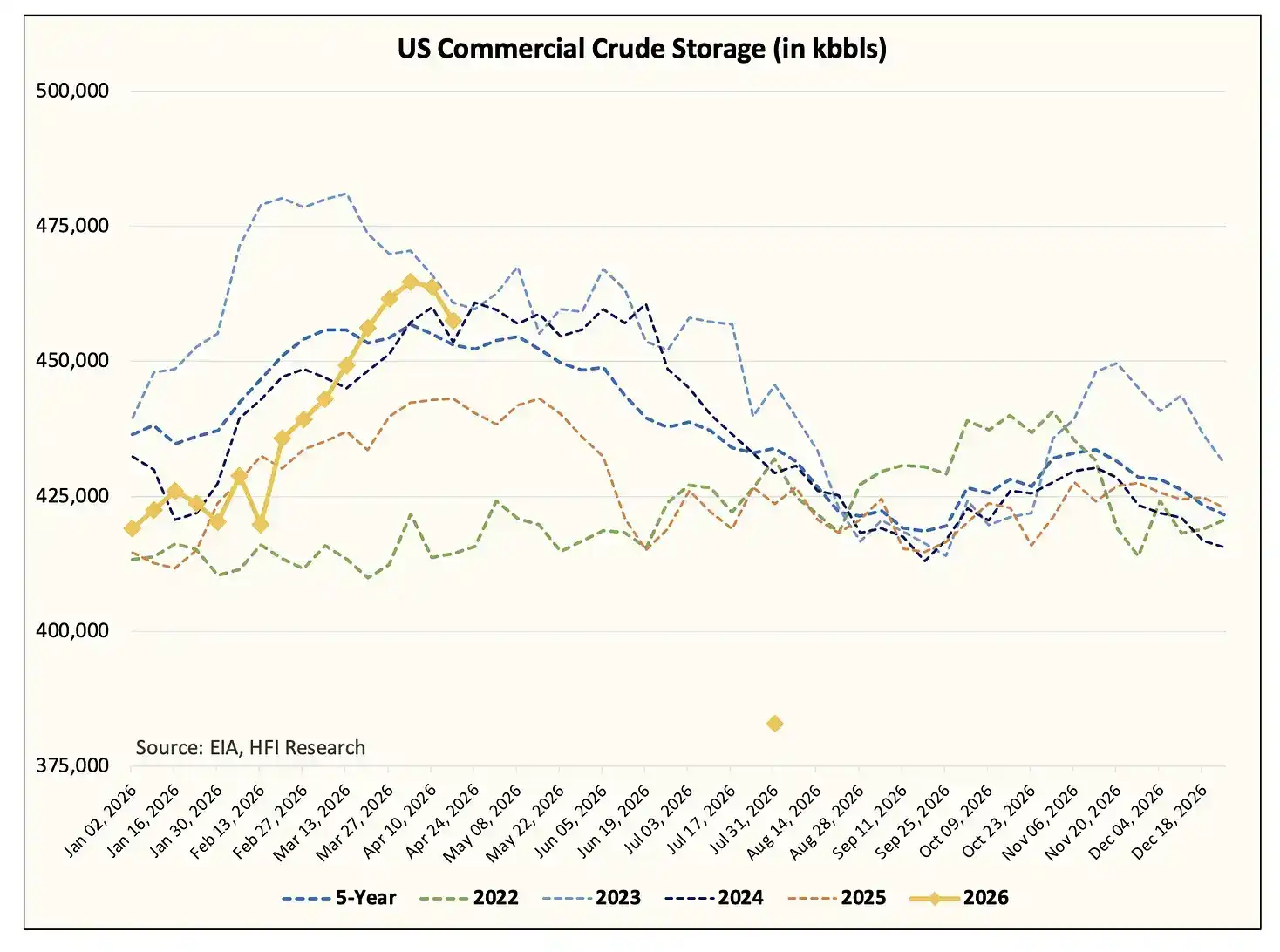
In the coming period, the Trump administration will likely have to impose restrictions on both crude oil and refined product exports. We judge that the Trump administration will most likely first restrict refined product exports; if U.S. refineries begin to reduce utilization rates due to compressed margins, crude oil exports may then be further restricted—which would be an extremely negative scenario for U.S. shale oil and Canadian oil producers (we will elaborate on this in subsequent analysis).

It is important to emphasize that all the above changes will occur regardless of whether the Strait of Hormuz reopens. Even if the U.S. and Iran reach an agreement and unconditionally resume navigation through the Strait of Hormuz, the drawdown of onshore crude oil inventories will still be inevitable.

Reiterating the Logic

Suppose a ceasefire is reached by this Tuesday, along with a long-term peace agreement.

The floating inventory in tankers at sea is currently about 160 million barrels, and this crude will begin unloading rapidly. However, it will take 30 to 40 days for these tankers to complete transportation and unloading; after that, the journey back will take an additional 20 days or so.

At the same time, there are about 70 VLCCs (Very Large Crude Carriers) heading to the U.S. to load crude oil and transport it to Asia. The loading cycle for these tankers is about 6 to 8 weeks, transportation to Asia takes 45 to 50 days, and unloading and returning through the Strait of Hormuz takes another 20 to 25 days. In other words, this fleet will not be able to form effective return capacity for at least the next 3 months.

To alleviate the current backlog of onshore inventories in the Middle East, at least 100 VLCCs would need to be involved in transportation. The current onshore inventory is about 600 million barrels, and for oil-producing countries to resume production, inventories need to be reduced by at least about 200 million barrels. However, given the existing transport capacity, this is physically impossible to achieve until at least mid-to-late June.

After onshore crude oil inventories are gradually released, a stable flow of tankers through the Strait of Hormuz for loading is still needed. At that stage, oil-producing countries such as Saudi Arabia, the UAE, Kuwait, Qatar, Iraq, and Bahrain can gradually resume production. This process will take several more weeks, which almost guarantees that supply shortages will persist.

According to our estimates in the March 25 "Tipping Point" report, the cumulative inventory loss due to the strait closure has reached about 1 billion barrels; by the end of April, it will expand to 1.2 billion barrels; by the end of May, 1.59 billion barrels; and by the end of June, it will approach 1.98 billion barrels.

There is not enough commercial crude oil in the market to fill a supply gap of this magnitude. Therefore, the only way to avoid systemic imbalance is through "demand destruction."

This is not a matter of judgment but simple mathematics.

The Geopolitical Issue

I have never liked geopolitics—it is full of uncertainty, lacks safety margins, is rife with gray areas, and rarely offers clear black-and-white distinctions. But on the issue of the Iran conflict, the situation seems to be heading toward an extreme of "either-or."

My friend PauloMacro recently recommended that I read the research of Professor Robert Pape, author of "The Escalation Trap." I have systematically read his related views over the past two months. He recently published an article, "Why the Ceasefire Keeps Failing," which is worth reading.

From my personal observation, everything that happened this weekend seemed almost straight out of a horror movie.

Since the conflict broke out at the end of February, most tankers have chosen to stay put and wait. There was a previous market narrative that the Strait of Hormuz was shut down due to insurance失效. I agreed with this assessment early in the conflict, but as events unfolded, especially everything that happened this weekend, I was shocked.

The Islamic Revolutionary Guard Corps (IRGC) effectively enforced a blockade by force, directly threatening tankers with firing. We see this clearly from tanker activity. Since we began tracking tanker movements, this is the first time we have seen such a large-scale collective U-turn of tankers. In the past, there were occasional one or two tankers changing course, but nothing on the scale seen this weekend.

In my view, this sends two signals: First, the IRGC has firmly taken control of the Strait of Hormuz; second, this conflict is likely to get worse before it gets better. Judging from the conditions set by the IRGC and Iran, it is almost impossible for the U.S. to accept them, so there is extremely limited room for maneuver in reality. To fundamentally resolve this issue, it恐怕 can only be "truly resolved"—you should understand what I'm暗示. I fear the worst is yet to come, and I say this not to be alarmist.

Scenarios for the Oil Market

In the previous article discussing the oil market's "tipping point," we pointed out that if the Strait of Hormuz could resume navigation by the end of April, Brent crude prices would "fall back" to $110 per barrel; today it is trading at $95.

But as I have already explained, the oil market has crossed the tipping point. The large-scale inventory drawdown that follows will jolt the market awake. I suspect that only when financial market participants亲眼 see actual crude oil shortages occurring will they realize that this supply disruption is not an illusion. Until then, most people will be unable to accept this reality.

That's the fact.

If the Strait of Hormuz reopens after April, we will no longer be able to provide accurate oil price predictions. Because by then, the market will have crossed a point of no return. This would become the largest supply disruption in the history of the oil market, roughly four times the size of previous records. In such a scenario, traditional fundamental pricing theories lose meaning, as "absolute shortage" cannot be measured by price. Once a market has no fuel available, it is simply "cut off."

At what price will that last marginal barrel of crude trade? I don't know, and I don't think anyone is smart enough to know the answer.

But what I do know is that demand destruction will inevitably arrive. For those watching oil, what will truly "kill" demand will be policy announcements. To balance the global supply disruption of about 11 to 13 million barrels per day, a demand slump on the scale of the pandemic lockdowns must occur.

And even in such an extreme scenario, the market would only barely achieve "balance," not shift into surplus. But at least it would mitigate the price shock. At that point, analysts like me, the "barrel counters," will be able to judge when the true fundamental turning point arrives.

So, to summarize in a few sentences: If the Strait of Hormuz remains closed after April, I don't know how high oil prices will go, but it certainly won't be $95 per barrel. Policy-driven demand destruction will rebalance the oil market, but it will only prevent inventories from deteriorating further.

We have established a market signal system to monitor when this turning point arrives.

Conclusion

The oil market's tipping point has arrived. Global onshore crude oil inventories will decline sharply, and the pace will be faster than ever seen before. U.S. crude oil inventories are the last to begin declining, and we will see this in next week's EIA inventory report. Once the market亲眼 sees a clear decline in onshore inventories, prices will quickly jump to new levels.

If the Strait of Hormuz does not resume navigation after the end of April, no one can tell you where the top for oil prices is. By then, the market will have彻底 crossed that line. The only way to rebalance oil prices is through demand destruction. Therefore, instead of obsessing over "how high oil prices will go," it is better to track those truly critical market signals.

But if there is only one takeaway from this article, it is this: The oil market absolutely cannot rebalance at $95 per barrel. Oil prices must rise enough to hedge against the daily supply disruption of about 11 to 13 million barrels. Governments will have to adopt mandatory demand compression policies, similar to those during the pandemic, to suppress demand. Even then, it will only offset the supply gap, not push the oil market back into surplus. From a geopolitical perspective, I fear the situation has entered a phase of "it will get worse before it gets better," as neither the U.S. nor Iran appears willing to让步.


Preguntas relacionadas

QWhat is the 'tipping point' that the oil market has passed, according to the article?

AThe 'tipping point' refers to the moment when the last batch of crude oil shipped from the Persian Gulf is unloaded. After this point, the inability to continue offloading new shipments will lead to a rapid drawdown of onshore crude inventories, marking the shift from a price-driven market to a physical supply shortage.

QWhy won't the oil supply problem be immediately resolved even if the Strait of Hormuz reopens?

ADue to a significant time mismatch. Even if the strait reopens, the prior shipping disruptions have caused major delays in tanker turnaround times. The existing fleet of VLCCs (Very Large Crude Carriers) is committed to long-haul routes for weeks, meaning it will take at least until mid-to-late June for sufficient shipping capacity to return and begin reducing the massive onshore inventory buildup in the Middle East.

QWhat self-reinforcing cycle in the refinery sector is described as a key amplifier of the crisis?

AThe cycle is: High crude prices → compressed refinery margins → refineries reduce runs → product inventories draw down → product prices rise → refinery margins improve → refineries increase runs → demand for crude increases → crude prices rise further. This cycle makes it difficult for the market to rebalance through regular supply and demand adjustments.

QWhat does the article identify as the only way to rebalance the market if the Strait of Hormuz remains closed beyond April?

AThe only way to rebalance the market is through 'demand destruction,' specifically policy-led demand suppression on a scale similar to COVID-19 lockdowns. Price alone becomes an insufficient tool to manage an absolute physical shortage, and governments would need to implement measures to forcibly reduce consumption.

QWhat is the estimated scale of the supply disruption, and why is it considered historically unprecedented?

AThe supply disruption is estimated at 11 to 13 million barrels per day. This is considered unprecedented because it is about 4 times larger than any previous oil supply disruption in history, moving the market into a state of 'absolute shortage' where traditional pricing models fail.

Lecturas Relacionadas

Two Legends Lost in Three Days: Is Google's AI Talent Dam Cracking?

In three days, Google lost two AI legends. On June 18, Noam Shazeer, co-author of the seminal "Attention is All You Need" paper and Gemini co-lead, left for OpenAI. Just 48 hours later, John Jumper, 2024 Nobel laureate and AlphaFold lead, departed DeepMind for Anthropic. This follows Andrej Karpathy joining Anthropic in May. These moves highlight a structural trend: top AI talent is concentrating at mission-driven, pre-IPO firms like OpenAI and Anthropic, while Google becomes a primary source. The exodus stems from a core mission mismatch. Google's ad-centric model often subordinates AI research to product and revenue goals, creating friction for pioneers like Shazeer, who returned in 2024 only to leave again. In contrast, OpenAI and Anthropic offer singular focus on pushing AI boundaries, whether towards AGI or safety-aligned models, which deeply appeals to top researchers like Jumper. Financial incentives amplify the pull. With both OpenAI and Anthropic nearing IPO, employees stand to gain immensely from equity, an upside Google's mature stock cannot match. Furthermore, the 2023 merger of Google Brain and DeepMind, intended to consolidate strength, has instead created cultural tension and slowed the path from research to product, as evidenced by Gemini's pace. This talent redistribution is reshaping the AI landscape. While Google retains vast data and compute resources, its true crisis is the quiet, continuous loss of the people who define the field's future. The real moat in AI is not infrastructure, but the concentration of brilliant minds—a battle Google is currently losing.

marsbitHace 56 min(s)

Two Legends Lost in Three Days: Is Google's AI Talent Dam Cracking?

marsbitHace 56 min(s)

Behind the AI Report Card, Lies a Chinese 'Exam Setter'

Beyond the familiar performance charts like MMLU-Pro and MMMU, which major AI models strive to ace, stands a key "examiner": Chinese-Canadian researcher Wenhu Chen. An assistant professor at the University of Waterloo and founder of TIGERLab, Chen addresses the crucial need for more rigorous AI evaluation. As models like GPT-4 began scoring near-perfect results on older benchmarks like MMLU, it became difficult to distinguish their true capabilities. In response, Chen introduced MMLU-Pro in 2024, featuring harder, more reasoning-focused questions with more answer choices, successfully reintroducing meaningful performance gaps. His work extends to multi-modal evaluation with MMMU and its enhanced version, MMMU-Pro. These benchmarks test a model's ability to understand and reason with complex information from images, charts, and text across diverse academic subjects, exposing the significant challenges even top models face in genuine comprehension. Chen's background in complex QA, table reasoning, and his experience at Google DeepMind on projects like Gemini inform his approach. He understands that effective benchmarks must anticipate how models might "cheat" by memorizing data or avoiding visual analysis. His lab also actively researches video understanding and generation models (e.g., UniVideo, Vamba), ensuring his evaluation work is grounded in practical model-building challenges. Now at Meta's Super Intelligence Lab, Chen continues his focus on multi-modal data and evaluation, representing the deep yet often unseen contributions of Chinese talent in shaping the fundamental tools of the AI industry.

marsbitHace 1 hora(s)

Behind the AI Report Card, Lies a Chinese 'Exam Setter'

marsbitHace 1 hora(s)

Alliance Co-founder's Letter to Entrepreneurs: Written at the Moment Cursor Sold for $600 Billion

Alliance Co-founder's Letter to Entrepreneurs: On Cursor's $60 Billion Sale Many aspiring founders see massive exits like Cursor's $60B sale and wonder why they can't achieve the same, often concluding opportunities are exhausted. But great companies aren't built in obvious, crowded spaces. Cursor, like Stripe, Figma, and Shopify before it, started with a non-consensus belief about the future. Before ChatGPT, they believed AI would transform knowledge work. They focused on a genuinely exciting domain, became their own customer, and obsessed over power users. Their journey involved years of "glass-chewing" effort before the market was ready. The pattern is consistent: identify a long-term technological shift, find a missed entry point, and execute for years before the trend becomes obvious. First-generation products (PayPal, Adobe, Amazon) prove a market exists. Second-generation winners (Stripe, Figma, Shopify) rebuild that market around new insights, technology, or changing customer behaviors. Founders must identify their phase in the cycle. Early entrants like Coinbase or Cursor focus on making new technology usable for power users. Later entrants find the "yin" to the established "yang"—the blind spots incumbents miss as they grow distant from individual users. The key is deep market immersion. Use every product in your space. Talk to users. Build an audience. Stop looking for ideas and start *seeing* them everywhere. Then, choose one. The idea must offer a 10x improvement or solve a "hair-on-fire" pain point—something severe enough that users are already crafting workarounds. When building, avoid feature bloat. Ask: why would someone switch? Great startups rarely force new behaviors; they improve familiar workflows with drastically lower friction (e.g., Cursor forked VS Code instead of creating a new editor). Distribution is the underestimated moat. Before product-market fit, achieve distribution-market fit. How do customers discover new tools? Founders like those at Airbnb, Stripe, and Cursor did unscalable, manual work to recruit early users. The final, unteachable ingredient is resilience. Cursor built for years pre-market, faced rejection, and persisted. So did Airbnb, Nvidia, and Rain (which launched post-FTX collapse). The lesson isn't that these founders were smarter, but that they stayed in the game long enough for their insights to compound. Framework: Spot technological cycles. Cultivate unique insight. Obsess over your market. Talk to customers. Find a hair-on-fire problem. Build the simplest wedge. Win your distribution channel. Above all, don't quit when it gets hard. Most people won't do these things consistently. The few who do build the next generation of great companies. Go build.

marsbitHace 1 hora(s)

Alliance Co-founder's Letter to Entrepreneurs: Written at the Moment Cursor Sold for $600 Billion

marsbitHace 1 hora(s)

Weekly Editor's Picks (0613-0619)

Weekly Editor's Picks (0613-0619): Market Insights & Analysis This weekly digest curates in-depth analysis often lost in the information flow, focusing on key insights across macro trends, investment, and technology. **Macro & Geopolitics:** With the Strait of Hormuz reopening and military conflict shifting to negotiation, markets are pivoting from "war shock" to "supply restoration." Trades include shorting crude risk premiums, longing airlines/tourism, Asian energy importers, and bond duration, while shorting inflation expectations. LNG, fertilizer, and chemical chains are also being repriced. **Investment & VC:** Ray Dalio advises against betting on concentrated AI giants dominating indices, advocating for diversified portfolios of high-quality, low-correlation assets instead. Analysis covers the 4-year crypto cycle, predicting the core surviving product by 2029 will be asset trading markets. Current BTC metrics suggest a potential bottoming zone, presenting a patient accumulation window. SpaceX's high-profile IPO at a $2.1T valuation faces scrutiny over fundamentals, with key watchpoints being its likely inclusion in the Nasdaq index and Q2 earnings. Concerns are raised about potential "gamma squeeze" and systemic risks if its narrative-driven valuation gets amplified by passive index funds. Robinhood (HOOD) is noted for breaking its high correlation with crypto, bolstered by its stock trading and new underwriting business. **Web3 & AI:** A warning highlights ~$1.8T in off-balance-sheet AI infrastructure commitments (purchase commitments, leases) as a potential systemic risk if AI monetization lags. AI models are being used for World Cup predictions, adding a new layer for betting markets. A cost breakdown of a $20 AI subscription reveals the supply chain from model companies to cloud, GPUs, and power. **Prediction Markets:** The emergence of prediction market "concept stocks" is noted, with Robinhood developing its own platform, Rothera, signaling a shift from market competition to a "channel war" for user access. **CeFi & DeFi:** The SpaceX IPO tested perpetual contract mechanisms for pre-IPO assets, highlighting challenges in handling corporate actions like stock splits on-chain. The de-pegging of STRC (Strategy's preferred share) to ~$89 reflects market concerns over MicroStrategy's capital structure and BTC-backed leverage model. BlackRock's covered-call Bitcoin ETF (BITA) offers yield but caps upside, appealing to yield-seeking institutions. **Ethereum:** An opinion piece argues Ethereum's core strength is its vast developer community and composability, solidifying its role as the default operating system for the financial internet. **Weekly Hot Topics:** Include the US-Iran deal reopening the Strait of Hormuz, Fed's hawkish hold, Anthropic restricting model access, SpaceX acquiring Cursor, and a humorous stock surge for "Liuliumei" due to its "LLM" ticker.

marsbitHace 1 hora(s)

Weekly Editor's Picks (0613-0619)

marsbitHace 1 hora(s)

Alliance's Co-Founder's Letter to Entrepreneurs: Written on the Occasion of Cursor's $60 Billion Sale

In this letter to entrepreneurs, Alliance reflects on the success of Cursor's $60 billion sale to Elon Musk, using it as a case study to counter the misconception that opportunities in crowded fields like AI or crypto are exhausted. The piece argues that great companies like Cursor, Stripe, Figma, and Shopify are not built by geniuses with perfect ideas, but by founders who start with a non-consensus belief about the future and build for years before that future becomes obvious to everyone. They identify long-term shifts, find overlooked entry points, and execute relentlessly. The framework for success involves: 1. **Identifying your place in the technology cycle**: Early-stage opportunities focus on making new tech usable for power users (e.g., Coinbase, Cursor). Later-stage opportunities involve finding the "yin" to an existing "yang"—the blind spots of first-generation players (e.g., Stripe vs. PayPal, Figma vs. Adobe). 2. **Cultivating unique insights**: Immerse yourself deeply in the market. Use every product, talk to users, and build an audience. Insights will emerge naturally from deep engagement. 3. **Finding a "hair-on-fire" problem**: Look for a 10x improvement or a severe, urgent pain point. The strongest signal is people already building clumsy workarounds. 4. **Building a focused MVP**: Don't just add features because you can. Ask why users would abandon their current tool for yours. The best startups rarely force new behaviors; they improve familiar workflows with drastically lower friction. 5. **Winning a distribution channel**: Distribution is often the moat. Before product-market fit, achieve channel-market fit. Find where your customers are and build an engine to reach them, even through unscalable, manual efforts initially. 6. **Persistence**: The final, unteachable ingredient is resilience. Success stories like Cursor, Airbnb, and Nvidia involved years of grinding, rejection, and perseverance when the path forward seemed unclear. The conclusion is that there is no secret. Most people fail to consistently execute these steps over the long term. The few who do build the companies that define the next era. The world is yours to create.

链捕手Hace 1 hora(s)

Alliance's Co-Founder's Letter to Entrepreneurs: Written on the Occasion of Cursor's $60 Billion Sale

链捕手Hace 1 hora(s)

Trading

Spot
Futuros
活动图片