US freezes $131M in Iran-linked crypto as Middle East tensions rise

cointelegraphPublished on 2026-07-28Last updated on 2026-07-28

Abstract

The U.S. government, at the direction of the Treasury Department, has frozen approximately $131 million in cryptocurrency (USDT) held in digital wallets linked to Iran's Central Bank. Treasury Secretary Scott Bessent confirmed the action, stating it is part of ongoing efforts to disrupt Iran's illicit financial activities, including the abuse of digital assets. This freeze, executed with stablecoin issuer Tether's compliance, follows heightened hostilities in the Middle East, including renewed U.S. port blockades, military strikes, and retaliatory Iranian drone attacks. It is the latest in a series of U.S. asset seizures under "Operation Economic Fury," a financial pressure campaign that has reportedly seized around $1 billion in Iranian crypto since early 2025.

US Treasury Secretary Scott Bessent confirmed the US government ordered the freezing of more than $130 million in cryptocurrency held in wallets linked to Iran on Tuesday, as hostilities ramped up in the Middle East.

Earlier on Tuesday, blockchain investigator Specter pointed to onchain data showing Tether froze four Tron wallets holding $131 million worth of USDt (USDT). Bessent confirmed on X that the wallets were tied to the Central Bank of Iran.

“US Treasury is committed to disrupting and degrading Iran’s illicit financial activities, including its abuse of digital assets,” Bessent said Tuesday. “We will continue to aggressively follow the money and deny the Iranian regime access to the proceeds of its illicit revenue schemes.”

The asset freeze comes amid a collapse in the ceasefire between the US and Iran. The US said it has renewed its blockade of Iranian ports, while the US military’s Central Command announced a new wave of strikes on Iran. Meanwhile, Iran’s military claimed on Tuesday that it carried out drone strikes against US military facilities at Jordan’s Al Azraq Air Base.
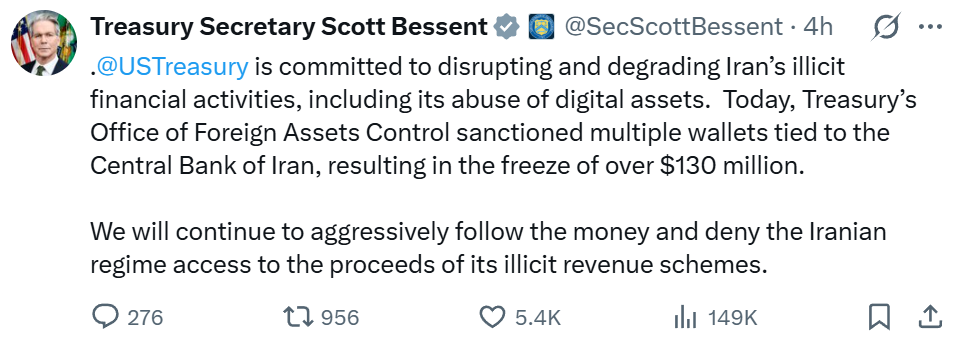
Source: Scott Bessent

The move follows a similar freeze in April, when stablecoin issuer Tether confirmed it had frozen more than $344 million in USDT at the request of US authorities.

In May, Bessent said the US had seized around $1 billion in Iranian crypto assets as part of the US financial pressure campaign against Iran known as Operation Economic Fury, which launched in March 2025.

Related: Iran-linked entities moved $3.8B through CoinEx, TRM says

“Through Economic Fury, the Treasury Department is disrupting the foreign procurement networks that support the Iranian military’s efforts to acquire weapons,” Bessent said in a statement in June.

“Treasury has frozen the Iranian regime’s assets, severely disrupted its economy, and dismantled the Iranian war machine. Treasury will not tolerate any support of the Iranian military.”

Magazine: Thai scammer’s $122M wallet, Japan embraces crypto credit: Asia Express

Related Questions

QWhat was the total value of cryptocurrency frozen by the US that was linked to Iran according to the article?

AThe US government ordered the freezing of more than $130 million, with the specific amount from the Tether freeze being $131 million worth of USDt.

QOn which blockchain platform were the frozen Tether (USDT) wallets holding the Iranian-linked funds located?

AThe frozen wallets were Tron wallets, as indicated by the blockchain investigator Specter.

QWhat reason did US Treasury Secretary Scott Bessent give for the asset freeze targeting Iran?

ABessent stated the US Treasury is committed to disrupting Iran's illicit financial activities, including its abuse of digital assets, and to denying the Iranian regime access to the proceeds of its illicit revenue schemes.

QWhat was the name of the US financial pressure campaign against Iran mentioned in the article, and when did it launch?

AThe campaign is called Operation Economic Fury, and it launched in March 2025.

QHow much in Iranian crypto assets had the US seized by May as part of Operation Economic Fury, according to Scott Bessent?

ABy May, the US had seized around $1 billion in Iranian crypto assets as part of Operation Economic Fury.

Related Reads

Thanks to Dice Rolls, Bitcoin Keys Are Stored Offline, But Not Everyone Will Do It

The article discusses using dice rolls to generate secure Bitcoin wallet seeds, providing entropy independent of potentially flawed hardware random number generators. It explains that each fair dice roll offers about 2.585 bits of entropy, with around 50 rolls needed for a standard 12-word seed phrase and 99+ recommended for higher security. This method gained attention after a vulnerability was revealed in some Coldcard hardware wallets, where a faulty firmware RNG (dating back to 2021) compromised generated keys. The analysis notes that while a dice-generated main seed was safe from this specific flaw, other Coldcard functions (like creating paper wallets, backup keys, or passwords) could still be vulnerable if they used the defective RNG. The piece argues that while dice-based entropy is technically robust, the manual process is error-prone, tedious, and unrealistic for most new users, who might make mistakes in recording or inputting rolls. It concludes that while manual entropy generation should remain an option for advanced users, the long-term goal is to develop reliable, user-friendly hardware and software that securely generates randomness without requiring specialized knowledge. Coldcard users are advised to check their firmware version and replace any secondary secrets (like paper wallet keys) created with vulnerable devices, while also considering multi-signature setups with devices from different manufacturers for added security.

cryptonews.ru3h ago

Thanks to Dice Rolls, Bitcoin Keys Are Stored Offline, But Not Everyone Will Do It

cryptonews.ru3h ago

Trading

Spot
活动图片





