On August 1, cryptocurrency policy journalist Eleanor Terrett reported that Trump is considering a bipartisan counteroffer on ethics issues as the fate of the Digital Asset Market Clarity Act (CLARITY Act) remains uncertain heading into the weekend. The bill aims to provide crypto companies with a federal rulebook, dividing oversight of digital assets between the Securities and Exchange Commission (SEC) and the Commodity Futures Trading Commission (CFTC).
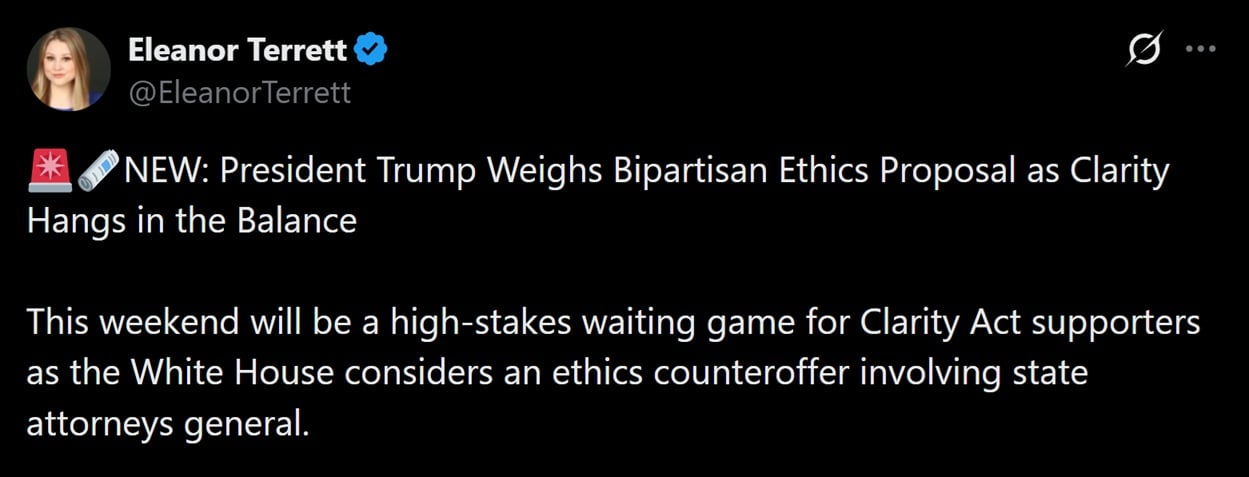
The White House is currently considering whether to adopt a revised enforcement mechanism that would allow state attorneys general, not just the Justice Department, to police crypto-related conflicts of interest among high-ranking officials.
A counterproposal was put forward by Republican Senator Tom Tillis of North Carolina and Democratic Senator Ruben Gallego of Arizona, who refined compromise wording for the ethics provisions and sent it to the White House on July 29. Their plan would allow state authorities to enforce the ban on federal officials issuing or sponsoring digital tokens, closing a gap that Senate Democrats had identified in an earlier version of the bill.
Why Enforcement Became a Sticking Point
The origins of the dispute trace back to an ethics deal reached at the White House on July 21, which handed a package of ethics provisions within the CLARITY Act to Senate Republicans with Trump's personal approval. As Bitcoin.com News reported at the time, negotiators called the deal the last major obstacle for the bill to reach a Senate vote.
That optimism quickly faded as, just two days later, five major loopholes were found in the draft, which Senate Democrats said remained in the text. Among them was a provision granting the Justice Department exclusive authority to enforce the law, simultaneously stripping state attorneys general and private individuals of the right to file lawsuits for violations.
Democratic staff pointed to Trump's cryptocurrency ventures as the reason they wanted oversight independent from the executive branch's own Justice Department. According to tax filings, Trump earned at least $1.4 billion in cryptocurrency income in 2025, including $635 million in royalties from the TRUMP meme coin and $515 million from the sale of World Liberty Financial tokens—projects that Democrats believe should be covered by the ethics package.
Senator Cynthia Lummis, a top Republican negotiator on the bill, expressed frustration with the pace of negotiations, adding:
"After nearly 11 months where we have met virtually every single demand, I genuinely do not know what more my Democratic colleagues need."
White House crypto advisor Patrick Witt struck a similar tone, telling reporters: "Let it be reasonable."
The stakes are high as the CLARITY Act has already passed one chamber of Congress. On July 17, 2025, the House of Representatives passed its version of the bill by a vote of 294 to 134, with more than 70 Democrats crossing over to join Republicans in a vote that remains the most bipartisan digital assets vote in congressional history.
The Senate has yet to hold a full floor vote, and seven Democratic senators rejected the latest draft of the ethics code, leaving the state attorneys general provision as the key bridge to reaching a deal.
One Week Left Until Recess
Senate Majority Leader John Thune made clear a Senate vote is still possible, telling reporters the chamber "will likely vote on the CLARITY Act." However, the bill requires 60 votes to pass, meaning at least seven Democrats would need to cross over to join Republicans, even if the White House agrees to the state attorney general wording.
Industry leaders are watching closely: Coinbase (Nasdaq: COIN) CEO Brian Armstrong wrote earlier this week that "clear rules are almost here," characterizing the bill's progress as reaching the "one-yard line."
Gallego said lawmakers are close to finalizing wording to be introduced in the coming days, and Tillis called the expanded applicability an acceptable starting point. As of the weekend Terrett reported on, neither the White House nor Democratic Senate leadership had publicly confirmed acceptance of the new wording.