Top Korean Crypto Media TokenPost Integrates RootData and Launches Relationship Map Feature

链捕手Published on 2026-07-27Last updated on 2026-07-27

Abstract

Korean leading crypto media TokenPost has integrated RootData's data and introduced a 'Relationship Map' feature on its crypto asset data platform, Token Watch. This new functionality visualizes the connections between projects, investors, and key personnel, specifically focusing on crypto assets listed on the Korean Won market. The map displays the top 30 investors by portfolio and key individuals active across multiple projects. Users can search or filter by type to view specific connections. Relationship lines are categorized into General Investment, Lead Investment, Current Affiliation, and Past Affiliation. This allows users to identify not only who invested but also who led investment rounds, as well as the current or past organizational ties of key figures. Key utilities of the tool include identifying co-investors, frequently co-investing VC combinations, overlapping investors among competing projects, and recurring key personnel. It serves as a reference for investors, a research tool for journalists, and a means for professionals to explore connection pathways. The underlying investor and personnel data is sourced from RootData, with TokenPost editorial verification for some details. The feature is available directly on the web with Korean and English language support. TokenPost emphasized that understanding a project requires insight into its backing network and stated plans to continue optimizing the map. All information is for reference only and not investment...

Author: Han Jae-ho

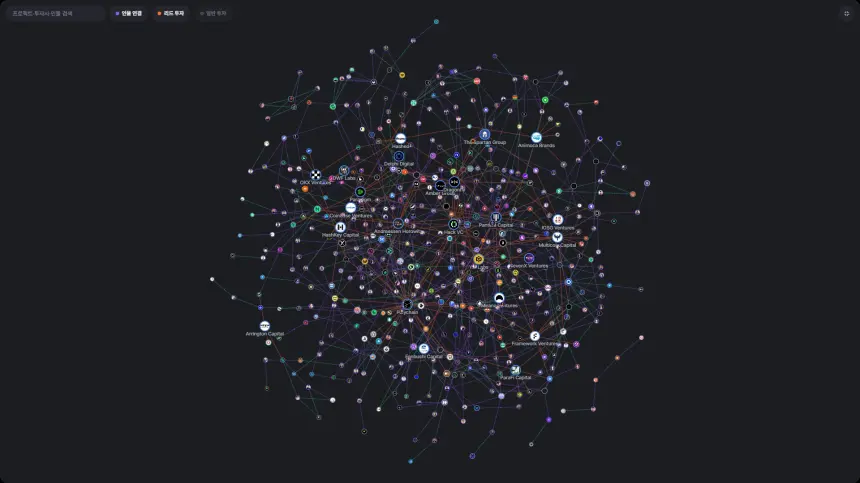
TokenPost's crypto asset data platform "Token Watch" has launched an "Interaction Relationship Map" feature that allows users to visually understand the connections between projects, investors, and key figures at a glance.

The newly added relationship map visualizes the connections between investors and key figures, centered on crypto asset projects listed on the Korean Won market. It allows users to not only view the investment background of individual projects but also explore other projects backed by the same investors, as well as past and present affiliations of individuals, all within the same screen.

The map currently displays the top 30 investors by portfolio and key figures identified across multiple projects. Users can directly search for projects, investors, or people, or filter by type to extract only the desired relationships.

The relationship lines are categorized into ▲General Investment ▲Lead Investment ▲Current Affiliation ▲Past Affiliation. This distinction allows users to confirm not only which investors participated in a specific project but also who led the investment round, and which organizations a key figure is currently or was previously associated with.
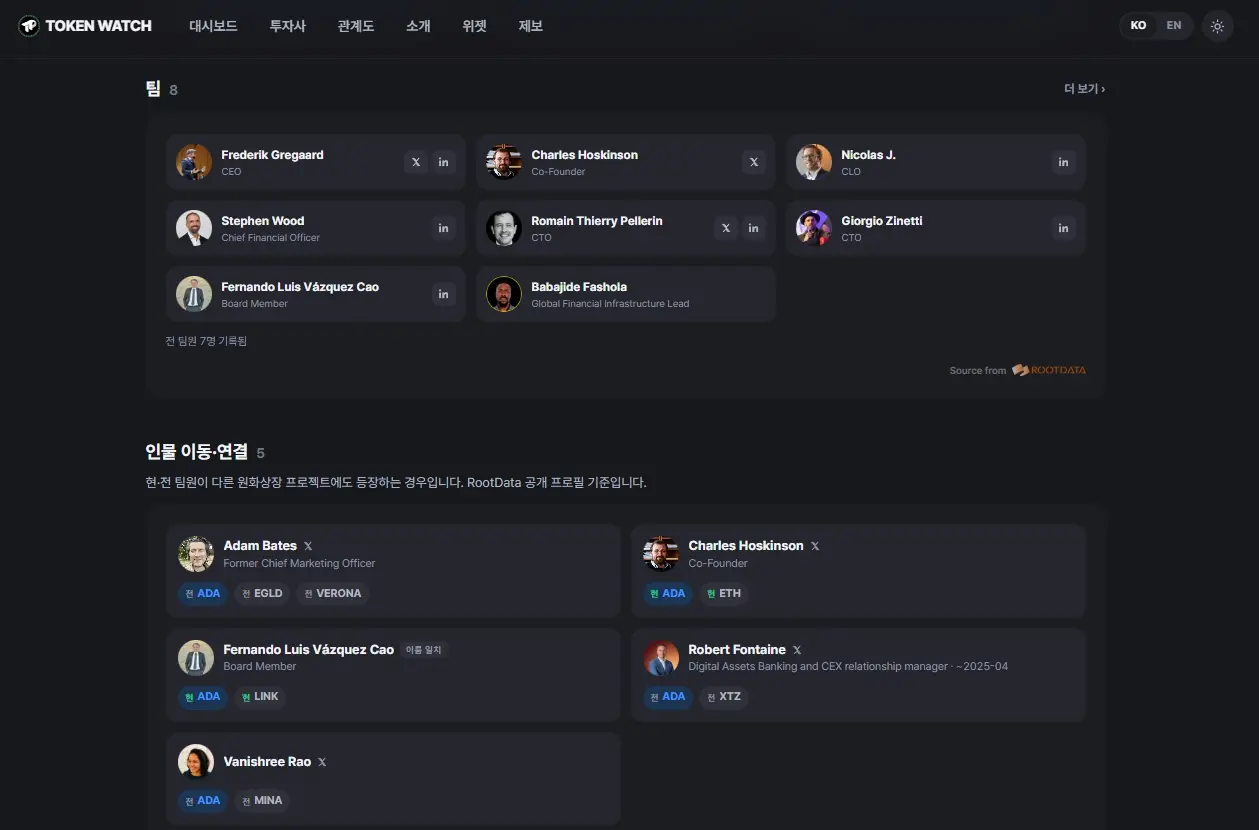
For example, selecting a specific project displays the investors in that project and related individuals. Conversely, focusing on an investor shows that investor's portfolio of Won-listed projects and co-investment relationships with other investors.

Clicking on a node and using the "View centered on this node" function retains only connections within two degrees of separation from the selected object. This allows users to quickly focus on a specific project or investor and narrow down the core relationships, even when the overall network appears complex. The feature also supports dragging nodes and zooming the view.

With this relationship map, Token Watch goes beyond simple investor lists, enabling users to explore the multi-dimensional networks of capital and talent in the crypto asset market.

This feature can be used to uncover information previously difficult to confirm from project-disclosed investor logos alone, such as:

  • Co-investors

  • Frequently co-investing VC combinations

  • Investor overlap between competing projects

  • Key individuals recurring across multiple projects

For investors, it can serve as a reference to verify the background of projects of interest. For journalists and researchers, it can be used as a tool for interviews and analysis to uncover hidden commonalities between projects. For industry professionals and business development personnel, it can be used to view connection paths between projects, investors, and key figures.
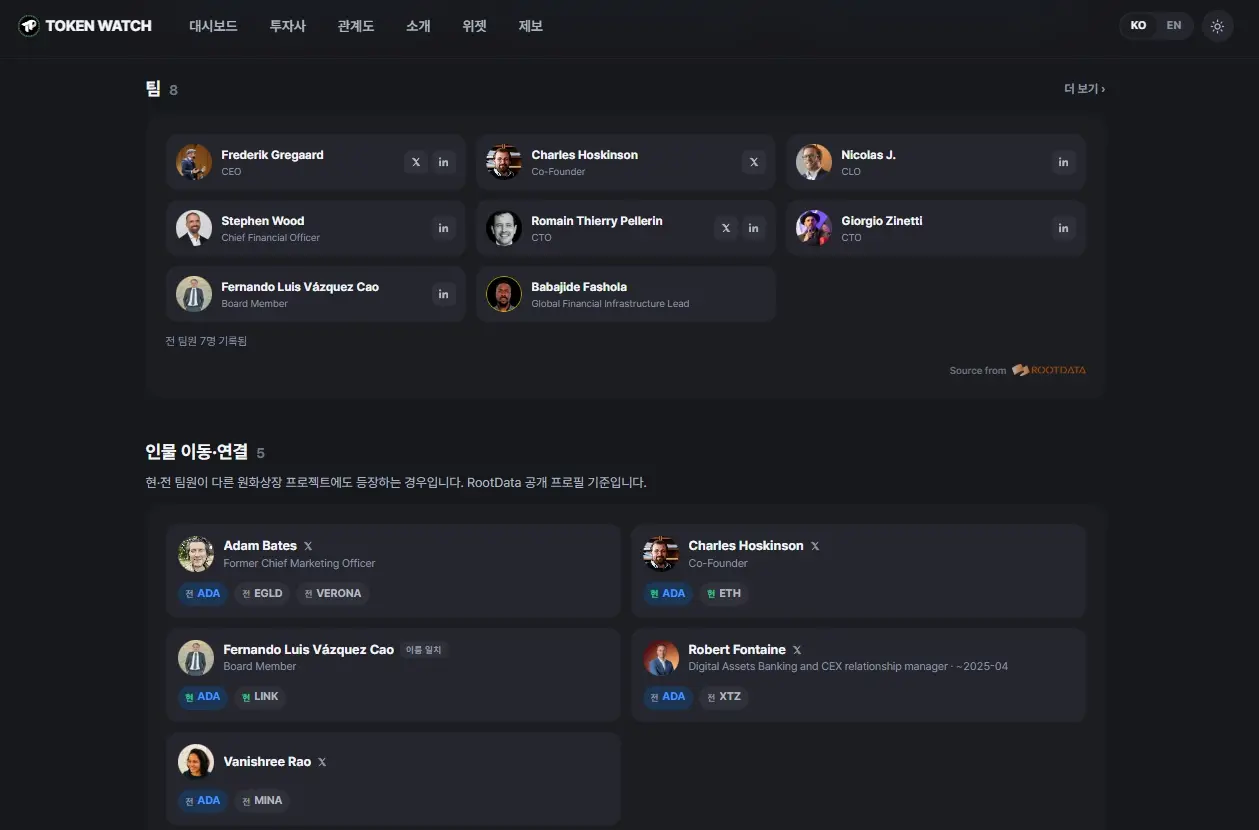
The investor and people data used in the relationship map is based on RootData, with some information (such as whether a project has responded) being based on TokenPost's editorial records. For personal relationships, to reduce false connections for the same individual, associations are made only when X (formerly Twitter) account handles match or when two or more full names are identical.

The Token Watch relationship map requires no additional installation and can be used directly on the web, supporting both Korean and English interfaces.

A TokenPost representative stated, "To understand crypto asset projects, one needs to not only look at prices and listing information but also understand the capital and individuals connected behind them. We will continue to optimize the relationship map to allow intuitive exploration of scattered investment and people information."

Token Watch also notes that the information displayed in the relationship map may differ from the latest actual status due to the timing of data collection and verification, and all data is for reference only, not constituting investment advice.


This article is based on market data and chart analysis and does not constitute investment advice for specific projects.

Trending Cryptos

Related Questions

QWhat new feature has the Korean crypto media TokenPost added to its data platform 'Token Watch'?

ATokenPost has added an 'Interaction Relationship Map' feature to its Token Watch platform. This function visually maps the connections between crypto projects, investors, and key personnel in a single, interactive graph.

QWhat is the primary data source for the investor and personnel information in Token Watch's relationship map?

AThe investor and personnel data used in the relationship map is primarily based on the database provided by RootData. Some additional information, such as whether a project has responded to inquiries, is based on records from TokenPost's editorial team.

QWhat are the four types of relationship lines shown in the relationship map, and what do they indicate?

AThe four types of relationship lines are: 1) General Investment, 2) Lead Investment, 3) Current Affiliation, and 4) Former Affiliation. These distinguish between types of investor participation (lead vs. general) and the current or past organizational ties of key individuals.

QWhat are two examples of insights that users can gain from the relationship map, according to the article?

AAccording to the article, the map helps reveal information that is difficult to confirm from simple project listings, such as: 1) Identifying co-investors and frequent VC co-investment partnerships. 2) Discovering investor overlap between competing projects. It also helps spot key individuals who appear across multiple projects.

QWho are the target users for this relationship map tool, and what are its stated use cases for them?

AThe tool is designed for: 1) Investors, to research the background of interesting projects. 2) Journalists and researchers, as a tool for interviews and analysis to uncover hidden commonalities. 3) Industry professionals and business developers, to trace connection paths between projects, investors, and key figures.

Related Reads

Super Storage Week, How to Value It?

"Super Memory Week: How to Value It?" The week of July 27th marked a pivotal moment for the global memory chip market. On Monday, ChangXin Memory Technology (CXMT, 688825.SH) debuted on the Shanghai STAR Market, with its share price experiencing high volatility and settling around 49 yuan, resulting in a massive market capitalization of over 3.2 trillion yuan. This valuation far exceeds traditional models, as the market priced in CXMT's future potential as China's first large-scale DRAM producer rather than just current fundamentals. This event signaled that China's memory industry is transitioning from a cycle follower to a significant variable in global market valuations. The week also saw major earnings reports from South Korean giants SK Hynix and Samsung Electronics, which highlighted strong profits driven by AI memory demand but also raised questions about future capacity expansion and the cycle's sustainability. The core debate centers on CXMT's true worth: is it based on immediate profits, the current DRAM boom, or China's strategic potential in semiconductors over the next decade? While CXMT has rapidly grown to become the world's fourth major DRAM player, gaps remain with incumbents in profitability, advanced products (like HBM), and technology ecosystems. The divergent market reactions underscored the valuation challenge. Chinese markets priced CXMT for its scarcity and national strategic importance, while overseas markets began to reprice global chip stocks, factoring in potential future competition from Chinese capacity expansion. Ultimately, CXMT's valuation hinges on its ability to convert its massive financing and market-assigned "option value" into tangible technological progress, yield improvements, capacity, and sustained profits in the coming quarters and years.

marsbit12m ago

Super Storage Week, How to Value It?

marsbit12m ago

Trading

Spot

Hot Articles

How to Buy DATA

Welcome to HTX.com! We've made purchasing DATA Network (DATA) simple and convenient. Follow our step-by-step guide to embark on your crypto journey.Step 1: Create Your HTX AccountUse your email or phone number to sign up for a free account on HTX. Experience a hassle-free registration journey and unlock all features.Get My AccountStep 2: Go to Buy Crypto and Choose Your Payment MethodCredit/Debit Card: Use your Visa or Mastercard to buy DATA Network (DATA) instantly.Balance: Use funds from your HTX account balance to trade seamlessly.Third Parties: We've added popular payment methods such as Google Pay and Apple Pay to enhance convenience.P2P: Trade directly with other users on HTX.Over-the-Counter (OTC): We offer tailor-made services and competitive exchange rates for traders.Step 3: Store Your DATA Network (DATA)After purchasing your DATA Network (DATA), store it in your HTX account. Alternatively, you can send it elsewhere via blockchain transfer or use it to trade other cryptocurrencies.Step 4: Trade DATA Network (DATA)Easily trade DATA Network (DATA) on HTX's spot market. Simply access your account, select your trading pair, execute your trades, and monitor in real-time. We offer a user-friendly experience for both beginners and seasoned traders.

894 Total ViewsPublished 2026.07.01Updated 2026.07.01

How to Buy DATA

Discussions

Welcome to the HTX Community. Here, you can stay informed about the latest platform developments and gain access to professional market insights. Users' opinions on the price of DATA (DATA) are presented below.

活动图片