Tokenized Deposits vs. Stablecoins: The Future of Finance is Not Replacement, but Integration

深潮Published on 2025-12-10Last updated on 2025-12-10

Abstract

Tokenized deposits and stablecoins represent complementary, not competing, visions for the future of finance. Banks create money through fractional reserve lending, offering low-cost credit to large clients in exchange for deposits—tokenized deposits extend this on-chain but remain within the banking system’s regulatory and operational framework. Stablecoins, like USDC or USDT, function as permissionless, 24/7 cash-like instruments ideal for global settlements, especially in cross-border payments. The future lies in interoperability: corporations may hold tokenized deposits for credit benefits while using stablecoins for efficient, off-ledger transactions. Smart contracts enable complex, multi-party financial workflows beyond what traditional APIs offer. Rather than one replacing the other, both tokenized deposits (for banking-integrated credit) and stablecoins (for borderless liquidity) will coexist on-chain, enabling a more efficient and accessible financial system. The key is building bridges between these models, not choosing sides.

Author: Simon Taylor

Compiled by: Block Unicorn
Banks create money; stablecoins move it. We need both.

Proponents of tokenized deposits say: "Stablecoins are unregulated shadow banking. Once banks tokenize deposits, everyone will prefer to use banks."

Some banks and central banks love this narrative.

Proponents of stablecoins say: "Banks are dinosaurs. We don't need them on-chain. Stablecoins are the future of money."

Crypto natives particularly favor this story.

Both sides are missing the point.

Banks Provide Cheaper Credit to Their Largest Clients

You deposit $100, it becomes $90 in loans (or even more). This is how fractional reserve banking works. For centuries, it has been an engine of economic growth.

  • A Fortune 500 company deposits $500 million at JPMorgan Chase.

  • In return, they receive a massive line of credit at below-market interest rates.

  • Deposits are the bank's business model, and large corporations know this.

Tokenized deposits bring this mechanism on-chain, but they only serve the bank's own customers. You are still within the bank's regulatory perimeter, still subject to its business hours, processes, and compliance requirements.

For businesses that need low-cost credit lines, tokenized deposits are a good option.

Stablecoins Are Like Cash

Circle and Tether hold 100% reserves, equivalent to $200 billion in bonds. They earn a 4-5% yield but don't pay you anything.

In return, you get funds free from any bank's regulatory oversight. An estimated $9 trillion will be moved cross-border via stablecoins by 2025. Accessible anytime, anywhere with an internet connection, permissionless, 24/7.

No correspondent bank inquiries, no waiting for SWIFT settlement, no "we'll get back to you in 3-5 business days."

For a company that needs to pay an Argentine supplier at 11 PM on a Saturday, stablecoins are a good option.

The Future is Both

A company that wants a good credit line from a bank might also want to use stablecoins as an on-ramp to long-tail markets.

Imagine this scenario:

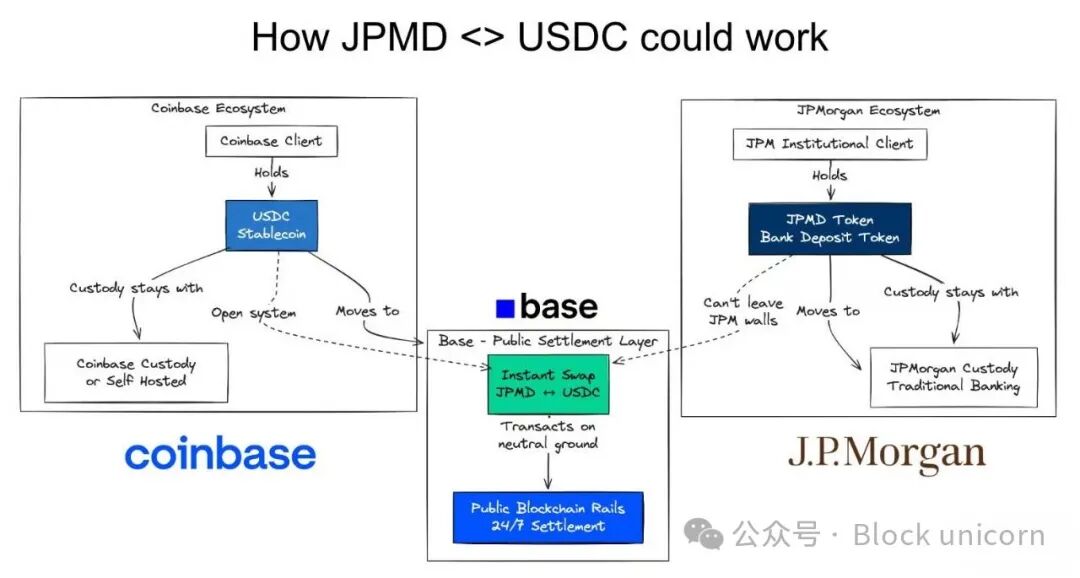
  • A Fortune 500 company holds tokenized deposits at JPMorgan Chase

  • In return, it gets a preferential credit line for its US operations

  • It needs to pay an Argentine supplier who prefers stablecoins.

  • So, it swaps JPMD for USDC.

This is an example of where we are headed.

On-chain. Atomic.

Having both.

Using traditional rails where they work.

Using stablecoins where they don't.

It's not an either/or. It's both.

  • Tokenized deposits → Low-cost credit inside the banking system

  • Stablecoins → Cash-like settlement outside the banking system

  • On-chain swaps → Instant conversion, zero settlement risk

Both have pros and cons.
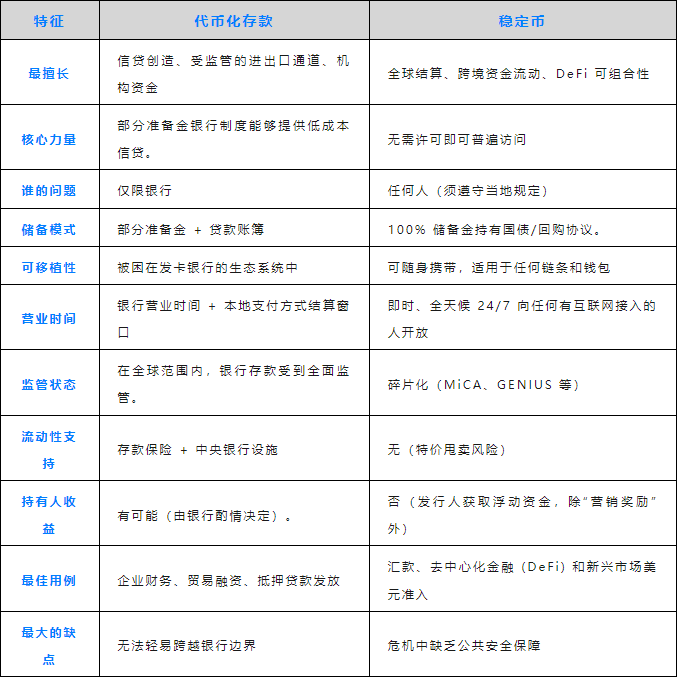
They will coexist.

On-Chain Payments > APIs for Payment Orchestration

Some large banks might say "We don't need tokenized deposits, we have APIs," and in some cases, they are right.

This is precisely the power of on-chain finance.

Smart contracts can build logic across multiple firms and individuals. When a supplier's deposit arrives, a smart contract can automatically trigger inventory financing, working capital financing, FX hedging. Automatically. Instantly. Whether from a bank or a non-bank.

Deposit → Stablecoin → Pay invoice → Downstream payments complete.

APIs are point-to-point. Smart contracts are many-to-many. This makes them ideal for workflows that cross-organizational boundaries. This is the power of on-chain finance.

It's a fundamentally different architecture for financial services.

The Future is On-Chain

Tokenized deposits solve for low-cost credit. Deposits are locked in. Banks lend against them. Their business model remains.

Stablecoins solve for the portability of money. Funds flow permissionless, anywhere. The Global South gets access to dollars. Businesses get fast settlement.

Proponents of tokenized deposits want regulated payment rails only.

Proponents of stablecoins want to replace banks.

The future needs both.

Fortune 500s want massive credit lines from banks AND instant global settlement. Emerging markets want local credit creation AND dollar on-ramps. DeFi wants composability AND real-world asset backing.

Arguing about who wins misses what's happening. The future of finance is on-chain. Tokenized deposits and stablecoins are both necessary infrastructure to get there.

Stop arguing about who wins. Start building interoperability.

Composable money.

Related Questions

QWhat is the core argument of the article regarding tokenized deposits and stablecoins?

AThe article argues that the financial future is not about one replacing the other, but about the fusion and coexistence of both tokenized deposits and stablecoins. Each serves a distinct purpose: tokenized deposits provide low-cost credit within the banking system, while stablecoins offer cash-like, permissionless settlement outside it.

QAccording to the article, what primary benefit do tokenized deposits offer to large corporate clients?

ATokenized deposits offer large corporate clients access to substantial, low-cost credit lines from their banks, as the deposits form the basis of the bank's lending business model.

QWhat key advantage do stablecoins provide for cross-border payments as highlighted in the text?

AStablecoins provide a permissionless, 24/7, and fast settlement method for cross-border payments, enabling transactions like sending money to an international supplier at any time without relying on traditional banking hours or intermediaries like SWIFT.

QHow does the article describe the role of smart contracts in the future of on-chain finance?

AThe article states that smart contracts enable multi-party logic and automation across organizational boundaries. They can automatically trigger actions like inventory financing, working capital loans, and FX hedging upon payment's receipt, making them more powerful than point-to-point APIs for complex financial workflows.

QWhat is the final call to action for the industry presented in the conclusion?

AThe final call to action is to stop arguing about which will win—tokenized deposits or stablecoins—and instead start building interoperability to create a future of composable money on-chain.

Related Reads

Just Now, Chinese AI Enters Top 2 in Global Programming, Only Claude Remains Ahead

**China's AI Ranks Second Globally in Programming, Trailing Only Claude** Today, Alibaba's Qwen3.7-Max achieved a score of 1541 on the Code Arena benchmark, securing fourth place globally and surpassing top models like GPT-5.5 and Gemini 3.5 Flash. Among the top positions, it is now the only non-Claude model, placing second overall after Anthropic's Opus models. Before this official ranking, Qwen3.7-Max had already gained recognition overseas. In practical tests, it outperformed rivals on tasks like creating a self-training Tetris AI and generating complex 3D models, often at a significantly lower cost. Developers praised its ability, especially when integrated with tools like Hermes Agent and OpenCode, to effectively replace models such as GPT-5.5. In a hands-on challenge to create a 3D racing game from a detailed prompt, Qwen3.7-Max delivered a fully playable HTML file in the first attempt, requiring only minor bug fixes. It uniquely included a start menu and sound effects—details missed by other models. While competitors like Gemini 3.5 Flash and Claude Opus 4.6 produced less polished or functional versions, and GPT-5.5 had its own quirks, Qwen3.7-Max stood out for its initial completeness and playability. This performance stems from its design as an "Agent Base Model," built for long-duration, autonomous task execution. Internal tests show it can run continuously for 35 hours, making over 1158 tool calls without context degradation or instruction drift. Key technical advancements include "environment expansion" training, which improves adaptability across different frameworks, and "long-horizon autonomous execution" training, enabling sustained strategic decision-making. By entering the top tier of the programming arena, Qwen3.7-Max demonstrates that Chinese AI models are not just catching up but are becoming defining competitors, challenging the long-standing dominance of Silicon Valley in this field.

marsbit21m ago

Just Now, Chinese AI Enters Top 2 in Global Programming, Only Claude Remains Ahead

marsbit21m ago

From a Lunch Table to an Infinite Universe: Fei-Fei Li Bets on AI's Next Dimension

From a Lunch Table Conversation to an Infinite Universe: Fei-Fei Li Bets on AI's Next Frontier - Spatial Intelligence In an era dominated by large language models, AI pioneer Fei-Fei Li argues that true understanding requires spatial intelligence — the ability to perceive, reason, and interact within the physical 3D/4D world. She points to evolutionary history: spatial perception drove the Cambrian explosion 540 million years ago, while language is a far more recent, inherently "lossy" way to encode reality. Current models struggle with basic spatial tasks a child can do, like counting chairs in a video. Her company, World Labs, is pioneering this shift with "Marble," a model that generates navigable, consistent 3D worlds from text, images, or simple 3D inputs—distinct from video generators like Sora. Though smaller than models like GPT-5, due to scarce 3D data and early-stage scaling laws, Marble is already used in gaming, robot training (by NVIDIA), architectural design, and personalized therapy for conditions like OCD and acrophobia. Li envisions this technology enabling "infinite universes" for creativity, social interaction, and more. However, she cautions against utopian or dystopian extremes, advocating for a measured vision where AI enhances human dignity and prosperity, akin to how electricity transformed civilization. The journey is long — as evidenced by the 20-year path to viable autonomous vehicles — but the direction is clear: for AI to move from merely talking about the world to truly understanding and acting within it.

marsbit24m ago

From a Lunch Table to an Infinite Universe: Fei-Fei Li Bets on AI's Next Dimension

marsbit24m ago

X Stock Market Investment & Trading: A 'Noise-Free' List of 50 Key Accounts

Titled "A 'Noise-Reduction' List of 50 Top US Stock Market Influencers on X," this article curates a selection of accounts for investors seeking quality information beyond follower counts. The list prioritizes accounts that have consistently discussed US stocks, ETFs, earnings, macroeconomics, options, and tech/AI/semiconductor topics over the past 90 days. Selection criteria focused on genuine informational value, stable analytical frameworks over mere news aggregation, and a clear relevance to US equity markets, with tighter filtering for crypto-heavy accounts. The final 50 accounts are categorized into three groups: - **Core US Stocks/Trading (31 accounts)**: Covering market trends, individual stocks, earnings, valuation, options, macroeconomics, and trading strategies. - **Tech/AI/Semiconductors (18 accounts)**: Focused on tech stocks, AI supply chains, semiconductor cycles, data centers, and cloud capital expenditure. - **News Source (1 account)**: Useful as a news radar, not for standalone decision-making. Presented alphabetically by handle, the list includes analysts, traders, and researchers such as @amy6tina (options/CFA), @dylan522p (semiconductors/AI infrastructure), @gerberkawasaki (tech stocks), @jimcramer (market commentary), and @tengyanai (semiconductors/AI trends). The article suggests using the list to: 1) complete one's information sources on US markets and specific sectors, 2) observe narrative linkages between AI, semiconductors, earnings, macro liquidity, and stock prices, and 3) "de-noise" and enhance the quality of one's X feed. It clarifies this is not investment advice or an endorsement, but a snapshot of content relevance and informational value for US equity investors.

marsbit30m ago

X Stock Market Investment & Trading: A 'Noise-Free' List of 50 Key Accounts

marsbit30m ago

Trading

Spot
Futures
活动图片