They Knew the TGA Game of the Year Winner in Advance and Made Tens of Thousands of Dollars

marsbitPublished on 2025-12-12Last updated on 2025-12-12

Abstract

Summary: The 2025 TGA (The Game Awards) ceremony concluded with the indie game "Light & Shadow: Expedition 33" making history by winning both "Best Independent Game" and the coveted "Game of the Year (GOTY)" award, breaking a long-standing TGA curse. Prior to the event, the prediction market platform Polymarket had already listed the topic, with "Light & Shadow's" probability of winning GOTY consistently above 80% for over a month. Several traders, including users DieselDiesel, trumpnogo, and kasae, placed unusually large, concentrated bets on this outcome weeks in advance, a move that would have resulted in massive losses if wrong. Their bets appeared to be "all-in" convictions rather than calculated risks. Just three hours before the GOTY announcement, after the "Best Indie" award was given to the same game, a mysterious user (bobo9997) deposited $10,000 and bet it all on "Yes" for "Light & Shadow" winning GOTY at a price of $0.98 per share—a bet that would yield less than $200 in profit if correct. The final award confirmed the predictions. The early traders realized significant profits, with their winnings from this single event representing a large percentage of their total historical earnings on the platform (e.g., 176% for DieselDiesel). The article suggests these traders likely had insider knowledge of the results, using the prediction market as a anonymous, low-risk method to monetize their confidential information, turning a guaranteed outcome into thousands of d...

Today, the highly anticipated The Game Awards (TGA) ceremony finally concluded.

Let's jump back to 3 hours before the awards ended. At that time, the "Best Independent Game" had just been awarded to the popular title "Light & Shadow: Expedition 33," but this instead made many fans worried: historically, no game has ever won both the "Best Independent Game" and the "Game of the Year (GOTY)" awards at TGA. As a GOTY favorite, "Light & Shadow" now needed to break the curse that had existed since TGA's inception and create an unprecedented moment in gaming history.

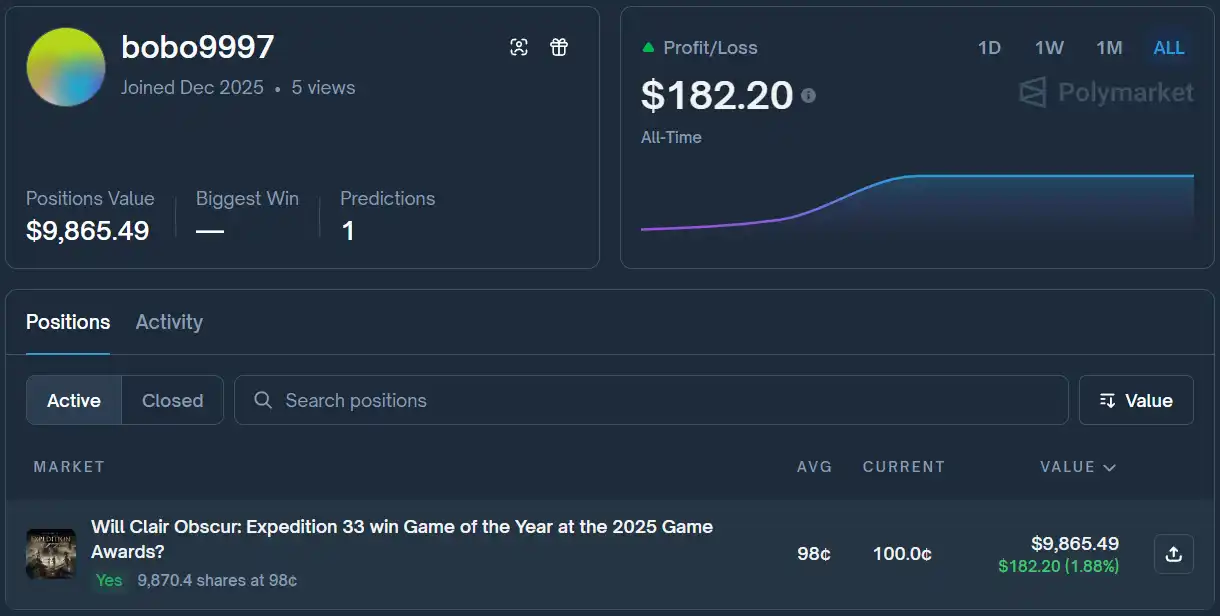
Just as everyone was filled with anxiety, a mysterious individual registered an account on a seemingly unrelated "prediction market" platform and deposited ten thousand dollars. He found the topic "Will Light & Shadow win the 2025 GOTY?" on the platform and bet the entire ten thousand dollars on "Yes." At that time, the price for "Yes" was $0.98 per share, meaning that even if "Light & Shadow" did indeed make gaming history by winning both awards, his ten-thousand-dollar bet would only yield a profit of less than two hundred dollars. However, if "Light & Shadow" failed to break the TGA curse, the probability of the topic would instantly drop to 0, which meant his newly deposited ten thousand dollars would be wiped out. What kind of狂热 fan of "Light & Shadow" would take such a reckless risk? And how do prediction markets attract game fans from around the world to guess the winners in advance?

The "Pre-Determined" Script

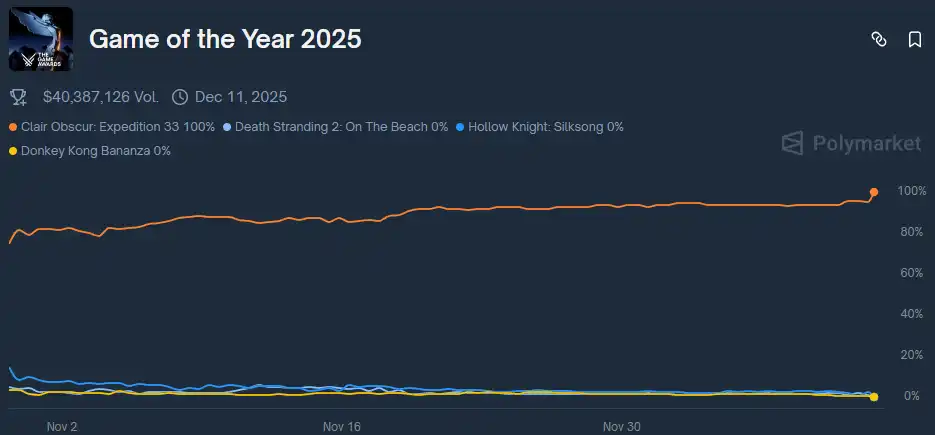
As early as October 30th, a month and a half before the awards ceremony, the prediction market Polymarket had already launched the topic for "2025 Game of the Year." The probability of "Light & Shadow" winning was firmly pinned above 80% from the start, while the probabilities of other highly anticipated AAA titles winning were suppressed below 10%. Because such a one-sided situation usually only occurs in events where the outcome is already certain, this anomaly made many traders smell something unusual: this wasn't just optimism, this was certainty.

Among these traders with a "certain" attitude, a few operated in an extremely unified style, hinting at the possibility of insider trading. DieselDiesel, trumpnogo, and kasae all bet on "Light & Shadow wins TGA 2025 GOTY" when the probability was around 85%, and the amounts they bet were dozens or even hundreds of times larger than their usual bets. This highly concentrated,反常 betting behavior meant they faced enormous risks: if "Light & Shadow" ultimately did not win, they would not only have to give up all past profits but also suffer huge losses.

As time progressed and the probability of "Light & Shadow" winning increased, they did not sell any of their held shares to realize profits. Even 3 hours before the award announcement, after the "Best Independent Game" award had been announced, they, already significantly浮盈, remained motionless as if they knew the future, betting their entire account balance alongside the mysterious individual mentioned at the beginning for that final, tiny profit.

The Historic Award Moment and the Cashing Out of Insiders

Amid doubts and unease, TGA played out exactly like the script these few traders had arranged over a month ago, dispelling the final suspense: the highly anticipated "Light & Shadow," having already won the "Best Independent Game" award, broke the historical curse and won the Game of the Year award.

And while players on one side cheered and celebrated, the mystery was solved in the prediction market on the other side: the three traders who had been convinced since a month ago that "Light & Shadow" would win confirmed their role of "foreseeing the future" and realized huge profits:

DieselDiesel made a profit of $5,357 in this event, accounting for 176% of all his other trading profits;

trumpnogo made a profit of $2,958 in this event, accounting for 62% of all his other trading profits;

kasae made a profit of $1,658 in this event, accounting for 220% of all his other trading profits.

And the mysterious individual (bobo9997) mentioned at the beginning, because he was certain that "Light & Shadow" would make history," used ten thousand dollars to win a "whopping" $200.
"Even Those Who Foresee the Future Need to Eat"

The most noteworthy common point among these four traders is that while many players doubted whether "Light & Shadow" could break the historical curse, they were "willing to risk" nearly $100,000 in positions to "gamble" on this historic moment happening, and this "gamble" brought them less than two thousand dollars in combined profits.

Now, let's assume these "foreseers" are TGA vote auditing staff. As insiders with an annual income of $100,000, if they wanted to monetize the information in a traditional way, they would need to sell the insider information to media platforms, but this represents various potential fines, dismissal, and even imprisonment. However, with the emergence of prediction markets, they can use anonymity to convert information asymmetry into real money equivalent to 1 to 3 months of their disposable income.

When we view them as assumed insiders who already knew the result in advance, everything becomes clear: being 100% sure that "Light & Shadow" would be GOTY, their final "bet" was just using the one-hour wait time before the announcement to换取 seemingly huge risks but实际上毫无变数的 two thousand dollars in profit. This kind of seemingly high-risk but实际上毫无变数的赚钱 "bet" was almost impossible to encounter before platforms like prediction markets appeared.

However, with the popularity of Polymarket, how many people can resist converting information into real money anonymously?
Related Questions

QWhat is the name of the prediction market platform mentioned in the article where users bet on the TGA 2025 Game of the Year outcome?

AThe prediction market platform mentioned is Polymarket.

QWhich game won both the 'Best Indie Game' and 'Game of the Year (GOTY)' awards at TGA 2025, breaking a historical curse?

AThe game that won both awards is 'Light and Shadow: Expedition 33'.

QWhat were the usernames of the three traders who made unusually large bets on 'Light and Shadow' winning GOTY and profited significantly?

AThe three traders were DieselDiesel, trumpnogo, and kasae.

QHow much did the mysterious user 'bobo9997' profit from betting $10,000 on 'Light and Shadow' winning GOTY at the last moment?

AThe user 'bobo9997' profited approximately $200 from the bet.

QWhat is the suggested explanation in the article for the traders' confident and large bets on 'Light and Shadow' winning GOTY?

AThe article suggests that the traders likely had insider information, possibly from being involved in the TGA vote auditing process, which they anonymously monetized through the prediction market.

Related Reads

The AI Industrial Revolution: Where Are We Now?

This article explores the current stage of the AI industrial revolution, arguing we are still merely attaching new tools to old workflows rather than fundamentally redesigning production. The author compares this to the early Industrial Revolution, where factories simply replaced waterwheels with steam engines without changing their core structure. Similarly, today we embed AI chat windows into existing software but leave organizational processes unchanged. While massive investment floods into AI infrastructure (data centers, chips), akin to railway manias of the past, the real transformation lies in "dismantling the old workshop"—reorganizing companies around AI. Examples include Notion's use of hundreds of AI Agents and Y Combinator's experiments with self-improving AI systems that operate autonomously. The author notes a critical gap: while China has vast AI user growth, few companies have rebuilt core workflows. AI is beginning to impact entry-level jobs, and early adopters are gaining a compounding advantage. The conclusion is that the pivotal moment will not be the invention of better models, but when organizations decide to tear down old structures and rebuild around AI, shifting the bottleneck from human coordination to computing power. The future workplace and job titles are yet to be defined, but the imperative is to move away from legacy processes and position oneself where the new "railway" is being built.

marsbit4m ago

The AI Industrial Revolution: Where Are We Now?

marsbit4m ago

Morning Post | Hyperliquid Launches Off-chain Event Prediction Market Contract; Strategy Completes $1.5 Billion Debt Buyback; Kelp DAO Announces rsETH Fully Restored

Crypto Market Digest (May 27, 2026) Ondo Finance's founder Nathan Allman has passed away, with President Ian De Bode taking over as CEO. In regulatory news, Hong Kong authorities concluded a consultation on virtual asset service provider licensing, aiming to align rules with traditional finance. Kelp DAO announced its rsETH token has fully recovered five weeks after a $293 million hack by Lazarus Group, though the incident caused significant damage to DeFi lending protocols like Aave. Key industry developments include Hyperliquid launching off-chain event prediction market contracts, and the CME introducing futures for Avalanche and Sui. A report highlights the rise of AI Agent payments, with over $73 million settled on-chain in a year, predominantly using USDC. Meanwhile, blockchain detective ZachXBT exposed market manipulation involving several BSC tokens. In investment news, a firm referred to as "Strategy" completed a $1.5 billion debt buyback. Political contributions from the crypto sector for the 2026 U.S. elections have surpassed $500 million, heavily favoring Republican candidates. BitMEX founder Arthur Hayes revealed Zcash is his second-largest holding, citing the growing necessity for monetary privacy. The digest concludes with trending memecoins on Ethereum, Solana, and Base networks, and highlights in-depth articles covering the impending SpaceX IPO, Polymarket's regulatory challenges, and an analysis of the on-chain treasury landscape.

链捕手5m ago

Morning Post | Hyperliquid Launches Off-chain Event Prediction Market Contract; Strategy Completes $1.5 Billion Debt Buyback; Kelp DAO Announces rsETH Fully Restored

链捕手5m ago

Just Now, Chinese AI Enters Top 2 in Global Programming, Only Claude Remains Ahead

**China's AI Ranks Second Globally in Programming, Trailing Only Claude** Today, Alibaba's Qwen3.7-Max achieved a score of 1541 on the Code Arena benchmark, securing fourth place globally and surpassing top models like GPT-5.5 and Gemini 3.5 Flash. Among the top positions, it is now the only non-Claude model, placing second overall after Anthropic's Opus models. Before this official ranking, Qwen3.7-Max had already gained recognition overseas. In practical tests, it outperformed rivals on tasks like creating a self-training Tetris AI and generating complex 3D models, often at a significantly lower cost. Developers praised its ability, especially when integrated with tools like Hermes Agent and OpenCode, to effectively replace models such as GPT-5.5. In a hands-on challenge to create a 3D racing game from a detailed prompt, Qwen3.7-Max delivered a fully playable HTML file in the first attempt, requiring only minor bug fixes. It uniquely included a start menu and sound effects—details missed by other models. While competitors like Gemini 3.5 Flash and Claude Opus 4.6 produced less polished or functional versions, and GPT-5.5 had its own quirks, Qwen3.7-Max stood out for its initial completeness and playability. This performance stems from its design as an "Agent Base Model," built for long-duration, autonomous task execution. Internal tests show it can run continuously for 35 hours, making over 1158 tool calls without context degradation or instruction drift. Key technical advancements include "environment expansion" training, which improves adaptability across different frameworks, and "long-horizon autonomous execution" training, enabling sustained strategic decision-making. By entering the top tier of the programming arena, Qwen3.7-Max demonstrates that Chinese AI models are not just catching up but are becoming defining competitors, challenging the long-standing dominance of Silicon Valley in this field.

marsbit1h ago

Just Now, Chinese AI Enters Top 2 in Global Programming, Only Claude Remains Ahead

marsbit1h ago

From a Lunch Table to an Infinite Universe: Fei-Fei Li Bets on AI's Next Dimension

From a Lunch Table Conversation to an Infinite Universe: Fei-Fei Li Bets on AI's Next Frontier - Spatial Intelligence In an era dominated by large language models, AI pioneer Fei-Fei Li argues that true understanding requires spatial intelligence — the ability to perceive, reason, and interact within the physical 3D/4D world. She points to evolutionary history: spatial perception drove the Cambrian explosion 540 million years ago, while language is a far more recent, inherently "lossy" way to encode reality. Current models struggle with basic spatial tasks a child can do, like counting chairs in a video. Her company, World Labs, is pioneering this shift with "Marble," a model that generates navigable, consistent 3D worlds from text, images, or simple 3D inputs—distinct from video generators like Sora. Though smaller than models like GPT-5, due to scarce 3D data and early-stage scaling laws, Marble is already used in gaming, robot training (by NVIDIA), architectural design, and personalized therapy for conditions like OCD and acrophobia. Li envisions this technology enabling "infinite universes" for creativity, social interaction, and more. However, she cautions against utopian or dystopian extremes, advocating for a measured vision where AI enhances human dignity and prosperity, akin to how electricity transformed civilization. The journey is long — as evidenced by the 20-year path to viable autonomous vehicles — but the direction is clear: for AI to move from merely talking about the world to truly understanding and acting within it.

marsbit1h ago

From a Lunch Table to an Infinite Universe: Fei-Fei Li Bets on AI's Next Dimension

marsbit1h ago

Trading

Spot
Futures
活动图片