The US Dollar Challenges Japan's Intervention Threshold: Will the Carry Trade Collapse Again?

marsbitPublished on 2026-06-23Last updated on 2026-06-23

Abstract

The U.S. dollar remains strong, with the Dollar Index holding above 101 as Federal Reserve policy expectations turn more hawkish. The 2-year Treasury yield is near highs from early 2025, boosting the dollar's appeal against currencies like the euro and pound. The USD/JPY pair is approaching a critical level near 161.96, which would mark the yen's weakest point since December 1986. This pressure stems from the widening interest rate differential between the U.S. and Japan. Japanese authorities have issued verbal warnings about potential intervention to support the yen, but uncertainty remains over if and when action will be taken. Oil prices rebounded after a recent drop, introducing renewed inflation concerns. While not the main driver, higher oil prices could further fuel expectations that the Fed will maintain a restrictive policy. Market focus centers on three key issues: whether the Fed will follow through on rate hike expectations, the possibility of Japanese FX intervention, and the trajectory of oil prices. The resolution of these factors will determine whether the current strong dollar trend persists or gives way to increased volatility.

During the session on June 23rd, the US Dollar Index remained above 101, with USD/JPY approaching a key level near 161.96. This level is under scrutiny because a break above it would send the yen into its weakest territory since December 1986. The main theme in the forex market is tightening: Fed policy expectations have turned hawkish again, short-term US Treasury yields are elevated, and the yen's weakness is pushing the question of potential Japanese intervention to the forefront for traders. For investors, this isn't just about a stronger dollar; it's about global funding costs, carry trades, and pressure on Asian currencies.
Fed Expectations Turn Hawkish, Dollar Holds Above 101

As of the June 23rd session, the US Dollar Index was around 101.01, not far from the week's high of 101.13. The DXY, which measures the dollar against a basket of major currencies, regained strength, with the most direct driver being a shift in Federal Reserve policy expectations.

According to Reuters, the Fed held the federal funds rate steady at 3.50% to 3.75% on June 17th, but the latest dot plot showed that nine officials project a rate hike before the end of 2026. The statement also removed wording hinting at a rate cut this year. This change made it harder for markets to continue trading on easing expectations, and futures markets have significantly increased bets on the possibility of a hike within the year or before September.

Short-term US Treasury yields provided concurrent support. The 2-year yield hovered between 4.22% and 4.23% during the session, near its highest level since February 2025. For forex markets, rising short-end yields increase the appeal of dollar-denominated assets, especially when the policy outlooks of other major economies like Japan and Europe remain relatively dovish.

OCBC FX strategist Sim Moh Siong believes that rising yields and more hawkish Fed expectations are jointly supporting the dollar. If the dollar index further breaks above its 14-month high of 101.97, the dollar could gain fresh upward momentum. This level makes the area above 101 not just a simple integer threshold but a technical zone for short-term funds to observe whether the dollar can continue strengthening.

Other major currencies are also under pressure. During the session, the euro was around 1.1423, sterling around 1.3246, and the Australian and New Zealand dollars around 0.6991 and 0.5704, respectively. Remarks from ECB President Lagarde downplaying secondary inflation concerns and political changes in the UK affecting sterling did not alter the day's main theme. The market focused more on whether US rate expectations would continue to rise.

Yen Approaches 161.96, Japan's Verbal Warnings Intensify

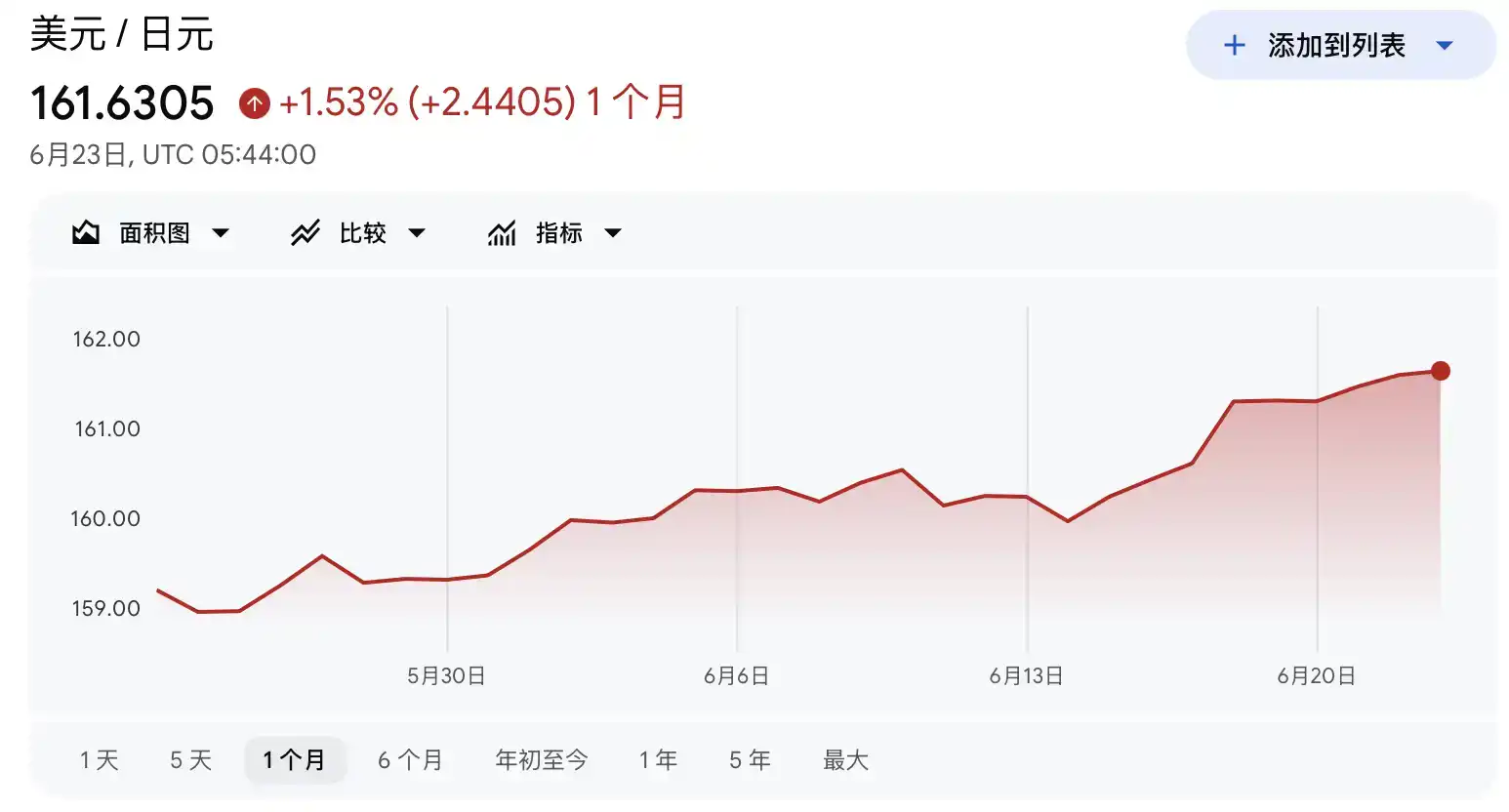
The yen is one of the most sensitive assets in this round of dollar strength. As of the June 23rd session, USD/JPY was around 161.59, having touched 161.93 intraday, just a step away from the 161.96 level. According to The Japan Times and Reuters, a break above approximately 161.95 to 161.96 would mean the yen falls to its lowest level since December 1986.

The core reason for the yen's sustained pressure remains the US-Japan interest rate differential. Renewed bets on US rate hikes, coupled with the relatively slow pace of policy normalization by the Bank of Japan, have widened the yield advantage for investors holding dollar assets, increasing selling pressure on the yen. A weak yen benefits Japanese exporters' profit conversion but also raises import costs, particularly for energy and food, putting pressure on household purchasing power and inflation expectations.

Therefore, the stance of Japan's Ministry of Finance has become a market focus. Japanese Finance Minister Katayama Satoki recently issued verbal warnings about yen volatility, stating that Japan is prepared to act if necessary. This has led traders to speculate that Japanese authorities might intervene in the currency market by buying yen and selling dollars as it nears historic lows.

However, intervention remains at the expectation stage and is not a confirmed policy action. Historical experience shows that Japanese FX intervention can typically create sharp volatility in the short term, forcing short-covering. If the US-Japan yield gap continues to widen, a single intervention is unlikely to fundamentally change the USD/JPY trend. Japanese authorities are more likely to alter the pace of appreciation rather than completely reverse the trend.

This makes the area near 161.96 a dual threshold. On one side, yield differentials and dollar strength continue to push USD/JPY higher; on the other, the closer it gets to the nearly 40-year low, the higher the policy intervention risk. For short-term traders, this level is not only a technical point but also a policy risk point.

Oil Price Rebound Brings Inflation Concerns Back into Trading

Beyond forex, oil prices also re-entered the market spotlight during the same trading session. According to Reuters, oil prices fell about 4% on June 22nd on news of progress in US-Iran talks and related reports about the opening of the Strait of Hormuz passage. The subsequent rebound in oil prices shows the market is still waiting for clearer geopolitical and supply signals.

The Strait of Hormuz is one of the world's most crucial oil transport chokepoints, with about one-fifth of seaborne oil passing through it. Once expectations for resumed passage strengthen, oil supply risks decrease, typically pressuring prices. However, as long as progress in talks, shipping security, and actual supply restoration are not fully confirmed, oil prices are prone to fluctuate between news headlines.

The reason oil prices affect dollar trading is that they re-enter inflation expectations and central bank policy assessments. If the oil price rebound persists, markets will find it harder to believe inflationary pressures have subsided, and the Fed's rationale for maintaining higher rates or even hiking would strengthen. If oil prices decline again, some inflation concerns might ease.

Currently, oil prices are more of a supplementary clue alongside the dollar and US Treasury yields rather than the main theme in the forex market that day. However, in an environment where Fed expectations have already turned hawkish, any sustained energy price rebound could amplify market sensitivity to inflation.

The Strong Dollar Trade Still Hinges on Three Unresolved Questions

The market's most immediate question is whether the Fed will actually hike rates within the year or before September. Futures market bets have clearly heated up, but this is not a Fed commitment and ultimately depends on upcoming inflation, employment, and growth data. If data continues to support a hawkish stance, the dollar may find further support. If inflation falls or employment weakens, rate hike bets could cool rapidly.

The second question lies with Japan. The closer USD/JPY gets to 161.96, the stronger intervention expectations become. However, whether Japanese authorities will act, the scale of any action, and whether the US will cooperate all remain uncertain. What the market truly worries about is not the verbal warnings themselves but the potential for instant volatility that intervention could bring.

The third question comes from oil prices. There is still distance between expectations regarding US-Iran talks, the Strait of Hormuz passage opening, and actual supply restoration. If oil prices continue to rebound, they will rekindle inflation concerns, in turn supporting US Treasury yields and the dollar.

For now, this market move is still primarily driven by US rate expectations. Whether the dollar index can break above 101.97, whether USD/JPY will surpass 161.96, and whether Japanese authorities will move from verbal warnings to concrete action will determine whether the forex market continues with a strong dollar or enters a period of more intense two-way volatility.

Related Questions

QWhy is the 161.96 level particularly significant for USD/JPY?

AThe 161.96 level is significant because if USD/JPY breaks above it, the yen would enter its weakest trading range since December 1986. This makes it a key technical level and a potential trigger for intervention by Japanese authorities.

QWhat are the main drivers behind the recent strengthening of the US dollar?

AThe main drivers are a shift towards more hawkish Federal Reserve policy expectations, with market pricing indicating increased chances of a rate hike later in the year, and high short-term US Treasury yields (like the 2-year), which enhance the appeal of dollar-denominated assets.

QWhat is the market's primary concern regarding a potential Japanese intervention in the FX market?

AThe primary concern is not the intervention itself, but the sharp and volatile price swings it could cause in the short term, forcing traders to quickly adjust their positions. The market doubts a single intervention could sustainably reverse the USD/JPY trend if the US-Japan interest rate differential continues to widen.

QHow does the oil price factor into the current market dynamics for the dollar?

AOil price rebounds can reintroduce inflation concerns into the market. In an environment where the Fed has already turned more hawkish, rising oil prices could amplify these concerns, potentially providing further support for the case for higher US interest rates and, by extension, the US dollar.

QWhat three unresolved questions are currently key for the strong dollar trade according to the article?

A1. Whether the Federal Reserve will actually hike rates later this year. 2. Whether and how Japanese authorities will intervene as USD/JPY approaches key historical levels. 3. The direction of oil prices, as sustained increases could reinforce inflation fears and support the dollar.

Related Reads

Quantum Computing "Manhattan Project" Unveiled: Is the Encryption Industry at a Critical Turning Point?

"Quantum Computing 'Manhattan Project' Launched: Is the Crypto Industry at a Critical Juncture?" On June 22, former U.S. President Donald Trump signed two executive orders. The first mandates all federal agencies upgrade their cryptographic systems to new, quantum-resistant standards by 2030. The second orders the Department of Energy to lead the development of a national quantum computer, signaling a shift from laboratory research to a state-enforced national agenda. This creates a hard deadline. A powerful quantum computer could break current encryption. The threat is compounded by "harvest now, decrypt later" attacks, where encrypted data is stored today for future decryption. Federal agencies must appoint migration officers and complete post-quantum cryptography (PQC) upgrades for key establishment by 2030 and digital signatures by 2031. Procurement rules will also be changed, forcing government contractors to comply. The crypto industry faces a direct threat. Bitcoin's ECDSA signatures are theoretically vulnerable. Research indicates millions of Bitcoin with exposed public keys are at risk if quantum computers advance. While projects like Bitcoin Quantum testnets and efforts by Ethereum, Solana, NEAR, and Zcash are exploring quantum-resistant solutions, achieving consensus in decentralized networks remains a major challenge. The centralized U.S. government has started a 5-year countdown. For decentralized crypto networks, the real test is whether they can complete this anti-quantum upgrade before the theoretical threat becomes a practical reality.

Foresight News4m ago

Quantum Computing "Manhattan Project" Unveiled: Is the Encryption Industry at a Critical Turning Point?

Foresight News4m ago

Coin Stock Barometer丨BitMine's Total Assets and Investment Reach $10.7 Billion, Exceeding ~$9.3 Billion Floating Loss; Strategy Buys Only 520 BTC, Strive Adds Positions Against the Trend (June 23)

This article provides a weekly market update on "coin-equity" trends, focusing on listed companies holding major cryptocurrencies. Key highlights include: **General Market Trends:** Global equities, particularly in the US, Japan, and South Korea, faced significant sell-offs, led by large tech and AI-related stocks. Analysts cite profit-taking and a shift from hype-driven to performance-driven valuation for AI companies. Market focus is on upcoming Micron Technology's earnings. **Cryptocurrency Treasury Updates:** * **Bitcoin (BTC):** Net weekly BTC purchases by listed companies (excluding miners) totaled approximately $86 million, down 13.97% from the prior week. Strategy (formerly MicroStrategy) purchased only 520 BTC for ~$34.9 million, while Strive Asset Management increased its holdings by 759 BTC for ~$50 million. Other notable actions include Mara Holdings adding 1,000 BTC and Capital B shareholders approving a massive financing plan (up to ~$1.2 trillion) to potentially expand its Bitcoin reserves. * **Ethereum (ETH):** BitMine emerged as the largest corporate ETH treasury, holding 5.67 million ETH (4.7% of supply). It purchased an additional 52,203 ETH ($92 million) in the past week. Sharplink completed a $75 million private placement to fund further ETH accumulation and stock buybacks. * **Solana (SOL):** The top five listed companies hold over 15.7 million SOL combined. However, Solmate Infrastructure, a SOL treasury firm, faces a lawsuit from its largest external shareholder alleging board misconduct and self-dealing. * **Other:** Updates include Canton Strategic's $50 million stock buyback plan and Lite Strategy's $1 million strategic investment in LitVM, a Layer-2 network for Litecoin. The article notes that while crypto treasury firms continue fundraising and accumulation, their stocks may struggle to rise against the broader market downturn until Q4.

marsbit18m ago

Coin Stock Barometer丨BitMine's Total Assets and Investment Reach $10.7 Billion, Exceeding ~$9.3 Billion Floating Loss; Strategy Buys Only 520 BTC, Strive Adds Positions Against the Trend (June 23)

marsbit18m ago

OpenAI Partners with PE Firms, Investing $4 Billion. Let's Talk About Silicon Valley's Hottest New Role: FDE.

The hottest new role in Silicon Valley is the Forward Deployment Engineer (FDE), a hybrid of engineer and business consultant whose core mission is to transform AI demos into native, practical workflows within client organizations. The recent surge in demand is driven by a strategic shift from leading AI companies. OpenAI, partnering with 19 private equity firms in a $4 billion investment, formed a Deployment Company and acquired Tomoro along with its 150 FDEs. Anthropic also announced a $1.5 billion joint venture with financial institutions like Blackstone. The article, based on interviews with industry experts Jove (FDE lead at Cresta) and Oliver (VP at Invisible Technologies, ex-McKinsey), explores the FDE role and the rise of deployment-focused companies. Key insights include: **The FDE Role:** Jove describes an FDE as a "Forward Deployed CTO"—a technically strong engineer who works intimately with clients to implement AI solutions, learn from the process, and feed those insights back to improve the core product. They require expertise in AI agents, client-facing experience, resilience, and the ability to handle complex, imperfect systems. While AI tools enhance their efficiency, the role's complexity makes full automation a distant prospect. **Industry Shift:** Model companies are moving beyond selling tools to ensuring real-world adoption. This blurs the line between model and application companies. Collaborations with private equity (PE) firms are key, providing access to large portfolios of traditional businesses needing AI transformation. For PE firms, these partnerships offer signal value to LPs, create tangible value in portfolio companies, and provide exposure to high-growth AI assets. **Consulting & Transformation:** AI deployment involves deep, customized workflow redesign, moving beyond simple tool augmentation. Companies like Invisible Technologies build modular platforms to create bespoke, AI-native workflows for clients. While traditional consulting will see growth in helping businesses rethink their models for AI, the real value is captured by firms that leave behind transformed, operational systems. Critical success factors include building robust data foundations and strategically deciding which workflow steps should be deterministic versus AI-driven. The ultimate goal shifts from pure cost-cutting to unlocking new revenue opportunities previously impossible without AI-scale capabilities.

marsbit30m ago

OpenAI Partners with PE Firms, Investing $4 Billion. Let's Talk About Silicon Valley's Hottest New Role: FDE.

marsbit30m ago

Trading

Spot
Futures
活动图片