The Silver Crisis: When the Paper System Begins to Fail

深潮Published on 2025-12-13Last updated on 2025-12-13

Abstract

Silver Crisis: When the Paper System Begins to Fail In December, silver became the most volatile asset in the precious metals market, surging from $40 to over $64 per ounce—a year-to-date increase of nearly 110%, far outpacing gold. While the rally appears fundamentally justified—driven by Fed rate cut expectations, industrial demand from solar/EV/AI sectors, and declining global inventories—it masks deeper structural risks. Unlike gold, which is backed by central bank purchases, silver lacks institutional support and has minimal official reserves. Its market is shallow, with a daily trading volume of only $5 billion (vs. gold’s $150 billion), dominated by paper derivatives like futures and ETFs. This makes it vulnerable to volatility and manipulation. The real driver of the rally is a futures squeeze. The market has entered a persistent “backwardation” (futures prices exceeding spot prices), indicating either extreme bullishness or deliberate market manipulation. Physical delivery demands have surged, with COMEX and Shanghai exchange inventories dropping sharply. The system—where paper claims vastly exceed physical silver—is under stress. JPMorgan, a historically dominant player in silver markets, controls ~43% of COMEX silver inventory and acts as custodian for major silver ETFs. Its influence over physical supply and delivery eligibility adds to market fragility. The silver crisis reflects a broader shift: investors are losing faith in financialized paper as...

Author: Xiaobing | Deep Tide TechFlow

In December's precious metals market, the protagonist wasn't gold; silver was the most dazzling light.

From $40, it surged to $50, $55, $60, piercing through one historical price point after another at an almost uncontrollable pace, leaving the market little room to breathe.

On December 12th, spot silver once hit a historical high of $64.28 per ounce before sharply reversing and falling. Year-to-date, silver has accumulated a gain of nearly 110%, far exceeding gold's 60% increase.

This appears to be an "extremely rational" rise, which also makes it seem particularly dangerous.

The Crisis Behind the Rise

Why is silver rising?

Because it seems worthy of rising.

From the explanations of mainstream institutions, it all seems rational sense.

The Fed's interest rate cut expectations reignited the precious metals rally; recent weak employment and inflation data led the market to bet on further rate cuts by early 2026. Silver, as a high-beta asset, reacted more violently than gold.

Industrial demand is also adding fuel to the fire. The explosive growth in solar energy, electric vehicles, data centers, and AI infrastructure has fully manifested silver's dual attributes (precious metal + industrial metal).

Persistently declining global inventories are adding insult to injury. Mexican and Peruvian mine production fell short of expectations in Q4, and silver ingot stocks in major exchange warehouses are lower year after year.

......

If one only looks at these reasons, the rise in silver prices is a "consensus," even a belated value re-rating.

But the danger of the story lies in this:

Silver's rise seems rational, but it's not solid.

The reason is simple: Silver is not gold. It lacks the consensus gold has; it is missing "national team" support.

Gold remains robust because central banks worldwide are buying. Over the past three years, global central banks have purchased over 2,300 tons of gold, which sits on national balance sheets as an extension of sovereign credit.

Silver is different. Global central bank gold reserves exceed 36,000 tons, while official silver reserves are almost zero. Without central bank backstop, silver lacks any systemic stabilizer during extreme market volatility, making it a typical "island asset."

The difference in market depth is even more stark. Gold's daily trading volume is about $150 billion; silver's is only $5 billion. If gold is the Pacific Ocean, silver is, at best, Poyang Lake.

It has a small market cap, fewer market makers, insufficient liquidity, and limited physical reserves. Most crucially, the primary form of silver trading is not physical metal but "paper silver"—futures, derivatives, and ETFs dominate the market.

This is a dangerous structure.

Shallow water capsizes easily; large funds entering can churn the entire surface.

And this is precisely what happened this year: A wave of funds suddenly rushed in, rapidly pushing up a market that wasn't deep to begin with, lifting prices off the ground.

Futures Squeeze

What derailed silver prices wasn't the seemingly rational fundamental reasons above; the real price war is in the futures market.

Normally, the spot price of silver should be slightly higher than the futures price. This makes sense—holding physical silver incurs storage and insurance costs, while a futures contract is just paper, naturally cheaper. This price difference is generally called "backwardation" (现货升水).

But starting in the third quarter of this year, this logic reversed.

Futures prices began systematically exceeding spot prices, and the gap kept widening. What does this mean?

Someone is frantically pushing up prices in the futures market. This "contango" (期货升水) phenomenon usually only appears in two situations: either the market is extremely bullish on the future, or someone is forcing a squeeze (逼仓).

Considering that the improvement in silver fundamentals is gradual—solar and new energy demand doesn't exponentially explode in a few months, and mine output doesn't suddenly dry up—the aggressive performance in the futures market更像 the latter: Funds are pushing up futures prices.

A more dangerous signal comes from anomalies in the physical delivery market.

Operational history data from the world's largest precious metals trading market, COMEX (Commodity Exchange Inc.), shows that physical delivery of precious metals futures contracts is less than 2%, with the remaining 98% settled in US dollars cash or through contract rollovers.

However, over the past few months, physical silver deliveries on COMEX have surged, far exceeding historical averages. More and more investors are losing trust in "paper silver"; they are demanding actual silver bars.
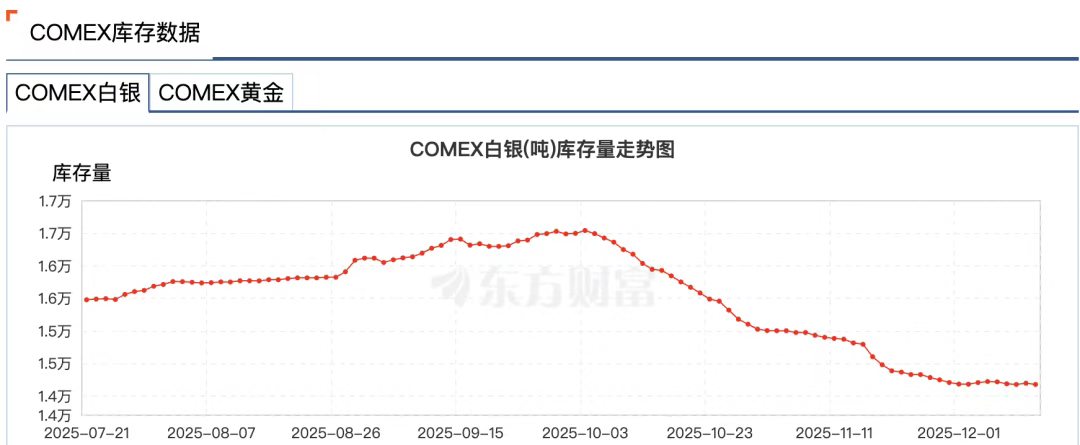
Silver ETFs have seen a similar phenomenon. While large amounts of funds flowed in, some investors began redeeming, demanding physical silver instead of fund shares. This "run-like" redemption is putting pressure on the ETFs' silver bar reserves.

This year, runs have occurred in succession in the three major silver markets: New York COMEX, London LBMA, and the Shanghai Metal Exchange.

Wind data shows that in the week of November 24th, silver inventories on the Shanghai Gold Exchange fell by 58.83 tons to 715.875 tons, hitting a new low since July 3, 2016. CME COMEX silver inventories plummeted from 16,500 tons in early October to 14,100 tons, a drop of 14%.

The reason isn't hard to understand: under the US interest rate cut cycle, people are unwilling to settle in dollars. Another hidden worry is that exchanges might not have enough silver available for delivery.

The modern precious metals market is a highly financialized system. Most "silver" is just book entries, with real silver bars being repeatedly pledged, leased, and derived globally. One ounce of physical silver might correspond to a dozen different entitlement certificates simultaneously.

Veteran trader Andy Schectman cited London as an example: LBMA has only 140 million ounces of floating supply, but daily trading volume reaches 600 million ounces. On top of this 140 million ounces, there exist paper claims exceeding 2 billion ounces.

This "fractional reserve system" works well in normal times, but once everyone wants physical metal, the entire system faces a liquidity crisis.

When the shadow of a crisis looms, a strange phenomenon似乎总是出现在金融市场, commonly called "pulling the plug."

On November 28th, CME was down for nearly 11 hours due to "data center cooling issues," a record-long outage, preventing COMEX gold and silver futures from updating normally.

Notably, the outage occurred at a critical moment as silver broke through historical highs. Spot silver breached $56 that day, and silver futures broke through $57.

Market rumors speculated that the outage was to protect commodity market makers exposed to extreme risk and potentially facing large losses.

Later, data center operator CyrusOne stated that this major interruption stemmed from human operational error, further fueling various "conspiracy theories."

In short, this futures squeeze-dominated market注定 results in剧烈 volatility in the silver market. Silver has essentially transformed from a traditional safe-haven asset into a high-risk speculative target.

Who is the Market Maker?

In this squeeze drama, one name cannot be bypassed: JPMorgan Chase.

The reason is simple: it is internationally recognized as the silver market maker.

For at least eight years, from 2008 to 2016, JPMorgan manipulated gold and silver market prices through its traders.

The method was simple and crude: placing large orders to buy or sell silver contracts on the futures market to create false supply and demand impressions, inducing other traders to follow the momentum, and then canceling the orders at the last second, profiting from the price fluctuations.

This practice, known as spoofing,最终 led to JPMorgan receiving a $920 million fine in 2020, once setting a record for a single CFTC fine.

But the real textbook-level market manipulation goes beyond that.

On one hand, JPMorgan depressed silver prices through massive short selling and spoofing in the futures market. On the other hand, it massively acquired physical metal at the low prices it itself created.

Starting around the 2011 silver price high near $50, JPMorgan began hoarding silver in its COMEX warehouses, consistently adding positions while other large institutions reduced theirs, at one point accounting for 50% of total COMEX silver inventory.
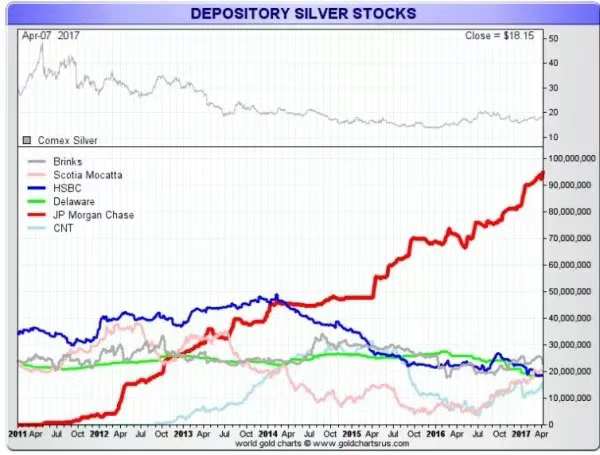
This strategy exploited the structural缺陷 of the silver market: Paper silver prices dictate physical silver prices, and JPMorgan could influence paper prices while being one of the largest physical silver holders.

So what role does JPMorgan play in this round of silver squeeze?

On the surface, JPMorgan seems to have "turned over a new leaf." Following the 2020 settlement, it underwent systematic compliance reforms, including hiring hundreds of new compliance officers.

There is currently no evidence表明 JPMorgan participated in the short squeeze行情. But in the silver market, JPMorgan still holds significant influence.

According to the latest CME data from December 11th, JPMorgan holds approximately 196 million ounces of silver within the COMEX system (proprietary + brokerage), accounting for nearly 43% of the exchange's total inventory.
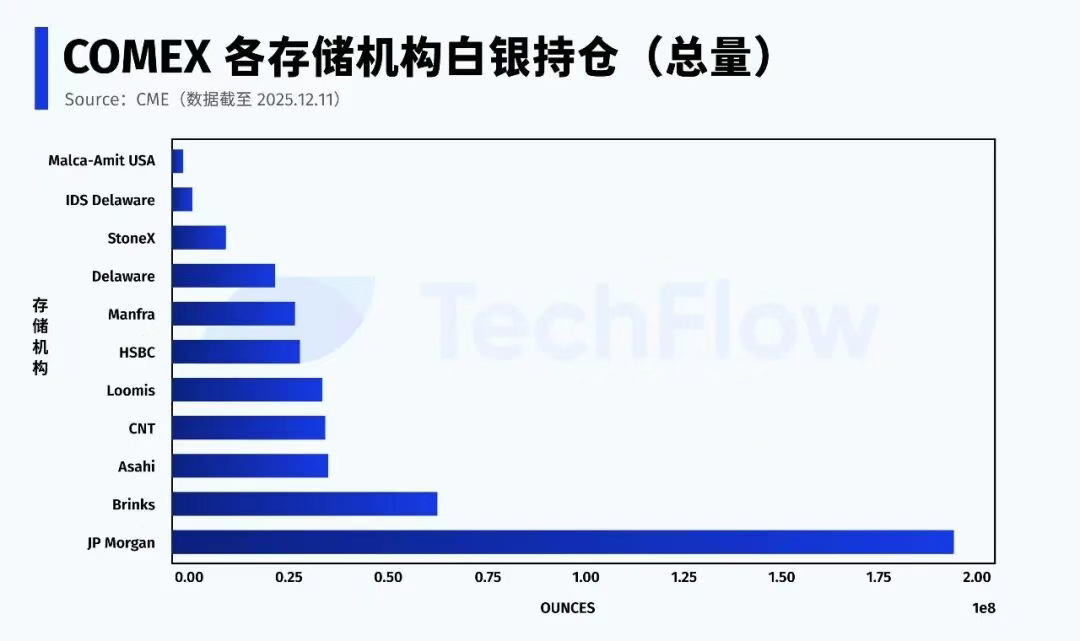
Furthermore, JPMorgan has a special身份: the custodian for the silver ETF (SLV). As of November 2025, it custodies 517 million ounces of silver, worth $32.1 billion.

More crucially, in the Eligible silver category (silver that qualifies for delivery but hasn't been registered as deliverable), JPMorgan controls over half the volume.

In any round of silver squeeze行情, the market truly博弈 over two points: First, who can produce physical silver; Second, whether, and when, this silver is allowed into the delivery pool.

Unlike its past role as a major silver short, JPMorgan now sits at the "silver gate."

Currently, Registered (deliverable) silver accounts for only about 30% of total inventory. When the majority of Eligible silver is highly concentrated in a few institutions, the stability of the silver futures market effectively depends on the behavioral choices of very few key players.

The Paper System Gradually Failing

If one had to describe the current silver market in one sentence, it would be:

The rally continues, but the rules have changed.

The market has undergone an irreversible shift; trust in the silver "paper system" is crumbling.

Silver is not an isolated case; the same change is happening in the gold market.

Gold inventories in New York futures exchanges continue to decline, Registered gold repeatedly touches lows, forcing exchanges to transfer bars from originally non-deliverable "Eligible" gold to complete matches.

Globally, capital is quietly undergoing a migration.

Over the past decade-plus, the direction of mainstream asset allocation was highly financialized—ETFs, derivatives, structured products, leverage tools. Everything could be "securitized."

Now, more and more capital is withdrawing from financial assets,转而 seeking physical assets that don't rely on financial intermediaries or credit背书,典型的 being gold and silver.

Central banks are continuously and massively increasing gold holdings, almost无一例外 opting for physical form. Russia has banned gold exports; even Western countries like Germany and the Netherlands have demanded the repatriation of gold reserves stored overseas.

Liquidity is giving way to certainty.

When gold supply cannot meet the huge physical demand, capital begins to look for substitutes, and silver naturally becomes the first choice.

The essence of this physicalization movement is the re-contesting of monetary pricing power against the backdrop of a weak US dollar and deglobalization.

According to a Bloomberg report in October, global gold is moving from West to East.

Data from US CME and the London Bullion Market Association (LBMA) show that since late April, over 527 tons of gold have flowed out of the vaults of New York and London, the two largest Western markets. Meanwhile, gold imports have increased in major Asian gold-consuming countries like China. China's gold imports in August hit a four-year high.

In response to market changes, in late November 2025, JPMorgan moved its precious metals trading desk from the US to Singapore.

Behind the surge in gold and silver lies the return of the concept of the "gold standard." It might not be realistic short-term, but one thing is certain: Whoever holds more physical metal holds greater pricing power.

When the music stops, only those holding real gold and silver can sit down safely.

Trending Cryptos

Related Questions

QWhat are the main factors driving the recent surge in silver prices according to mainstream analysis?

AAccording to mainstream analysis, the surge in silver prices is driven by the Federal Reserve's interest rate cut expectations, which reignited the precious metals market, as well as strong industrial demand from solar energy, electric vehicles, data centers, and AI infrastructure. Additionally, global inventories have been consistently declining due to lower-than-expected mine output from Mexico and Peru.

QWhy is the structure of the silver market considered dangerous compared to gold?

AThe silver market is considered dangerous because it lacks the 'national team' support that gold has, as central banks hold almost no official silver reserves. It has a much smaller market depth with a daily trading volume of only $5 billion compared to gold's $150 billion. The market is dominated by 'paper silver' products like futures and ETFs, making it highly susceptible to volatility and liquidity crises when large funds enter.

QWhat is a 'short squeeze' in the futures market, and how is it related to the current silver price movement?

AA 'short squeeze' occurs when traders who have bet on falling prices (short sellers) are forced to buy back contracts at higher prices to limit losses, further driving up prices. In the silver market, this is evidenced by the unusual 'futures premium' where futures prices are systematically higher than spot prices, suggesting that funds are aggressively pushing up futures prices rather than the movement being solely based on gradual fundamental improvements.

QWhat role does JPMorgan play in the silver market, and why is it significant?

AJPMorgan is a dominant player in the silver market, holding approximately 43% of COMEX silver inventories and acting as the custodian for the iShares Silver Trust (SLV) ETF, which holds over 517 million ounces of silver. It controls more than half of the 'Eligible' silver (metal that qualifies for delivery but isn't yet registered). This positions JPMorgan as a key 'gatekeeper' that significantly influences the availability of physical silver for delivery, thereby impacting market stability.

QWhat broader trend does the current situation in the silver market represent regarding financial assets?

AThe situation represents a broader trend of a 'physicalization' movement, where trust in the 'paper' financial system (ETFs, derivatives) is eroding. Investors and central banks are increasingly moving away from highly financialized assets and seeking safety in physical assets like gold and silver that do not rely on financial intermediaries or credit backing. This shift is a response to de-globalization and a contest for monetary pricing power in a weaker dollar environment, emphasizing that 'whoever holds more physical metal holds greater pricing power.'

Related Reads

Bitcoin and Ethereum Soar Together! Eight Altcoins Worth Watching in the Later Market

Bitcoin and Ethereum Surge, Fueling Altcoin Speculation. Bitcoin Eyes $77,000, Ethereum Gains 20% in a Single Day. Market anticipates capital rotation from major cryptos to high-beta altcoins, but a selective rise is expected, favoring projects with genuine users, protocol revenue, and healthy tokenomics. Analysts highlight eight altcoins across key sectors: **High-Performance Blockchains:** * **SOL (Solana):** Market cap ~$51.88B. A dominant player with a strong ecosystem. Considered a relatively safe bet for potential catch-up growth. * **SUI (Sui):** Market cap ~$3.03B. High volatility potential but faces risks from its low circulating supply and future token unlocks. **DeFi Lending:** * **UNI (Uniswap):** Market cap ~$2.38B. Transitioning to a revenue-capturing asset post-fee switch implementation. * **AAVE (Aave):** Market cap ~$1.53B. Features balanced tokenomics and revenue but has seen significant recent gains. * **MORPHO:** Market cap ~$1.50B. Rapid protocol growth but weaker token value capture and opaque supply data. **Perpetual DEX:** * **HYPE (Hyperliquid):** Market cap ~$16.41B. The clear sector leader with strong revenue but high valuation and a large portion of tokens still locked, warranting caution. **RWA & On-Chain Finance Infrastructure:** * **LINK (Chainlink):** Market cap ~$8.09B. A key oracle provider positioned to benefit from multiple trends like RWA and institutional adoption, offering strong fundamentals. * **ONDO (Ondo Finance):** Market cap ~$1.77B. Shows strong business growth but carries high risks due to concentrated token holdings and a massive unlock scheduled for 2027. **Conclusion:** The altcoin rally is expected to be selective. Recommendations include a medium position in SOL, small allocations to SUI and UNI/AAVE for DeFi exposure, and caution with HYPE and ONDO due to their specific risks. LINK is suggested as a core holding for the RWA thematic.

marsbit1h ago

Bitcoin and Ethereum Soar Together! Eight Altcoins Worth Watching in the Later Market

marsbit1h ago

Shanghai's $10 Billion Unicorn Is About to Go Public

Shanghai-based automotive-grade millimeter-wave radar chip unicorn Calterah Microelectronics Technology (Shanghai) Co., Ltd. has filed for an IPO on Shanghai's STAR Market, aiming to raise 3.49 billion yuan. Founded in 2014 by Chen Jiashu, a UC Berkeley PhD graduate, and his professor Ali Niknejad, Calterah pioneered CMOS technology for 77GHz radar chips, breaking the decades-long monopoly of international giants like Texas Instruments. Its low-cost, highly integrated solutions enabled millimeter-wave radar to move from luxury to mass-market vehicles. By 2025, Calterah captured a 31.1% share in China's automotive millimeter-wave radar chip market (second domestically, fourth globally), with cumulative shipments exceeding 30 million units. Its client list includes BYD, Geely, Nio, and Volvo. The company has undergone 11 funding rounds, attracting high-profile investors such as the National Integrated Circuit Industry Investment Fund Phase II, China Capital Management, and GD Capital. Its valuation has reached tens of billions of yuan, with a projected post-IPO valuation of approximately 14 billion yuan. Despite rapid revenue growth—increasing from 206 million yuan in 2023 to 632 million yuan in 2025 with a 75.28% CAGR—Calterah remains unprofitable. It reported net losses of 323 million yuan, 334 million yuan, and 193 million yuan from 2023 to 2025, accumulating over 900 million yuan in losses over three and a half years. These losses are primarily attributed to heavy R&D investment, which totaled over 1.039 billion yuan in the reporting period, often exceeding annual revenue. The company faces significant risks, including high customer concentration (its top five customers accounted for over 99% of revenue from 2023-2025, with BYD alone representing over 50% in 2025) and supply chain concentration. Revenue pressure from key customers and dependencies on overseas suppliers for EDA tools and IP pose challenges to sustainable growth. The IPO is seen as crucial for securing capital to expand production, diversify its customer base, and reduce supply chain dependencies.

marsbit1h ago

Shanghai's $10 Billion Unicorn Is About to Go Public

marsbit1h ago

Ray Dalio's Latest Macro Analysis Full Text: Buy More Gold, Add Some Bitcoin

In his latest macro analysis, Ray Dalio applies his framework from "How Countries Go Broke: The Big Cycle" to the current global debt environment. He highlights recent events like Japan selling U.S. Treasuries and rising U.S. long-term yields as signs of an unsustainable debt dynamic. Dalio explains that excessive government debt leads to either unacceptably high interest rates, severe economic downturns, or significant currency debasement through central bank money printing. He summarizes the U.S. fiscal situation: with $5.5 trillion in revenue, $7.5 trillion in spending, a $2 trillion deficit, and total debt at six times annual revenue, debt servicing costs are immense. Without correction, U.S. debt could reach $55-$60 trillion in a decade. Dalio proposes a "3% Three-Way" solution: reducing the budget deficit to 3% of GDP through balanced spending cuts, tax increases, and interest rate reductions to avoid a traumatic adjustment. In response to FAQs, he argues that the risk of a U.S. debt crisis is high and could materialize within a few years if the current path continues. He dismisses the notion that the dollar's reserve status makes the U.S. immune, citing historical precedents of reserve currency declines. He is also unconvinced by Japan's high-debt stability, noting poor returns for yen-denominated assets. For investors, Dalio recommends diversifying globally, underweighting bonds, and overweighting assets like gold and a small allocation to Bitcoin (around 10-15% to gold) to hedge against currency debasement and poor debt returns.

marsbit2h ago

Ray Dalio's Latest Macro Analysis Full Text: Buy More Gold, Add Some Bitcoin

marsbit2h ago

Stripe’s 16-Year Chronicle: From 7 Lines of Code to a $100 Billion Valuation

Stripe's 16-year journey began with a simple promise: "7 lines of code to accept payments." Founded by Patrick and John Collison, the company started by hiding the complexity of bank integrations and merchant accounts behind a clean API, initially targeting developers at startups. This early focus on user experience and technical simplicity fueled rapid adoption. A key early milestone was establishing vital bank partnerships, a challenge overcome by hiring Billy Alvarado, who brought crucial institutional relationship skills. From this foundation, Stripe systematically expanded its product boundaries. It launched Connect for platform payments, Atlas for company formation, Radar for fraud prevention, and Billing for subscriptions. This transformed Stripe from a payment processor into a broader financial infrastructure suite for internet businesses. The COVID-19 pandemic accelerated growth but also led to over-hiring. A 14% layoff in 2022 marked a period of organizational correction. Subsequently, Stripe shifted its growth strategy towards strategic acquisitions to enter new domains quickly. It acquired Bridge (stablecoin infrastructure), Privy (wallet infrastructure), Metronome (usage-based billing), and agreed to buy OpenRouter (AI model routing). These moves signal Stripe's ambition to build a "programmable money system" for the emerging AI and agent-based economy, managing not just currency flows but also the measurement and pricing of computational resources like AI tokens. Internally, Stripe leverages AI agents (like "Minions") to boost engineering productivity. Despite scaling to nearly 8,000 employees and processing $1.9 trillion in payment volume annually, the company remains private. A recent employee tender offer valued it at $159 billion. The core question for Stripe's future is whether it can successfully integrate its expanding product matrix—spanning payments, crypto, and AI infrastructure—into a cohesive platform, positioning itself as the foundational economic layer for autonomous software agents.

marsbit2h ago

Stripe’s 16-Year Chronicle: From 7 Lines of Code to a $100 Billion Valuation

marsbit2h ago

Trading

Spot

Hot Articles

Discussions

Welcome to the HTX Community. Here, you can stay informed about the latest platform developments and gain access to professional market insights. Users' opinions on the price of S (S) are presented below.

活动图片