The Next Memecoin Script: The Era of Flash in the Pan

marsbitPublished on 2025-12-15Last updated on 2025-12-15

Abstract

The memecoin market is evolving from a period of frenzy to a more mature, fast-paced "flash in the pan" era. While activity has cooled since the 2024 peak, it remains a key arena for attention-based speculation. Key shifts are defining this new phase: dominance has moved beyond Solana (now holding 57% of new token launches) to chains like Base and BNB Chain; the market cap ceiling for successful memes has lowered, with mid-to-small cap coins like BRETT and TOSHI becoming the norm; and the lifecycle of new coins has drastically accelerated. Driven by AI and social media algorithms, tokens can peak within 24-48 hours of launch before rapidly fading. Recent trending memecoins like $Franklin (inspired by a political meme), $DOYR (a typo-driven coin), and $Horse_Success (a Chinese community meme) exemplify this trend—all saw rapid, short-lived pumps. The market is maturing from pure jokes into a "cultural index" of social trends. While established memes like DOGE and SHIB are building utility, new launches are purely driven by social hype and data, offering high-risk, granular opportunities. This structural shift demands faster reflexes and deeper research (DYOR) from participants.

Against a backdrop of a somewhat fatigued market, Memecoins, though no longer frenzied, remain a battleground in the attention economy.

Memecoins Haven't Reached the End, They've Changed Direction

Compared to the scene in 2024 where Memecoins stole the show, they have indeed quieted down a lot after $TRUMP this year. However, this is not the end, but rather the market evolving to the next stage.

From Solana to Base, BNB Chain: Initially, Solana monopolized 90% of the new token issuance share with its low fees and high speed. The launch of Pump.fun, in particular, significantly decentralized the power to issue tokens, catalyzing a year-long Meme frenzy in 2024. However, with multi-chain expansion and the continued efforts of other public chains, Solana's share has now dropped to 57%, with BNB Chain, Base Chain, and others continuously grabbing on-chain market share.
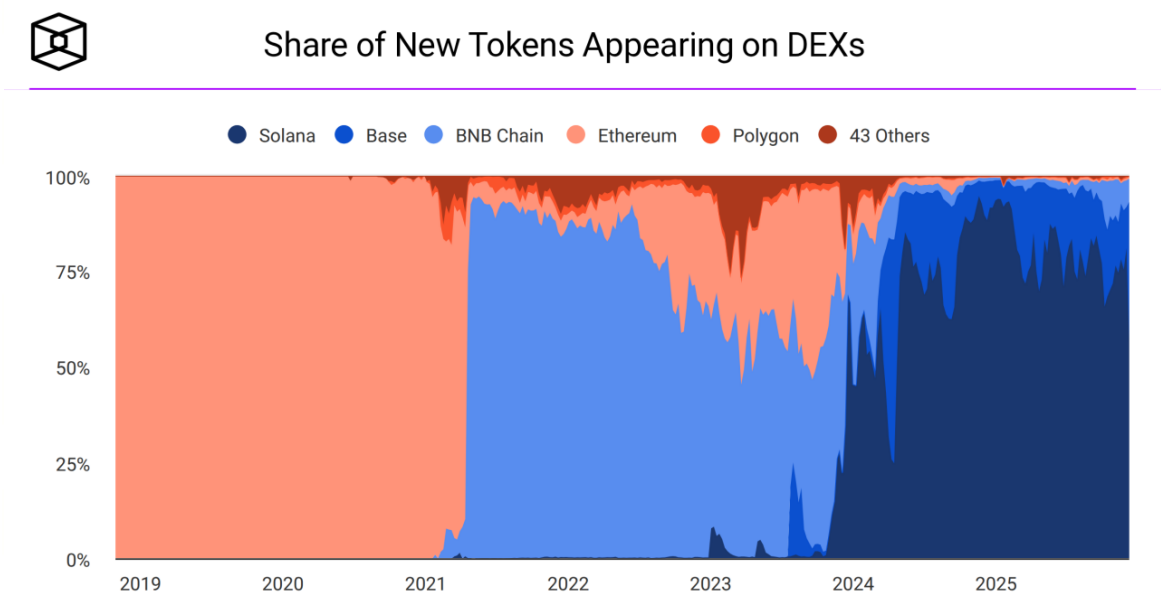
Source : https://www.theblock.co/data/decentralized-finance/dex-non-custodial/share-of-new-tokens-appearing-on-dexs

Small and Medium-Sized Memes Become Mainstream: The Memecoin market narrative has shifted from being dominated by Ethereum chain tokens with multi-billion dollar market caps like DOGE, SHIB, and PEPE, to Solana chain birthing large Memecoins with multi-billion dollar market caps like BONK, WIF, FARTCOIN, and TRUMP, and now to small and medium-sized Memecoins with tens of millions in market cap born on various chains, such as BRETT and TOSHI on Base chain, and Binance Life, BROCCOLI on BNB Chain. This indicates the market cap ceiling for Memecoins is continuously lowering, and the market is maturing.

Accelerated Rotation Pace: With limited liquidity growth and an accelerating trend in the number of Memecoins, the market rotation pace has shifted from "weekly" to "hourly." Particularly thanks to the proliferation of AI tools and upgrades in social media algorithms, the speed of viral spread and decay has increased dramatically. This results in a large number of new coins reaching their peak within just 24-48 hours of launch, with a lifecycle far shorter than the previous weekly cycles.

Recent Hot Memecoins: Social Media Hype + Small/Mid Cap

Browsing recent popular Memecoins undoubtedly confirms the above changes.

$Franklin: Franklin The Turtle was originally a classic children's character from a series of books and TV shows in Canada in the 1980s and 1990s. The current U.S. Secretary of Defense recently posted a politically satirical image on X, expressing a tough stance on U.S. cross-border military anti-drug operations. Subsequently, the同名 Memecoin portrayed Franklin the Turtle as a satirical, militarized anti-drug warrior. The coin launched on December 1st, reached a peak FDV of $24.36M by the 10th, and has currently retraced to $5.4M.

$DOYR: The起因 (cause) was that DYOR was misspelled as DOYR. Then, spurred by a reply post saying "DOYR = DO YouR meme?", the BNB Chain community quickly launched a同名 Memecoin. The coin launched on December 6th, reached a peak FDV of $31.34M the next day, and has currently retraced to $3.4M.

$马到成功 (Horse Success): Originating from the Chinese community's blessing phrase "马到成功" (meaning immediate success), it is a popular Chinese Memecoin following others like "Binance Life" and "Vulgar Penguin". The coin launched on November 15th, reached a peak FDV of $5.03M on December 2nd, and has currently retraced to $2.6M.

$jesse: A personal Memecoin issued by Base co-founder Jesse in November. The coin launched on November 21st, reached a peak FDV of $28.08M on the same day, and has currently retraced to $10M.

Opportunities in the Structural Changes of Memecoins

Starting from DOGE's dog meme to today's vast ecosystem where any topic can become a coin, Memecoins are no longer just simple internet jokes, but a perfect fusion of community narrative, attention propagation, and speculative frenzy.

This year's Memecoin market has been as刺激 (stimulating) as a roller coaster: accelerated rotation, smaller scale, multi-chain expansion—all marking a transition from狂欢 (carnival) to成熟 (maturity).
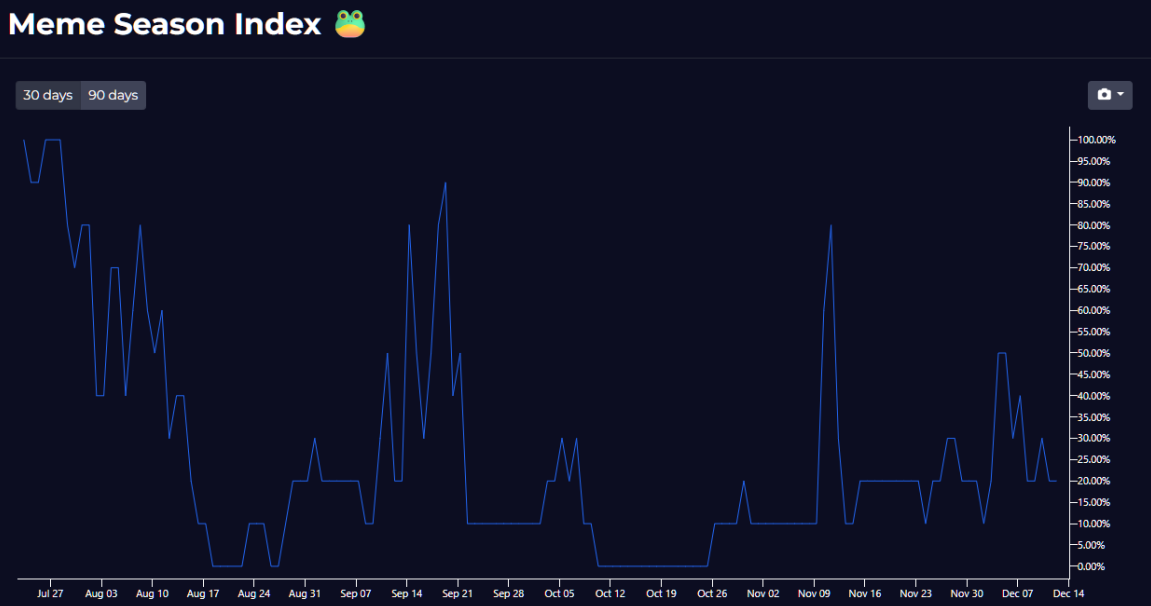
Source : https://whaleportal.com/meme-season-index/

It is foreseeable that, regardless of bull or bear markets, the Memecoin market will not fall silent, because as long as there is attention, someone will go all-in on a dog picture to spread emotion.

However, in the flash-in-the-pan era, Memecoins are beginning to transform from "jokes" into "cultural indices." For example, older tokens like DOGE, SHIB, and BONK are shedding their religious constraints, continuously undergoing technical upgrades, and applications are empowering the Meme. Meanwhile, more newly produced small and medium Memecoins are turning to "social media heat + data-driven," which carries higher risks but offers more refined opportunities. The rise and fall of these Memecoins also represent the ebb and flow of heat around certain social topics.

No matter how you look at it, this structural change will reshape investment logic, bringing more opportunities for participants while also demanding greater DYOR.

* This article is provided by WEEX Labs, intended solely for the purpose of trend research and discussion, and does not constitute any form of investment advice or commitment. The content, data, and opinions involved in the article are for reference only. Investors need to make their own judgments and bear the corresponding risks.


Related Questions

QAccording to the article, what is the main trend in the current Memecoin market cycle?

AThe market has evolved into a 'Flash Era' characterized by faster rotation speeds, smaller market caps, and multi-chain expansion, moving from a 'weekly' to an 'hourly' cycle.

QWhich blockchain was initially dominant for new token launches, and what has changed?

ASolana initially monopolized about 90% of new token launches, but its share has now decreased to 57% as other chains like Base and BNB Chain have gained market share.

QWhat are two key characteristics of popular recent Memecoins mentioned in the article?

AThey are typically small to medium market cap coins and are heavily driven by social media热度 (heat/hype).

QName one specific Memecoin example from the article that was created due to a typo or misspelling.

A$DOYR, which was created on BNB Chain after the common crypto acronym 'DYOR' (Do Your Own Research) was misspelled.

QHow is the role of older, established Memecoins like DOGE and SHIB changing according to the article?

AThey are shedding their 'religious' or purely cultural baggage and are undergoing technical upgrades and application development to add more utility and value to the meme.

Related Reads

When AI Begins to Audit the World: From Claude Discovering the ZEC Vulnerability, Watching the Encryption Industry Enter the 'Recursive Security Era'

**When AI Audits the World: From Claude's Discovery of a ZEC Vulnerability, Viewing the Crypto Industry Entering a "Recursive Security Era"** This article examines a pivotal shift in the blockchain security landscape, triggered by the convergence of two events: Anthropic's research on AI's "Recursive Self-Improvement" and Claude Opus 4.8's discovery of a critical vulnerability in Zcash's code. Traditionally, crypto security has relied on human experts and automated tools for periodic audits. However, the article argues AI is transitioning from a mere tool to an active participant in understanding and analyzing complex systems. Claude's ability to identify a subtle flaw in Zcash's zero-knowledge proof system demonstrates AI's potential to dramatically lower the cost and time required for risk discovery. This goes beyond finding a single bug; it signals a change in the very mechanism of how vulnerabilities are found. The core thesis introduces the concept of "Recursive Security," drawing a parallel to Anthropic's "Recursive Self-Improvement." Just as AI can accelerate its own development through feedback loops, security systems are evolving towards a continuous cycle of analysis, risk identification, remediation, and re-analysis. Security is becoming a persistent, evolving capability integrated into a system's lifecycle, rather than a one-time pre-launch audit. This shift is particularly urgent for the crypto industry, where system complexity from Layer-2 networks, modular architectures, and ZK-proofs is growing faster than human analysis capacity. AI excels at the pattern recognition and contextual understanding needed to navigate this complexity. Importantly, the article cautions that AI augments both defenders and potential attackers, accelerating the entire threat landscape. The future competitive advantage may not lie in having zero vulnerabilities, but in having the fastest risk discovery, validation, and response capabilities. The Claude-Zcash incident is thus an early signal of an era where AI-driven, recursive security systems become essential for managing risk in an increasingly complex digital world.

marsbit37m ago

When AI Begins to Audit the World: From Claude Discovering the ZEC Vulnerability, Watching the Encryption Industry Enter the 'Recursive Security Era'

marsbit37m ago

From MSTR to STRC+: Where Is the Limit of the Strategy Universe?

From MSTR to STRC+: The Evolution and Limits of the Strategy Universe This article examines the transformation of Strategy (formerly MicroStrategy) from a simple "Bitcoin treasury" company into a complex financial engineering firm building a BTC-backed credit system. **Core Thesis:** Strategy's true significance lies not just in its massive BTC holdings (~844k BTC), but in its attempt to transform this static reserve into a multi-layered credit curve within traditional capital markets and, subsequently, into on-chain yield infrastructure. **The MSTR Flywheel:** The initial model was a reflexive loop: BTC price rises → MSTR stock rises → company raises capital (debt/equity) at a premium → buys more BTC → increases per-share BTC exposure → MSTR premium grows. This "amplified Bitcoin" equity (MSTR) thrives on bullish momentum but is vulnerable to tightening premiums and rising funding costs. **Building the Credit Curve:** Strategy's innovation is slicing its single BTC balance sheet into different risk/return profiles via specialized securities: * **MSTR:** High-volatility equity layer absorbing full BTC upside/downside. * **STRC:** Key product. A perpetual preferred stock designed as "short duration high yield credit," offering ~11.5% floating monthly dividends. It attracts fixed-income investors seeking yield without direct BTC exposure, funding Strategy's operations. * **STRD/STRK/STRF:** Other preferred/share classes with varying durations, conversion rights, and fixed dividends. **Risks of the STRC Model:** STRC's high yield is not risk-free. Its stability depends on: 1) Sufficient BTC asset coverage, 2) Strategy's continued ability to pay dividends, and 3) Market faith in the MSTR/STRC funding flywheel. Stress points include deep BTC price declines eroding the asset buffer, rising dividend costs if STRC trades below par, and a broken flywheel if MSTR's premium (mNAV) falls persistently. **On-Chain Expansion: STRC+:** Projects like **Saturn** and **Apyx** aim to package STRC's (and other DAT preferred stock) cash flows into on-chain stablecoin yield (e.g., sUSDat, apyUSD). They offer DeFi a new yield source distinct from trading fees or incentives—cash dividends from traditional securities. However, this introduces compounded risks: off-chain custody, issuer credit risk, BTC volatility, and protocol execution risk. **Conclusion: The Ultimate Boundary** Strategy's endgame is not infinite BTC accumulation. It is the market's long-term acceptance of a new credit system where BTC serves as collateral for tradable securities whose cash flows can power on-chain financial applications. Its "universe" expands if this BTC-native credit curve gains legitimacy, but contracts if these instruments are repriced purely as high-risk, yield-bearing credit assets without stablecoin mythology.

marsbit56m ago

From MSTR to STRC+: Where Is the Limit of the Strategy Universe?

marsbit56m ago

Trading

Spot
Futures

Hot Articles

Ethena: Building a New Era of Web3‑Native Digital Dollars

Ethena is an Ethereum‑based synthetic dollar protocol that delivers crypto‑native monetary solutions, including USDe, a synthetic dollar, and sUSDe, a globally accessible U.S. dollar savings asset.

53.1k Total ViewsPublished 2026.03.16Updated 2026.03.16

Ethena: Building a New Era of Web3‑Native Digital Dollars

Discussions

Welcome to the HTX Community. Here, you can stay informed about the latest platform developments and gain access to professional market insights. Users' opinions on the price of ERA (ERA) are presented below.

活动图片