The Hottest Open Source Project in History, Almost Became a 'Trophy' in the Crypto World

marsbitPublished on 2026-03-04Last updated on 2026-03-04

Abstract

OpenClaw has rapidly become one of the most popular and fastest-growing open-source projects in history, amassing over 250,000 stars on GitHub in just three months. Its creator, Peter Steinberger, has gained significant influence in the AI community but has also taken a strong stance against the crypto industry. Despite its success, OpenClaw has faced challenges, including a trademark dispute that led to a name change. During this process, crypto speculators quickly created and promoted fake tokens using the project’s name, leading to significant financial losses for some investors. Steinberger publicly denounced these activities, clarifying that OpenClaw would never issue a token and disavowing any association with cryptocurrency. The project also briefly listed Venice, a crypto-native AI project on Base chain, as a recommended model provider—a move that was quickly reversed to maintain neutrality and avoid perceived endorsements of crypto-related initiatives. Steinberger has repeatedly expressed frustration with crypto communities, citing harassment, malicious code submissions, and off-topic speculation as disruptive to genuine technical discussion. He has even considered abandoning the project due to these issues. Steinberger, who is financially independent, has advised young developers to avoid cryptocurrency, reflecting his broader criticism of the industry’s speculative culture. The conflict highlights the ongoing struggle between open-source innovation and crypto-dr...

Author: Nancy, PANews

A dark horse has emerged in the open-source world. In just three months, OpenClaw has become the most popular and fastest-growing open-source project in history, a new favorite among developers.

This intelligent agent tsunami, sparked by Peter Steinberger, has not only made him a top AI influencer but also won him a large number of "lobster believers" worldwide. This highly sought-after lobster godfather, however, strongly rejects the crypto world and has repeatedly publicly criticized it. Such a stance undoubtedly brings more negative舆论 to cryptocurrency.

Topping GitHub's Star Ranking, Urgently "Distancing" from Crypto Projects

There is no doubt that AI has become the golden narrative for capital and talent migration. Its rapid rise has led many to see AI as the hope for revitalizing the crypto industry, becoming a new opportunity for many in the circle to蹭流量 or seek investment.

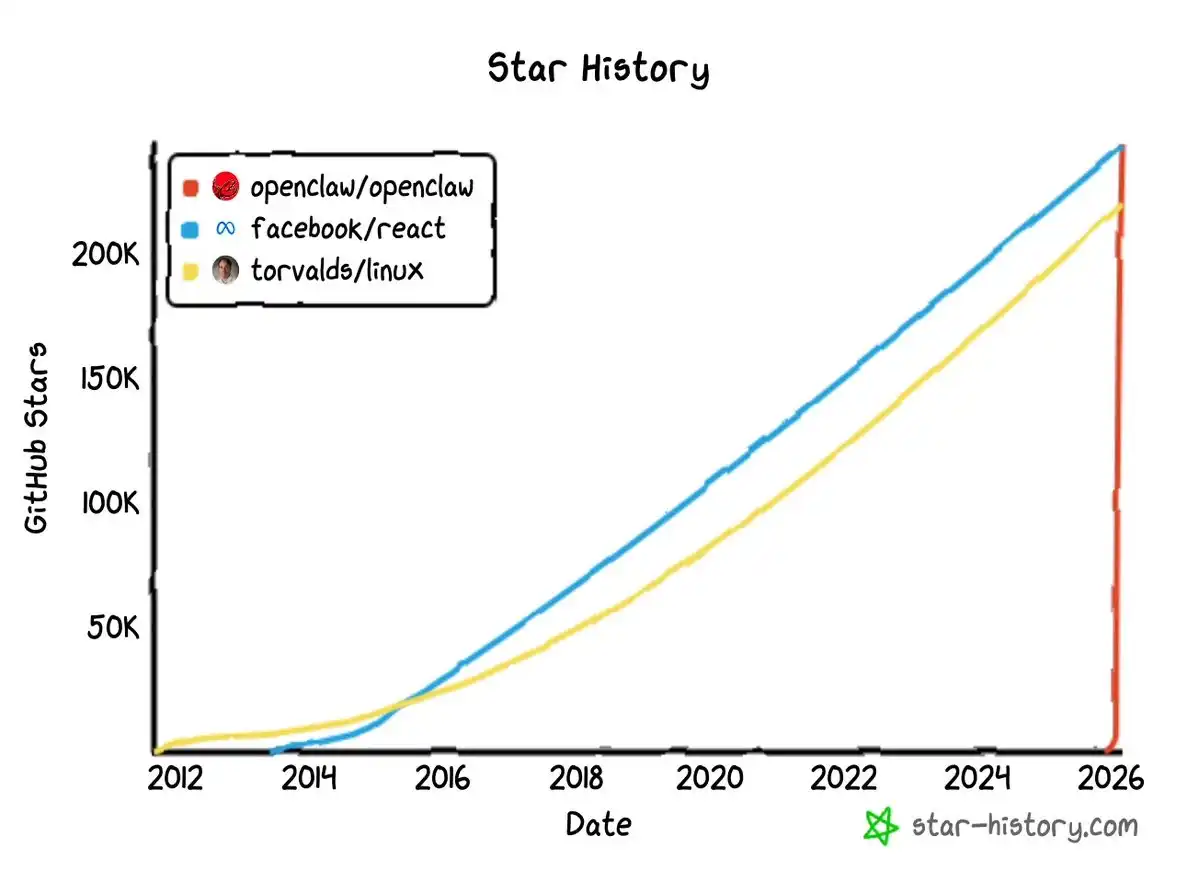
Especially the recently trending OpenClaw. According to the latest data, OpenClaw's star count on the GitHub platform has exceeded 250,000, surpassing Linux and React to become one of the most popular open-source projects and setting the record for the fastest growth in open-source history.
As "raising lobsters" becomes popular globally, tutorials,变现 cases, and user experiences around OpenClaw continue to emerge. Some even make a profit by offering on-site OpenClaw installation services. From independent developers to large companies to offline services, the "shovel-selling" business for OpenClaw is booming.

The crypto market naturally wouldn't miss this hotspot. Recently, Venice, an AI project on the Base chain, became a recommended model provider for OpenClaw, and the only crypto-native project. With the加持 of the top AI project's popularity, the Venice token surged, its market cap once exceeding $900 million. This news quickly caught the attention of crypto industry practitioners and was widely shared.

It is reported that Venice is a generative AI project focused on privacy protection and content censorship resistance. Its底层 integrates various open-source large models and was founded in 2024 by crypto OG and ShapeShift founder Erik Voorhees. It has recently gained attention due to the Agent privacy trend.

However, Steinberger clearly did not agree with this kind of捆绑炒作. He immediately publicly clarified, "This was an oversight in a previous document. We want to remain neutral on this matter." Simultaneously, OpenClaw promptly deleted the related recommendation content.

In other words, OpenClaw's "distancing" this time is not否定 or贬低ing the actual value and technical advantages of the Venice project, but rather proactively deleting the "official key recommendation" label that could lead to over-interpretation, to avoid unnecessary narrative绑架 and利益猜测. Especially as an open-source Agent framework, and with the founder having joined OpenAI, OpenClaw needs to maintain technical neutrality and avoid any suspicion of利益冲突.

Choosing to Sever Ties Due to Crypto "Piggybacking," Once Considered Abandoning the Project

Unlike AI leaders like OpenAI founder Sam Altman and xAI co-founder Musk, who hold positive or even open attitudes towards crypto, Steinberger adopts a stance of "fans only, no disturbances." This attitude of avoidance inevitably leaves the币圈 feeling "破防" (disheartened/offended).

In fact, Steinberger, who is not interested in crypto, is very排斥 the "piggybacking" phenomenon in the crypto circle. Since last year, he has issued dozens of public statements expressing strong dissatisfaction with crypto speculation culture, even直言 (stating bluntly) "don't come near."

Especially after OpenClaw became popular. In January of this year, OpenClaw's popularity rose, but its original name, Clawdbot, encountered a trademark dispute with Anthropic's AI model Claude and received a cease-and-desist notice from their legal team. Subsequently, Steinberger renamed the project twice,最终 settling on the name OpenClaw.

However, this renaming风波 was exploited by crypto speculators for抢注 (domain squatting) and炒作.

During the renaming process, snipers used automated scripts to quickly hijack accounts, impersonate the official team, and趁机 issue fake tokens, such as CLAWD. The market cap of some of these tokens once soared to tens of millions of dollars, attracting a large number of investors.

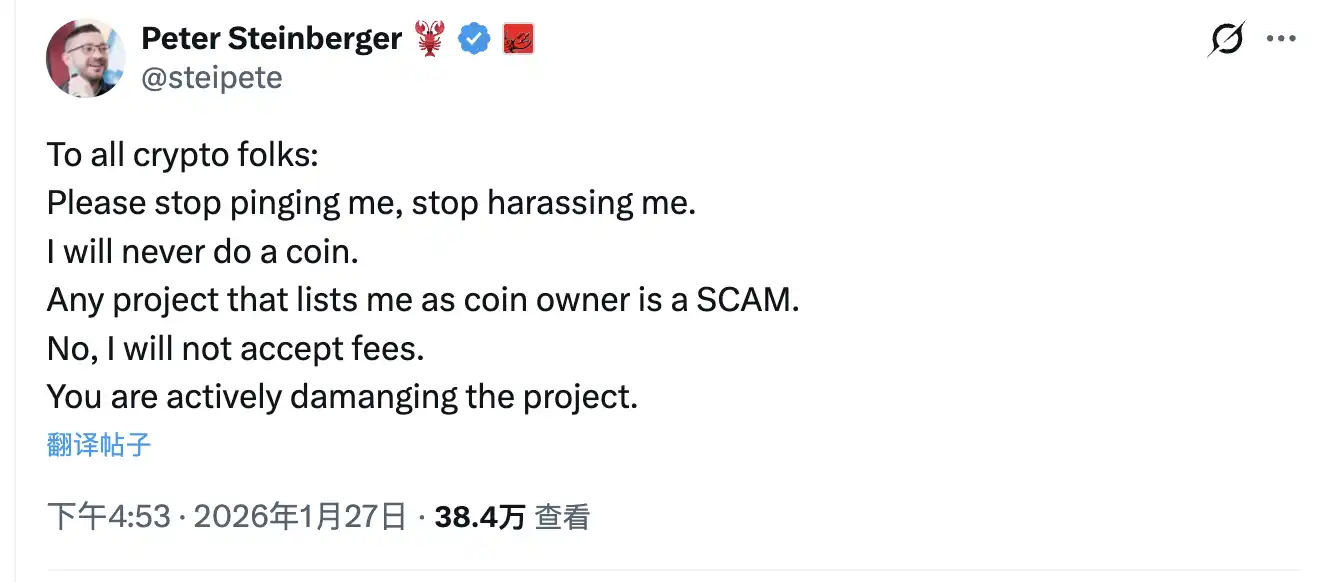
Faced with market speculation, Steinberger quickly publicly stated that he would never issue a token and emphasized that any project issuing tokens in his name is a scam. This caused the prices of these tokens to plummet, resulting in significant losses for many retail investors.
If this crypto闹剧 (farce) only made Steinberger反感 (disgusted), then the damage to the community ecology made him愤怒 (angry).

As OpenClaw continued to gain popularity, a large number of crypto players flooded into related communities, with some radicals even maliciously submitting code, sending abusive private messages, demanding Steinberger claim transaction fees or crypto-fy the project.

As a result, the official OpenClaw Discord server began completely banning mentions of keywords like Bitcoin, Crypto, etc., even neutral technical discussions were not exempt. Some users were removed for quoting Bitcoin block heights as benchmark tests.

"I underestimated these people," Steinberger said bluntly in a recent interview, pointing out that the crypto community is a very particular subculture that quickly tokenizes any hot topic. But he had already achieved financial freedom economically and simply did not want to support this (crypto) thing. The crypto noise made it almost impossible for him to see any real project discussion; the related speculative炒作 was harming the project.

It was precisely because of the "harassment" from the crypto community that this天才开发者 (genius developer) admitted he had even briefly considered abandoning the entire project. He very much did not want the project to become a tool for crypto speculation.

Just recently, Steinberger also publicly advised young people, "Don't waste your time on cryptocurrency." These remarks further exposed his dissatisfaction with the crypto industry.

This unexpected clash between the open-source world and the币圈 is not just a act of "self-preservation" by a hit project; it更折射出 (reflects even more) the difficult-to-reconcile矛盾 (contradiction) between technical purity and capital炒作 (hype/speculation) in the current AI wave.


Related Questions

QWhat is OpenClaw and why is it considered a breakthrough in the open-source community?

AOpenClaw is an open-source project that became the most popular and fastest-growing in history, gaining over 250,000 stars on GitHub in just three months. It is an AI agent framework that has attracted widespread attention from developers and is seen as a new favorite in the AI space due to its rapid growth and innovative approach.

QWho is Peter Steinberger and what is his stance on cryptocurrency?

APeter Steinberger is the creator of OpenClaw and a prominent figure in AI. He strongly opposes cryptocurrency, publicly criticizing it multiple times and expressing frustration with crypto communities for 'harassing' his project, issuing fake tokens, and disrupting discussions. He has stated that he will never issue a token and advises young people wasting time on crypto.

QWhy did OpenClaw remove its recommendation for the Venice project?

AOpenClaw removed its recommendation for Venice, a crypto-native AI project on the Base chain, to maintain a neutral stance and avoid any perception of endorsement or利益冲突. Steinberger clarified that the initial inclusion was an oversight and that OpenClaw wanted to remain impartial, especially as an open-source framework, to prevent narrative hijacking and speculative interest.

QHow did the cryptocurrency community react to OpenClaw's popularity, and what were the consequences?

AThe cryptocurrency community engaged in speculative activities, including creating fake tokens like CLAWD with millions in market cap, flooding discussions with crypto-related content, and even sending abusive messages. This led OpenClaw to ban crypto-related terms on its Discord and caused Steinberger to consider abandoning the project due to the harm from炒作 and harassment.

QWhat challenges did OpenClaw face regarding its name, and how was it resolved?

AOpenClaw faced a trademark dispute with Anthropic's AI model Claude, originally named Clawdbot, and received a cease-and-desist letter. After two name changes, it settled on OpenClaw. During this process, crypto opportunists quickly registered similar names and issued counterfeit tokens, prompting Steinberger to publicly denounce them as scams.

Related Reads

Who Decides the Rules of Bitcoin? BIP-110 Ignites Governance Debate

Bitcoin's governance is once again at the center of a heated debate, this time ignited by BIP-110, the "Reduced Data Temporary Softfork." This proposal aims to curb non-monetary data (like inscriptions and Runes) by introducing seven new consensus-layer restrictions over a year, such as limiting new output scripts to 34 bytes and restoring the OP_RETURN cap to 83 bytes. The controversy stems from BIP-110's fundamental shift: it moves the battle against "spam" from node relay and miner policies to the consensus layer, rendering currently valid transactions invalid. Supporters, arguing that default policy governance has failed (highlighted by Bitcoin Core v30's relaxation of OP_RETURN limits), see this as necessary to protect node resources and Bitcoin's monetary focus. Opponents, led by figures like Michael Saylor and Adam Back, warn it dangerously centralizes governance. Saylor listed 110 reasons against it, criticizing its low 55% miner activation threshold and potential for chain splits. Back emphasized Bitcoin's "permissionless" ethos, arguing no single group should impose value judgments via consensus rules. Further complicating matters, technical critiques suggest BIP-110 may be technically circumventable, and a "BlockSlop" vulnerability in its upgrade path poses a consensus risk. The debate has drawn in diverse stakeholders: miners (with pools like Ocean signaling support and Foundry polling clients), node operators (like Bitcoin Knots), and new players like corporate treasury holder MicroStrategy (Saylor), whose market influence adds a novel dimension. Ultimately, BIP-110 acts as a governance stress test, exposing the unresolved question: who decides Bitcoin's rules? It pits the authority of miners, node operators, developers, and capital holders against each other, with each side claiming to defend Bitcoin's core principles of neutrality and security.

marsbit4m ago

Who Decides the Rules of Bitcoin? BIP-110 Ignites Governance Debate

marsbit4m ago

Who Decides Bitcoin's Rules? BIP-110 Ignites Governance Debate

Title: Who Decides Bitcoin's Rules? BIP-110 Ignites Governance Debate A new technical proposal, BIP-110 (Reduced Data Temporary Softfork), has sparked a fundamental governance debate within the Bitcoin community. It aims to impose new consensus rules for one year to limit non-financial data (like inscriptions and Runes) on-chain, moving beyond simple node and miner policy filters to invalidate currently valid transactions. Supporters argue that default policies have failed due to workarounds, necessitating consensus-layer changes to protect Bitcoin's core monetary function from data spam. Critics, including Michael Saylor and Adam Back, contend this dangerously centralizes judgment, undermines permissionlessness, and sets a risky governance precedent. They advocate for market-based solutions like fees or Layer 2s instead. The debate exposes deeper tensions: miners are divided on activation; node operators assert their sovereignty; Bitcoin Core developers influence defaults without direct accountability; and large corporate holders like MicroStrategy now wield narrative influence. Technically, BIP-110 may not fully block data and carries a disclosed consensus bug risk. Ultimately, BIP-110 acts as a stress test, forcing the community to confront the unresolved question: who legitimately decides what Bitcoin is and how it evolves, amidst competing claims from miners, nodes, developers, and capital holders.

链捕手16m ago

Who Decides Bitcoin's Rules? BIP-110 Ignites Governance Debate

链捕手16m ago

Zcash's New Node Zakura Goes Live: Privacy Payments Can Reach 50,000 TPS, Aiming to Rival Visa and Mastercard

Zcash, a privacy-focused cryptocurrency, has launched a new full node software called Zakura version 1.0.0. Developed by Zcash co-founder Sean Bowe and Dev Ojha, with private ZEC donations, its goal is to enable Zcash to process over 50,000 transactions per second (TPS)—matching the scale of Visa and Mastercard—while maintaining full transaction privacy and verifiability. This addresses a key bottleneck, as Zcash currently handles only about 1 private transaction per second. Zakura is a fork of the Zcash Foundation's Zebra node. It features chain pruning and snapshots, reducing disk usage and allowing new nodes to sync in under two minutes. It also offers compatibility with the legacy `zcashd` client interface. The scalability challenge stems from the large data size of privacy proofs. Bowe's Tachyon project aims to use recursive proofs to reduce consensus-layer data needs from ~500 MB/s to ~100 MB/s. For wallet scalability, Valar Group is researching Private Information Retrieval (PIR) tech to allow wallets to fetch their data privately. Zakura supports fast block propagation and the upcoming "Ironwood" network upgrade (NU6.3), scheduled for activation around July 28th. Ironwood was created to contain a critical inflation bug discovered in the Orchard shielded pool in May 2024. The fix uses "turnstiles" to trap any counterfeit ZEC created during the vulnerability period within the shielded pool, preventing it from entering circulation and restoring supply integrity.

marsbit31m ago

Zcash's New Node Zakura Goes Live: Privacy Payments Can Reach 50,000 TPS, Aiming to Rival Visa and Mastercard

marsbit31m ago

Replicating the "DeepSeek Moment"? Wall Street Unanimously Says: Kimi K3 Instead Strengthens Computing Power Demand

Title: Wall Street Sees Kimi K3 as a Catalyst for Compute Demand, Not a "DeepSeek Moment 2.0" Summary: Following the release of Moonshot AI's powerful open-source model Kimi K3, initial market reaction mirrored the "DeepSeek moment" that sparked a sell-off in compute stocks earlier in 2025, fearing reduced demand for AI infrastructure. However, major Wall Street banks including UBS, Nomura, BofA, and Citi argue the opposite: K3 will accelerate, not weaken, demand for compute, memory, storage, and networking. Their analysis centers on K3's specifications—2.8 trillion parameters, 1M token context, and MoE architecture—which represent a "scale" story rather than a pure "efficiency" one like DeepSeek R1. These features increase pressure on inference, memory (especially KV cache), and storage. Analysts invoke Jevons Paradox: as high-quality models become more affordable (K3 is cheaper than top closed models but not the cheapest), usage and token volumes expand, ultimately increasing total compute consumption. The reports highlight that competition will force leading US AI labs (OpenAI, Anthropic, Google) to invest more in training and iteration to maintain their edge. Furthermore, the rise of capable open-source models like K3 is expanding the global AI developer ecosystem, with Chinese models now accounting for over 45% of developer traffic. Key beneficiaries identified across the AI infrastructure chain include memory/storage players (e.g., Micron, Samsung), compute leaders (Nvidia, TSMC), networking suppliers (due to "super-node" cluster needs for deploying K3), and cloud platforms (e.g., Alibaba) that host diverse model ecosystems. The consensus is that stronger open-source models are an entry point for the next wave of infrastructure demand diffusion, provided workload growth outpaces efficiency gains.

链捕手34m ago

Replicating the "DeepSeek Moment"? Wall Street Unanimously Says: Kimi K3 Instead Strengthens Computing Power Demand

链捕手34m ago

Trading

Spot
活动图片